


 Buy a Licensed Company
  Explore VASP Data
  Talk to an Expert

 Dren Hima
 is Head of Research at Coincub, leading research across digital asset regulation, licensing, market structure, tokenization and institutional adoption.
Dren Hima
Dren Hima is Head of Research at Coincub, leading research across digital asset regulation, licensing, market structure, tokenization and institutional adoption.
THORChain (RUNE) Price Prediction 2026-2030: The Cross-Chain King
- THORChain lets users swap native crypto assets like BTC, ETH, and SOL without relying on wrapped tokens or centralized exchanges.
- RUNE’s value is tied closely to network usage, liquidity deposits, and the protocol’s pairing model.
- The March 2026 Solana reintegration is one of the most important short-term catalysts for renewed volume.
- The base-case forecast sees RUNE recovering gradually if DeFi activity improves, but the token still carries high technical and market risk.
- A return to prior highs would likely require a major rebound in cross-chain trading demand, deposits, and broader crypto liquidity.
Currently trading at approximately $0.43, RUNE is sitting at a steep discount from its previous highs. However, looking past the price chart, the underlying protocol is actively processing cross-chain trades and rolling out major network upgrades, such as the recent v3.16 update that restored native Solana swaps.
This price prediction explores THORChain’s outlook based on its actual network usage, ecosystem growth, and a unique token model that ties RUNE’s baseline value to the assets deposited on the platform.
Current Market Snapshot

- Current Price: ~$0.43 (March 2026).
- All-Time High: ~$21.26 (May 2021).
- Market Cap: ~$148 Million.
Key Calls and Scenario Projections:
- 2026: A year of searching for a floor. With the price hovering in the $0.40s, a gradual recovery toward $0.70-$1.20 could take shape if decentralized finance (DeFi) yields become attractive again and recent network integrations drive new volume.
- 2030: A long-term growth scenario. If THORChain becomes a standard behind-the-scenes engine for major crypto wallets, the steady demand for RUNE could support price targets in the higher single digits ($8.00+).
What is THORChain?
THORChain is an independent blockchain built to function as a decentralized exchange. You can think of it as a decentralized routing engine. It allows users to trade cryptocurrencies across different blockchain networks (such as trading Bitcoin for Ethereum) without needing to use a centralized exchange or give up custody of their funds.
Unwrapped Swaps
Historically, the crypto industry has relied on “bridges” to move value between networks. These bridges usually lock up your original coin and give you a synthetic “wrapped” token in return (like wrapped Bitcoin on Ethereum).
This wrapped model has been a major security weak point, leading to billions in hacks over the years. THORChain takes a different approach by avoiding wrapped tokens entirely. It aims to facilitate trades using actual, native assets. It does this using decentralized vaults managed by a network of anonymous validators. When you trade Bitcoin for Ethereum, the protocol simply takes your Bitcoin into its vault and sends real Ethereum to your wallet from another.
The Role of RUNE
RUNE is the utility token that powers this system. It acts as the universal pairing asset for all trades.
Instead of creating hundreds of fragmented trading pairs (like BTC/ETH, BTC/USDT, ETH/USDT), every asset on THORChain is paired only with RUNE. When you swap Bitcoin for Ethereum, the system rapidly trades your Bitcoin for RUNE, and then that RUNE for Ethereum under the hood. RUNE is also used to secure the network, as vault operators are required to lock up large amounts of the token.
THORChain Price History
THORChain gained massive traction leading into the 2021 bull run. The novelty of trading native Bitcoin for Ethereum without a centralized exchange helped push RUNE to an all-time high of $21.26 in May 2021. During this peak, market hype pushed the token’s price far beyond the actual value of assets locked on the network.
The subsequent 2022-2025 bear market brought a sharp correction. As broader economic challenges drained liquidity from the DeFi sector, RUNE’s price dropped heavily. This was worsened by early network exploits (which have since been patched) and a general loss of trust in complex DeFi systems.
Trading in a tight range of $0.40-$0.45, RUNE is currently experiencing low volatility.
The circulating supply is roughly 351 million RUNE out of a hard cap of 500 million. This maximum supply cap is an important feature, meaning that any future growth won’t be diluted by endless token printing.
Despite the depressed price, the network is highly active. In March 2026, the protocol successfully deployed the v3.16 upgrade, which restored cross-chain swaps for Solana, reconnecting THORChain to one of the most active trading ecosystems in crypto.
Factors That Impact RUNE
RUNE’s price isn’t driven entirely by market sentiment; its token design naturally ties its baseline value to the platform’s usage.
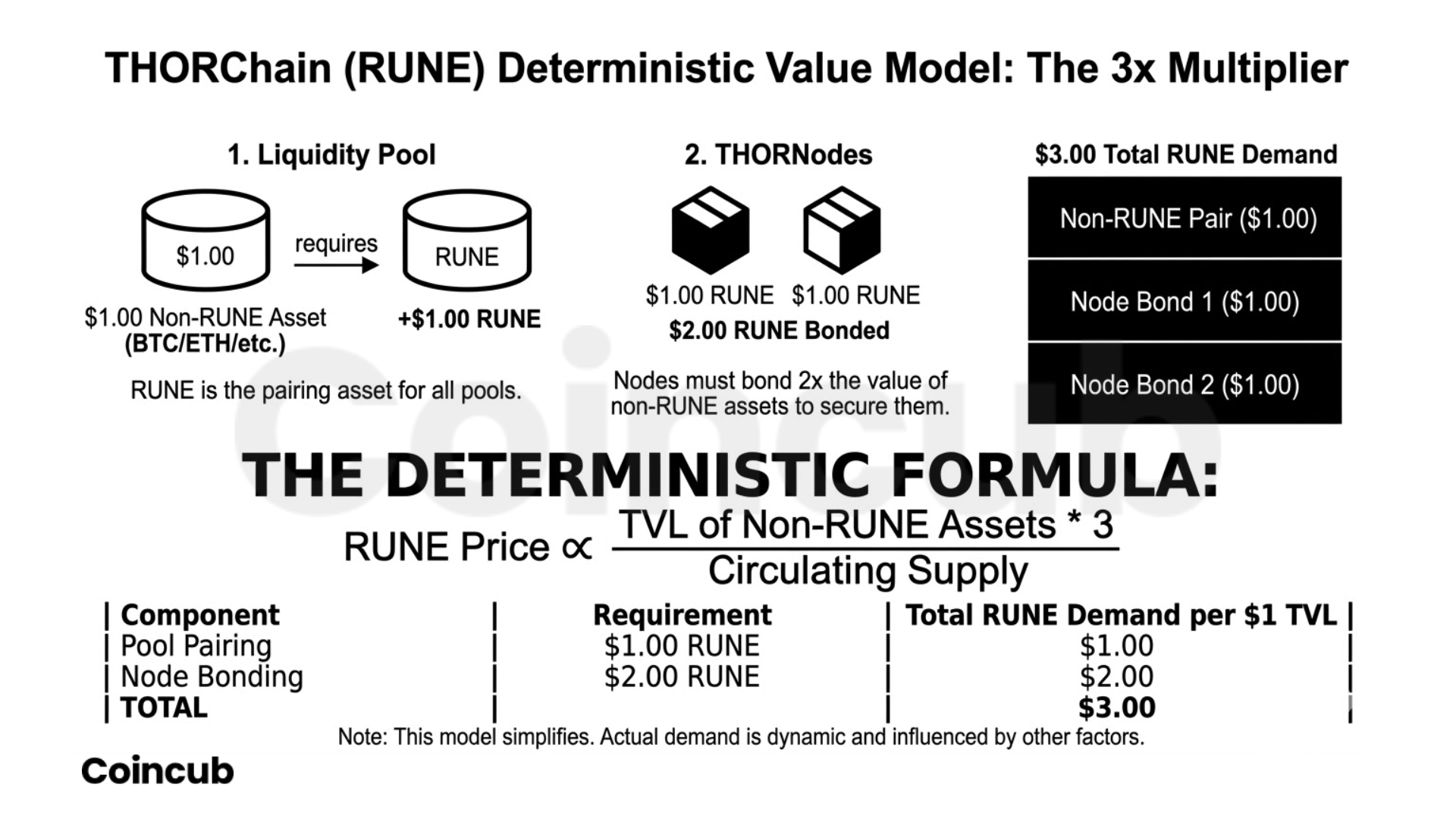
The 3:1 Value Ratio
To keep the network secure, THORChain is designed so that for every $1 of external crypto (like BTC or ETH) deposited into its trading pools, there needs to be $1 of RUNE paired with it. On top of that, the node operators securing the network are incentivized to lock up $2 of RUNE for that same $1 of external crypto.
This creates a target balance. $1 of deposited assets requires $3 of locked RUNE. As the platform grows and attracts more deposits, the baseline demand for RUNE naturally rises. The network uses an internal algorithm to constantly adjust rewards between liquidity providers and node operators to maintain this balance.
In bullish times, the open market often trades RUNE at a premium well above this structural floor. Right now, however, it is trading much closer to its baseline.
Ecosystem Integrations
A major catalyst for 2026 is how seamlessly THORChain integrates into the background of tools people already use.
The March 2026 v3.16 update fully restored native Solana swaps. Connecting to Solana’s high-volume retail ecosystem gives users a direct pipeline to trade their gains into native Bitcoin, which could drive notable swap volume and fee generation.
Beyond basic trading, the network is expanding its footprint. Recent integrations with platforms like Vultisig aim to bring institutional-grade security for stablecoins and native assets using THORChain’s infrastructure.
Regulatory Shifts
The broader regulatory landscape of early 2026 continues to push users toward decentralized options.
With the recent passage of the GENIUS Act in the U.S., stablecoins now have a clearer regulatory framework, which generally benefits on-chain liquidity. However, as traditional regulators continue to place stricter compliance and geo-blocking demands on centralized exchanges, a portion of the market naturally looks for alternatives.
If the US makes centralized trading more cumbersome, non-custodial networks like THORChain that offer native asset settlement stand to absorb some of that migrating volume.
| Driver | What to watch | Why it matters for RUNE |
| Solana reintegration | Whether restored native SOL swaps lead to higher cross-chain activity | More volume can improve fee generation and bring more attention back to THORChain |
| Liquidity deposits | Growth in BTC, ETH, SOL, and stablecoin deposits into THORChain pools | Higher deposits matter because RUNE sits at the center of the network’s liquidity design |
| Wallet integrations | More routing through wallets like Trust Wallet, XDEFI, and Vultisig | Easier access can increase usage without requiring users to interact with THORChain directly |
| DeFi market recovery | A broader return of activity across on-chain trading and yield products | RUNE remains heavily tied to overall DeFi sentiment and capital flows |
| Regulatory pressure on CEXs | More compliance friction, restrictions, or geo-blocking on centralized exchanges | That can push some users toward non-custodial cross-chain alternatives |
| Network security and uptime | Stable performance, no major exploits, and smooth upgrades | Trust is critical for any protocol handling native assets across multiple chains |
THORChain Price Prediction 2026-2030
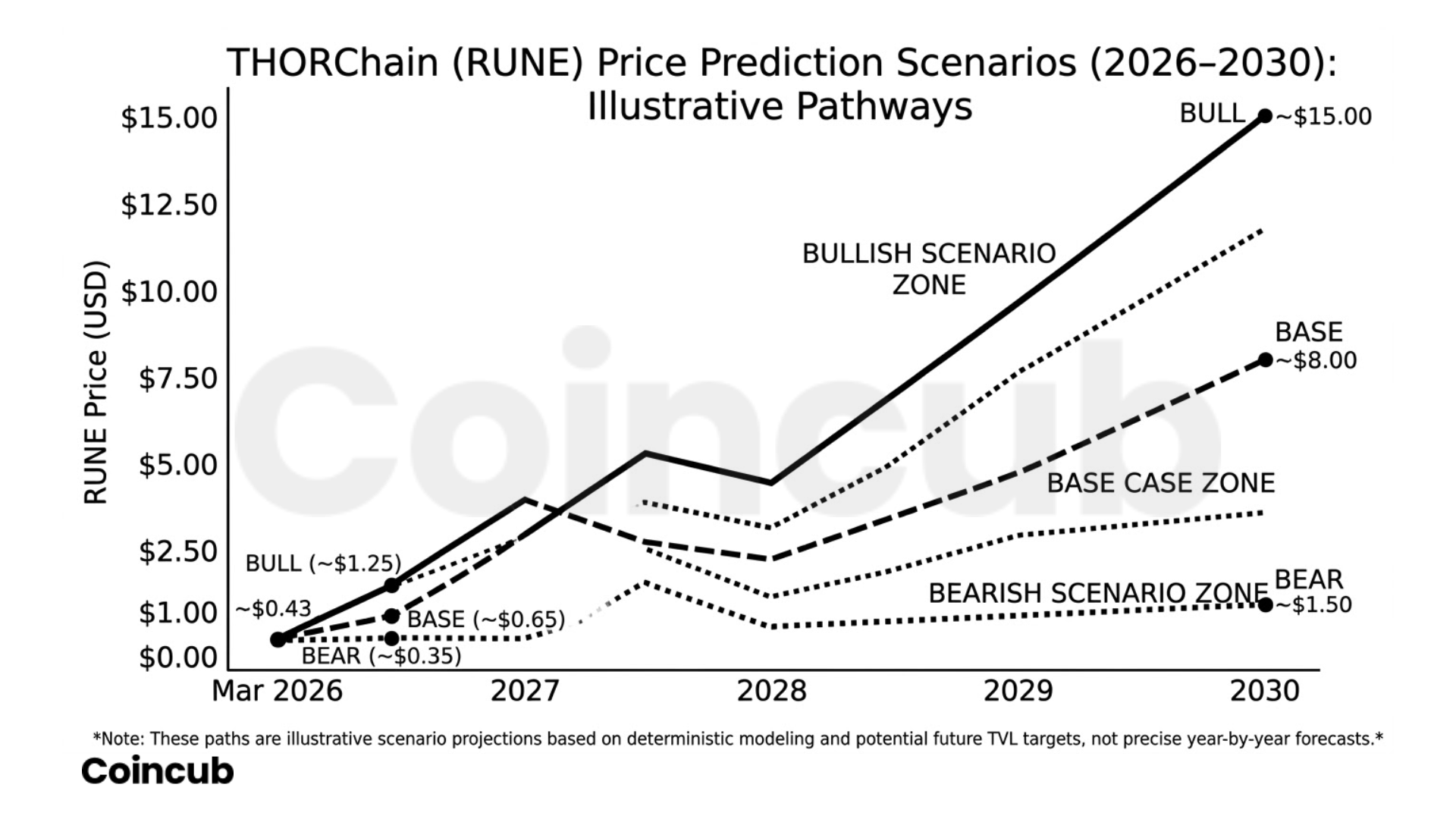
Because RUNE’s valuation is tied to network deposits, our forecast models scenarios based on potential platform growth and trading volume.
THORChain price prediction 2026
Searching for Stability. In this scenario, the market is still digesting the long bear market, and RUNE establishes a firm foundation.
If broader economic challenges persist and trading volumes remain flat, price action will likely chop sideways, with bearish estimates testing supports around $0.35. Conversely, a mild recovery (sparked by the successful Solana integration and increased stablecoin yield farming) could push a base-case recovery toward $0.65 as confidence slowly returns.
THORChain price prediction 2027-2028
Potential Volume Recovery. Assuming global markets stabilize and users look for ways to earn yield on their crypto again, cross-chain activity could see a resurgence.
If wallet front-ends (like Trust Wallet and XDEFI) continue using THORChain as their behind-the-scenes engine, user friction practically disappears. In an optimistic scenario, a steady increase in swap fees would trigger the protocol’s mechanics, requiring operators to buy and lock more RUNE from the open market.
THORChain price prediction 2029-2030
Decentralized Trading Grows Up. As the broader crypto ecosystem fractures into dozens of different Layer-1 and Layer-2 networks, the need for a unified exchange system becomes critical.
If THORChain can secure a reliable slice of global cross-chain exchange volume by 2030, the resulting growth in deposits would support a much higher token valuation. This, of course, assumes the protocol remains secure and competitive against newer technologies over the next half-decade.
| Year | Bear Case (Low) | Base Case (Average) | Bull Case (High) |
| 2026 | $0.35 | $0.65 | $1.25 |
| 2027-2028 | $0.80 | $2.50 | $4.50 |
| 2029-2030 | $1.50 | $8.00 | $15.00+ |
THORChain vs. Other DEXs
The decentralized exchange sector is highly competitive. Comparing RUNE to its peers gives a clearer view of its standing in 2026.
Uniswap is the undisputed leader for Ethereum-based tokens, but its base layer cannot handle native Bitcoin. Any Bitcoin traded on Uniswap has to be wrapped (wBTC). THORChain is specifically designed to handle the native assets that Ethereum-bound exchanges cannot securely hold.
Chainflip is a direct competitor offering native cross-chain swaps. While THORChain uses standard liquidity pools where users deposit assets, Chainflip uses a “just-in-time” liquidity model. It relies on professional market makers to provide funds exactly when a trade happens, which can help reduce slippage for certain trades. However, THORChain currently has the advantage of a longer track record, deeper established pools, and more wallet integrations.
Maya Protocol is a “friendly fork” of THORChain, meaning it copied the original code to create a backup network. It uses the same core mechanics but features a dual-token system (CACAO and MAYA) rather than relying on a single token like RUNE. Maya acts as a helpful redundancy for the ecosystem, though it handles a much smaller share of the market.
Is THORChain a Good Investment?
Evaluating RUNE requires separating the token’s brutal price history from the platform’s working technology.
The token model provides a logical price floor tied directly to network usage. As one of the most established decentralized exchanges for native Bitcoin and Solana swaps, it is well-positioned. If the DeFi sector sees a return of general market liquidity, an increase in deposits should naturally translate to increased demand for RUNE.
The protocol is incredibly complex. Managing real Bitcoin, Ethereum, and Solana across different networks means the risk of an unforeseen technical exploit is always higher than with simple smart contracts. Additionally, retail interest in complex DeFi mechanics is currently muted, and the token has struggled to regain momentum.
RUNE functions as a high-leverage bet on the overall growth of decentralized finance. It is best suited for investors who understand how liquidity pools operate and are comfortable with the risks of cross-chain tech. If you believe trading volume will eventually shift away from centralized exchanges, RUNE offers a modeled approach to capturing that trend, assuming the network remains secure.
How to Buy and Store THORChain (RUNE)?
Acquiring and securing RUNE is relatively straightforward across major platforms today.
RUNE is available on Binance, Kraken, and Crypto.com. Given the evolving regulatory climate, users should ensure their fiat onboarding is handled carefully to avoid unexpected account holds. You can also acquire RUNE through decentralized aggregators that route through THORSwap.
Because RUNE operates on its own independent blockchain, standard Ethereum wallets (like a basic MetaMask setup) cannot hold native RUNE without specialized configurations.
- Ledger Hardware: Ledger offers seamless integration for THORChain via the Ledger Live desktop application. This allows users to secure RUNE completely offline and execute native swaps directly through the hardware interface.
- Software Wallets: Trust Wallet, XDEFI, and Vultisig offer native support for RUNE, enabling easy portfolio management and direct connections to trading front ends.
Frequently Asked Questions (FAQ)
What is THORChain?
THORChain is a decentralized exchange network that allows users to swap native assets across different blockchains without using wrapped tokens.
What is RUNE used for?
RUNE is the core utility token of THORChain. It powers liquidity pools, helps secure the network, and acts as the pairing asset for swaps.
Why is RUNE different from other DEX tokens?
RUNE is tied directly to THORChain’s cross-chain swap model. Its demand depends on liquidity, deposits, and network activity rather than simple governance use.
Can THORChain handle native Bitcoin swaps?
Yes. That is one of its main differentiators. THORChain is built to support native BTC swaps without converting Bitcoin into wrapped BTC.
What could push RUNE higher in 2026?
Higher DeFi activity, stronger swap volumes, more wallet integrations, and renewed demand for decentralized trading could all support a recovery.
What are the biggest risks for RUNE?
The main risks are smart contract or protocol complexity, declining interest in DeFi, competition from other cross-chain platforms, and weak overall market conditions.
What is THORChain’s maximum supply?
RUNE has a maximum supply of 500 million tokens.
Can RUNE reach $10 again?
It is possible in a strong long-term scenario, but it would likely require a major increase in network deposits, trading volume, and broader market participation.
Can RUNE reach its old all-time high?
That would take a much stronger recovery in liquidity and user demand. It is possible in theory, but it sits firmly in the bullish end of the forecast range.
Is THORChain a good investment?
It depends on risk tolerance. RUNE is a high-risk crypto asset with real utility, but it remains heavily exposed to DeFi cycles and execution risk.