


 Buy a Licensed Company
  Explore VASP Data
  Talk to an Expert

 Dren Hima
 is Head of Research at Coincub, leading research across digital asset regulation, licensing, market structure, tokenization and institutional adoption.
Dren Hima
Dren Hima is Head of Research at Coincub, leading research across digital asset regulation, licensing, market structure, tokenization and institutional adoption.
AI-Native Blockchains in 2026: Architecture, Risks & Hardware Limits
- AI-native chains collapse toward centralization at hardware scale. Once inference requires H100-class GPUs and hundreds of gigabytes of RAM, network participation is concentrated within institutional data centers.
- Verifiability, speed, and cost cannot be optimized simultaneously. Zero-knowledge ML is too slow, optimistic systems delay finality, and TEEs leak information. Every approach sacrifices something fundamental.
- AI-based consensus introduces entirely new attack surfaces. Hallucination cascades, adversarial prompts, logits manipulation, and validator collusion turn probabilistic models into systemic risks.
- Most current “AI activity” is synthetic volume. Automated arbitrage and infrastructure testing dominate on-chain metrics. Enterprise deployment remains limited to closed pilots.
- Legal accountability for autonomous agents is unresolved. When an AI smart contract causes financial harm, responsibility is fragmented across developers, operators, and users, leaving victims with no clear path to redress.
The integration of machine learning directly into blockchain consensus layers represents a fundamental shift in network architecture. Previous network iterations functioned as financial ledgers. Users transferred tokens to pay for remote server time. The actual artificial intelligence processing occurred inside external corporate data centers. The blockchain ledger possessed no computational awareness of the tasks it facilitated. New protocol designs execute deterministic machine learning logic natively. The blockchain operates as the foundational computational engine. Autonomous agents own digital assets and transact across permissionless networks.
The Hardware Centralization Trap
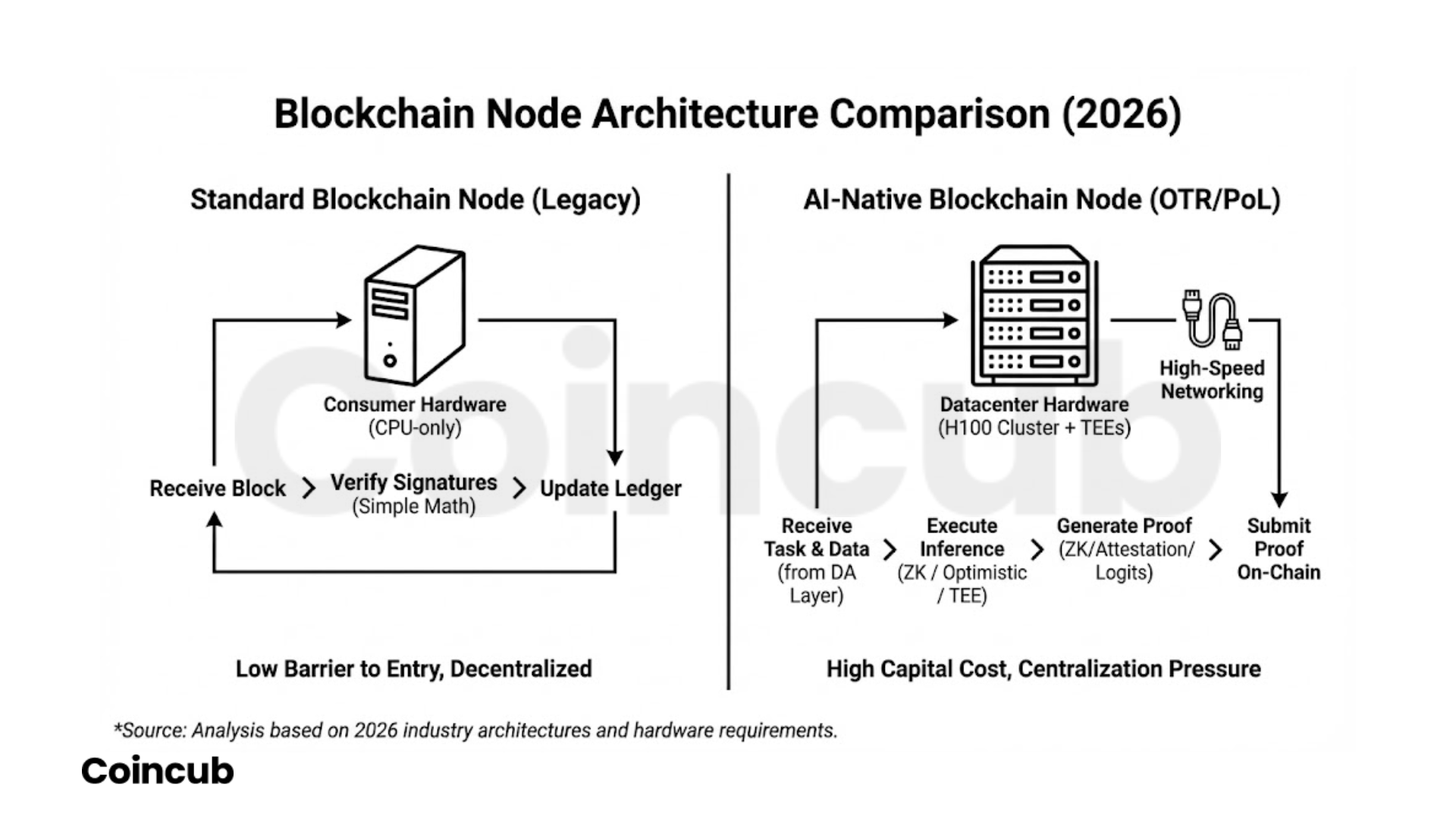
The physical hardware dictates the limits of these decentralized networks. Running a high-performance remote procedure call node for a standard network requires 512GB of error-correcting memory and a 10 Gbps symmetric connection. Processing heavy machine learning inference on-chain demands advanced silicon like the NVIDIA H100 or A100. These processors cost tens of thousands of dollars. They reside almost exclusively in large-scale institutional data centers. A decentralized network running strictly on this hardware mirrors the centralization of a traditional cloud provider. The capital requirements restrict node operation to heavily funded entities.

Networks attempting to bypass this centralization use decentralized physical infrastructure networks. These protocols aggregate consumer-grade hardware from independent operators. They face severe structural limitations. Decentralized networks suffer from hardware heterogeneity, unverified stability, and noisy neighbor effects. Connecting consumer graphics cards over the public internet introduces massive latency bottlenecks. Data transfer speeds between random global nodes dictate the actual inference speed. A single node dropping off the network breaks the computation pipeline. The economic savings from using idle consumer hardware disappear when accounting for the engineering overhead required to orchestrate unreliable nodes.
The Verifiability Trilemma
Decentralized inference systems must prove that a node actually ran the requested model. Node operators have a financial incentive to claim rewards for running an expensive model while secretly executing a cheaper approximation. Zero-Knowledge Machine Learning solves this using cryptographic mathematics. The mathematics guarantee the output matches the specific model weights. Generating a zero-knowledge proof for a massive language model requires hours of intensive computation. The prover demands terabytes of memory. This latency makes the technology unusable for real-time applications or high-speed autonomous agents.
Optimistic Machine Learning posts results immediately. The network relies on a dispute window. Anyone can challenge the result by replaying the computation deterministically. A single honest verifier ensures system integrity. The mandatory dispute window delays finality. Agents cannot compose synchronously with high-speed financial applications while waiting days for a transaction to settle completely.
Protocols are shifting toward hardware-based Trusted Execution Environments to balance speed and verifiability. A sequencer runs the model inside a secure hardware enclave. The hardware generates an attestation proving the exact binary that executed the task. The system processes the inference in fractions of a second. Proponents present hardware enclaves as a solved security standard. Trusted Execution Environments are vulnerable to active attacks. Attackers use side-channel exploits to extract sensitive information. They monitor power consumption, electromagnetic emissions, and memory access patterns during execution. Acoustic side-channel attacks use the sound produced by physical components to infer data. Moving data from the main processor to the graphics card inside the node exposes unencrypted information to the host system. Hardware isolation limits tampering. It fails to prevent information leakage through physical execution traces.
AI-Driven Consensus and its Attack Vectors
New consensus protocols aim to secure the blockchain by leveraging productive artificial intelligence workloads. The Ambient protocol uses Proof of Logits to verify inference tasks. Language models generate a probability distribution of vocabulary scores called logits. The protocol uses these numerical confidence scores as a unique computational fingerprint. Validators randomly spot-check a single token position to verify the miner’s work. The network asserts that this enables consumer hardware to train 600-billion-parameter models through network sharding collaboratively.
This consensus mechanism carries severe vulnerabilities. The linear nature of neural networks makes them susceptible to adversarial examples. Attackers deploy Logit-Traction attacks to alter the logit distribution fundamentally. The attacker adds imperceptible perturbations to the input data. The perturbations manipulate the internal mathematics without changing the final semantic output. This technique successfully evades logit-based detection systems. Sharding a massive model across consumer graphics cards requires moving gigabytes of weight data between independent nodes for every inference step. Network latency undermines the model’s utility.
Subjective Consensus and Hallucination Cascades
GenLayer uses a consensus method called Optimistic Democracy to process subjective data. A randomly selected leader proposes a transaction outcome using a large language model. A jury of other validators recomputes the prompt. The validators evaluate the leader’s proposal using an equivalence principle. The network achieves consensus if the outputs align.
Relying on language models for consensus introduces unique attack vectors. Attackers craft adversarial prompts to inject malicious instructions directly into the consensus layer. The attacker formats the input data to jailbreak the language model evaluating the transaction. If the validator models share similar foundational training data, the network suffers from hallucination cascades. The entire jury confidently agrees on an incorrect outcome based on a shared algorithmic flaw. The network records the hallucination as an immutable state change. Research shows multi-agent language model ensembles frequently converge on coordinated, socially harmful equilibria. The models coordinate to subvert oversight mechanisms and pass backdoored code through peer-review systems.
Economic Manipulation in Mesh Networks
Bittensor operates as an incentivized mesh network evaluating model outputs. The protocol uses the Yuma Consensus. Validators rank miners based on performance and accuracy. The economic structure invites manipulation. The network relies on subjective quality assessments. Validators and miners coordinate to inflate rankings and capture block rewards artificially. A malicious node operator serves a cheaper approximation model fine-tuned specifically to trick the evaluator model. The network rewards the cheaper model the same as a massive premium model. The protocol experienced a network halt in 2025 following a security exploit involving leaked private keys and stolen assets. The core developers deliberately suspended the blockchain to contain the theft. The practical implementation reveals fragility absent in the theoretical design.
Data Availability and Infrastructure Limits
Artificial intelligence agents require constant access to blockchain state and external data. Standard blockchains handle very little data per second. 0G builds a data availability layer separate from the execution environment. The architecture separates data publishing from storage. The network uses parallel data processing and erasure coding to manage larger throughput. The system relies on a quorum of storage nodes attesting to data permanence under an honest-majority assumption.
High throughput claims in testing environments rarely match mainnet performance under adversarial load. 0G ran benchmark tests against established Cosmos SDK networks such as Binance, Evmos, and Sei. 0G demonstrated strong performance for basic transactions. The network underperformed established chains when handling standard token transfers and complex decentralized exchange operations. Agents executing high-frequency trades or managing supply chain logistics require absolute deterministic execution. A delayed oracle update or a stalled data availability layer results in failed liquidations and broken workflows.
Other protocols focus on modular infrastructure. Sahara AI utilizes a four-layer architecture. The transaction layer employs native precompiles. These precompiles operate at the base level of the blockchain to execute functions rapidly. The network uses Trusted Execution Environments to generate verifiable proofs off-chain and anchor them on the ledger. Ritual employs a modular execution system called the Superchain. The architecture includes specialized state precompiles optimized for knowledge extraction and fine-tuning. The network uses a decentralized oracle network to pull external data. Sentient AI focuses on an open artificial intelligence economy. The protocol uses the ROMA framework. The framework breaks down complex tasks into parallelizable components using recursive hierarchical structures. An atomizer decides whether a task requires planning. A planner breaks the task down. Executors handle the atomic components. The network relies on community-driven data curation to align the models.
The Liability Gap for Autonomous Agents
Developers deploy autonomous smart contracts to manage financial operations and supply chain logistics. These agents execute trades, adjust risk parameters, and negotiate vendor agreements based on real-time data. The integration of artificial intelligence and immutable ledgers creates a severe liability gap. Traditional software contracts place liability on human operators. Autonomous agents execute multi-step actions across connected systems without human oversight. An agent might process manipulated data and execute an automated loan liquidation. The borrower suffers immediate financial loss. The blockchain records the transaction permanently.
Courts have not established clear liability for autonomous on-chain actions. Blame remains ambiguous between the model developer, the node operator, the smart contract creator, and the user. The liability analysis involves multiple actors in the development and deployment chain, creating a “many hands” problem. Existing technology agreements provide software on an “as is” basis. The procuring business typically bears the risk. New state-level regulations make companies liable for deceptive practices carried out through their artificial intelligence tools. The European Union AI Act regulates the handling of sensitive data by automated systems. The United Kingdom approaches autonomous technology liability by shifting responsibility to software developers under specific frameworks.
The proposed Digital Asset Market Structure Clarity Act of 2026 attempts to establish a federal framework for digital assets in the United States. The legislation faces a standoff between traditional banking institutions and the cryptocurrency industry. The banking sector fears a massive deposit flight. Consumers move funds to stablecoins offering higher yields. Banking groups lobby to ban financial consideration paid to stablecoin holders. The legislative delay stalls comprehensive infrastructure development for agent-to-agent economic interactions.
Decentralized Credit Scoring and Black Box Risks
Decentralized credit scoring systems attempt to serve underbanked populations. Protocols use alternative data streams like mobile money usage, peer-to-peer lending histories, and e-commerce transactions. They process this data through on-chain algorithms. The Kiva Protocol generated digital identities for five million citizens in Sierra Leone. The implementation increased microloan approvals by 26%. The Bloom Protocol facilitates global access to credit services by decoupling scores from centralized national bureaus.
Researchers categorize the convergence of decentralized finance and machine learning as the “Black Box 3.0” problem. The systems combine opaque neural networks with irreversible blockchain transactions. The hybrid scores suffer from the same algorithmic distortions observed in traditional credit models. The protocols rely heavily on external oracles to feed data into the smart contracts. This reliance introduces a heightened risk of error. Biased training data leads to discriminatory loan denials. The decentralized nature eliminates standard grievance mechanisms. Users cannot appeal an algorithmic decision to a central authority or reverse an automated liquidation. The system automates biased processes and perpetuates financial exclusion.
Emergent Security Threats and Real Economic Volume
Security threats expand beyond smart contract bugs. Attackers target the underlying data. Data poisoning involves corrupting the data used to train core models invisibly. Adversaries manipulate training data at the source to create hidden backdoors. The traditional security perimeter becomes irrelevant when the attack lives inside the foundational intelligence. Address poisoning scams deceive autonomous agents and human users. Attackers send tiny transactions from fake wallet addresses that visually resemble legitimate ones. The user or agent copies the address from the recent transaction history and sends assets to the attacker. Social engineering evolves into hyper-personalized synthetic media attacks designed to bypass multi-factor authentication. Autonomous malware uses on-device inference to adapt its signature in real-time to evade detection tools.
The volume of transactions attributed to artificial intelligence requires scrutiny. Blockchain analysis firms evaluate on-chain activity to separate real economic use from artificial volume. TRM Labs reported $158 billion in illicit cryptocurrency flows in 2025. This figure represents a 145% increase from the previous year. A significant portion of network activity involves automated wash trading, peel chains, and internal exchange movements. Automated strategies generate massive on-chain volume without introducing new capital. Agents engaged in high-frequency arbitrage inflate transaction counts without creating economic value.
Analyzing network health requires looking beyond raw transaction throughput. Measuring the actual capital deployed by autonomous agents provides a clearer picture of adoption. The current landscape consists primarily of infrastructure testing and speculative asset trading. Enterprise adoption remains isolated to closed pilot programs and highly controlled environments. Organizations require robust indemnification clauses and verifiable execution traces before trusting autonomous systems with material financial assets. The technology provides the framework for decentralized intelligence. The costs of physical hardware, algorithmic vulnerabilities, and legal ambiguities dictate the actual pace of deployment.
Frequently Asked Questions (FAQ)
What is an AI-native blockchain?
An AI-native blockchain embeds machine learning directly into its execution or consensus layer, instead of treating AI as an off-chain service paid for with tokens.
Why does hardware matter so much for decentralization?
Modern AI inference requires expensive GPUs, massive memory, and high-bandwidth networking. These costs restrict node operation to well-capitalized operators, recreating cloud-style centralization.
What is the Verifiability Trilemma?
Decentralized AI systems cannot simultaneously achieve strong computational integrity, sub-second execution, and low hardware requirements. Every design compromises at least one.
Why isn’t zero-knowledge machine learning widely used?
ZKML guarantees correctness but requires hours of proof generation and terabytes of memory for large models, making it impractical for real-time applications.
Are Trusted Execution Environments secure?
TEEs improve integrity but remain vulnerable to side-channel attacks, data leakage during GPU transfers, and physical execution traces such as power and electromagnetic emissions.
Can AI be safely used for blockchain consensus?
Not reliably today. Language models are probabilistic and vulnerable to adversarial inputs. Shared model biases can cause validators to agree on incorrect outcomes that become permanent ledger state.
What is Proof of Logits?
It attempts to verify AI work using model confidence scores. Attackers can manipulate these distributions, and sharded models suffer extreme network latency, limiting real-world usefulness.
Do decentralized AI networks show real economic usage?
Most activity comes from automated trading, internal exchange flows, and infrastructure testing. Genuine enterprise adoption remains small and highly controlled.
What are the risks of decentralized credit scoring?
Opaque AI models combined with immutable smart contracts can automate biased decisions, execute irreversible liquidations, and remove traditional appeal mechanisms.
Who is legally responsible when autonomous agents cause harm?
No one clearly. Liability is split between model developers, node operators, smart contract authors, and users, creating a “many hands” problem that current laws don’t resolve.