Buy a Licensed Company
  Explore VASP Data
  Talk to an Expert

 Atis Shala
Atis is a senior analyst and community lead with four years of experience in crypto. He has a bachelor from the Rochester Institute of Technology.
Atis Shala
Atis is a senior analyst and community lead with four years of experience in crypto. He has a bachelor from the Rochester Institute of Technology.
Crypto Robotics: How Autonomous Machines Transact Globally
- Crypto robotics connects autonomous machines with blockchain-based payments.
- Machine wallets let robots, drones, and vehicles send or receive digital assets.
- Smart contracts can automate payments once tasks are verified.
- Stablecoins may make machine transactions more predictable and practical.
- Crypto robotics could support real-time commerce between machines, infrastructure, data providers, and AI agents.
Robots are no longer limited to repetitive factory tasks or carefully controlled laboratory environments. They are moving through warehouses, delivering food, inspecting infrastructure, monitoring crops, assisting in hospitals, mapping cities, and supporting supply chains. At the same time, artificial intelligence is giving machines the ability to make more complex decisions, respond to changing environments, and optimize their behavior without constant human direction.
This creates an important question: what happens when autonomous machines need to transact?
A delivery robot may need to pay for battery charging. A drone may need to purchase real-time weather data before choosing a flight path. A self-driving vehicle may need to pay for tolls, parking, insurance, or electricity. A factory machine may detect that one of its parts is wearing down and automatically order a replacement. In each case, the machine is not simply performing a physical task. It is participating in an economic activity.

Traditional financial systems were not designed for this world. Bank accounts, card networks, manual approvals, business hours, chargebacks, and cross-border payment delays are built around humans and institutions. They are often too slow, too expensive, or too rigid for machines that may need to make thousands of small transactions in real time.
Crypto Robotics and the Machine Economy
This is where crypto robotics comes in.
Crypto robotics combines robotics, blockchain, artificial intelligence, smart contracts, digital wallets, and decentralized infrastructure. It gives autonomous machines a way to send, receive, and verify payments across borders without relying on traditional banking systems. Instead of waiting for a human operator to approve every transaction, a robot can interact with programmable payment systems based on predefined rules.
The result is a new model of machine-to-machine commerce. Robots, drones, sensors, vehicles, and AI agents can exchange value directly with service providers, digital networks, and even other machines. This does not mean machines become independent legal persons overnight. But it does mean they can be connected to financial tools that allow them to act with far greater autonomy.
What Is Crypto Robotics?
Crypto robotics refers to the integration of autonomous machines with blockchain-based financial and coordination systems. In simple terms, it is the use of cryptocurrency, smart contracts, and decentralized networks to allow robots and machine agents to transact.
A robot in a traditional system may follow instructions from a central server. It may perform a task, collect data, or move through a physical space, but its financial activity is usually controlled by a human or company. It cannot independently pay for a service, receive compensation, or interact with a marketplace.
A crypto-enabled robot is different. It can be connected to a blockchain wallet, interact with smart contracts, verify conditions, and trigger payments automatically. The machine may still be owned and governed by a person, company, or organization, but it can carry out financial actions according to programmed rules.
This creates a more flexible model. Machines can be paid based on performance, usage, time, output, or verified results. Crypto robotics is built on robotics, AI, blockchain networks, smart contracts, machine wallets, IoT sensors, and decentralized identity systems.
The key difference between ordinary robotics and crypto robotics is economic autonomy. Traditional automation allows machines to perform tasks. Crypto robotics allows machines to interact with markets.
This does not mean every robot needs cryptocurrency. Many machines will continue to operate perfectly well inside closed systems. But for robots that need to transact across companies, countries, platforms, or networks, blockchain-based systems offer something powerful: a shared financial layer that is open, programmable, and global.
Do Autonomous Machines Need Crypto?
Autonomous machines need a payment system that matches the way they operate. They are fast, digital, data-driven, and increasingly global. Traditional finance often moves in the opposite direction. It can be slow, permission-heavy, geographically fragmented, and dependent on human approval.
A robot does not need a beautiful banking app. It needs a reliable way to execute transactions automatically.
Consider a drone that provides inspection services for solar farms. It may need to pay for flight path data, access a weather API, rent temporary storage for high-resolution images, and receive payment after completing the inspection. These transactions may involve several parties in different countries. Some payments may be very small. Some may need to happen instantly.
Using traditional payment rails, this would be difficult. Card networks may not support very small payments efficiently. Bank transfers may be too slow. Cross-border settlement may introduce delays and fees. Human authorization may create friction at every step.
| Feature | Traditional Financial Systems | Crypto Robotics Infrastructure |
| Primary User | Humans & Legal Institutions | Autonomous AI & Machine Agents |
| Transaction Speed | Hours to Days (Settlement) | Near-Instant (Onchain) |
| Operating Hours | Business Hours / Banking Days | 24/7/365 |
| Cost Basis | High (Fees + Manual Overhead) | Low (Micropayments & Gas) |
| Authorization | Manual / Permission-heavy | Programmable / Smart Contracts |
Main Advantages of Crypto for Autonomous Machines
Crypto offers several advantages for autonomous machines:
- Availability: Blockchain’s 24/7 operation ensures machines can transact instantly without banking interruptions.
- Automation: Smart contracts enable conditional machine payments that trigger only upon task verification.
- Borderlessness: Cryptocurrency allows machines to trade services globally without traditional geographic friction.
- Efficiency: Low-cost networks make tiny, high-frequency machine micropayments economically practical.
Stablecoins are especially important in this context. While cryptocurrencies like Bitcoin and Ethereum are well known, their price volatility can make them difficult for everyday machine services. A robot should not have to guess whether the price of a token will change dramatically between the start and end of a charging session. Stablecoins, which are designed to maintain a stable value relative to a fiat currency such as the U.S. dollar, can make pricing easier.
The Core Technologies Behind Crypto Robotics
Crypto robotics is not a single technology. It is a stack of technologies working together. To understand how autonomous machines transact globally, it helps to break the system into its main components.
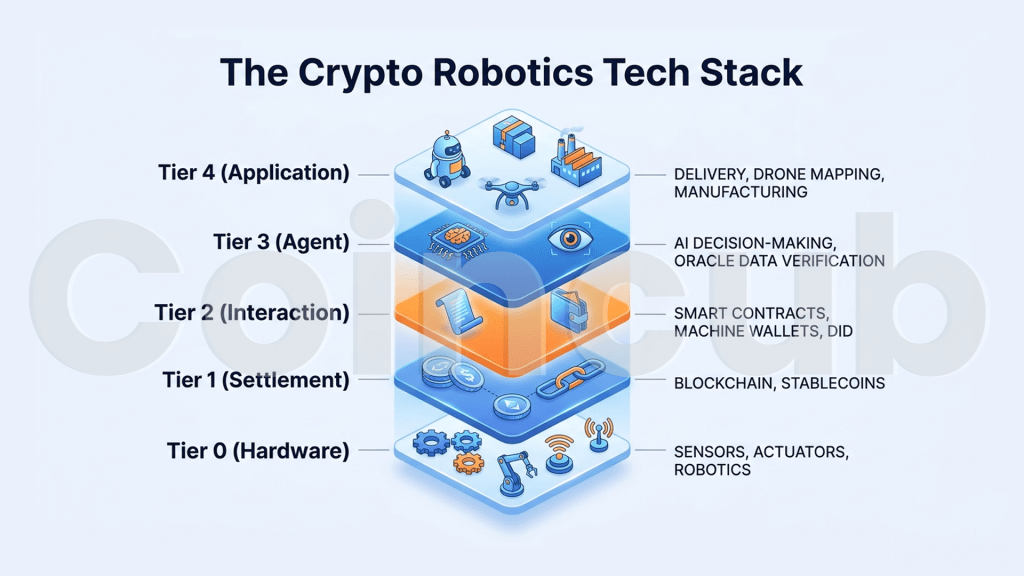
Blockchain Networks
A blockchain is a shared digital ledger that records transactions across a network of computers. Instead of relying on one central authority to approve and store every transaction, blockchain networks distribute that responsibility across many participants.
For crypto robotics, blockchains provide the settlement layer. This is where payments are recorded, verified, and finalized. When a robot pays a charging station, a drone receives payment for mapping land, or a machine purchases data from a decentralized marketplace, the transaction can be recorded onchain.
Public blockchains are especially useful because they are open and global. A robot does not need a separate payment integration for every country or financial institution. It can use the same blockchain wallet to interact with different services, platforms, and smart contracts.
However, not every blockchain is suitable for robotics. Autonomous machines may require low fees, fast confirmation times, and high reliability. This is why Layer 2 networks, high-throughput blockchains, and specialized payment channels may play an important role. A robot making frequent small payments cannot afford high transaction costs or long delays.
Smart Contracts
Smart contracts are programs that run on blockchain networks. They automatically execute rules when certain conditions are met.
In crypto robotics, smart contracts act as the business logic between machines and service providers. They can define who gets paid, when payment happens, what conditions must be satisfied, and what happens if something goes wrong.
For example, a smart contract could be used for a robot delivery service. The customer deposits payment into the contract. The robot picks up the package and delivers it. A location sensor, QR code scan, or customer confirmation verifies delivery. Once the condition is met, the smart contract releases payment.
Smart contracts can also handle more complex arrangements. A single payment could be split between the robot owner, software provider, maintenance company, insurance pool, and infrastructure network. This makes it possible to create automated revenue-sharing systems for robotic services.
Machine Wallets
For a machine to transact, it needs a wallet. A machine wallet is a blockchain wallet associated with a robot, drone, vehicle, sensor, or AI agent.
The wallet allows the machine to send, receive, and manage digital assets. It can be programmed with spending limits, approval rules, and security restrictions. For example, a delivery robot might be allowed to spend up to a certain amount per day on charging, routing data, and maintenance, but larger payments may require human approval.
Security is critical. A robot with an unrestricted wallet would be dangerous. If the wallet were hacked, funds could be stolen or the robot’s behavior could be manipulated. For this reason, machine wallets may use multi-signature controls, hardware security modules, spending caps, allowlisted addresses, and emergency shutdown mechanisms.
It is also important to separate technical control from legal ownership. A robot may control a wallet address in the technical sense, but the assets are usually owned or governed by a person, company, DAO, or legal entity. The machine acts as an automated operator, not necessarily as an independent legal owner.
Stablecoins
Stablecoins are digital tokens designed to maintain a stable value, often tied to a fiat currency. In crypto robotics, they may be more practical than volatile cryptocurrencies for everyday payments.
A robot paying for electricity, bandwidth, cloud computing, or spare parts needs predictable pricing. Service providers also need to know what they are receiving. If a robot pays $2 for a charging session, both sides should be confident that the value will not swing dramatically within minutes.
Stablecoins can support machine-to-machine transactions by making payments more stable, understandable, and commercially usable. They also allow global settlement without requiring every machine or service provider to interact directly with traditional banks for every transaction.
Decentralized Identity
Autonomous machines need identity. A charging station must know whether a robot is authorized to use its service. A customer must know whether a delivery robot belongs to a trusted provider. A smart city system must know whether a drone has permission to enter a certain area.
Decentralized identity systems can help machines prove who they are without relying entirely on a single centralized database. A robot could carry verifiable credentials showing its manufacturer, operator, maintenance history, compliance status, and permissions.
This is essential for trust. In a global machine economy, machines cannot transact safely if they cannot identify each other.
Oracles and Real-World Data
Blockchains are excellent at verifying onchain transactions, but robots operate in the physical world. A smart contract cannot automatically know whether a package was delivered, a battery was charged, or a field was inspected unless reliable data is provided.
This is where oracles come in. Oracles connect real-world data to blockchain systems.
In crypto robotics, oracles may use sensor data, GPS signals, device logs, camera verification, API feeds, or human confirmations to prove that something happened. For example, an oracle could confirm that a robot completed a cleaning task, that a drone reached a specific location, or that a machine used a certain amount of electricity.
The quality of oracle data is one of the biggest challenges in crypto robotics. If the data is wrong or manipulated, the payment may also be wrong. That is why secure sensors, trusted hardware, cryptographic proofs, and reputation systems will be important.
AI Agents and Decision-Making
AI agents give crypto-enabled robots the ability to make financial decisions, not just payments. A robot with a wallet can send and receive funds, but it also needs to decide when to pay, who to pay, how much to spend, and whether a transaction is safe. In crypto robotics, AI agents can compare service providers, manage budgets, detect fraud, optimize routes, schedule maintenance, and interact with smart contracts. For example, a delivery robot could evaluate battery level, charging prices, weather, and customer deadlines before paying for a recharge. This helps machines operate independently within human-defined limits.
How Autonomous Machines Transact Globally
To understand crypto robotics in practice, imagine a simple scenario: an autonomous delivery robot needs to recharge its battery while operating in a city.
First, the robot identifies a need. Its battery level drops below a certain threshold, and its AI system determines that it should recharge before accepting another delivery.
Next, the robot searches for a compatible charging station. It may compare nearby stations based on distance, price, availability, charging speed, and reputation.
Once the robot selects a station, it checks the terms of service. The station may charge a fixed rate per kilowatt-hour or offer dynamic pricing based on demand. The robot’s wallet verifies that it has enough funds and that the transaction is within its approved spending limits.
A smart contract then defines the transaction. The robot may lock a small payment deposit before charging begins. The charging station agrees to provide electricity. Both sides rely on the smart contract to handle settlement.
As the robot charges, sensors measure how much energy is delivered. When charging ends, the station submits usage data. The robot may also submit its own confirmation. An oracle verifies the charging session and sends the result to the smart contract.
Finally, payment is released automatically. The robot’s wallet sends stablecoins to the charging station. A small platform fee may go to the network. The transaction is recorded, and both the robot and the station update their reputation scores
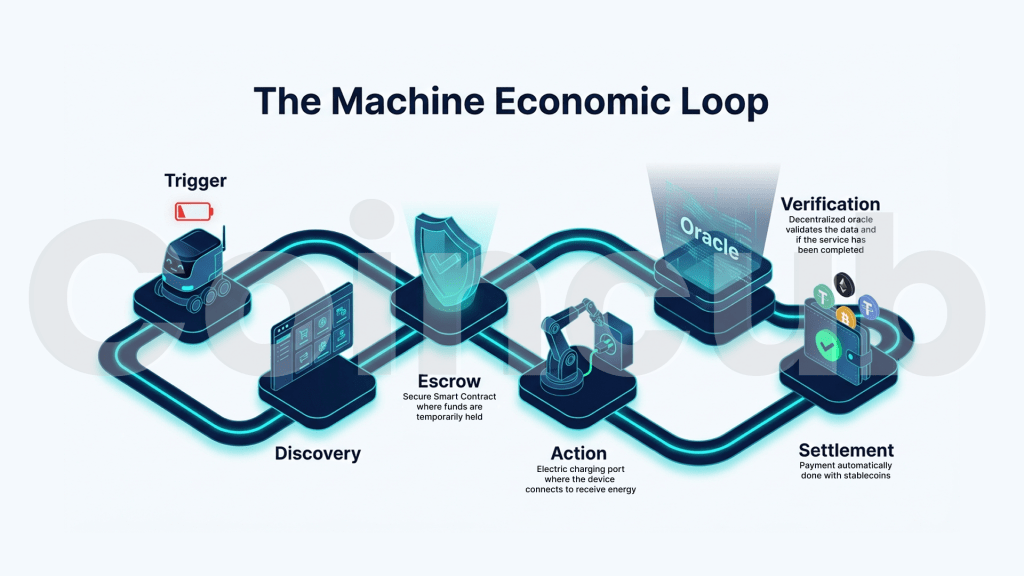
This entire process can happen without a human manually approving the payment.
Now expand that idea globally. A farming robot in Kosovo could purchase satellite weather data from a provider in Singapore. A drone in Kenya could buy mapping software from a decentralized compute network… and so on.
Real-World Use Cases of Crypto Robotics
Crypto robotics becomes easier to understand when we move from theory to practical examples. The most promising use cases involve machines that already operate with some level of autonomy and need to interact with services, infrastructure, or marketplaces.
Autonomous Delivery Robots
Delivery robots are one of the clearest examples of crypto robotics in action. These machines may move through sidewalks, campuses, warehouses, airports, or urban neighborhoods to transport food, groceries, medicine, parcels, or industrial supplies.
In a crypto-enabled system, a delivery robot could use a machine wallet to pay for services during its route. It might pay for battery charging, access to private delivery zones, temporary storage, mapping data, or maintenance diagnostics. Instead of every payment being handled through a centralized company account, the robot could make small automated payments based on real-time needs.
For example, a delivery robot running low on battery could locate the nearest compatible charging station, compare pricing, reserve a charging slot, and pay automatically after the session ends. A smart contract could verify the charging duration and release payment only when the service is complete.
This model could also improve how delivery robots earn revenue. A robot could receive payment after a successful delivery, with proof confirmed through GPS, customer confirmation, QR code scanning, or sensor data. The payment could then be split automatically between the fleet operator, software provider, maintenance partner, and insurance provider.
Drone Networks
Drones are another major area where crypto robotics could be useful. They are already used for aerial photography, infrastructure inspection, agriculture, emergency response, mapping, logistics, and environmental monitoring.
A drone may need to purchase several digital and physical services before completing a mission. It may need weather data, airspace authorization, route optimization, image processing, cloud storage, landing-pad access, or battery swapping. Crypto payments could allow these transactions to happen quickly and automatically.
Imagine an inspection drone assigned to examine a wind farm. Before takeoff, it buys updated weather information, pays for access to a restricted flight corridor, and locks funds in a smart contract with the wind farm operator. After the inspection, image data is uploaded, the task is verified, and payment is released.
Drones could also participate in decentralized marketplaces. A company that needs aerial mapping could post a task, and available drones could bid for the job based on location, battery level, equipment quality, and price. Smart contracts could manage deposits, verification, and payment settlement.
Smart Manufacturing
Factories already use robots, sensors, and automated machines. Crypto robotics could make these systems more financially autonomous and interoperable.
An industrial machine could detect that a component is wearing down and automatically order a replacement. A robotic arm could sell unused production capacity during low-demand periods. A manufacturing line could pay for predictive maintenance only when sensor data indicates that servicing is needed.
Smart contracts could also improve supply chain verification. When a machine completes a production step, it could record the event onchain. This creates a traceable record of how goods move through production, inspection, packaging, and delivery.
For manufacturers, the value is efficiency. Instead of relying on manual invoicing, delayed reconciliation, and disconnected enterprise systems, machines could settle payments and record activity in near real time.
Autonomous Vehicles
Self-driving vehicles may eventually need to interact with many payment systems during a single trip. They may pay tolls, parking fees, congestion charges, charging stations, vehicle-to-vehicle services, insurance, software updates, and maintenance providers.
Crypto robotics could give autonomous vehicles a unified way to manage those transactions. A robotaxi, for example, could receive payment from passengers, pay for charging, settle road usage fees, and distribute revenue to different stakeholders.
Challenges and Risks of Crypto Robotics
Despite its potential, crypto robotics faces serious challenges. These risks need to be solved before autonomous machine payments can become mainstream.
Security Risks
A robot connected to a crypto wallet becomes a financial target. If attackers compromise the wallet, they may steal funds, redirect payments, or manipulate the machine’s economic behavior.
Security risks include private key theft, smart contract vulnerabilities, malicious software updates, sensor spoofing, and compromised APIs. In some cases, financial compromise could also affect physical behavior. For example, a hacked system might trick a robot into paying for a fake charging station or accepting a fraudulent task.
Legal and Regulatory Uncertainty
Crypto robotics raises difficult legal questions. Can a robot enter into a contract? Who is responsible if a machine makes a bad payment? Who pays taxes on machine-generated income? What happens if a robot causes physical damage while executing a paid task?
In most legal systems, machines do not have independent legal personhood. They are usually treated as property or tools controlled by a person, company, or organization. This means responsibility will likely fall on operators, manufacturers, software providers, or asset owners.
Regulators may also be concerned about anti-money laundering rules, cross-border payments, consumer protection, data privacy, and financial accountability. Any system that allows autonomous payments needs compliance controls.
The Oracle Problem
Robots operate in the physical world, while smart contracts operate on digital networks. A smart contract needs reliable data to know whether a machine completed a task.
This creates the oracle problem. If the data source is wrong, manipulated, delayed, or incomplete, the contract may execute incorrectly.
For example, a drone may claim it completed an inspection, but the images may be low quality. A charging station may report more electricity delivered than the robot actually received. A delivery robot may claim a package was delivered, but the customer may disagree.
Solving this requires trusted sensors, cryptographic proofs, tamper-resistant hardware, independent verification, and reputation systems.
Ethical Concerns
Autonomous machines making payments also raise ethical concerns. Human oversight remains essential, especially when machines operate in public spaces or handle sensitive data.
Key concerns include surveillance, job displacement, algorithmic bias, unsafe automation, and unclear accountability. If robots can earn and spend money, operators must define strict boundaries around what machines are allowed to do.
The goal should be controlled autonomy, where machines can transact efficiently within safe, transparent, and auditable limits.
What Comes Next for Crypto Robotics?
Crypto robotics is still in its early stages, but several trends suggest where it may go next. As robots become more common, they could begin trading services directly with one another. A warehouse robot might pay another machine to move inventory, a drone could buy support from a ground robot, or an autonomous vehicle could purchase road condition data from nearby vehicles. These transactions would likely be small, fast, and highly automated, making programmable payments a natural fit.
Future marketplaces may also allow machines to list services, bid on tasks, and settle payments automatically. Drones could offer inspection services, robotaxis could sell transportation, cleaning robots could accept building contracts, and sensor networks could sell real-time data. Smart contracts could manage escrow, verification, ratings, and dispute resolution.
However, growth will depend on stronger standards and infrastructure. Machines will need common protocols for identity, payments, security, data verification, and compliance. Governments and industry groups will also need clear rules for taxation, liability, insurance, and financial oversight. Adoption will likely begin in controlled environments such as warehouses, farms, ports, campuses, and logistics hubs, while public urban use cases may take longer due to safety and regulatory demands.
Conclusion: From Automated Tools to Economic Actors
Crypto robotics brings together robotics, blockchain, AI, smart contracts, stablecoins, decentralized identity, and real-world data systems. Its purpose is simple but powerful: to give autonomous machines a way to transact globally.
As robots become more capable, they will need to interact with services beyond their original owners. They may buy electricity, data, compute, maintenance, connectivity, insurance, and access to infrastructure. They may also earn revenue by completing tasks, providing data, or contributing to decentralized networks.
Traditional payment systems were built for humans and institutions. Crypto-based infrastructure offers a programmable alternative that better fits the speed, scale, and automation of machine activity.
The opportunity is significant, but so are the risks. Security, regulation, identity, oracle reliability, volatility, and ethics must be addressed before crypto robotics can reach mass adoption.
Still, the direction is clear. The future of robotics will involve machines that move, sense, decide, coordinate, and transact. Crypto robotics points toward a global machine economy where autonomous systems can exchange value safely, efficiently, and across borders.
Frequently Asked Questions (FAQs)
What is crypto robotics?
Crypto robotics is the integration of robotics with blockchain technology. It allows autonomous machines to use digital wallets, smart contracts, stablecoins, and decentralized networks to send, receive, and verify payments.
How can robots use cryptocurrency?
Robots can be connected to blockchain wallets. These wallets can be programmed to make payments under specific conditions, such as after receiving energy, completing a delivery, or purchasing data.
Why do autonomous machines need blockchain?
Autonomous machines need payment systems that are fast, programmable, global, and available 24/7. Blockchain can support automated machine-to-machine payments without relying on traditional banking infrastructure for every transaction.
Are stablecoins important for crypto robotics?
Yes. Stablecoins are useful because they reduce price volatility. This makes them better suited for pricing real-world services such as charging, bandwidth, maintenance, data access, and transportation.
Can robots legally own crypto?
In most jurisdictions, robots do not have independent legal personhood. A robot can technically control a wallet, but the assets are usually owned or governed by a human, company, DAO, or other legal entity.
What are examples of crypto robotics?
Examples include delivery robots paying for charging, drones buying weather data, autonomous vehicles paying tolls, industrial machines ordering replacement parts, and agricultural robots purchasing satellite imagery.
Is crypto robotics the same as DePIN?
No. DePIN refers to decentralized physical infrastructure networks, while crypto robotics focuses on autonomous machines that transact using blockchain systems. The two areas can overlap when robots use or contribute to decentralized infrastructure.