


 Buy a Licensed Company
  Explore VASP Data
  Talk to an Expert

 Atis Shala
Atis is a senior analyst and community lead with four years of experience in crypto. He has a bachelor from the Rochester Institute of Technology.
Atis Shala
Atis is a senior analyst and community lead with four years of experience in crypto. He has a bachelor from the Rochester Institute of Technology.
Compliance-by-Design in Smart Contracts

For the better part of a decade, the blockchain industry operated under a distinct, somewhat rebellious philosophy: “Code is Law.” Ideally, this meant that if the smart contract allowed a transaction, that transaction was valid regardless of what a government, a bank, or a regulator had to say about it.
This ethos fueled the initial explosion of Decentralized Finance (DeFi). It created a permissionless ecosystem where anyone with an internet connection could lend, borrow, and trade. However, as the industry has matured from the experimental “Wild West” of early ICOs to the current era of institutional adoption, tokenized Real-World Assets (RWAs), and heavy regulatory scrutiny, that philosophy has hit a hard wall.
The reality of modern finance is that “Code is Law” is not enough. We also have actual law: Anti-Money Laundering (AML) directives, Know Your Customer (KYC) requirements, and sanctions lists.

Currently, the industry faces a massive friction point. Traditional finance (TradFi) relies on manual, retroactive compliance. Banks hire armies of analysts to review transactions after they happen, flagging suspicious activity and filing reports. This is slow, expensive, and prone to human error. Conversely, blockchain is instant, immutable, and operates 24/7. When you try to force slow, manual compliance onto a high-speed blockchain, you break the very efficiency that makes the technology valuable.
This disconnect has kept trillions of dollars of institutional capital on the sidelines. Major asset managers cannot interact with liquidity pools if there is even a 1% chance they are counter-trading against a sanctioned entity.
The solution is not to slow down the blockchain to match the speed of bureaucracy. The solution is to embed the rules of bureaucracy directly into the blockchain itself. This is the dawn of Compliance-by-Design, a paradigm shift where regulatory adherence is not an afterthought, but a prerequisite for the code to execute at all.
What is Compliance-by-Design?
At its simplest level, Compliance-by-Design is the practice of embedding regulatory rules and logic directly into the smart contract architecture.
In the traditional world, compliance is Ex-Post (after the fact). You swipe your credit card, the transaction goes through, and perhaps days later, a compliance officer flags it as suspicious. If they find a problem, they have to unwind the trade, freeze the account, or issue a fine. It is a reactive system of “detect and punish.”
Compliance-by-Design is Ex-Ante (before the fact). It is a proactive system of “prevention.”
Think of it like the difference between a speed limit sign and a speed governor in an engine.
- Traditional Compliance is a Speed Limit Sign: It tells you the rule (“Do not go over 65 mph”), but it relies on a police officer catching you if you break it. You can break the law if you choose to.
- Compliance-by-Design is a Speed Governor: The car’s computer physically prevents the engine from accelerating past 65 mph. You cannot break the law, even if you try.
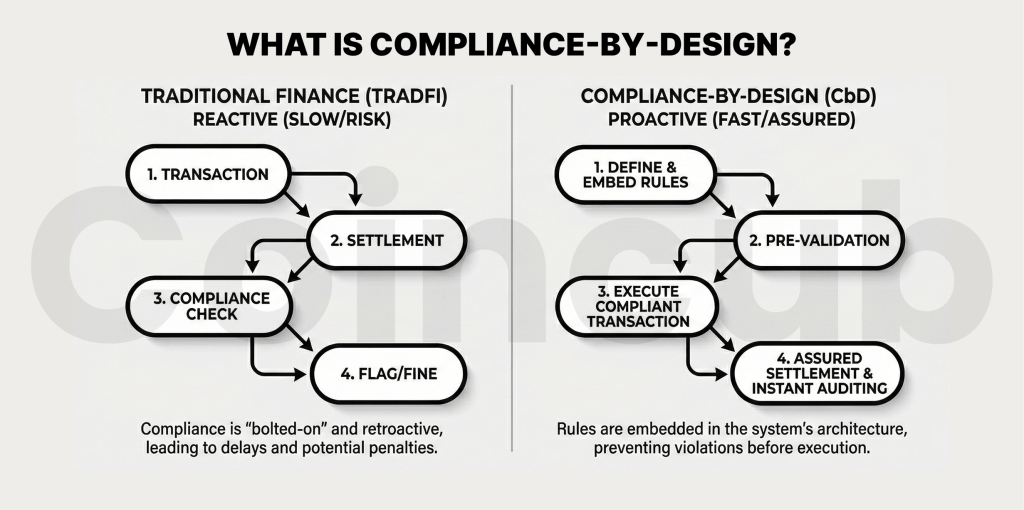
In the context of smart contracts, this means the rules of the game are baked into the token or the protocol. If a user tries to transfer a security token to a wallet that hasn’t been KYC-verified, or if a trader tries to swap an amount that exceeds their daily jurisdiction limit, the smart contract simply rejects the transaction.
It doesn’t revert the trade because a regulator intervened; it reverts because the mathematical conditions for the trade, which include regulatory compliance, were not met. The code essentially says: “I cannot move these funds because the destination address lacks the required digital credentials.”
This shift transforms compliance from a burdensome administrative task into an automated, invisible layer of infrastructure. It ensures that assets remain compliant 24/7, globally, without the need for constant manual oversight.
How Do Smart Contracts “Know” the Law?
To understand how a piece of code can enforce a law, we first need to look at how traditional blockchains work. In a standard Bitcoin or Ethereum transaction, the protocol only checks one thing: Does the sender have enough money? If the answer is yes, the money moves.
Compliance-by-Design introduces a second layer of checks. It asks: Is the sender allowed to move this money? And is the receiver allowed to accept it?
This process relies on three core pillars: Digital Identity, Oracles, and Permissioned Token Standards.
The Role of Digital Identity (DID)
The biggest hurdle for compliance in crypto has always been anonymity. A wallet address is just a string of random characters. It does not tell you if the owner is a sanctioned individual or a law-abiding citizen.
To solve this, we use Decentralized Identity (DID) and Verifiable Credentials (VCs).
Imagine you go to a bar. The bouncer needs to know you are over 21. You show your ID card. The bouncer checks the birthdate and lets you in. Importantly, the bouncer does not need to store your home address or keep a copy of your ID. They just need to verify the specific claim that you are of legal age.
In the blockchain world, a trusted third party (like a KYC provider) verifies your real-world identity documents. They then issue a digital “badge” or Verifiable Credential to your wallet. This badge proves you passed the check without revealing your personal data to the public.
The Logic Loop
Once a user has this digital badge, the smart contract can enforce rules automatically. Every time a user attempts a transaction, the smart contract runs a logic loop:
- Trigger: User A tries to send 100 tokens to User B.
- Identity Check: The contract checks if User A and User B both hold valid “KYC Badges.”
- Rule Check: The contract checks specific rules coded into it. For example, is the amount under the $10,000 reporting limit? Is User B located in a blocked jurisdiction?
- Execution: If all checks pass, the tokens move. If even one check fails, the transaction reverts.
Oracles and Offchain Data
Sometimes the smart contract needs information that does not exist on the blockchain, such as a government sanctions list that was updated five minutes ago.
This is where oracles come in. Oracles are bridges that fetch data from the real world and feed it to the smart contract. A compliance oracle effectively watches global sanctions lists (like the OFAC list in the US). If a wallet address is added to that list, the oracle updates the smart contract, and that wallet is instantly blocked from interacting with the protocol.
The ERC-3643 Standard
Technical standards are what make this scalable. The most prominent standard for compliant tokens is ERC-3643 (often called the T-REX protocol). Unlike a standard token that anyone can trade, an ERC-3643 token has a built-in “Validator” system. It is impossible to transfer this token to a wallet that has not been allowlisted. This standard is becoming the backbone for tokenizing real-world assets like securities, bonds, and real estate.
Why Institutions & Regulators Are Demanding Compliance-by-Design Smart Contracts
The push for Compliance-by-Design is not coming from crypto enthusiasts. It is being driven by the heavyweight players of global finance and government regulators.
The Institutional Dilemma
Banks and asset managers are desperate to access the efficiency of blockchain. They want to trade Real-World Assets (RWAs) on-chain to save costs and increase speed. However, institutions have strict legal mandates. They cannot legally interact with a liquidity pool if they do not know who the other counterparties are.
If a bank inadvertently trades with a money launderer because the pool was “permissionless,” that bank faces massive fines and reputational damage. Compliance-by-Design creates “permissioned pools” or “walled gardens” where institutions can trade freely, knowing that every other participant in the pool has passed the same rigorous KYC checks.
Regulatory Clarity (MiCA) on Smart Contracts
In Europe, the Markets in Crypto-Assets (MiCA) regulation has set a clear standard. It requires Crypto-Asset Service Providers (CASPs) to adhere to strict AML and counter-terrorism financing rules.
Regulators are realizing that they cannot police decentralized networks with human auditors. There are simply too many transactions. They are beginning to favor systems where the supervision is embedded. If the rules are in the code, the regulator’s job shifts from chasing criminals to auditing the code itself.
Risk Reduction
Manual compliance is a nightmare of paperwork. It is reactive, meaning you often only catch the fraud after the money is gone. By automating these checks, businesses reduce the risk of human error. A smart contract does not get tired, it does not accept bribes, and it does not forget to check the sanctions list because it is Friday afternoon.
Real-World Use Cases of Compliant Smart Contracts
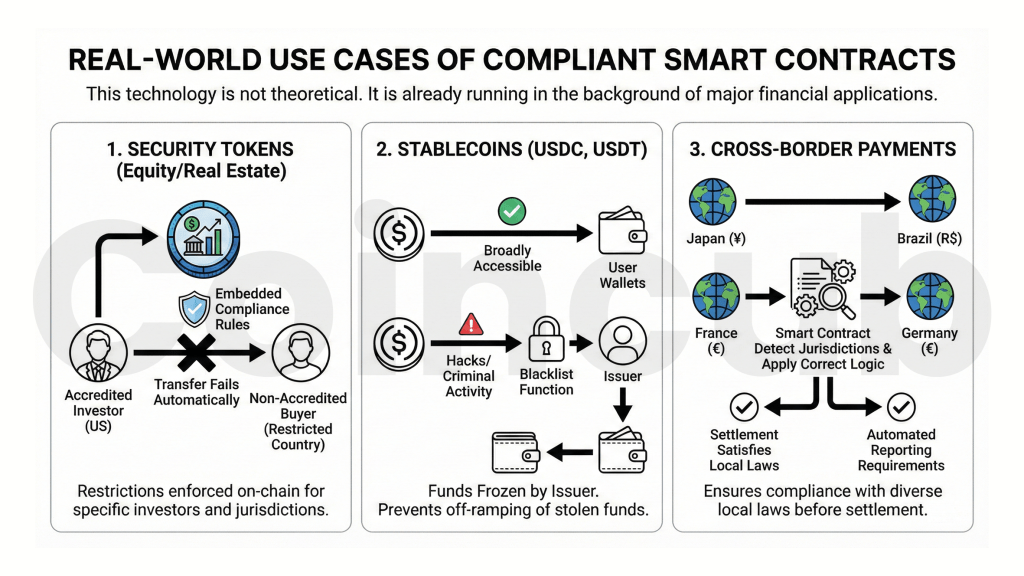
This technology is not theoretical. It is already running in the background of major financial applications.
Security Tokens
When a company tokenizes its equity or real estate, those tokens are legally securities. They cannot be sold to just anyone. They are often restricted to accredited investors or residents of specific countries. Compliance-by-Design ensures that if an American investor tries to sell their token to a non-accredited buyer in a restricted country, the transfer will fail automatically.
Stablecoins
Major stablecoins like USDC and USDT already have blacklist functions built into their smart contracts. While they are broadly accessible, the issuers retain the power to freeze funds associated with hacks or criminal activity. This is a basic form of compliance-by-design that prevents stolen funds from being off-ramped.
Cross-Border Payments
Sending money across borders involves navigating a web of different laws. A payment from Japan to Brazil has different reporting requirements than a payment from France to Germany. Smart contracts can detect the jurisdictions of the sender and receiver and automatically apply the correct logic, ensuring the transfer satisfies the local laws of both countries before settlement.
The Challenges and Limitations of Compliant Smart Contracts
While Compliance-by-Design solves many problems, it is not a magic bullet. The transition from manual checks to automated code introduces a new set of complexities that the industry is still working to solve.
The Rigidity of Code vs. The Fluidity of Law
The most significant challenge is the fundamental difference between how code works and how law works. Code is binary. A condition is either true or false. It is rigid and precise. Law, however, is often open to interpretation. Legal frameworks use terms like “reasonable measures” or “good faith,” which are difficult to translate into simple “if/then” logic statements.
Furthermore, laws change. A smart contract deployed today might be fully compliant with current regulations. But if the law changes next month, that immutable contract cannot easily update itself. Developers have to build complex “proxy patterns” or governance mechanisms to allow the contract to be upgraded. This introduces a security risk because if the upgrade mechanism is compromised, the entire protocol is at risk.
Privacy vs. Transparency
There is a natural tension between verifying identity and maintaining privacy. The original promise of blockchain was pseudonymity. Users do not want their real-world identities linked publicly to their wallet addresses.
If a smart contract requires a “KYC Badge” to interact, does that mean everyone can see who you are? This is where Zero-Knowledge Proofs (ZK-proofs) become critical. A Zero-Knowledge Proof allows you to prove a statement is true without revealing the information itself. You can prove you are over 18 without revealing your birthdate. You can prove you are not on a sanctions list without revealing your name. While this technology is powerful, it is computationally heavy and complex to implement correctly.
The Jurisdictional Nightmare
The internet has no borders, but financial laws do. A smart contract exists everywhere at once. If a user in France interacts with a liquidity pool deployed by a team in Singapore, whose laws apply?
Does the smart contract need to enforce French law, Singaporean law, or both? This creates a “matrix of compliance” that can become incredibly complicated. If a protocol tries to block users from every restricted jurisdiction in the world, it might end up blocking half the planet. Deciding which rules to enforce is often a legal decision, not a technical one.
Final Thoughts on The Future of RegTech
Compliance-by-Design represents the maturation of the blockchain industry. It marks the end of the “move fast and break things” era and the beginning of the “build fast and follow the rules” era.
This shift does not mean the end of decentralization. Instead, it means decentralization is becoming compatible with the real world. By embedding the rules of finance directly into the infrastructure of the internet, we are creating a system that is more efficient, more transparent, and safer than the traditional banking system it aims to improve.
We are moving toward a future of Embedded Supervision. In this future, regulators will not need to ask for reports or audit paperwork. They will be able to audit the code itself. If the code is correct, the compliance is guaranteed.
For institutions, this opens the door to the trillion-dollar promise of tokenization. For regulators, it offers a way to monitor markets in real-time without stifling innovation. And for users, it means a safer ecosystem where the guardrails are built-in, invisible, and automatic.
The code is no longer just law. The code is now the enforcer of the law.
Frequently Asked Questions (FAQs)
What is blockchain compliance?
Blockchain compliance refers to the practice of adhering to financial regulations, such as Anti-Money Laundering (AML) and Know Your Customer (KYC), while operating on decentralized networks. It ensures that transactions on a blockchain meet the legal standards set by government bodies to prevent financial crimes and illicit activity.
What does compliance-by-design mean?
Compliance-by-design involves embedding regulatory rules directly into the smart contract code. Instead of checking for compliance after a transaction occurs, the code automatically blocks any action that violates the rules. This makes non-compliant behavior technically impossible to execute, rather than just illegal to perform.
How are smart contracts regulated under UK law?
Smart contracts are recognized as legally binding agreements in the UK. The Law Commission confirmed they fit within the common law framework, and the Electronic Trade Documents Act 2023 further validated electronic trade documents. If a smart contract meets the basic elements of offer, acceptance, and consideration, it is enforceable in court.
Are smart contracts legal in India?
Yes, smart contracts are generally legal in India under the Information Technology Act, 2000 (specifically Section 10A) and the Indian Contract Act, 1872. They are treated as valid electronic contracts. However, to be enforceable, they must satisfy standard contract requirements like free consent, lawful consideration, and competent parties.