


 Buy a Licensed Company
  Explore VASP Data
  Talk to an Expert

 Dren Hima
 is Head of Research at Coincub, leading research across digital asset regulation, licensing, market structure, tokenization and institutional adoption.
Dren Hima
Dren Hima is Head of Research at Coincub, leading research across digital asset regulation, licensing, market structure, tokenization and institutional adoption.
Why Solana is the Execution Layer for Real-World Networks
Key Takeaways
- Solana already clears tens of millions of DePIN transactions; no other L1 comes close.
- Micropayments work; the low Solana fees let hotspots, dashcams, and GPUs settle earnings in real time.
- Networks that charge users keep their contributors; those that do handouts tend to lose them.
- Airdrops do not drive sustainable demand; 5G data, GPS centimetre fixes, GPU renders do.
- DePIN Revenue is concentrated among the top performers: Render, Helium, io,net.
- Hundreds of thousands of real DePIN hardware infrastructure already feed the chain.
- VCs notice proof rather than pitch as DePIN startups have raised over $500 million since January 2024.
- Burn-to-mint ratios (e.g., Render’s BME) and buyer-funded rewards (Helium’s post-HIP-138) are critical for sustainable DePIN networks
- Firedancer’s performance can ensure Solana can handle DePIN growth, more than any other chain.
1.0 Methodology
This report is based on a combination of primary interviews, public disclosure, and a structured analysis of on-chain data. All quantitative figures and visuals reflect the ledger state through 30 June 2025; events or transactions after that timestamp are not included. The aim was to move past narrative-driven claims and instead surface measurable activity across projects building real world infrastructure on Solana
To contextualize the operational mechanics of major DePIN networks, a podcast interview was conducted with Frank Mong, the COO of Helium Mobile, who provided insights into Helium Mobile’s user acquisition costs, token reward strategy, and their migration to Solana. Given the nature of the discussion, key insights were included in the report. Several of his remarks are quoted in this report where relevant. In particular, his breakdown on various aspects such as why DePIN projects may opt to migrate to Solana were highly relevant for the overall theme of the research.
The quantitative aspects of this report were sourced from various analytics sources, including Coincub data, Dune Analytics, TopLedger, Solana official docs, etc. These provided high-frequency data on monthly transactions, token burn events, wallet activities, chain-level metrics, and much more.

Data was cleaned, normalized, and time-aligned to allow cross-project comparison with projects bucketed under the DePIN vertical only if they met the following criteria:
- Tangible real-word footprint;
- On-chain coordination mechanisms (i.e. reward, burn, DAO control, etc.);
- Active user or contributor base on Solana mainnet.
Additional qualitative data was obtained from various sources that provided public grant records, GitHub tooling initiatives, funding disclosures (i.e. Crunchbase), official project press releases, whitepapers, and public statements by various ecosystem builders.
All visualizations are derived directly from program-level metrics and token contract interactions unless otherwise noted. In cases of projections or estimates, they are clearly marked and explained.
On-chain data is dynamic; token balances, burn counts, and wallet activity can change retroactively as contracts upgrade or blocks are re-orged. Readers should treat every metric as a point-in-time observation and refresh the cited queries if making operational or investment decisions.
2.0 Introduction
DePIN, short for decentralized physical infrastructure, sits between real-world systems and crypto-native coordination. The thesis is to incentivize people to deploy or interact with hardware networks (i.e. from GPUs to cell towers to mapping devices), using permissionless, tokenized systems. If built correctly, DePIN turns infrastructure from a capital-intensive business into a distributed marketplace. Still, most people tend to think of DePIN as a “future” idea, rather than something that is already operating at scale.
That disconnect breaks down in Solana. Other ecosystems have published whitepapers and various engagement-inducing strategies. Solana, on the other hand, has become THE execution layer for DePIN. It remains the place where the workloads are real, the tokens are live, the coordination happens fully on-chain, and so on. As of June 2025, Solana processed over 26 million DePIN-related transactions; it saw activity from over 2 million unique wallets; and it supported over $800 million worth of token burns and rewards tied to DePIN-specific projects. So it is quite clear that the infrastructure exists and is being used.
Yet, DePIN might be misunderstood. Coverage often leans on two extremes: either there is vague “optimism” about AI-related DePIN trends, or simply cynical dismissal that the whole category is emissions-driven yield farming. Neither lens reflects what’s actually happening on Solana today. There’s projects such as Helium that have been live for over a year with real supply-side scale. Networks such as Render, io.net, Grass, have launched tokens, created measurable demand loops, and executed burn mechanics on-chain. So DePIN is no longer a tentative “roadmap” for crypto but rather an operational subsector of this industry.
This report tries to shed light on that narrative and move past the misperceived narratives. It draws on several metrics, including funding activity to show firsthand how DePIN is evolving (not just what founders say in pitch decks). Last but not least, this report traces usage patterns through 2024 and early 2025 to assess what separates short-term activity from sustained network growth.
In the event that Solana will serve as the foundational layer for real-world infrastructure coordination, the evidence needs to go beyond mere grants, hype, or ecosystem diagrams. People need to firsthand experience, transact, move tokens, and help give life to networks so that DePIN sees sustainable growth.
3.0 Why Solana is Suited for DePIN
Blockchains can be designed for various reasons. They can be designed for high-throughput, real-world infrastructure, and so on. When it comes to DePIN, the requirements need to impose architectural demands that many chains simply aren’t built to meet. With Solana, it is different. Besides hosting DePIN projects, it also provides the technical substrate that allows them to function as live, on-chain systems. There’s fundamentals that matter when the goal is decentralized coordination.
3.1 Micro Transaction Economics
DePIN models depend on constant, low-cost interactions. For instance, mapping a road, pinging a sensor, forwarding bandwidth, and other similar actions often pay out fractions of a cent in rewards and fees. For the sake of the argument, if each of these transactions would cost $1 in gas, the model would be bound to collapse.
Solana’s fee structure enables DePIN to be economically viable. Transactions typically cost under $0.0002, with predictable performance even at high throughput. That means reward flows, usage verification, burn mechanisms, all can run continuously without “ballooning” the costs or forcing off-chain shortcuts.
Different projects may rely on thousands of on-chain events per hour (i.e. Render). These systems only work when every micro–interaction can be settled cheaply, which might not be very feasible for L2s or EVM rollups that still lean costly finality assumptions or batch constraints.
3.2 State Compression
A scaling reward system is about fees but also about data weight. A single project distributing thousands of daily rewards needs a way to store that history without bloating chain state or incurring excessive rent.
Solana’s state compression framework solves this by anchoring compressed Merkle trees on-chain, allowing high-volume reward issuance without the storage burden. Projects can distribute millions of compressed tokens or points in a single transaction, consequently reducing infrastructure costs. For instance, Helium’s April 2023 migration minted 991,000 hotspot NFTs as compressed assets on Solana for around $113 total gas. Without compression, those mints would have cost hundreds of thousands on Solana (and millions on Ethereum mainnet). This single event proved that Solana’s compressed account model can absorb IoT-sized identity sets at a price point no other L1 or L2 approaches.
Burn tracking also benefits here. A DePIN project might apply aggressive supply burns that must be auditable on-chain. Compression enables these logs to be written efficiently while preserving verifiability, which might be a key element for real-time dashboards and ecosystem trust.
3.3 Validator Performance & Firedancer
No DePIN network can operate on probabilistic finality. Users expect real-time interaction, be that a GPU marketplace or a mobile data protocol. And infra providers need payment resolution to be deterministic.
Solana’s high-performance validator set, in tandem with the Firedancer enhancements, guarantees low-latency finality and consistent throughput. Firedancer is expected to push validator efficiency past 1 million TPS under load. This is crucial execution stability for workloads that cannot tolerate lag or failure.
Today, Solana’s L1 validators support sub-second blocktimes with global propagation. That stability is what underpins continuous earning loops for sensor-based protocols.
3.4 Infra Tools & RPC Stack
Real executing depends on dev tooling at the end of the day. Solana’s DePIN ecosystem benefits from a maturing stack of RPC providers and infra services tailored to high-frequency use cases.
A project may enable compressed NFT indexing, webhook alerts, and token activity scans that can be used by DePIN teams for reward tracking and fraud detection. Others may provide specialized, performance-optimized RPC endpoints ideal for querying compressed accounts at scale. Lastly, Analytics APIs offer real-time wallet resolution and token traceability, which could power user dashboards and ecosystem explorers.
This is a mere illustration on how tooling can let projects go from contract deployment to functional coordination network without hiring a full backend indexing team.
3.5 Dev Momentum & Grant Programs
The Foundation and venture ecosystem have made DePIN a funding priority since early 2023, which has resulted in a visible pipeline of active deployments.
Hackathons, ventures or aligned funds, SDK patterns; all have made onboarding new builders easier. So it is no surprise that Solana might have the highest count of live, funded, and user-active DePIN projects of any ecosystem today. In other ecosystems, grant traction tends to outpace executing, but in Solana, the build-to-live conversion rate is quite high due to real infra and strong technical fit.
So Solana indeed offers the economic conditions and dev support as well. And it’s not something that can be added after the fact. Hence, this report treats Solana as DePIN’s execution layer and not another mere grant host.
3.6 Composability Across Projects
Composability could be defined as the ability for infrastructure projects to plug into shared primitives without fragmentation. Projects are already leveraging compressed account schemas and token authorization standards that originated with Helium and Render.
More significantly, Render’s GPU job registry has begun integrating with io.net’s broker model to allow shared verification rails. Other projects explore integrations with privacy layers for secure data verification (i.e. exploring zk-based verification with Arcium’s confidential infra layer). This might suggest that the line between mapping, compute, and privacy-preserving infrastructure is starting to blur.
But it’s Solana’s single-shard architecture and state compression model that make these cross-project integrations low-latency and composable by design. The same might not be said for other chains, where composability often comes at the cost of performance or depends on bridges.
3.7 Mobile-Native UX: Solana Mobile Stack (SMS)
DePIN participation usually begins on a phone. Solana is the only major L1 shipping its own hardware/SDK stack (i.e. Saga + SMS). Seed Vault hardware signing lets apps stream dozens of signed micro-transactions per day without UX friction, while secure element storage keeps private keys off the cloud.
Some of the Saga phones ship with some of these apps pre-installed, which instantly adds thousands of devices to the data-routing network. So SMS removes the problem of getting millions of trusted wallets into user pockets since they are already there.
3.8 Future-Facing Performance & Resilience
A final reason DePIN teams treat Solana as “future-proof” is the chain’s performance head-room. Jump Crypto and Visa ran a stress-test. A pre-released Firedancer validator processed around 600,000 transactions per second while maintaining consensus-safe behavior, which is way above today’s main-net averages. Firedancer’s arrival will give Solana a second, fully-independent client, hardening the network against single-code-base failures and boosting liveness.
Even before Firedancer, the local-fee-market design averaged the fees below $0.001; hence allowing the likes of Helium to push millions of micro-transactions on-chain. Considering Helium had its own L1 retired, those same micro-transactions would have cost the users hundreds of thousands if not millions of dollars. Regarding this, in an interview held with Frank Mong, the COO of Helium Mobile, he explained the very reasons of why the migration to Solana was necessary and how it had instant impact.
“The big problem that Helium was trying to solve was actually figuring out how to connect Internet of Things devices … maybe it could track your pets … using very, very small amount of power and not using cellular was the key…Turns out you can’t use Bitcoin, so we went down this journey of building our own blockchain called the Helium blockchain. It was an L1… Our dev team was probably 11 to 15 people; that same 15 people had to support this chain that was running on a million hotspots. We migrated to Solana … Solana’s chain had evolved massively, and it was the only one that could handle the speeds and costs we needed.” – Frank Mong, COO of Helium Mobile
4.0 Cross-Chain Benchmarks
Nearly every major L1 has staked some claim to the physical infrastructure narrative. But traction varies widely. Some ecosystems host high-profile names with little usage. Others see organic adoption but lack real economic throughput. This section tries to break down how Solana’s DePIN layer stacks up across chains in terms of actual usage, while trying to isolate real economic activity from narrative noise.
4.1 Monthly DePIN Revenue
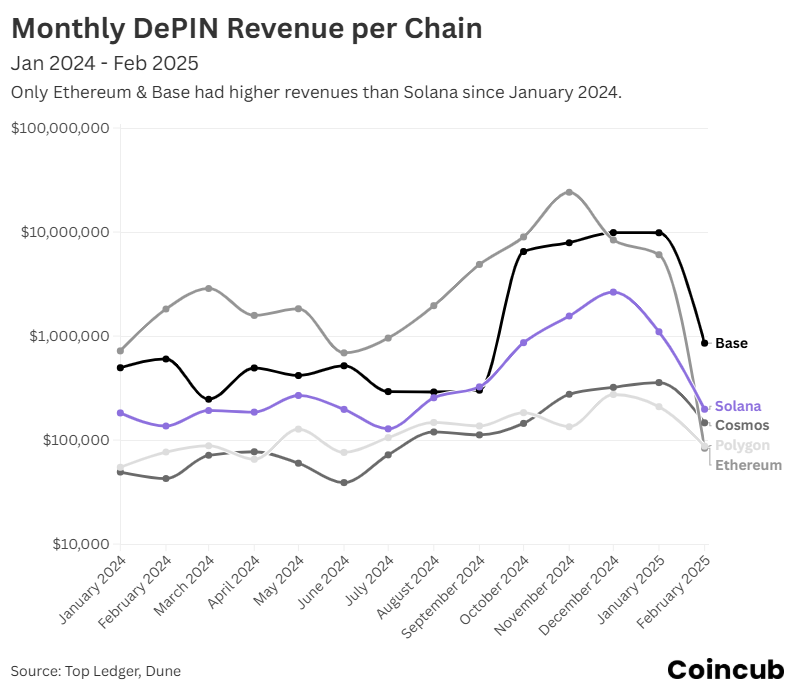
Looking at protocol-level DePIN fee revenue, only Ethereum and Base consistently outpace Solana. From January 2024 to February 2025, Solana held third position, and it has stayed ahead of Cosmos, Polygon, and IoTeX. Each chain saw huge reductions in DePIN revenue in the first quarter of the year, primarily due to macro trends impacting the rest of the market. Interestingly, Ethereum’s DePIN went below Solana’s. The latter has around 12% of the entire DePIN industry revenues.
4.2 Vertical Concentration by Chain
Solana is fielding live workloads across four verticals. On Filecoin or IoTeX, most activity still happens through getaways or side networks and not touching the base chain.
| Chain | Dominant Vertical | Note |
| Solana | Compute, Mapping, Mobile, Sensors | Four distinct income streams → risk-diversified |
| Ethereum L1 | Archival Storage | High fees push activity off-chain |
| Base | Social + Light AI | Revenue episodic; infra minimal |
| Cosmos | Cloud Compute | Single anchor (Akash) drives >80 % of volume |
| Filecoin | Storage | Burns token off-chain; little on-chain velocity |
| Polygon | Consumer IoT | Low burns, grant-driven growth |
4.3 Technical Head-to-Head
While revenue-wise Solana is still behind Ethereum overall, it leads in measurable usage. And this difference, the fact that Solana supports real-world execution of DePIN can pay dividends long-term for both the chain and DePIN in itself.
| Dimension | Solana L1 | Ethereum L1 | Cosmos (Akash) | Avalanche C-Chain |
| Real-world TPS | 2–3k avg; 65k+ stress | 15 | 3k (app-chain) | 4.5k |
| Finality | ~0.4 s slot; 12 s final | 12 s to 6-12 min final | 5- s | 1- s |
| Typical Fee | < $0.001 | $0.50–$5 | ≈ $0.01 | ≈ $0.01 |
| State Compression | Yes – 1M NFTs for $113 | No | No | No |
| Flagship DePINs | Helium, Render, Hivemapper, io.net | (none on L1) | Akash | Nodle (via Polkadot) |
Solana may lead in DePIN transaction volume. Notably, other blockchains like Polkadot, Cosmos, and IoTeX support decentralized infrastructure. Polkadot’s parachain models allow for specialized DePIN chains, but its cross-chain communication adds latency, with transaction finality often exceeding 10 seconds compared to Solana’s sub-second confirmations. Cosmos’ app-chain approach may offer customization but struggles with interoperability and higher fees than Solana. IoTeX supports projects for different purposes (i.e. Wi-Fi sharing) but lacks Solana’s throughput. And there’s no need to go in detail with regard to Ethereum, which does not compare in any metric to Solana when it comes to efficiency. Therefore, all these reasons make Solana well suited for high-frequency DePIN workloads, even if it hasn’t gained the traction that it promises to have.
5.0 Sector-Level Metrics on Solana
DePIN data really tells a story. It shows how DePIN is a functioning sector, complete with recurring transactions, consistent contributors, and much more.
5.1 Aggregate Activity Since January 2024
Across all indexed DePIN programs on Solana, on-chain activity from January 2024 through June 2025 has been persistent:
- Transactions: Hundreds of thousands per month, with steady participation even outside airdrop windows.
- Depin Signers: Averaging over 100,000 monthly, indicating real contributor presence.
- Token Burns: Several projects show consistent burn events, suggesting demand-side utility.
- Rewards Issued: Cumulative rewards in the millions of USD-equivalent, tracked on-chain, not promised in pitch decks.
- Funding: The DePIN subset has pulled over $600M in known capital, with an average round size far above other Solana verticals.
Growth has accelerated in mid-2025 across several dimensions. June 2025 saw a record 90,000+ unique DePIN signer wallets on Solana. That’s a 27% month-over-month increase driven largely by new contributors in the Grass relaunch and renewed Helium Mobile SIM campaigns in Latin America. The trailing 3-month average for DePIN transaction count now exceeds 4 million, showing sustained system-level growth beyond one-time events.
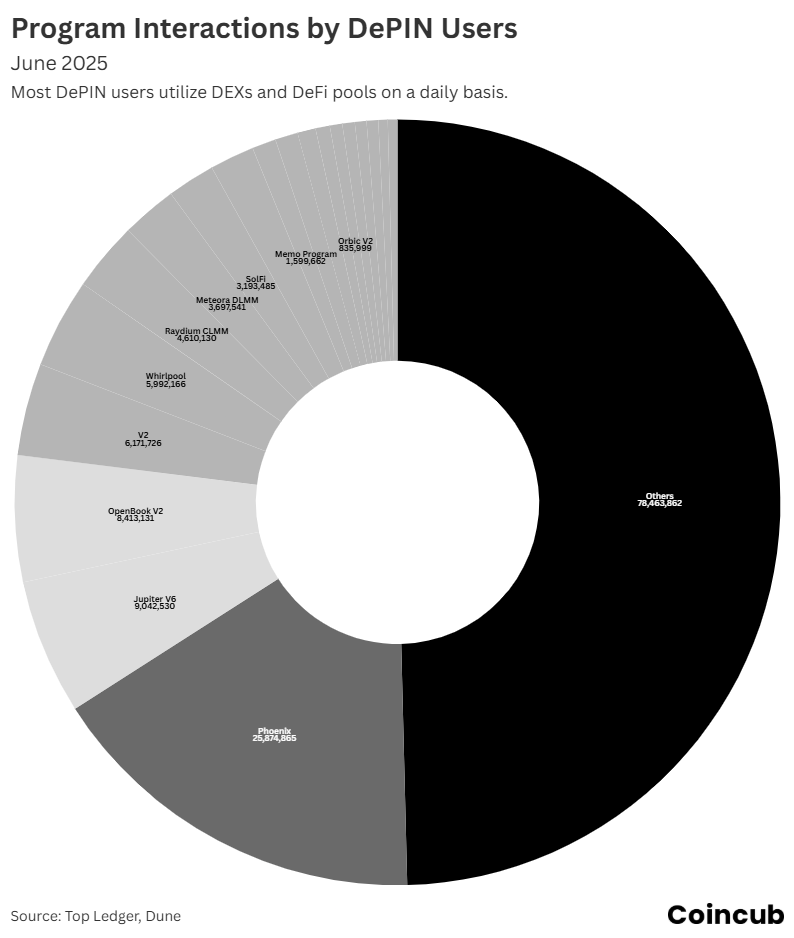
DePIN users also utilize various DeFi pools and DEXs, but even without top-level TVL metrics, DePIN protocols show continuity.
5.2 Rewards vs. Usage: The Incentive Cliff
A key dynamic visible in nearly every active DePIN is the incentive cliff, the point where reward emissions slow or eligibility tightens, and users drop off. In Hivemapper, for instance, monthly rewards dropped 25% between March and May 2025. User count fell even faster.
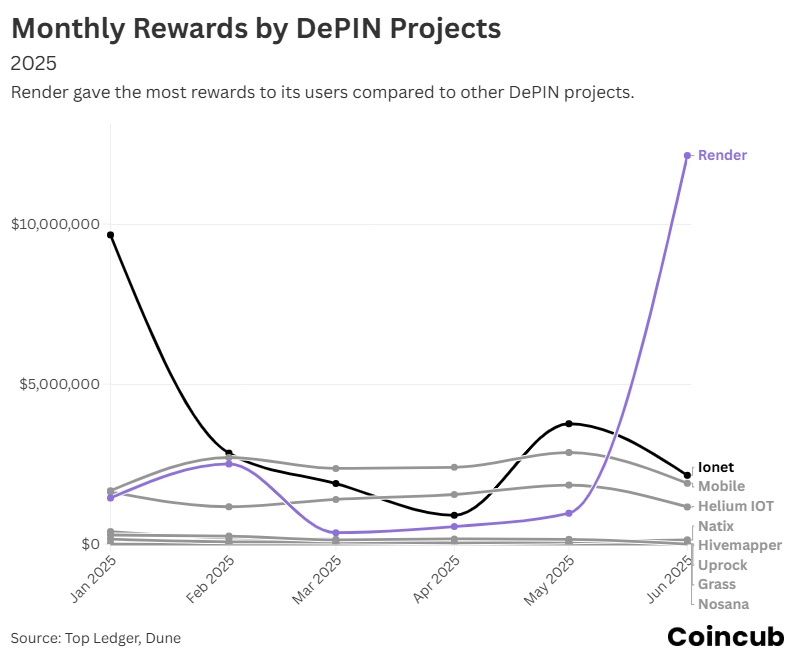
Similarly, Grass saw a surge during its airdrop lead-up, followed by over a 50% decline in active reward recipients usage once eligibility was reduced. Helium Mobile shows a longer tail (likely due to real-world telecom use) but even there, speculative churn is visible.
The pattern is consistent: where the reward curve flattens without demand-side reinforcement, contributor numbers contract.
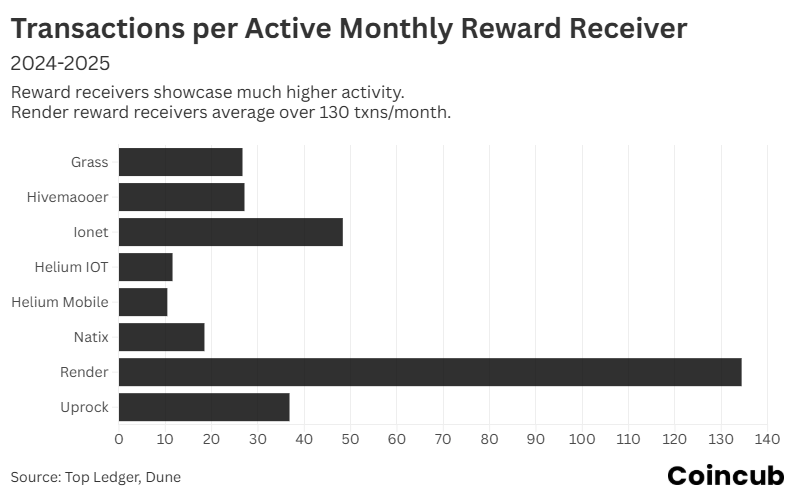
This ratio captures the quality of engagement. In protocols where this number rises post-airdrop, it suggests usage concentration: fewer users, more committed. In others, it points to exit behavior.
5.3 Revenue Concentration
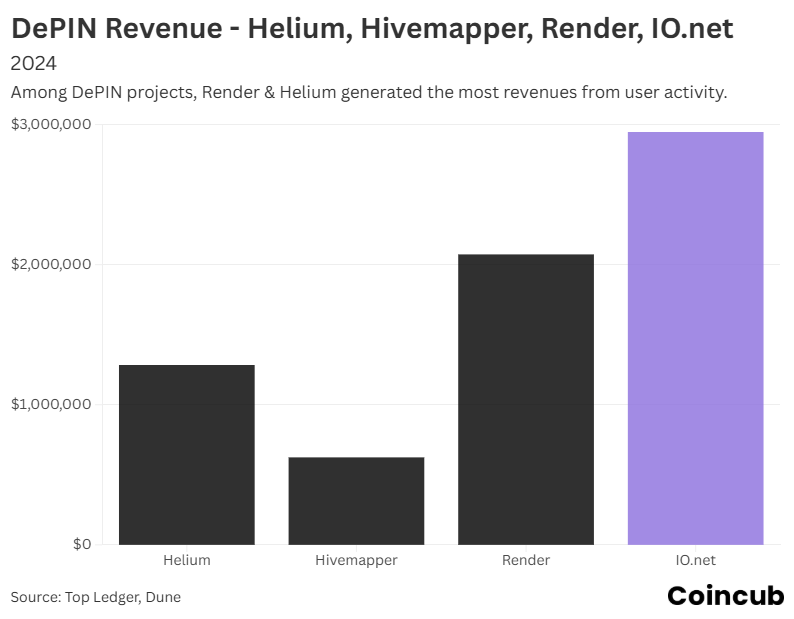
Despite a broad range of DePIN projects launching, the economic throughput remains top-heavy. Render, Helium (IoT and Mobile), and io.net account for the majority of on-chain value exchange.
In certain months, the top 3 projects by burn volume and revenue have accounted for over 80% of all activity in the sector.
This has two implications:
- Solana’s DePIN sector is still relatively early: with room for distribution.
- Economic gravity is real: foundational infrastructure (compute, connectivity) is where the money flows first.
5.4 Token Economics: Signal of Healthy Systems
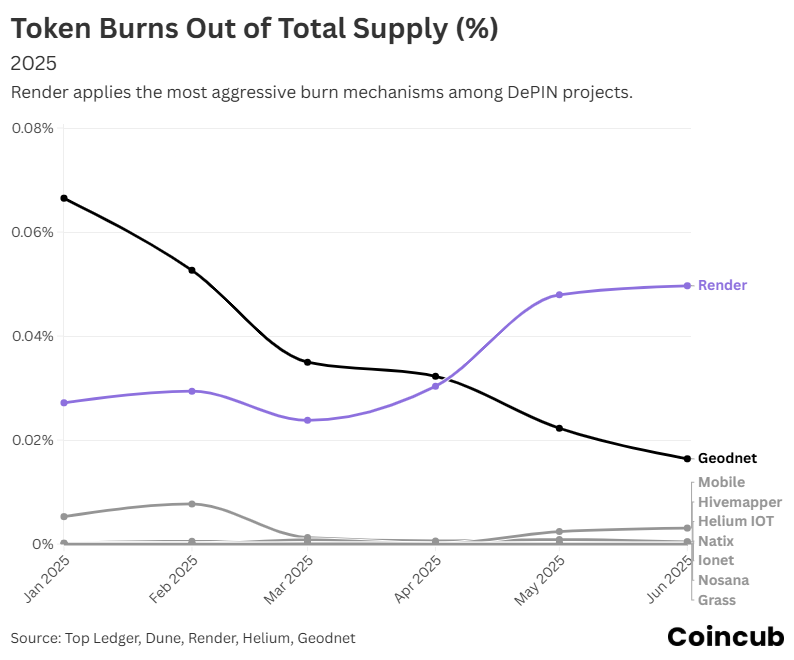
Token burns are a pivotal mechanism in DePIN networks, serving as a barometer of real-world usage and a tool to manage token supply. Unlike minting, which introduces new tokens to reward contributors, burning removes tokens from circulation when users pay for services, such as compute power, data credits, or mapping updates.
Data from 2025 shows that DePIN projects exhibit diverse burn patterns, with some aggressively reducing supply as usage grows, while others see burns taper off, signaling waning activity. High burn rates indicate a network where value is actively consumed, creating a self-sustaining economy that resists inflation from emissions.
For instance, projects leveraging burns tied to utility (e.g., GPU rendering or IoT connectivity) can maintain contributor engagement by aligning token value with service delivery. However, burns alone aren’t enough; without corresponding utility growth, networks risk losing users if burns fail to offset minted tokens over time. This then shows the importance of designing burn strategies that reflect actual network usage, a trend increasingly evident across Solana’s DePIN ecosystem.
5.5. Global Footprint: How Decentralized is “Physical”?
There’s a tendency for people to think that DePIN adoption on Solana is North-America-centric, especially with the likes of Helium gaining ground.
But now Helium now counts 98k hotspots spanning various countries, while its newer 5G radios already cover a lot of U.S. cities, giving the network the one of the broadest LoRaWAN reach on earth.
Hivemapper contributors filmed more than 8% of the world’s driveable roads by 2023, with dense clusters in the U.S., Western Europe and Australia but an expanding tail into Latin America and South-East Asia.
GEODNET’s 13.5k centimetre-accuracy GNSS stations are dispersed across 4,300+ cities on six continents, delivering truly global RTK coverage.
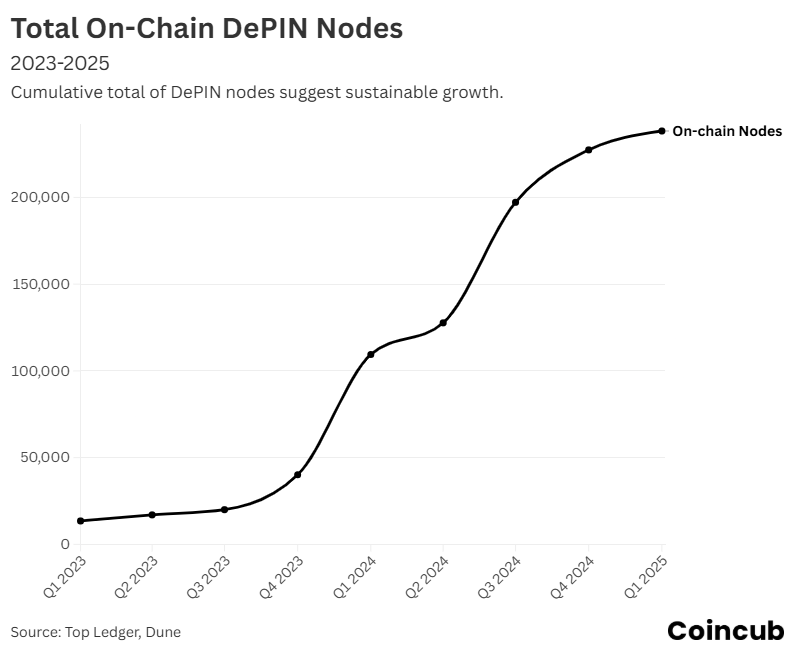
Token incentives drive initial clusters in tech-forward metros, but community hardware quickly seeps into second-tier cities and even rural corridors, something traditional, cap-ex-heavy incumbents rarely accomplish at similar speed. As of April 2025, more than 230,000 on-chain nodes have been registered globally.
5.6 Builder Momentum
Behind every node graph is a growing bench of maintainers. GitHub scrape-data show Helium’s public repos averaged 150+ commits per month post-migration, while Render’s Solana-side tooling has drawn contributions from over 40 distinct devs in the past year. The Solana Foundation has amplified that energy:
- Four consecutive hackathons (Summer ’23 to Spring ’25) included dedicated DePIN tracks, seeding projects such as WiHi (community weather sensors) and Pipe (IoT launch kit).
- Direct grants have gone to Ambient, Teleport, and DeCharge, and Solana Ventures led or co-led recent rounds for io.net ($30M) and Teleport ($9 M).
- Community forums now host specialised “DePIN token-engineering” threads, where teams openly share reward-curve code and state-compression patterns.
Each migration (Helium, Render) open-sources new infra, which the next cohort reuses rather than reinventing, consequently shrinking time-to-mainnet and accelerating the sector’s release cadence.
6.0 Project Deep Dives
Not all DePINs are built the same. Some may chase speculative cycles, but some really build real infra and traction.
6.1 Key Players
6.1.1 Helium (IoT, Mobile)
Helium has evolved from a decentralized IoT network to one of Solana’s most significant mobile infrastructure experiments. The migration to Solana in early 2023 enabled scalable reward accounting and higher throughput, both critical for managing two separate reward tokens: HNT (IoT) and MOBILE (cellular).
Since then:
- Wallet Activity: Thousands of monthly signers across both subnets.
- Rewards: Mobile emissions have seen periodic cuts; yet usage remains stable due to real-world SIM adoption.
- Burn Events: Frequent, especially for MOBILE, tied to data credits.
- Challenges: Multiple token SKUs (HNT, MOBILE, IOT) make coordination harder.
- Strength: Sustained real-world usage and one of the few demand-side DePINs.
Helium has notably deepened partnerships with traditional telecom providers, significantly boosting its real-world adoption. In 2024, Helium partnered with Telefónica’s Movistar, bringing decentralized wireless coverage to over 2 million users in Mexico. In June 2025 Helium hit 1M daily network users and close to 100k hotspots, powered by its “Zero Plan”, the first free 3GB 5G plan in the U.S. businesswire.com A subsequent AT&T partnership lets AT&T devices off-load onto Helium Wi-Fi hotspots, converting retail routers into pay-per-packet infrastructure. These moves shook off the post-migration lull and pushed on-chain revenue past $2.3 million.
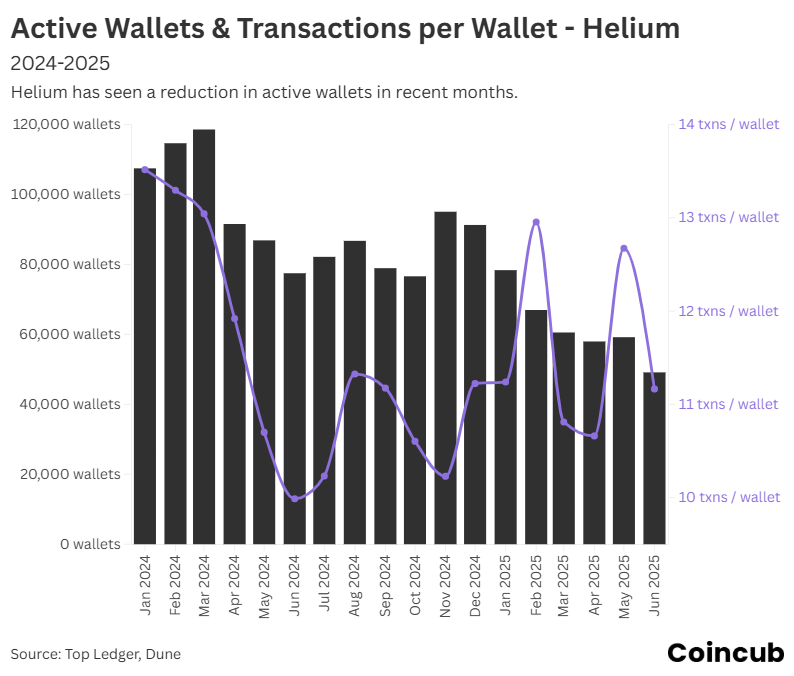
HIP-138 has now unified IoT and MOBILE rewards back into HNT, cutting token fragmentation and raising on-chain burn pressure. Early data show average hotspot revenue per user holding steady, while supply-side churn fell once reward maths became simpler. Though due to macro trends and ongoing political tensions, there have been reductions in user activity in recent months. Still, Helium users average more than 10 transactions per month.
6.1.2 Hivemapper
Hivemapper built one of the most viral DePIN launches on Solana, rewarding users for dashcam-collected map data. At its peak in late 2024, it commanded tens of thousands of contributors and daily uploads.
In a nutshell:
- Reward Issuance: Peaked in Q4 2024, followed by a major incentive taper.
- Burn Activity: Minimal relative to emissions.
- Wallet Engagement: Declined due to reward cuts.
- Tokenomics Issue: Reward dilution → contributor dropoff.
- Outlook: Needs stronger demand-side integration to retain mappers.
In May 2025 Lyft signed a multi-year agreement to ingest Bee Maps’ real-time street imagery, making Lyft the first Fortune-500 consumer of Solana-secured mapping data. coindesk.com The deal monetizes the 77k+ active dashcams already online and has lifted API revenue back above $50k/week, reversing Q1’s emission cliff.
6.1.3 IO.Net
A decentralized GPU cloud for AI workloads, io.net has received the highest level of hype and institutional capital across Solana DePINs. Their April 2025 token launch ($IO) was one of the most anticipated events of the year.
Performance so far:
- GPU Hours Supplied: Public dashboard shows steep onboarding curve in Q1 2025.
- On-chain Activity: Modest, as many workloads are offchain via brokers.
- Airdrop Fallout: Post-$IO launch, speculative interest dropped fast.
- Challenge: Bridging the offchain AI demand to visible on-chain metrics.
A $30M Series A (Mar 2024) led by Hack VC plus Solana Ventures gave io.net the runway to onboard enterprise-grade GPUs across 50+ countries. A live dashboard streams real-time earnings to Solana, demonstrating millisecond-settled micropayments that would be cost-prohibitive on other chains.
6.1.4 Render
Originally built on Ethereum, Render migrated to Solana for throughput and lower fees. It offers decentralized GPU rendering for visual assets, games, and 3D workflows.
Solana-native metrics:
- Burn-to-Mint Ratio: Among the healthiest in the sector.
- Transaction Volume: Tied closely to compute job settlement.
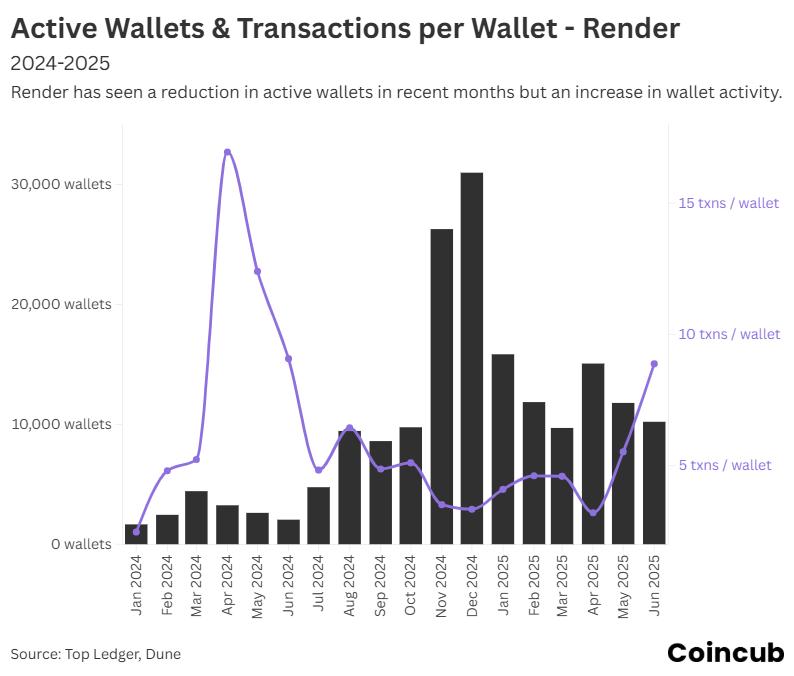
- Wallet Activity: Rising steadily in 2025.
- Strength: Strong product-market fit + token utility via rendering fees.
- Institutional Use: Several partnerships in game and visual industries.
In Q2 2025, Render began onboarding game studios and visual effects houses through an API-based burn gateway that bypasses retail staking and streamlines GPU job payments. This initiative could further increase the protocol’s burn-to-mint ratio, which already trends favorably.
New tokenomics proposals are under community review. It would shift more staking rewards to high-throughput job validators, aligning token flows more closely with usage, not idle stake. The early feedback has been positive, with Render’s DAO noting higher GPU job match rates since the pilot began.
6.1.5 Grass
Grass took the “passive income” model to its limit by indexing public web data via a browser extension and routing that traffic for AI training.
Post-launch takeaways:
- Wallet Count: Spiked pre-airdrop; dropped post-reward eligibility cutoff.
- Rewards: Compressed sharply after campaign ended.
- Usage Quality: Most txns related to reward validation, not usage.
- Outlook: Highly dependent on new utility phases or B2B integrations.
Grass Network notably reached over 2 million connected devices by April 2024, making itself as one of the largest decentralized node networks ever. Primarily driven by demand for AI training data, Grass has gained industry attention for reshaping how AI data collection can scale affordably. Its substantial growth underscores a critical market shift toward decentralized infrastructure solutions in AI.
6.2 Emerging Players
New entrants continue to diversify the DePIN sector. Below is a list of a few of the projects that are building towards making DePIN a real use case.
| Project | Vertical | What It Does | Notes |
| NATIX | Smartphone Mapping | Crowdsources street imagery via phones; rewards $NATIX | 2025 Grab partnership expands to SE Asia; 2M+ images collected |
| GEODNET | Precision GNSS | 13.5k RTK stations for cm-level GPS | $8M raise led by Multicoin (Mar 2025); Solana settlement live. |
| Kuzco | AI Inference | Decentralized GPU cluster for LLM serving | Test-net w/ thousands of GPUs; KZO points accruing |
| PowerLedger | Energy | P2P energy trading / smart-meter data | Migrating settlement to Solana for micro-trades |
| DeCharge | EV Charging | Token-incentivized EV charger rollout | Launched Q1 2024; Solana handles per-kWh payments |
7.0 DePIN Funding Trends and Investor Sentiment
Capital is flowing into DePIN. Different types of projects attract different types of funding. And different narrative layering may deliver different outcomes. For instance, some DePIN projects also layer AI, gaming, or NFTs, but that does not necessarily mean better projects. This section frames funding as a signal of long-cycle conviction.
7.1 VC Momentum
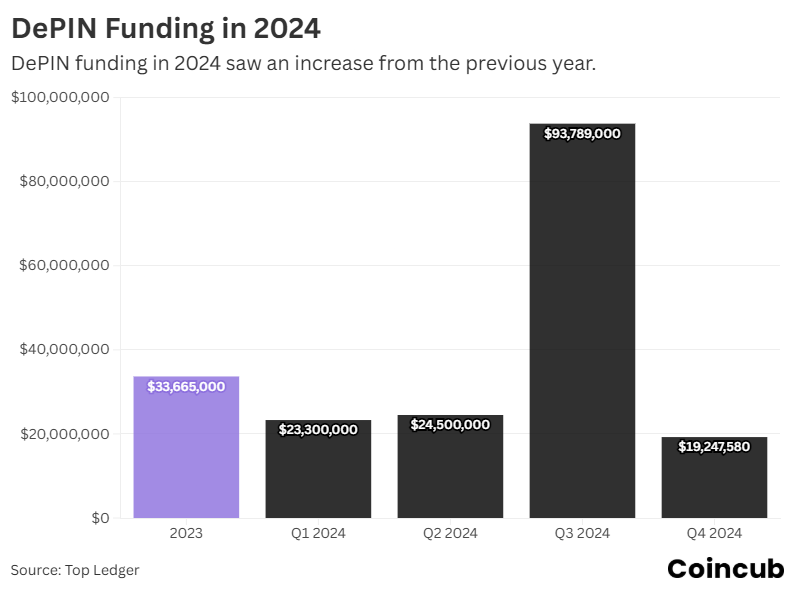
In 2023, DePIN startups raised a modest $33.7 million across fragmented rounds. But Q3 2024 marked an inflection point. Nearly $94 million was raised in a single quarter, more than doubling the combined totals from Q1 and Q2. This showed true structural acceleration.
This spike reflects institutional awareness catching up with ecosystem performance. The majority of Q3 funding went to execution-stage projects like io.net, Grass, and Arcium. Several Solana-native projects also closed follow-on rounds, signaling capital recycling is now possible within the vertical.
7.2 Investor Count
Not all DePIN pitches are created equal. When broken down by project category, the data shows that DePIN-only infrastructure attracts the most capital and the most distinct backers.
- DePIN-only: $544M raised across 176 investors
- DePIN + AI: $94M across 135 investors
- DePIN + Gaming / NFTs: Far lower totals, limited investor diversity
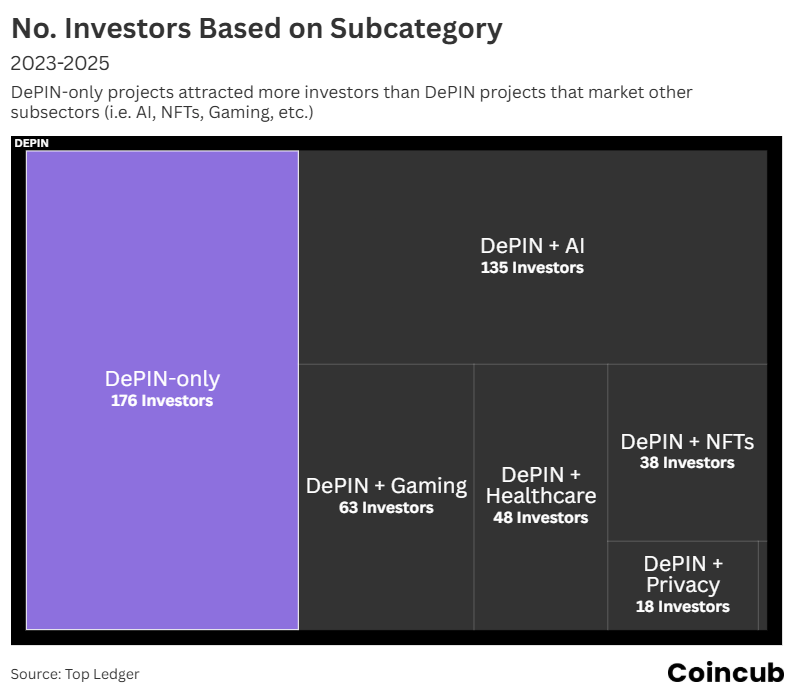
While this might not prove anything significant, it may show that VCs are increasingly prioritizing “infra with provable usage” over hybrid projects riding thematic waves. While AI and gaming narratives bring attention, they don’t necessarily close rounds.
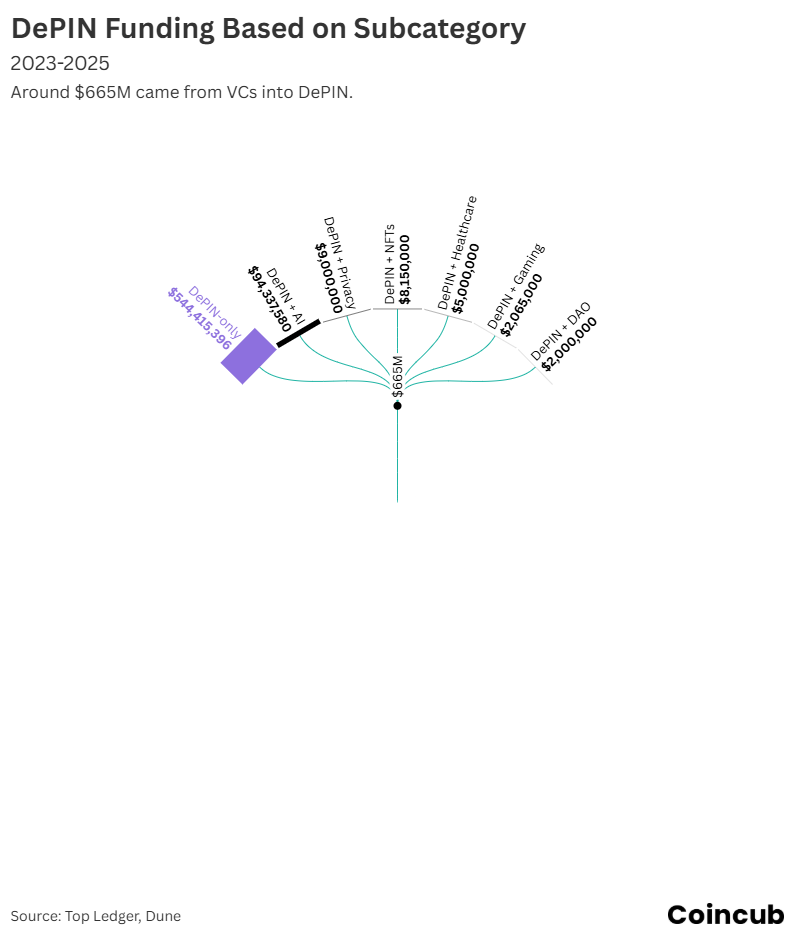
AI-hybrid DePINs (like Grass or Nillion) generate “buzz,” but often lack observable unit economics. Most still rely on speculative use cases (“AI training data routing,” “confidential compute layer”) rather than concrete user bases.
8.0 Token Design and Market Behavior
Token economics, rather than hardware counts alone, explain why some Solana DePIN networks retained usage after the 2024 incentive boom while others flat-lined. Three design patterns stand out in the on-chain data.
8.1 Airdrop Lift-offs ≠ Utility
Grass is the clearest example. Its October 2024 airdrop campaign pushed the network to “over two million connected devices” and 11.6 million monthly transactions. By March 2025 active wallets had collapsed below 40,000 (a 97 % draw-down from the peak) as speculative miners left once points stopped accruing.
Hivemapper’s HONEY followed a similar arc: rewards peaked in December 2023, but when payouts were cut in early 2025, contributor wallets fell into the low hundreds and map-tile burns stagnated.
8.2 Burn-first Designs
Render’s migration to Solana introduced a burn-and-mint equilibrium (BME) model, where customers burn RENDER tokens to purchase GPU credits for rendering or AI tasks, and new tokens are minted only for node operators based on completed jobs. This design ensures that token supply aligns with actual network usage, fostering economic sustainability
Render’s migration to Solana in November 2023 introduced a burn-and-mint equilibrium (BME) model, where customers burn RENDER tokens to purchase GPU credits for rendering or AI tasks, and new tokens are minted for node operators based on completed jobs. This design aligns token supply with network usage, fostering economic sustainability. As of July 2025, the Render Network dashboard reports 591,924 RENDER tokens burned all-time ($1.99M USD), with 20,267.9 RENDER burned in the latest epoch (June 27–July 2, 2025). Epoch-specific data shows a burn-to-mint ratio above 1 (e.g., 1.35:1 in July 2025, 2:1 in December 2024), though monthly averages may dip below 1 due to broader mint allocations.
Helium’s MOBILE token tells a midway story. Because every SIM activation immediately consumes MOBILE for data credits, wallet activity stayed stable through multiple reward halvings, and the network still processed over 500,000 transactions a month as of June 2025.
9.0 Design Lessons & Recommendations
Eighteen months of on-chain data confirm that Solana DePIN networks succeed or stall, for the same underlying reasons. Initial reward curves can recruit tens of thousands of contributors, but retention survives only when a second engine-room of real, paying demand takes over before emissions taper. Projects that paired rewards with an obvious customer market (precision GPS corrections, GPU render cycles, mobile data) still show active wallets and weekly revenue even after the 2025 pull-back; those that treated token distribution as the product lost nine out of ten users once the faucet slowed.
The contrast highlights a first principle: utility must be visible to the contributor. Wallets that can see, in one place, how much they earned, how much of the token supply was burned, and who paid for it are far more likely to stay beyond the launch phase. Today that telemetry is fragmented across bespoke explorers and Discord bots. A sector-wide, consumer-grade dashboard, feeding openly from Dune, Helius and Triton indices, would remove a persistent blind spot and shorten the feedback loop between network health and contributor behaviour.
Project teams should treat the post-airdrop period as Day 1, not the victory lap. That means baking a burn or spend mechanic into the MVP, rehearsing the shift from “points” to paid usage long before token generation, and designing lock-ups or staking hooks that give early farmers a reason to keep skin in the game. Networks that wait to retrofit utility after distribution will repeat 2024’s boom-and-bust cycle in miniature.
For the Solana Foundation and investor base, the priority now is economics, not throughput. Grants and follow-on rounds should hinge on three reportable metrics:
- The ratio of burns-to-mints;
- The share of rewards funded by external buyers;
- 90-day contributor retention after the first large emission drop.
Funding milestone templates that already exist for DeFi (e.g., TVL or daily volume) need a DePIN analogue; enforcing that standard will align capital with durable networks instead of one-cycle farms.
Additionally, crypto, DePIN, and every new technology that emerges, is bound to have regulatory scrutiny across jurisdictions. Helium’s hotspots must comply with different telecom regulations; Grass’ data collection via browser extensions may raise privacy concerns under different regulatory frameworks. Therefore, projects must proactively address such issues by integrating compliance into their design. Solana’s state compression can be used for auditable, transparent data trails
Finally, infrastructure is not the bottleneck. Firedancer, state-compression and mobile seed-vaults have solved the scaling questions that drove Helium to migrate. The next gains will come from economic design and user-experience discipline: clear reward statements, predictable burn schedules, and front-ends that feel less like miners’ consoles and more like consumer apps. The chains that master that layer will own the next wave of real-world deployment. Solana is technically prepared; the challenge ahead is behavioural and economic.
10.0 Conclusion
Solana’s DePIN experiment has moved from proof-of-concept to measurable economy in barely two years. By the end of June 2025 the network had processed more than 26 million DePIN-tagged transactions, settled almost USD $6 million in on-chain revenue, and anchored hundreds of thousands of physical devices, from GPU rigs and dash-cams to LoRa hotspots, directly to a public ledger. Every compressed NFT, every burn-to-mint event, every HNT-funded data-credit represents hardware in the wild doing economically useful work.
Three signals stand out:
- Throughput is no longer the gating factor. Firedancer tests and sub-second finality give Solana more head-room than even its most aggressive DePIN cohorts currently need. The bottleneck has shifted decisively to economic design.
- Demand loops, not emissions, separate the durable from the disposable. Networks that can point to paying customers (Render’s GPU jobs, GEODNET’s centimetre-grade GPS, Helium’s SIM activations) are still compounding. Those that treated the token as the product have already round-tripped most of their early contributors.
- Composability is emerging as an unexpected moat. When a Helium hotspot doubles as a location oracle for Hivemapper, or when io.net pipes idle GPUs into Render’s marketplace, value accrues to the chain that lets those hand-offs clear in a single state space. Solana is proving that advantage in real time.
“We wanted to make sure that these hotspots that were disparate and owned by individuals could trust each other and talk to each other. That’s the whole point of a decentralized network…You don’t have to buy it from a big telco; you can do it yourself. There’s a DIY approach that actually pays you…We need everybody! If we can achieve that, we can change the economics of the entire industry.” – Frank Mong, COO of Helium Mobile
But what happens when DePIN starts to cannibalise the off-chain services it currently measures itself against? If a free 5G plan or a pay-per-render GPU grid undercuts legacy providers by an order of magnitude (and the underlying tokens clear at fractions of a cent), pricing power in those incumbent markets will deteriorate. At that point DePIN tokens stop being niche reward instruments and start acting as micro-denominated utility currencies. It all depends if governance frameworks, regulatory clarity, and risk models will keep pace with that shift. The hardware is ready; the economics are “gestating”; the policy layer remains the wild card as expected.
For Solana builders and backers, it is clear that the next dollar should flow less to “more devices” and more to falsifiable demand experiments; burn-gated APIs, enterprise SLAs, consumer UX that hides the wallet until it matters. The chain has delivered the technical rails; now the sector must prove it can fill those rails with commerce that survives once the faucet trickles. If it can, the line between “crypto” and “infrastructure” will blur just as quickly as DePIN transactions are finalised – about two seconds.
Appendix – Glossary of Abbreviations
| Abbreviation | Definition |
| 5G | Fifth-Generation Cellular Network |
| AI | Artificial Intelligence |
| API | Application Programming Interface |
| B2B | Business-to-Business |
| BME | Burn-and-Mint Equilibrium (Render Network token model) |
| CI/CD | Continuous Integration / Continuous Deployment |
| cNFT | Compressed Non-Fungible Token |
| DAO | Decentralized Autonomous Organization |
| DC | Data Credit (Helium spend unit) |
| DeFi | Decentralized Finance |
| DePIN | Decentralized Physical Infrastructure Network |
| DEX | Decentralized Exchange |
| FDV | Fully Diluted Valuation |
| GEOD | GEODNET native token (context: precision-GPS DePIN) |
| GNSS | Global Navigation Satellite System |
| GPS | Global Positioning System |
| GPU | Graphics Processing Unit |
| HIP | Helium Improvement Proposal (e.g. HIP-138, HIP-70) |
| HNT | Helium Network Token |
| IO | Native token of io.net |
| IoT | Internet of Things |
| IOT | Helium IoT sub-DAO token (retired June 2025) |
| KZO | Kuzco network points / forthcoming token |
| L1 | Layer-1 blockchain (base layer) |
| L2 | Layer-2 scaling solution |
| LLM | Large Language Model |
| LoRaWAN | Long Range Wide Area Network (low-power IoT radio standard) |
| MOBILE | Helium 5 G sub-DAO token (now merged back into HNT) |
| MPC | Multi-Party Computation (privacy tech referenced in Nillion) |
| MVNO | Mobile Virtual Network Operator |
| NATIX | Token symbol for NATIX Network |
| NFT | Non-Fungible Token |
| NOS | Nosana network token |
| pNFT | Programmable Non-Fungible Token |
| PoC | Proof-of-Coverage (Helium validation process) |
| PoT | Proof-of-Time-Lock (io.net node-validation element) |
| PoW | Proof-of-Work (referenced in io.net hybrid scheme) |
| RNDR | Legacy Ethereum token for Render (now bridged as RENDER on Solana) |
| RPC | Remote Procedure Call (node/API interface) |
| RTK | Real-Time Kinematic (centimetre-grade GNSS correction) |
| RTT | Round-Trip Time (minor metric in network latency charts) |
| SDK | Software Development Kit |
| SIM | Subscriber Identity Module (mobile-network smart card) |
| SLA | Service Level Agreement |
| SMS | Solana Mobile Stack |
| SOL | Native asset of the Solana blockchain |
| TPS | Transactions Per Second |
| TVL | Total Value Locked (DeFi metric) |
| UPT | UpRock network token |
| UX | User Experience |
| VC | Venture Capital |
| Wi-Fi | Wireless Fidelity (IEEE 802.11 standard) |
| ZK | Zero-Knowledge (cryptographic proof system) |