

 Buy a Licensed Company
  Explore VASP Data
  Talk to an Expert

 Atis Shala
Atis is a senior analyst and community lead with four years of experience in crypto. He has a bachelor from the Rochester Institute of Technology.
Atis Shala
Atis is a senior analyst and community lead with four years of experience in crypto. He has a bachelor from the Rochester Institute of Technology.
SupTech: How Regulators Use AI
The global financial system has undergone a dramatic transformation over the past two decades. Trading floors have given way to algorithmic engines. Paper reporting has been replaced by cloud infrastructure. Financial institutions now operate in hyper connected digital ecosystems powered by artificial intelligence, high frequency trading, and decentralized finance.
This rapid digitization has created unprecedented levels of data. Millions of transactions occur every second across global markets. Order books update in microseconds. Cross border capital flows move instantly. For central banks and financial regulators, this explosion of complexity has created a serious challenge. Traditional supervisory methods built on periodic reporting, manual reviews, and retrospective audits are no longer sufficient.
To keep pace with AI driven financial institutions, regulators are adopting their own advanced technologies. The solution is Supervisory Technology, commonly known as SupTech.

SupTech represents the integration of artificial intelligence, machine learning, big data analytics, and natural language processing into financial supervision. Rather than reviewing historical data months after the fact, regulators can now monitor markets in near real time, detect emerging risks, and intervene before small problems become systemic crises.
SupTech is not simply an operational upgrade, however. It is becoming an essential capability for regulators in the digital financial era.
What Is SupTech? A Clear Explanation
As mentioned before, SupTech stands for Supervisory Technology. It refers to the use of advanced digital tools by financial regulators to enhance oversight, automate processes, and strengthen enforcement. At its core, SupTech helps authorities:
- Ingest and process massive volumes of regulatory data
- Identify systemic risks using AI models
- Monitor market behavior in real time
- Detect fraud, manipulation, and misconduct
- Automate document review and reporting analysis
SupTech is sometimes confused with RegTech. While both use similar technologies such as machine learning and natural language processing, they serve very different users. RegTech is used by financial institutions to comply with regulations, while SupTech is used by regulators to supervise those institutions.
For example:
- A bank uses RegTech to generate a compliant liquidity report.
- A regulator uses SupTech to analyze thousands of such reports to identify sector wide risks.
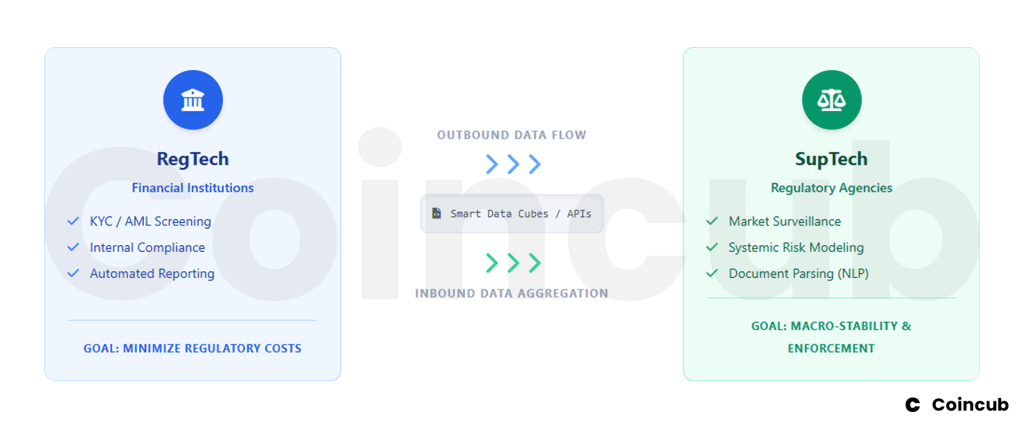
SupTech can be thought of as RegTech, but for supervisors.
Why Are Regulators Turning to AI?
Financial markets have become too complex for purely human oversight. The drivers behind the adoption of SupTech are structural and unavoidable.
Explosion of Financial Data
Modern capital markets generate extraordinary amounts of data. High frequency trading systems can execute thousands of trades per second. Exchanges process billions of messages daily. Human analysts simply cannot parse this volume of information effectively. Regulators are now dealing with billions of trade and message data points per day. Detecting microsecond level manipulation patterns requires algorithmic analysis.
Increasing Market Complexity
Financial markets now include:
- Algorithmic trading systems
- Complex derivatives
- Decentralized finance platforms
- Shadow banking networks
- Cross border digital assets
Risks are no longer isolated to traditional bank balance sheets. They spread through interconnected networks of exposures. Understanding these nonlinear relationships requires advanced computational modeling.
Resource Constraints
Supervisory agencies operate under public sector budget limitations. They often lack the staffing capacity to manually review thousands of pages of board minutes, prospectuses, governance reports, and compliance filings. AI enables regulators to automate routine tasks, freeing human supervisors to focus on high impact investigations.
Shift From Reactive to Proactive Supervision
Historically, regulators identified problems after institutions collapsed. SupTech enables predictive risk monitoring. Instead of relying solely on quarterly reports, regulators can now use AI models to forecast liquidity stress, detect behavioral anomalies, and identify systemic vulnerabilities before contagion spreads. This represents a philosophical shift in financial supervision.
Core Use Cases of AI in SupTech
SupTech applications fall into four major categories. Each addresses a different regulatory objective.
Risk Detection and Early Warning Systems
One of the most powerful uses of AI in supervision is macro level risk detection. Machine learning models can analyze large datasets to:
- Detect anomalies in capital and liquidity positions
- Simulate stress scenarios dynamically
- Forecast potential institutional distress
- Identify hidden systemic vulnerabilities
Traditional stress testing uses predefined scenarios. AI models can simulate thousands of economic variables simultaneously. Network analytics is particularly important. Financial institutions form interconnected networks linked by credit exposures, derivatives, and clearing relationships. AI driven network models can:
- Map contagion pathways
- Rank institutions by systemic importance
- Calculate potential loss propagation
- Identify which nodes require targeted intervention
Algorithms can iterate through interbank payment matrices to determine how distress would cascade through the system. This enables regulators to deploy liquidity support precisely where needed.
Market Surveillance and Fraud Monitoring
Market integrity is central to financial stability. Regulators must detect insider trading, spoofing, wash trading, and other forms of manipulation. In modern markets, including the cryptocurrency market and blockchains, abusive tactics occur in fractions of a second. SupTech platforms ingest real time tick data and analyze microstructural patterns within order books. Instead of relying on fixed thresholds, machine learning models:
- Establish behavioral baselines for traders
- Track deviations in trading patterns
- Calculate dynamic risk scores
- Flag unusual order cancellation rates
- Detect sudden profit and loss anomalies
For example, spoofing involves placing large fake orders to create artificial demand or supply signals. AI models analyze order book dynamics to detect these deceptive behaviors. Regulators today increasingly rely on high performance computing infrastructure to process billions of messages in real time.
Automated Reporting and Document Processing
Regulators receive enormous volumes of documentation, including:
- Audit reports
- Prospectuses
- Board meeting minutes
- Fit and proper questionnaires
- Risk disclosures
Natural Language Processing enables automated extraction of relevant information from unstructured text.
AI systems can:
- Identify key financial metrics
- Extract names and relationships
- Detect governance discussions
- Flag inconsistencies with regulatory requirements
Large Language Models enhance this capability by summarizing long documents and cross referencing them against regulatory frameworks.
This drastically reduces manual review time and improves supervisory efficiency.
Consumer Protection and Conduct Supervision
Protecting consumers is a core regulatory responsibility.
AI enables regulators to monitor non traditional data sources, including:
- Social media platforms
- Online forums
- Complaint portals
- News feeds
Sentiment analysis algorithms process unstructured text to detect spikes in negative sentiment related to specific institutions or products.
If an AI model identifies sudden increases in complaints about hidden fees or aggressive sales tactics, regulators can launch investigations before the issue escalates into a broader crisis. This early signal detection provides critical lead time for intervention.
Real World Examples of SupTech in Action
Several leading regulators have already implemented advanced SupTech systems.
The European Central Bank in SupTech
European Central Bank has built one of the most comprehensive SupTech ecosystems in the world.
Its initiatives include:
- A cloud based collaborative Virtual Lab
- Shared AI prototyping environments
- Centralized prudential data lakes
- NLP powered text analysis tools
- Automated consistency checks
These tools help harmonize supervision across multiple European jurisdictions.
The Australian Securities and Investments Commission
Australian Securities and Investments Commission deployed an advanced Market Analysis Intelligence system capable of processing up to one billion trade and message data points per day. This dramatically reduced the time between detecting anomalies and launching enforcement actions.
The Financial Conduct Authority
Financial Conduct Authority uses machine learning models to identify mis selling and predatory advisory practices. By assigning probability scores to firms and brokers, the regulator can prioritize high risk cases instead of conducting random audits.
Benefits of AI Powered SupTech
- Faster Supervision: Automated data pipelines reduce regulatory lag. Authorities gain near real time visibility into market conditions.
- Better Risk Prioritization: AI triages millions of data points to highlight statistically significant anomalies, ensuring human resources focus on high impact risks.
- Reduced Manual Workload: Routine document review and data entry tasks are automated, improving efficiency within budget constrained public agencies.
- Improved Regulatory Consistency: Machine learning models apply rules uniformly across institutions, reducing subjectivity and human fatigue.
- Earlier Detection of Systemic Threats: Predictive modeling and network analysis reveal hidden vulnerabilities long before institutions exhibit overt signs of distress.
These improvements strengthen macroeconomic stability and consumer protection at a base level.
Challenges and Risks of SupTech
SupTech adoption is not without challenges, however, as regulators must carefully manage operational and ethical risks.
- Model Transparency and Explainability: Complex AI systems can behave like black boxes. Regulators must be able to legally justify decisions based on algorithmic outputs. Explainable AI frameworks are essential to preserve due process and institutional credibility.
- Data Quality Issues: Machine learning models depend on high quality training data. Fragmented legacy systems and noisy unstructured data can undermine model accuracy.
- Algorithmic Bias: AI systems trained on historical enforcement data may inherit human biases. Continuous validation is necessary to ensure fairness and prevent discrimination.
- Skills Gap: Supervisory agencies often struggle to recruit data scientists and AI experts. Competing with private sector salaries is challenging. Without internal expertise, regulators risk over reliance on external vendors.
- Cybersecurity Risks: Centralized data lakes create attractive targets for cyberattacks. Protecting confidential supervisory information is critical.
The Future of SupTech
The next phase of SupTech will be shaped by three major trends.
Generative AI Integration
Generative AI and Large Language Models will enhance contextual reasoning, document synthesis, and automated report generation.
These tools can assist supervisors in:
- Summarizing complex regulatory changes
- Generating standardized review reports
- Cross checking code and compliance frameworks
- Synthesizing economic data
Live Real Time Supervision and Cross Border Collaboration in SupTech
Periodic reporting will gradually be replaced by continuous data flows via API integrations. Regulators may pull transaction data directly from institutional systems as activity occurs, eliminating reporting delays. Moving on, financial risks are global. SupTech platforms will increasingly support cross jurisdictional data sharing and collaborative analytics. Global regulatory networks may share anonymized risk metrics and AI models to combat contagion and regulatory arbitrage.
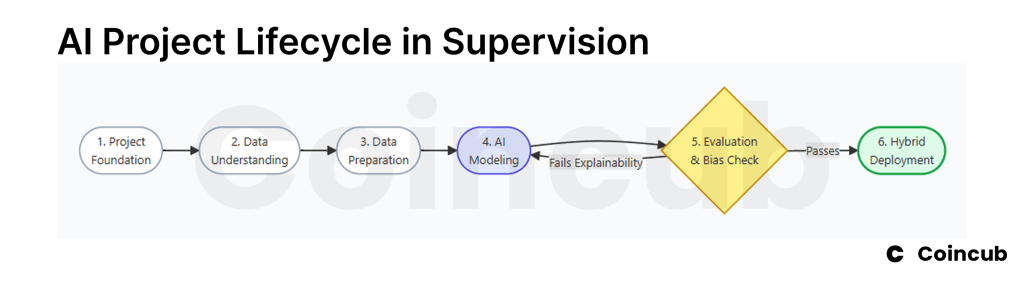
Human and AI Hybrid Supervision
Despite rapid automation, SupTech is not designed to replace human supervisors.
AI excels at:
- Processing massive datasets
- Identifying statistical anomalies
- Synthesizing unstructured text
- Generating predictive risk scores
Humans excel at:
- Ethical judgment
- Contextual interpretation
- Policy decisions
- Legal accountability
The future of supervision lies in hybrid models where AI acts as an investigative assistant while humans retain final authority.
AI as a Strategic Partner in Financial Regulation
Artificial intelligence is transforming financial supervision. As markets become more digitized and interconnected, regulators must match the technological sophistication of the institutions they oversee. SupTech enables authorities to move from reactive oversight to proactive risk management. Through predictive analytics, real time surveillance, automated document processing, and consumer sentiment monitoring, regulators are enhancing their ability to safeguard financial stability.
At the same time, responsible implementation requires careful governance. Model transparency, data quality, algorithmic fairness, cybersecurity resilience, and workforce upskilling are essential components of sustainable SupTech adoption. SupTech represents a structural evolution in regulatory architecture. It is not about replacing human judgment. It is about augmenting it. In an algorithmic financial world, AI has become an indispensable partner in modern supervision.
Frequently Asked Questions (FAQs)
What is SupTech in banking?
SupTech in banking refers to Supervisory Technology used by central banks and financial regulators to oversee banks more effectively. It uses artificial intelligence, machine learning, and data analytics to monitor risks, detect misconduct, automate reporting analysis, and strengthen financial stability through real time supervision.
What is the meaning of SupTech?
SupTech stands for Supervisory Technology. It describes the use of advanced digital tools by regulatory authorities to improve oversight and enforcement. SupTech systems analyze large volumes of financial data, identify systemic risks, and support decision making through automation, predictive analytics, and intelligent reporting.
What is the difference between RegTech and SupTech?
RegTech is used by financial institutions to comply with regulations, while SupTech is used by regulators to supervise those institutions. RegTech focuses on internal compliance and reporting. SupTech focuses on analyzing submitted data, detecting risks, monitoring markets, and enforcing financial regulations.
What exactly is fintech?
Fintech, short for financial technology, refers to digital innovations that improve or automate financial services. It includes mobile banking apps, payment platforms, robo advisors, blockchain systems, and AI driven lending tools. Fintech enhances efficiency, accessibility, and speed across banking, investing, and payments.
What is an AI regulator?
An AI regulator is a supervisory authority that uses artificial intelligence tools to enhance financial oversight. It applies machine learning, natural language processing, and predictive analytics to detect fraud, monitor systemic risk, analyze documents, and support data driven enforcement decisions.
How can regulators use AI?
Regulators use AI to monitor financial markets in real time, detect suspicious trading patterns, analyze regulatory filings, assess systemic risk, and track consumer complaints. AI improves supervision by automating data processing, identifying anomalies, and enabling earlier intervention before financial instability spreads.
Will AI replace regulators?
AI will not replace regulators. Instead, it supports human supervisors by automating repetitive tasks and analyzing complex datasets. Final decisions, legal judgments, and policy actions remain the responsibility of trained professionals. AI enhances regulatory efficiency but does not eliminate human oversight.