Buy a Licensed Company
  Explore VASP Data
  Talk to an Expert

 Atis Shala
Atis is a senior analyst and community lead with four years of experience in crypto. He has a bachelor from the Rochester Institute of Technology.
Atis Shala
Atis is a senior analyst and community lead with four years of experience in crypto. He has a bachelor from the Rochester Institute of Technology.
Tether vs. Europe: Navigating the New Stablecoin Rules
- Tens of millions of European Economic Area (EEA) users lost access to USDT on major centralized exchanges, including Binance, Coinbase, and Kraken, following the enforcement of the EU’s Markets in Crypto-Assets (MiCA) regulation.
- The central point of contention is a MiCA rule requiring “significant” stablecoin issuers to hold at least 60% of their reserves within fractional-reserve European banks, rather than the U.S. Treasury bills Tether prioritizes.
- Tether did not “fail” to comply; it made a strategic calculation that modifying its global reserve model to satisfy European regulators would introduce systemic risk and jeopardize liquidity for its core user base.
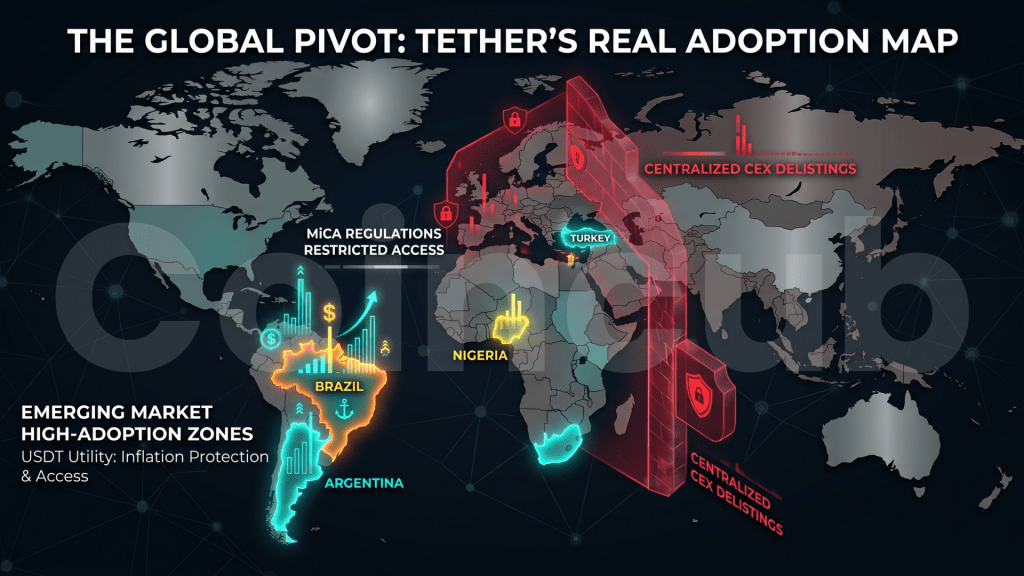
- Europe represents only a fraction of Tether’s business. The company is doubling down on serving emerging economies (such as Turkey, Argentina, and Nigeria) where USDT serves as a vital tool for inflation protection and dollar access.
- Where Tether stepped back, Circle stepped forward. By securing MiCA compliance, USDC became the primary compliant dollar-backed stablecoin available on regulated European platforms.
- The standoff signals a wider divergence in global digital finance, creating a split between regulated, “walled garden” environments like the EU and borderless utility models serving the global south.
The Day the Digital Dollar Disappeared
Picture a European crypto trader opening their Binance app in late 2024. The USDT trading pairs are gone. So are the ones on Coinbase. Kraken pulled them too, and OKX followed shortly after. The world’s most actively traded stablecoin had vanished from the platforms that tens of millions of European Economic Area (EEA) users relied on every single day.
This was no technical glitch or market shock. It was the direct result of a regulatory collision years in the making. Major centralized exchanges operating under EU licenses faced a clear choice: delist USDT or risk sanctions under the new rules. They made the only rational commercial decision available. They delisted.
Two forces now define the stablecoin landscape across Europe. On one side stands Tether, the issuer of USDT, the world’s largest stablecoin by market capitalization and annual trading volume. The platform processes trillions of dollars each year and serves users across more than 100 countries. USDT plays a central role in global crypto liquidity, from retail speculation and DeFi protocols to cross-border remittances and inflation protection in developing economies.

On the other side stands MiCA, the European Union’s Markets in Crypto-Assets regulation. The framework entered full force in 2024 and arrived with a specific mandate for stablecoin issuers: get licensed, restructure your reserves, and submit to ongoing oversight. No carve-outs for scale. No extended runway for the biggest players.
The common narrative suggests Tether failed to comply in time. The fuller picture shows a deliberate choice. Tether evaluated MiCA’s requirements, calculated what full compliance would cost their global business model, and walked away.
The MiCA Rulebook: What Brussels Demanded
Getting Licensed the Old-Fashioned Way
Under MiCA, any company wishing to issue a stablecoin on regulated platforms within the EEA must first obtain an Electronic Money Institution (EMI) license. This is the same licensing framework that governs traditional digital payment companies, neobanks, and regulated fintech platforms across Europe.
The EMI application process runs neither fast nor cheaply. It requires establishing a legal presence within the EU, building out dedicated compliance and risk management infrastructure, and entering into ongoing supervisory relationships with national financial regulators across member states. For a globally structured issuer without a traditional regulatory headquarters, this requirement introduces costs and operational obligations that extend far beyond European borders.
The license was a serious hurdle. But it was only the beginning.
The 60% Rule: The Real Dealbreaker
MiCA contains one provision that proved most damaging for Tether’s European future. For stablecoins classified as “significant” under the regulation (a category determined by user numbers and transaction volume that USDT qualifies for easily), at least 60% of all reserves must sit inside European bank accounts.
This rule goes far beyond adding a compliance cost. It forces a fundamental restructuring of how a stablecoin backs its entire circulating supply. For Tether, whose reserve strategy rests on holding highly liquid, low-risk instruments like U.S. Treasury bills, this mandate represented a full replacement of their core financial model, not an adjustment to it.
Why “significant”?
MiCA classifies a stablecoin as “significant” when it exceeds 10 million users, 5 billion euros in market cap, or 500 million euros in average daily transaction volume. USDT clears all three thresholds by a wide margin, making the toughest tier of MiCA rules applicable from day one.
The Transparency Squeeze
MiCA added strict disclosure requirements alongside the reserve rules. Significant stablecoin issuers must submit to external audits, maintain constant regulatory reporting, and comply with daily transaction limits. These standards bring stablecoin operators into the same transparency framework as traditional regulated financial institutions.
Critically, these requirements target centralized service providers holding EU licenses. Decentralized protocols and self-custody wallets fall outside this specific jurisdiction, a distinction that carries real consequences for what European users ultimately lost when the delistings began.
Tether’s Response to MiCA
Tether CEO Paolo Ardoino made the company’s objection public and specific. His argument against the 60% banking reserve rule centers on systemic risk, and it carries more weight than a typical corporate compliance complaint.
Traditional European banks operate on a fractional-reserve model. They do not hold 100% of deposited funds in liquid form at any given time. Most deposits get lent out or invested in longer-duration assets. If a large wave of USDT holders demanded redemptions simultaneously (a “mass redemption event”), the European banks holding Tether’s reserves might lack the immediate liquidity to process those demands. The bank faces a run. The stablecoin’s backing freezes or collapses.
This scenario is not theoretical. Silicon Valley Bank collapsed in March 2023 through exactly this mechanism. Depositors demanded withdrawals faster than the bank could process them, and regulators had to intervene. SVB held around $200 billion in assets when it failed. Tether’s reserve base is larger. Ardoino’s concern about depositing the majority of that base into fractional-reserve European banks carries structural logic.
Treasury Bills vs. Bank Deposits
Tether’s preferred reserve instrument is the U.S. Treasury bill. T-Bills are short-term U.S. government debt instruments, widely regarded as the most liquid and low-risk asset class in global finance. They trade on deep secondary markets and convert to cash rapidly, even during periods of elevated market stress.
Placing 60% of reserves in European bank deposits means depending on those banks’ internal liquidity positions to honor redemptions. In normal conditions, the distinction between T-Bills and bank deposits seems abstract. In a stress scenario, it determines whether a stablecoin survives or collapses. Ardoino argues that MiCA’s 60% rule trades a reliable safety net for a compliance checkbox.
The Privacy Angle
Tether’s resistance to European oversight also connects to a broader tension in the digital finance debate. The EU’s parallel project, the development of a Digital Euro (a central bank digital currency), would give governments real-time visibility into payment flows at a granular level. USDT, operating on public blockchains, gives users a degree of financial autonomy that a state-issued CBDC cannot offer by design.
Ardoino has framed USDT as a tool for financial sovereignty. That argument resonates most powerfully in markets with histories of capital controls and currency seizures. It plays less convincingly in Brussels, but Tether was not designing their rebuttal for Brussels.
The Global Pivot: Who Is Tether Actually Built For?
Emerging Markets First
Europe represents a fraction of Tether’s actual user base. USDT’s most critical function plays out in economies where domestic currencies have become unreliable as a store of value.
In Turkey, the lira lost more than 80% of its value against the dollar between 2019 and 2024. Turkish citizens who held savings in USDT preserved their purchasing power. Those who kept savings in lira watched them erode. In Argentina, recurring peso crises spanning decades have made dollar access a genuine financial survival skill. USDT gave ordinary Argentinians access to dollar-equivalent value outside the formal banking system. Brazil and Nigeria face similar dynamics: local currency volatility, limited access to stable foreign-currency savings accounts, and a rapidly growing user base that treats USDT as a practical financial tool rather than a speculative asset.
These users are protecting their financial lives from inflation, devaluation, and institutional instability. They are also the users whose needs depend most directly on Tether’s current reserve model and liquidity structure.
Refusing to Compromise the Global Model
Complying with MiCA would have required Tether to restructure the very reserves that its core user base relies on. Shifting the majority of backing assets into EU bank deposits would have degraded the liquidity profile that makes large-scale redemptions dependable. The compliance cost, both financially and operationally, would have been enormous relative to what Europe actually contributes to Tether’s global volume.
Tether’s leadership made a strategic assessment: retaining the model that serves the majority of users took priority over satisfying European regulators. The global south needed the current structure. Europe had a compliant alternative in Circle’s USDC.
Beyond Crypto: The Sovereign Entity Play
Tether has moved well beyond its identity as a stablecoin issuer. The company holds significant investments in artificial intelligence infrastructure, Bitcoin mining operations, and sustainable energy projects across multiple continents. Their stake in Adecoagro, a major South American agri-business operating across Argentina, Brazil, and Uruguay, points to an ambition that has nothing to do with EU regulatory approval.
Tether is building the profile of an independent economic actor with diversified global assets and long-term infrastructure strategy. Viewed through that lens, declining MiCA compliance reads less like a regulatory failure and more like a deliberate alignment. Their future is simply not tied to European authorization.
The European Fallout: Who Fills the Void?
The Rise of Circle
Circle moved aggressively into the space Tether vacated. The company pursued MiCA compliance for both USDC (its dollar-backed stablecoin) and EURC (its euro-backed stablecoin), securing the approvals needed to operate on centralized exchanges across the EEA. Where Tether stepped back, Circle stepped forward.
For European institutions, retail platforms, and users who need stablecoin access through regulated channels, USDC has become the primary option. Exchanges that removed USDT trading pairs replaced them with USDC alternatives almost immediately. Circle’s decision to pursue regulatory legitimacy in Europe looks, from a market position standpoint, like exactly the right bet. They gained European market share through default selection rather than competition.
The trade-off is real, though. USDC’s reserve strategy must now accommodate MiCA requirements, including exposure to European bank deposits. Whether that exposure introduces the very systemic fragility that Ardoino warned about remains a live question in the industry.
The DeFi Loophole
European users did not lose access to USDT entirely. They lost their most convenient access routes.
MiCA’s restrictions apply to centralized service providers that hold EU operating licenses. Decentralized exchanges (DEXs) sit outside this jurisdiction. Self-custody wallets do too. A European user with a MetaMask wallet or hardware device can still hold USDT, move it on-chain, and trade it through decentralized protocols like Uniswap or Curve Finance.
What European users lost is the easy fiat on-ramp and off-ramp. Buying USDT directly with euros through a regulated, licensed exchange is now impractical across the EEA. Converting USDT back to euros through the same channels is equally restricted. For users who operate primarily through centralized platforms, the path is effectively blocked. For users comfortable with DeFi infrastructure, USDT remains accessible, though far harder to bridge in and out of the traditional euro economy.
The Stablecoin Split
| Feature | Tether (USDT) | Circle (USDC) |
| Regulatory Status (EU) | Non-compliant. Delisted from major CEXs in the EEA. | MiCA Compliant. Fully licensed and available on EU platforms. |
| Reserve Strategy | U.S. T-Bills, short-term instruments, Bitcoin, gold. | Cash, short-duration bonds, EU-mandated European bank deposits. |
| Target Demographic | Global South, emerging markets, unbanked populations, inflation hedgers. | Western institutions, TradFi bridges, regulated retail in developed markets. |
| CEX Availability (EU) | Heavily restricted. Removed from Binance, Coinbase, Kraken, OKX for EEA users. | Full availability on all major regulated European exchanges. |
| DeFi / On-Chain Access | Accessible via DEXs and self-custody wallets; fiat off-ramps blocked. | Accessible via both centralized and decentralized channels. |
| Transparency Posture | Quarterly attestations; historically resisted full third-party audit. | Monthly attestations by Grant Thornton; MiCA-mandated external audits. |
| Market Cap (approx.) | ~$140 billion (global leader). | ~$45 billion (second largest, growing fast in EU). |
The Fracture of Global Crypto
The Tether-MiCA standoff is a specific example of a broader pattern: the global crypto ecosystem fracturing along regulatory fault lines. What played out across European exchanges in 2024 previews a much larger divergence still unfolding.
Europe has made its choice. MiCA creates a defined, controlled environment for digital asset activity. Licensed issuers, audited reserves, monitored transactions, and clear consumer protections. For retail investors who previously had no regulatory recourse if a stablecoin failed, this framework offers something the pre-MiCA landscape never provided. The walled garden has real walls, and it also has real protections inside.
Tether has made its choice too. The company is doubling down on a world where the most urgent financial problems are nowhere near European. Hyperinflation in Latin America. Currency instability in sub-Saharan Africa. Banking exclusion in large parts of Asia and the Middle East. USDT serves those problems effectively in its current form. Restructuring to satisfy Brussels would compromise that service for the populations who need it most.
Classic regulatory arbitrage is playing out in real time. Compliance-friendly capital flows toward Circle and its MiCA-approved products. Borderless liquidity continues to flow through Tether toward the billions of people who have no equivalent alternative and no functional access to EU-compliant financial infrastructure.
Both strategies can succeed in parallel, for now. But as more jurisdictions (the United States, the UAE, Singapore, Brazil) develop their own digital asset frameworks, the pressure on every major stablecoin issuer to choose a regulatory lane will intensify. The question of which model scales into the true global standard for stablecoins will depend heavily on which populations the industry decides to count when it takes stock of who digital finance is actually meant to serve.
Tether vs. Europe: Does USDT Have a Future in Europe?
MiCA offers consumer protection, transparency, and institutional credibility within Europe’s borders. It also requires stablecoin issuers to embed their reserves inside the very traditional banking system that crypto was built as an alternative to.
Does heavy regulation genuinely protect the user, or does it hand market control back to the traditional banking sector that regulation was supposed to hold accountable in the first place? Time will tell.
Frequently Asked Questions (FAQs)
Why did the EU ban Tether?
The EU did not ban Tether directly. However, MiCA regulations imposed strict reserve and licensing requirements. Because Tether chose not to comply with these specific rules, centralized exchanges were forced to delist USDT for European users to avoid regulatory sanctions.
Is Tether available in the EU?
Tether is heavily restricted in the EU. Major centralized exchanges have delisted USDT for EEA users. While it remains accessible through decentralized exchanges and self-custody wallets, easy fiat on-and-off-ramps through regulated channels are effectively blocked.
Is USDT compliant with MiCA?
No, USDT is not compliant with MiCA. Tether strategically decided against seeking compliance, specifically objecting to MiCA’s mandate that “significant” stablecoin issuers hold 60% of reserves in European bank deposits, citing systemic risk to their global model.
What is MiCA stablecoin?
Under the MiCA regulation, a compliant stablecoin is a regulatory asset whose issuer holds an Electronic Money Institution (EMI) license. Issuers must adhere to strict rules regarding reserve management, transparency, governance, and supervisory oversight within the European Economic Area.
Is USDC MiCA compliant?
Yes, USDC is MiCA compliant. Circle, the issuer of USDC, aggressively pursued the necessary licenses and regulatory approvals. As a result, USDC has become the primary compliant dollar-backed stablecoin available on regulated exchanges across the European Economic Area.