


 Buy a Licensed Company
  Explore VASP Data
  Talk to an Expert

 Atis Shala
Atis is a senior analyst and community lead with four years of experience in crypto. He has a bachelor from the Rochester Institute of Technology.
Atis Shala
Atis is a senior analyst and community lead with four years of experience in crypto. He has a bachelor from the Rochester Institute of Technology.
Crypto and Capitalism: Disruption or Evolution?
Every generation builds tools to escape the systems that confine them. For centuries, capitalism promised freedom through private ownership, open markets, and the pursuit of profit. It rewarded creativity and punished inefficiency. Yet as markets expanded, power concentrated in banks, corporations, and governments that decided who could access money and under what conditions.
Crypto emerged as a direct response to that imbalance. When Bitcoin appeared in 2008, it represented both a breakthrough and an ideological statement. The whitepaper argued that trust should shift from institutions to mathematics. Satoshi Nakamoto, the anonymous creator of Bitcoin, challenged the idea that financial freedom must depend on centralized approval. In doing so, Bitcoin exposed the fragility of modern capitalism, where control over money had become more valuable than money itself.
At the center of this movement lies a fundamental tension between decentralization and profit. Blockchain networks invite open participation, yet much of their activity revolves around speculation. Tokens move according to narratives, not just use cases. Markets form around promise and risk, echoing the same cycles of greed and correction that define capitalism.

I call this crypto’s paradox. It resists central authority but thrives on capitalist motivation. Miners compete for rewards; investors chase yields; developers race to dominate networks that claim to belong to everyone. Each element reflects the same hunger for advantage that drives traditional markets, but without the institutional oversight.
The real question is whether capitalism can evolve within this new digital environment. Crypto does not aim to destroy it. Instead, it exposes what capitalism hides behind regulations and intermediaries: the raw mechanics of incentive, competition, and self-interest. In that sense, crypto does not stand outside capitalism but exists inside it.
Capitalism’s Evolution and Crypto’s Entry Point
Capitalism has always adapted to technology. The printing press expanded markets for ideas. The industrial age turned labor into leverage. The internet transformed data into profit. Each wave made economies faster, more connected, and more dependent on centralized systems of control.
By 2008, that control had reached its peak. The global financial crisis revealed how fragile the system had become when trust in a few institutions determined the fate of… well, everybody.
Bitcoin’s Beginnings
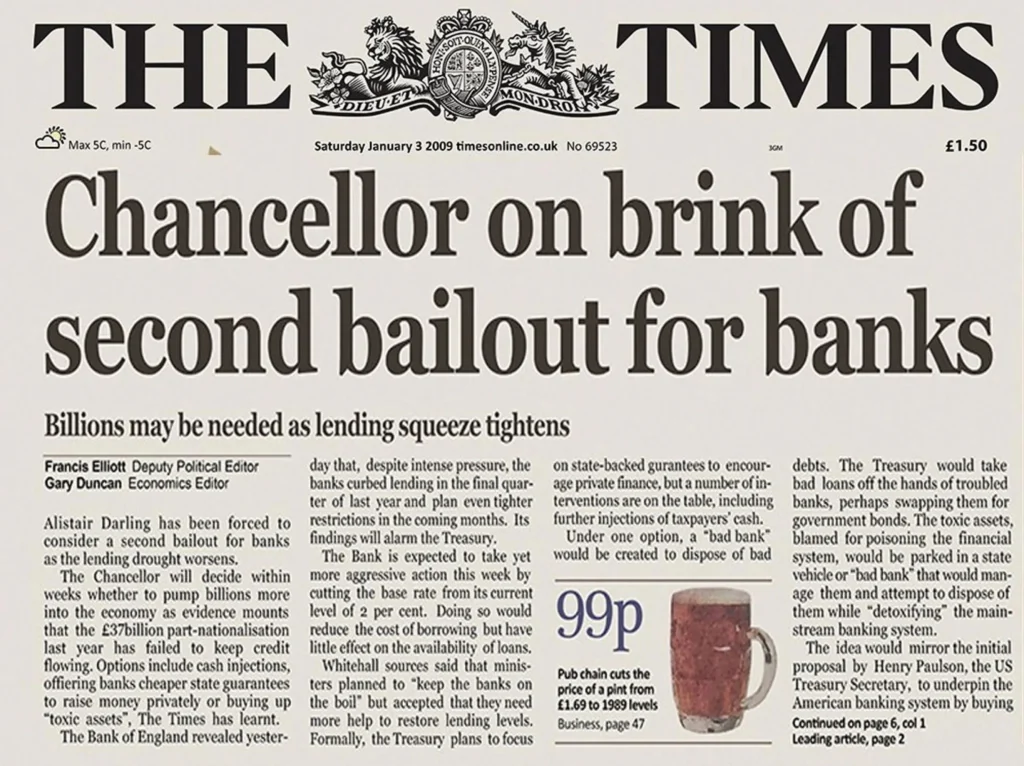
Bitcoin was born in that moment of collapse. The 2008 financial crisis exposed a system where profit was privatized but failure was shared. Think about it, over $10 trillion in losses led to only 1 person being jailed for inflating mortgage prices in the US. Bank bailouts revealed the limits of accountability in capitalism. Against that backdrop, the Bitcoin whitepaper appeared online with a simple message: trust the code, not the bankers. The first Bitcoin block carried a headline from The Times: “Chancellor on brink of second bailout for banks.”
The movement behind it had deeper roots. The cypherpunks of the 1990s envisioned digital cash that preserved privacy and autonomy. They believed financial freedom required resistance to surveillance and censorship. For them, Bitcoin was not a business opportunity but a civil defense mechanism that separated money from state control.
Early adoption followed that same spirit. Miners and forum users shared software, ideas, and conviction long before Bitcoin had a market price. The Silk Road used it for commerce outside traditional rails, proving its functionality and use case. Purpose mattered more than profit during those times, but that changed quickly.
Introduction of Smart Contracts
The turning point came between 2016 and 2020. Ethereum introduced programmable money and made financial contracts accessible through code. The ICO boom attracted massive speculation, and the DeFi summer of 2020 transformed decentralized trading and lending into mainstream phenomena. Bitcoin focused on preserving value. Ethereum pursued flexibility and scale. One guarded its ideology while the other expanded the frontier of use cases.
Institutional capital soon entered. Hedge funds, banks, and payment companies began to treat crypto as a strategic asset. The inflow of liquidity brought recognition but shifted incentives. Ideals of autonomy competed with the pursuit of profit. Privacy gave way to compliance while governance tokens replaced grassroots coordination.
What began as an anti-system experiment now trades on global exchanges and sits inside pension portfolios. Bitcoin tried to step outside capitalism but ended up deep in it. The shift from rebellion to asset class captures the entire journey of crypto: a movement that started as a protest against financial power and evolved into an important sector of modern markets.
When Decentralization Meets Wall Street
As crypto matured, capital found its way in. This “experiment” suddenly became a structured market with investors, valuations, and corporate strategies. Venture firms no longer observed from the sidelines; they became architects of the next financial infrastructure. The open-source ethos that fueled early development gave way to a new industrial model where tokens, timelines, and profit expectations shaped the design of entire ecosystems.
Venture capital started engineered projects. Tokenomics became the bridge between ideology and enterprise. Incentive structures that once encouraged participation evolved into mechanisms for accumulation. Token allocations, vesting schedules, and pre-market rounds turned networks into predictable investment vehicles. The dream of decentralized coordination melted into the precision of corporate finance.
Transparency vs. Profit
This shift redefined competition within the crypto industry. Uniswap and Binance capture the contrast clearly. Uniswap operates through autonomous code that executes trades without custodians, embodying crypto’s founding principle of openness. Binance, on the other hand, refines that principle into efficiency and scale, delivering the same service under a single brand and centralized authority. One relies on distributed governance; the other depends on strategic control. Both succeed, but they serve different masters – transparency vs. profit.
Speculation became the common denominator. Markets began rewarding volatility more than vision. Tokens fluctuated less by utility and more by momentum. Custodial wallets replaced personal keys, and corporate DAOs started mirroring boardrooms. The idea of ownership blurred as users held claims to tokens, not control.
By the time exchanges cemented their dominance, the transformation was complete. Crypto’s gateways began to resemble the financial institutions they once sought to disrupt. They custody assets, manage liquidity, and influence sentiment across global markets that never close. What separates them from banks is not principle anymore, but velocity. Capital moves faster, spreads wider, and operates with fewer barriers.
Crypto now stands at a reflective point. Its systems still promise decentralization, yet its incentives echo capitalism’s hymn: the pursuit of growth, efficiency, and most importantly, control. Can crypto evolve within capitalism without losing the purpose that made it different?
Capitalism Reinvented on the Blockchain
Crypto’s relationship with capitalism has never been one of destruction. It functions more like a refinement process. The blockchain strips capitalism down to its raw mechanics, ownership, exchange, and incentive, and rebuilds them in code. The result is an accelerated version of the same system, operating without borders and with near-total efficiency.
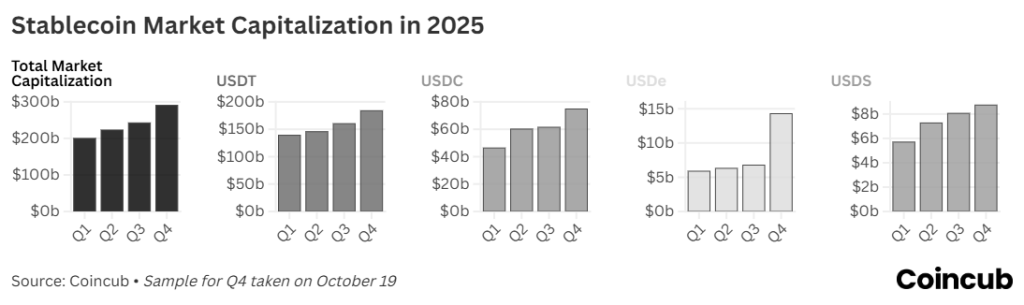
Stablecoins represent this transformation better than any other financial product. Tether, USDC, and PayPal USD have become the payment rails of the digital economy. They mirror fiat currency yet function at internet speed, connecting traders, remittance users, and institutions through programmable liquidity. In less than a decade, they turned the blockchain into a 24/7 settlement layer, competing directly with banks and card networks. Capitalism’s appetite for faster transactions found its perfect medium in magic internet money that never sleeps.
DeFi built the next layer of that structure. Protocols now automate lending, borrowing, and yield generation without intermediaries. Credit and liquidity flow across continents through smart contracts instead of balance sheets. Users can earn yield from a mobile wallet in Egypt or Mumbai with the same tools used by hedge funds in New York. This global accessibility expands capitalism’s reach rather than limiting it.
Real World Tokenization: The Next Step for Capitalism
The tokenization of real-world assets pushes the idea even further. Bonds, equities, and real estate are being fractionalized into digital tokens that trade in real time. Ownership becomes liquid, divisible, and borderless. BlackRock and JPMorgan have already launched tokenized treasury projects, proving that institutional finance sees blockchain as an upgrade rather than as a threat. Traditional players now use DeFi protocols to manage risk and optimize yield with the precision of algorithmic finance.
However, decentralized systems are increasingly serving centralized profit. The same institutions that once resisted crypto now dominate its volume. The tools of autonomy have been repurposed for scale. Liquidity pools operate on open code, but most capital comes from the same concentrated sources that govern traditional finance.
Blockchain did not replace capitalism. It made it faster, leaner, and more transparent. Profit still drives participation, but the infrastructure is now global and permissionless; the latter differs from blockchain to blockchain. Some may say that crypto did not end the system it set out to challenge. Nevertheless, that depends on how you view the correlation between crypto and capitalism. In reality, crypto only revealed what capitalism looks like when it runs on code instead of contracts.
The Efficiency Trap: Autonomy vs Accumulation
What we currently see with blockchain and protocols is a system optimized for accumulation. Efficiency runs so deep that autonomy begins to erode under its weight. What started as a rebellion against central power now strains under the logic of scale.
In a decentralized context, “efficient” means minimal friction: faster settlement, cheaper execution, permissionless access – issues that blockchain and crypto in general has been facing for years. Those gains attract institutional capital, but institutional investors bring different priorities focused on predictability, scale, and control. The systems built for the masses are now being adjusted for major, institutional players.
Let’s take governance tokens as an example. In practice, a small group of whales or early insiders often controls key votes in such DAOs or other governance voting mechanisms. An empirical study of four governance-token distributions found that power concentrates disproportionately in a few hands. Token “democracy” becomes symbolic when token distribution funnels influence toward those with capital.
Similarly, protocol parameters shift toward capital-friendly strategies: yield farming, liquidity mining, leveraged positions. The market rewards volatility, not slow utility. That encourages risk-taking at the edges. Instead of resisting profit maximization, many protocols embed it into their architecture and even use it to promote themselves.
This tradeoff also appears in custody. Users can hold keys, but many prefer custodial wallets with insurance and convenience. Additionally, institutions and regulatory bodies demand custody solutions. That consolidates control into custodial providers and autonomy shrinks to make room for convenience. How is crypto different from banks, then?
Developers Prioritizing Money Over Decentralization
More absurdly, growth and Total Value Locked (TVL) guide decisions of core team members of different projects. Decentralization becomes secondary, and in some cases, even optional. Protocols run tests, audits, compliance layers and these enhance institutional trust, but they also pull systems closer to traditional finance.
The real question becomes: Has the pursuit of efficiency undermined autonomy at the core? The tools of decentralization keep on getting better and better, but taking a look at the current industry, the vast majority of attention as well as value goes towards centralized projects. Nowadays, accumulation is more important than decentralization, and the whole industry cheers and pushes for that.
Comparing Capitalism and Bitcoin via Game Theory
| Aspect | Capitalism | Bitcoin | Game Theory Insight |
| Incentives | Profit-driven; rewards innovation but can encourage exploitation. | Alignment via rewards/penalties; honest behavior maximizes long-term gains. | Both rely on self-interest for stability, but Bitcoin’s rules are hardcoded, reducing reliance on external enforcement. |
| Equilibria | Market equilibria can be efficient but unstable. | Nash equilibria in mining and consensus; highly resistant to change. | Capitalism allows for multiple equilibria, while Bitcoin converges on a single, secure state. |
| Sum Nature | Positive-sum through growth, but zero-sum in competition. | Positive-sum network effects; zero-sum in mining races but net beneficial. | Both generate value creation, but Bitcoin’s scarcity (21M cap) mirrors capitalism’s resource limits. |
| Adoption/Scale | Evolutionary; spreads via trade and globalization. | Coordination game; hyperbitcoinization as a tipping point. | Capitalism adapts organically; Bitcoin’s game theory forces rapid cascades. |
| Risks | Inequality, externalities. | Centralization risks, but self-correcting. | Both face cheating, but Bitcoin’s transparency mitigates it better than capitalism’s intransparent institutions. |
Custody in Capitalism vs. Bitcoin
Crypto, Bitcoin in particular, and capitalism are a great match if you look at it from this perspective. However, what’s even more interesting is the original custodial model of Bitcoin and how it aligns really well with capitalism.
Bitcoin’s custody options fit well with capitalism’s focus on private control and free choice. Self-custody lets users keep their own private keys and this gives them full power over their assets. It matches capitalist ideas of personal property rights and no need for middlemen and helps users avoid blocks or restrictions by authorities while building true money sovereignty. On the other hand, custody services from exchanges or banks also come from capitalist ideas. They give ease of use and growth for big groups and new users in exchange for giving up control.
While capitalism favors both sides of the trade, custodial and non-custodial, the concept that Bitcoin uses is in line with capitalism’s true nature, with a sprinkle of steroids in the mix. Your keys, your responsibility.
Bitcoin: Capitalism’s Constructive Critic
Bitcoin reflects capitalism’s most fundamental principles, including private ownership, open competition, and transparent incentives, while also exposing the failures of the global financial system that distorted those ideals. It transforms property rights into cryptographic keys and replaces trust in institutions with proof of work, rewarding efficiency and participation over privilege.
However, data reveals that Bitcoin has not escaped capitalism’s structural imbalances. Ownership remains highly concentrated.
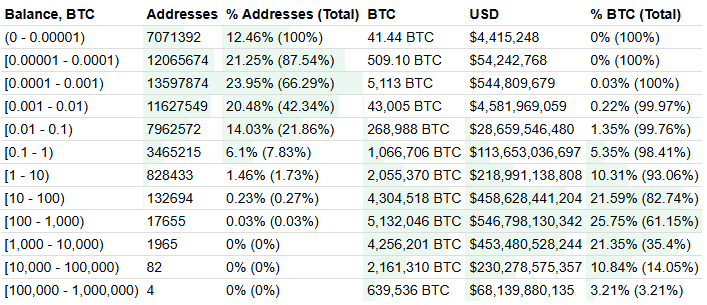
Data from Bitinfocharts shows that roughly 2% of addresses hold more than 90% of circulating Bitcoin, though many of these represent custodial pools rather than individuals – quite contradictory of what Bitcoin stood for. Moreover, a Grayscale Research report found that nearly three-quarters of Bitcoin holders possess less than 0.01 BTC, illustrating that retailers are investing small amounts of money into BTC.
Bitcoin remains both a supporter and critic of capitalism. It accepts the profit motive but rejects control by central banks and intermediaries. It exposes the inflationary risks of fiat systems while showing how free markets behave without intervention. As an economic experiment, Bitcoin has proven that capitalism’s logic can operate without permission, yet its inequalities and volatility remind us that technology alone cannot correct human behavior within markets… or maybe we are still too early to conclude that indefinitely.
The Financial System’s Immune Response
Every dominant system eventually learns to defend itself. As crypto expanded beyond ideology and into capital markets, states and institutions began forming antibodies. The result is not destruction but containment, a process that reshapes financial autonomy into a regulated, monitored, and ultimately manageable form.
In Europe, the Markets in Crypto-Assets Regulation (MiCA) represents the most structured response. It sets uniform rules for issuers, stablecoin providers, and trading platforms across all 27 member states. Projects that once operated in legal ambiguity now face registration, reserve, and disclosure requirements. MiCA’s goal is stability, but with its current structure, it is often seen as an anti-crypto framework. Despite its flaws, it integrates crypto into the legal and banking framework, turning crypto into a supervised industry.
The United States took a different approach. The Securities and Exchange Commission (SEC) has relied on litigation to define the boundaries of compliance. Each lawsuit against exchanges, token issuers, and staking providers creates case law that substitutes for clear legislation. The result is uncertainty that favors holders. Institutional players can adapt to compliance costs, while startups cannot.
In the East, regulatory bodies are taking an interesting approach, combining experimentation with enforcement. Singapore and Hong Kong use regulatory sandboxes to attract capital while testing risk frameworks. Japan treats exchanges as licensed financial institutions, prioritizing consumer protection. Each jursdiction competes to balance the freedom and limitations that they impose onto the industry.
Central Bank Digital Currencies as Weapons Against Monetary Sovereignty
Behind these efforts lies a deeper motive: the preservation of monetary freedom. Central banks are developing Central Bank Digital Currencies (CBDCs) to maintain control over payments and data. The People’s Bank of China already leads with its digital yuan pilot, while the European Central Bank and the Federal Reserve are exploring their own prototypes. CBDCs extend state control into programmable money, closing the autonomy gap that crypto opened.
This is the current financial system’s immune response. Regulation absorbs the shock of disruption and converts it into structure. The result is not a ban but a cage. Crypto will continue to grow, but within parameters defined by the same institutions it once defied. The contest is no longer between freedom and control; it is about who programs the rules that govern both.
Will the “boomers” succeed, or will crypto continue to provide the freedom that banks never did? That remains to be seen, but as things stand right now, the outcome could still go either way. As Bitcoin becomes more and more institutionalized, one notable attempt at promoting custody as well as privacy is the current advocacy for ZCash by crypto twitter, but that’s a topic for another time.
the founder of Google shilling Zcash btw
probably nothing https://t.co/KWsKbj0WwH
— mert | helius.dev (@0xMert_) October 16, 2025
Final Thoughts: Testing Capitalism’s Limits
Crypto began as an act of resistance and matured into a mirror. It exposed the contradictions of capitalism without escaping them. What started as a peer-to-peer rebellion against financial intermediaries now functions as their parallel infrastructure. The technology promised decentralization, yet profit remains the primary incentive. The dream of autonomy persists, but its reach is limited by regulation, capital, and convenience.
Still, the story is far from finished. Each cycle of adoption and rejection pushes the system forward. Developers continue to build tools that reduce friction and expand access. Institutions adapt rather than retreat. Governments regulate, integrate, and experiment with digital currencies of their own. The boundaries between crypto and traditional finance grow thinner every year.
The test now lies in how far that evolution can stretch. If crypto can deliver financial inclusion, transparency, and self-custody at scale, it might transform capitalism from within. But if the same concentration of power reemerges, hidden behind algorithms and liquidity pools, the promise will fade into repetition. Efficiency without equality becomes a loop, not progress.
Regulation will shape the future of crypto. States will keep tightening control through frameworks like MiCA and CBDCs. Corporations will keep integrating blockchain to protect their advantage. Users will continue to hop between trust and independence.
It’s too early to call, and at this point the odds of a definitive outcome remain evenly split. Crypto may yet prove that capitalism can evolve without collapsing, or it may confirm that every revolution eventually becomes part of the structure it opposes. What is certain is that the experiment continues. The crypto industry, for all its volatility, remains the world’s most honest stress test. For technology. For governance. For monetary sovereignty. And for capitalism itself.
Frequently Asked Questions (FAQs)
What is cryptonomics?
Cryptonomics (or crypto economics) is the study of how blockchain networks use economic incentives, game theory, and token design to coordinate behavior without central authority. It explains how systems like Bitcoin and Ethereum remain secure and efficient by rewarding honest participation and penalizing bad actors.
What is the relationship between crypto and capitalism?
Crypto and capitalism share the same foundation of ownership, competition, and incentive. While crypto challenges centralized power, it still operates within profit-driven systems. Instead of replacing capitalism, blockchain technology amplifies its speed, reach, and efficiency through code.
How does Bitcoin tie to capitalism?
Bitcoin emerged in 2008 as a response to financial bailouts and centralized control. It rejects intermediaries and puts financial sovereignty in the hands of individuals. Yet it still rewards competition and accumulation, making it both a critique of capitalism and an extension of it.
What role do stablecoins play in modern capitalism?
Stablecoins such as USDT and USDC act as digital cash for the global market. They combine the stability of fiat currency with the accessibility of blockchain networks, creating a new payment infrastructure that serves both individuals and institutions worldwide.
How are governments responding to crypto?
Governments are integrating regulation to contain crypto without banning it. The EU’s MiCA law standardizes compliance, the US SEC uses enforcement to set legal boundaries, and Asian markets like Singapore and Japan foster innovation through sandboxes. Each approach reasserts state control while allowing growth.
Will crypto replace capitalism?
No. Crypto is unlikely to replace capitalism. Instead, it tests its limits by exposing inefficiencies and concentrating power in new forms. The future depends on whether blockchain can deliver autonomy and transparency without reproducing the same inequalities it set out to solve.