


 Buy a Licensed Company
  Explore VASP Data
  Talk to an Expert

 Dren Hima
Rochester Institute of Technology (RIT) graduate.
Crypto Analyst, Market Researcher and Editor.
Dren Hima
Rochester Institute of Technology (RIT) graduate.
Crypto Analyst, Market Researcher and Editor.
Bitcoin Price Prediction 2026-2030
Summary
- Halvings set supply; prices move when reduced issuance meets sustained net demand in ETFs and stablecoins.
- Fee share must rise across quarters so miners aren’t forced sellers as subsidy fades.
- ETF primary creations/redemptions (not secondary volume) explain most of the medium-term tape.
- Pool concentration and template filtering impose a measurable “censorship discount” until diversification returns.
- Short-horizon ML can improve week-to-week bias; multi-year targets still live and die on flows and policy.
Bitcoin began as a fix for a simple failure in digital money. Every prior attempt needed a central bookkeeper. Satoshi Nakamoto’s design removed the bookkeeper, replaced it with rules, and made those rules enforceable by anyone running a node. The supply is capped at 21 million coins. Ownership is a private key rather than an account at a company. Transactions settle on a public ledger where miners compete in proof-of-work to add blocks. Difficulty adjusts so blocks keep arriving roughly every ten minutes. This structure is why Bitcoin is still the benchmark. It is a network that tolerates failure and interference because no single actor decides issuance, finality, or who is allowed to transact.
The original goal, “peer-to-peer electronic cash,” was never just about cheap payments. It was about money that doesn’t depend on an issuer or a censor and can still be verified decades from now. In practice, the base layer acts like a high-assurance settlement system. Payment activity and high-frequency transactions have moved to layers and services built on top, but the guarantees that matter (fixed supply, neutral access, and verifiable history) live on the base chain. Those guarantees are why Bitcoin attracts the deepest liquidity, why its security budget is taken seriously, and why regulators and institutions have inched from hostility to integration.
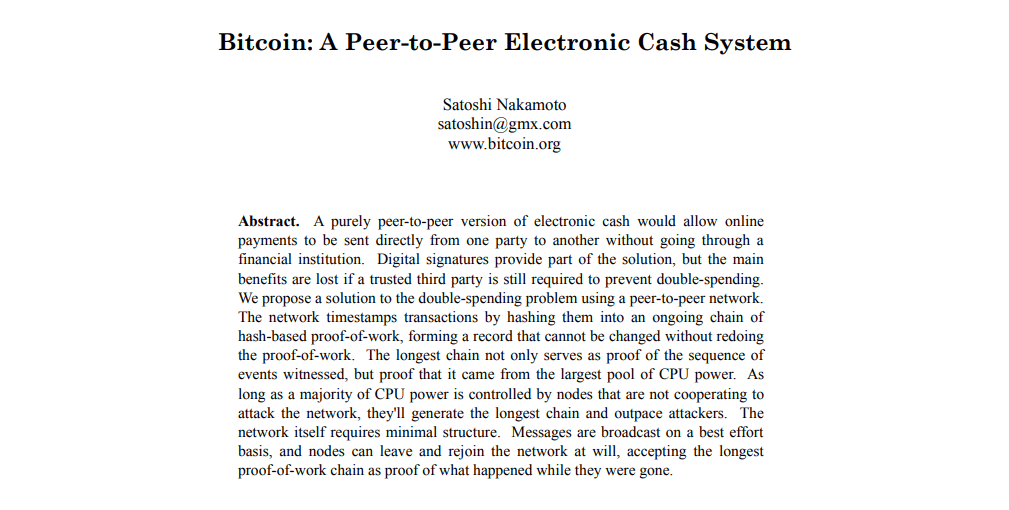

Everything investors care about flows from those design choices. A fixed supply makes issuance predictable; halvings reduce new coins on a schedule no committee can change. A public mempool and UTXO model expose useful signals about holder behavior and liquid float. A global mining market pushes security where energy and hardware economics work, and a broad node set decides the rules clients will enforce. The result is a monetary network that has survived hostile markets, policy swings, and internal disputes without changing its fundamentals. That is why Bitcoin as “number one” is not merely market cap. It is durability, auditability, and the quality of settlement. The rest of this piece is about how those fundamentals meet real-world flows (ETFs, stablecoins, exchange reserves, miner income) and what that means for price over 2026-2030.
Bitcoin in a Nutshell
Bitcoin is a fixed-rule monetary network. Supply caps at 21 million. Ownership is control of a private key. The ledger does not keep balances. It records unspent transaction outputs (UTXOs). That design exposes coin age, dormancy, and which cohorts are actually moving coins. It is possible to observe when long-held coins wake up, when short-term hands dominate, and how much liquid float still sits on exchanges. Blocks are added by miners spending electricity in proof-of-work. The protocol adjusts mining difficulty so blocks arrive around every ten minutes. Miner revenue comes from a block subsidy and transaction fees.
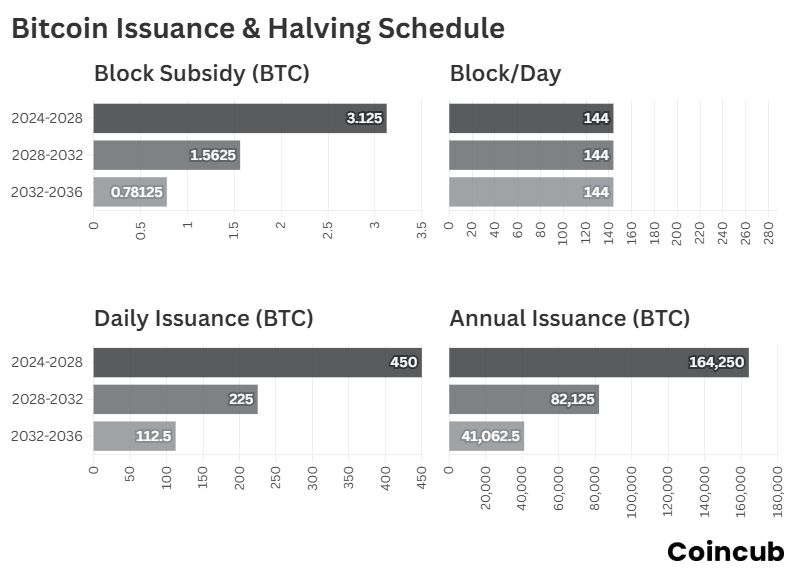
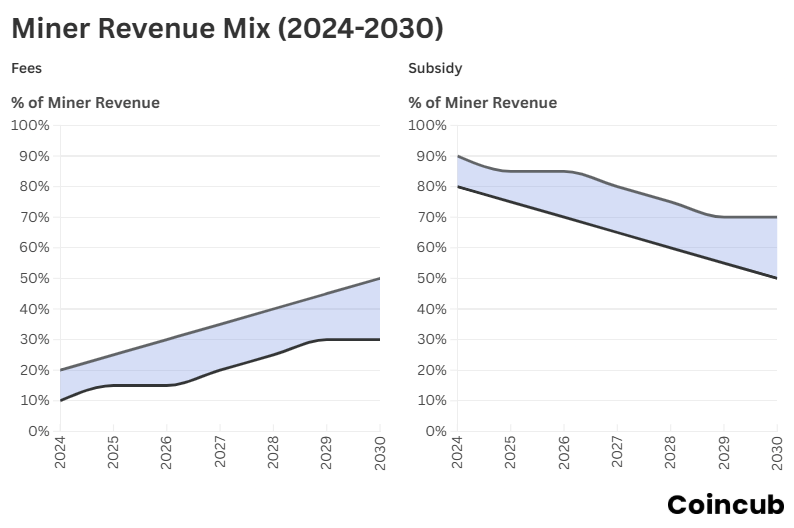
The subsidy halves about every four years (halving event). Fees rise or fall with demand for block space. That split is the security budget. When fees carry a larger share across quarters, miners depend less on selling inventory to fund operations. When fees stagnate and subsidy shrinks, weaker miners hedge more, sell more, or switch off until difficulty catches down.
Issuance reductions do not manufacture demand. They change the cadence of new supply and the stress on miner income. The 2024 halving already reduced daily issuance. The 2028 halving will do it again. The variable that decides whether halvings are background or disruptive is fee share of miner revenue across multi-month windows. A healthy trend in fee share implies less forced selling and a security budget that does not rely on constant price appreciation. A flat or falling trend into 2028 implies periodic inventory sales, tighter miner credit, and slower formation of durable floors.
Demand That Actually Moves Price
There are three main channels that consistently explain why price overshoots or stalls even when narratives are unchanged: primary flow in spot ETFs, the size of the stablecoin base, and the level of exchange reserves.
ETF secondary trading is commentary; primary creations and redemptions are the signal because they move coins into or out of long-term custody. Sustained net creations reduce the liquid float, which raises price impact per marginal dollar. Stablecoin net supply is the venue’s cash balance. Expansion correlates with deeper bids and faster refills after drawdowns. Contraction signals de-risking, thinner books, and longer recoveries. Exchange reserves are the sell-button inventory. When reserves fall while creations are positive, float tightens and rallies require less cash. When reserves climb alongside redemptions, the same buying power moves less price.
Holder structure sets tone around those flows. Long-term holders (LTHs) anchor floors because they have demonstrated a willingness not to sell below their cost basis for long stretches. Short-term holders (STHs) amplify both directions. Because the ledger is UTXO-based, it is possible to observe spent-output age bands, coin-days destroyed, and the LTH/STH split without hand-waving. Old-coin spending into strength is distribution. Exchange-to-self-custody behavior reduces liquid float, while the reverse loosens it. These are not perfect on their own, but together, they rarely lie.
Market structure mainly determines the path. Perpetual funding, basis, and liquidation clusters on a bitcoin heatmap show how the crowd is leaned.. Weeks of rich funding and call-heavy skew become top risk once ETF creations slow. Deep put skew with flat or negative funding often coincides with basing (especially if creations remain positive) because hedging flow exhausts into stronger hands. Venue depth and time-of-day liquidity matter. Illiquid hours during Asia overnight exaggerate prints that would look routine around U.S. ETF trading hours.
Policy and Geopolitics (This Time with Teeth)
Policy either opens or restricts distribution. In March 2025, the White House established a Strategic Bitcoin Reserve and a U.S. Digital Asset Stockpile by executive order. The text directs Treasury to administer custodial accounts for the Strategic Bitcoin Reserve and to capitalize it with bitcoin finally forfeited in criminal and civil cases, and it establishes a stockpile for non-BTC digital assets held by Treasury. The official fact sheet and the executive order are unambiguous about the structure. The change matters for two reasons.
First, it reduces routine auction overhang from forfeitures, which is an irregular but material source of supply in past cycles. Second, it normalizes the presence of bitcoin on a sovereign balance-sheet, lowers institutional career risk, and accelerates bank and RIA platform inclusion for spot ETFs. Subsequent messaging from the administration referenced the reserve again in July 2025, and private-sector trackers catalogued the order and fact sheet as standing policy.
The timing collided with record seizures. U.S. and U.K. actions against Cambodia-based scam networks in October 2025 were accompanied by reporting of more than $14-15 billion in bitcoin seized or frozen, and by formal charges and sanctions against alleged organizers, including Prince Group’s Chen Zhi. When forfeited balances default into a reserve and stockpile framework rather than immediate auctions, the supply cadence shifts at the margin in a way that makes tops easier to print and drawdowns less violent once forced sellers are gone.
Policy cuts the other way via sanctions. Independent monitoring through late 2024 and into 2025 documented windows where transactions linked to OFAC-designated wallets were missing from blocks built by specific pools and appeared later, consistent with template filtering. That behavior has been publicly discussed since 2023 in the context of individual pools, and more systematically tracked in 2024-2025. Settlement continued and the network did not break, but if filtering becomes standard among a few dominant pools, markets will assign a modest “censorship discount” to the long-run fee story because neutral settlement is part of Bitcoin’s premium. The simple way to price this is to watch top-pool share and independent filtering observations; reduce the discount as share diversifies and non-filtering templates dominate.
Security and Mining Concentration
Hashrate is strong. Capital expenditure cycles and better power deals have kept it that way after the halving. But concentration at the pool layer repeatedly crossed thresholds where two pools controlled a majority of hashpower. This is a policy surface and a governance problem waiting to happen if left unaddressed. The risk to price is not a melodramatic “51% attack tomorrow.” It is a small but persistent haircut to the premium investors place on censorship-resistant settlement and on future fee growth. The haircut is removed if pool share diversifies and template filtering fades, but it grows if concentration hardens and filtering becomes common.
The miner income statement is the bridge between issuance and market. Miners borrow in fiat and earn in BTC. They hedge to protect cash flow. If fee share trends up across quarters, inventory pressure eases and the security budget looks funded without relying on relentless appreciation. If fee share disappoints into 2028, expect periodic inventory selling from high-cost operators, difficulty step-downs, and longer basing. Hashprice (revenue per unit of hash) will show stress first, then hedging data and public miner filings usually follow.
Quantum Risk, Quantified and Bounded
Quantum is not a 2026 trading catalyst. The realistic risk this decade is signatures, not proof-of-work. A sufficiently capable fault-tolerant machine running Shor’s algorithm would threaten ECDSA/Schnorr and coins whose public keys are on-chain. Standards bodies spent 2024-2025 finalizing the initial post-quantum set. Dilithium, Kyber, and SPHINCS+ arrived as FIPS 203-205 in August 2024.
In March 2025, NIST selected HQC for standardization and published an updated status report for the fourth round. The mitigation path for Bitcoin is straightforward: embed post-quantum spending paths under Taproot and plan a staged migration well before credible machines arrive. Until then, the risk is an options and confidence discount if timelines pull forward without a published migration plan. With a plan and wallet support in place, the premium fades.
What Modern Prediction Models Add (and What They Don’t)
The academic picture is consistent when papers are read closely. Recurrent sequence models such as LSTMs (Long Short-Term Memory networks) and GRUs (Gated Recurrent Units) learn patterns in ordered data. LSTMs maintain information through gates that keep or forget signals. GRUs are simpler and often train faster with similar or better generalization on noisy financial series. Attention layers let the network emphasize the most relevant time steps. Empirical Mode Decomposition (EMD) is a preprocessing technique that splits a non-stationary series into intrinsic mode functions (IMFs), each representing a different frequency band. Separate learners can model each IMF and then recombine the outputs.
On Bitcoin and peer assets, these techniques add value at short horizons when signal is fused properly. A 2025 Expert Systems with Applications paper introduces a multimodal fusion architecture that explicitly treats time-lagged sentiment as necessary to capture delayed reactions. It chains BiLSTM into BiGRU, uses BorutaShap feature selection with attention and spatial dropout, and fuses news and tweet sentiment with technical indicators. The authors report superior next-hour performance against single-modal and simpler baselines and emphasize that lagged sentiment is the critical ingredient.
A 2025 PeerJ Computer Science comparison across BTC, ETH, and LTC finds GRU outperforming LSTM on core error metrics like MSE and RMSE (substantially for BTC in their dataset) and highlights GRU’s better generalization under train/test loss curves. The authors also note that both architectures smooth the very spikes and air-pockets that define liquidation cascades and euphoric squeezes, which is an inherent property of sequence learners trained on mean-squared losses. The practical takeaway is to use them as regime detectors and nowcasting tools rather than as decade forecasters.
Daily-horizon ensembles that combine EMD with sentiment are also useful. One study decomposes daily BTC into IMFs, fits separate LSTMs on each IMF, and averages those outputs with a stacked LSTM trained on raw price merged with daily tweet sentiment ratios. The fused model outperforms baselines for next-day direction. The paper walks through the data pipeline from tweet collection and cleaning to TextBlob polarity calculations and demonstrates why decomposition helps on non-stationary crypto series.
Another 2025 paper extends univariate LSTMs by adding sentiment and tweet-volume features, showing materially lower MAE and RMSE for multivariate architectures and documenting, with plots and tables, where bidirectional and stacked variants still fail (sudden spikes and drops) despite capturing broad trend. That limitation is why they belong in a weekly dashboard rather than in a 2030 target.
Systematic reviews set the honest boundary. Models often show attractive metrics inside constrained windows, but advantages degrade as horizons extend and regimes shift. Narrative-only formulas like Stock-to-Flow do not outperform flexible, data-driven setups out of sample. The fix is to use modern learners at the right horizon with the right inputs and to tie longer-term ranges to flows that do not vanish when the training window changes.
Interpreting Headline Predictions (Without Hand-Waving)
Well-known calls need to be translated into operational requirements. Cathie Wood’s framework assumes Bitcoin captures a material share of gold’s monetary premium and enters institutional portfolios as a reserve-like asset. For 2026, the band sitting in the high end of six figures only makes sense if cumulative primary ETF creations remain positive through most months and distribution widens across banks and RIAs. For 2030, the upper bands imply hundreds of billions in cumulative net creations and a steady rise in fee share that keeps the security budget uncontroversial. The U.S. reserve and stockpile structure strengthens this path by reducing auctions and normalizing sovereign holding, but the mechanism still depends on creations rather than mere quotes.
Cathie Wood’s 2030 Bitcoin Target:
Base Case: $700K-$750K
Bull Case: $1.5 MillionWhy? It’ll match and surpass the market cap of gold. pic.twitter.com/XRfZyI0SUb
— Aaron Bennett (@AaronDBennett) May 9, 2025
Michael Saylor’s view treats bitcoin explicitly as issuer-free digital capital for treasuries. The 2026 cluster (high five to low six figures) aligns with an ETF-driven base case. The 2030 talk climbs to seven figures if corporate balance sheets and a handful of sovereigns allocate non-trivial percentages. The way to falsify or confirm that is obviou. Just watch primary creations in quiet months and watch for accounting and custody changes that let large corporates act without career risk.
JUST IN: Michael Saylor says the bear market “is not coming back.”
“Bitcoin is not going to zero, it’s going to $1,000,000.” pic.twitter.com/kodw2huwL5
— Watcher.Guru (@WatcherGuru) June 10, 2025
Tom Lee links macro and pipes. Falling real yields and open ETF distribution take 2026 into low/mid six figures; longer-term upside is just continuation of those same flows. Matt Hougan (Bitwise) and Matthew Sigel (VanEck) anchor on ETF mechanics, where a constructive 2026 is simply creations exceeding redemptions most months as platforms broaden. The multi-million tails by 2030 require international replication and, at the margin, sovereign adoption.
PlanB’s Stock-to-Flow is clean as narrative and weak as out-of-sample guidance. It is useful as an upper imagination bound only when flows validate it. Arthur Hayes frames the cycle through liquidity. If real yields fall and credit spreads behave while ETF pipes stay open, overshoots are normal. If not, liquidity will trump slogans.
The common language across all these is flow. If creations are cold, they stay as headlines. If creations are hot while stablecoins expand and fee share trends up, their upper bands migrate from marketing to plausible paths.
Scenarios and Ranges (2026-2030)
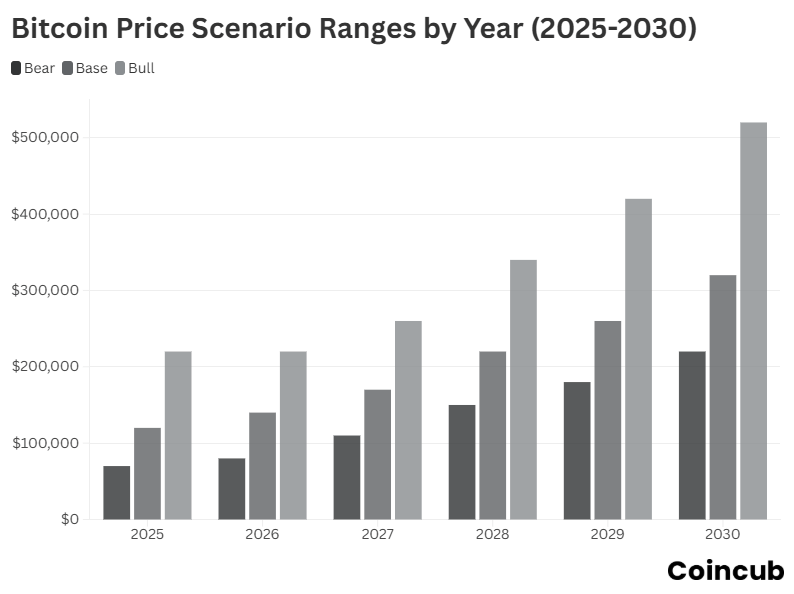
For 2026, the base case is that primary ETF creations remain positive in the months left, stablecoin supply expands modestly across issuers, fee share is slightly higher than 2024 on ordinary settlement rather than fads, and hashrate holds. Macro does not need to be heroic (neutral real yields are fine). With that stack, a cycle high prints during a strong creations window, followed by digestion as long-term holders distribute into strength and options hedging adds supply.
The bull variant widens bank and RIA distribution, sustains larger primary creations, expands stablecoins more decisively, and sees fee share trend up for quarters. Real yields ease and late allocators chase. That path can over-shoot the base bands without exotic assumptions. The bear variant is a policy or venue shock that crimps liquidity, stablecoins contract across chains, creations run flat or negative for a couple of quarters, fee share disappoints, hashprice presses miner breakevens and weaker operators liquidate inventory, and macro tightens at the wrong time. Price revisits deep supports and forms floors only after the forced sellers are out and creations stabilize.
Long-term holder supply rebuilds. Rallies fade when creations slow. Volatility compresses relative to 2025. A constructive variant keeps creations net positive even in quiet months and allows late-2027 new highs as allocations broaden. A pessimistic variant pairs ETF outflows with shrinking stablecoins and forces a slower grind to stability. Overlay mining: if two pools hold a majority and template filtering persists for quarters, apply a modest censorship discount to the fee-growth multiple; remove it if share diversifies and non-filtering templates win.
For 2028-2030, another halving shifts more weight to fees. If fee share climbs across quarters, miner selling is less pro-cyclical, the security budget looks funded without subsidy drama, and international ETF penetration makes distribution routine rather than controversial. Volatility remains high versus equities but lower than earlier cycles. A stronger variant adds a published post-quantum migration plan, healthier fee economics driven by real settlement demand, deeper ETF access across conservative platforms, and benign macro. Under that set, multi-hundred-thousand end-decade prints are defensible, with higher tails if distribution and macro both cooperate. A weaker variant keeps fees stagnant while subsidy falls, allows mining concentration with measurable filtering to persist, and runs into hostile macro. The market assigns a visible security/censorship discount until the network adapts.
The conditions that explicitly move ranges are kept simple on purpose. Raise ceilings when primary creations are persistently positive, stablecoins expand across issuers, fee share of miner revenue rises for several quarters, pool concentration eases, and real yields are benign. Cut ceilings when creations flatline or turn negative across months, stablecoins contract, fee share slumps, and measured filtering persists alongside concentration. Raise floors when long-term holder supply rebuilds on drawdowns while exchange reserves keep falling and hashprice stabilizes. Cut floors when redemptions, shrinking stables, and miner liquidations land together.
Why This Forecast is Defensible
It explains the system before it predicts. It prices policy because the March 2025 executive order materially changed how seized bitcoin is handled and because the same policy environment accelerated ETF distribution across mainstream channels. And it handles security honestly. Hashrate strength does not erase pool concentration or intermittent filtering. Those are observable and priced as a small, reversible discount. It treats quantum risk as a migration and governance task with standards already published, not as a narrative weapon for 2026. And it keeps forecasting where forecasting works. Short-horizon multimodal learners (with lagged sentiment) improve next-hour/day regime reads, and peer-reviewed comparisons favor GRU-style models for those horizons. None of that is stretched into decade certainty.
The most likely 2026 outcome is a cycle high on sustained creations, modestly expanding stablecoins, and stable miner economics, followed by digestion rather than collapse. The mid-cycle window resolves based on whether allocations keep broadening and whether fee share keeps rising into the 2028 halving. The late-decade window is about fees carrying more of the security budget and distribution becoming boring. End-decade multi-hundred-thousand bands are viable when the four inputs align: primary ETF flow, stablecoin expansion, fee share and miner health, and non-hostile macro. They are not viable when those inputs diverge. The range should be adjusted quarterly with those inputs, not with slogans. All else equal.
Frequently Asked Questions (FAQ)
What are the main drivers of Bitcoin’s price between 2026 and 2030?
Primary ETF creations/redemptions (which add or remove coins from float), the size of the stablecoin base (venue “cash”), exchange reserves (sellable inventory), and miner economics as fees replace subsidy; policy and security (distribution rules, mining concentration, PQ readiness) modulate all four.
Do Bitcoin halvings guarantee higher prices?
No. Halvings reduce issuance, but they don’t create demand. Prices rise when reduced issuance meets sustained net demand (ETF creations, expanding stablecoins) and miner sell pressure is contained by a rising fee share of revenue.
How do spot Bitcoin ETFs affect price, really?
Secondary trading is noise. Primary creations and redemptions move coins. Net creations pull BTC into custody and reduce liquid float, while net redemptions push supply back. Monthly primary flow explains far more about the tape than most headlines.
What role do stablecoins play in the Bitcoin market?
Stablecoin net supply acts as the market’s cash balance. Expanding supply correlates with deeper bids and faster post-selloff refills; contracting supply signals de-risking and thinner liquidity, amplifying drawdowns.
Why does “fee share of miner revenue” matter after the 2024 and 2028 halvings?
As subsidy shrinks, fees must fund more of the security budget. A rising fee share across quarters lowers forced miner selling; a flat fee share into 2028 increases the odds of inventory sales and slower floor formation.
Are mining pools becoming too centralized, and does that affect price?
Concentration at a few pools has been high at times. Even without an attack, template filtering of certain transactions introduces a “censorship discount” in valuations. Diversification and non-filtering block templates remove that discount.
Is quantum computing a real threat to Bitcoin in this timeframe?
Not for proof-of-work. The main concern is signatures (ECDSA/Schnorr). Standards for post-quantum cryptography exist. Migration can be staged via Taproot paths. This is a governance/timeline issue late in the decade, not a 2026 pricing catalyst.
Do machine-learning models like LSTM/GRU forecast Bitcoin’s long-term price?
No. They add value at hours-to-days when fusing sentiment + on-chain + market features with proper lags (useful for regime reads). They smooth extremes and are not reliable for multi-year point targets.
How should I interpret the big “expert” targets for 2026–2030?
Translate each into flow requirements: sustained ETF creations, broader bank/RIA distribution, expanding stablecoins, rising fee share, and neutral-to-benign macro. Without those, treat upper bands as ceilings.
What would invalidate a bullish 2026–2027 range?
Months of flat/negative primary ETF flow, contracting stablecoins, a falling fee share into the 2028 halving, persistent pool concentration with filtering, and tightening macro (higher real yields + wider credit spreads).