Buy a Licensed Company
  Explore VASP Data
  Talk to an Expert

 Atis Shala
Atis is a senior analyst and community lead with four years of experience in crypto. He has a bachelor from the Rochester Institute of Technology.
Atis Shala
Atis is a senior analyst and community lead with four years of experience in crypto. He has a bachelor from the Rochester Institute of Technology.
Will Ethereum Reach $100K? A Deep Dive Into Bullish and Bearish Scenarios
- Ethereum is the second-largest cryptocurrency and the settlement backbone for DeFi, stablecoins, and tokenized real-world assets.
- As of mid-2026, ETH traded near 1,750 to 1,800 dollars with a market cap around 233 billion dollars, well below its 2021 all-time high.
- Reaching 100,000 dollars would require a market cap above 12 trillion dollars, larger than the value of all gold, which makes it a long-shot, multi-decade scenario.
- The bull case rests on ETH as “ultrasound money,” institutional tokenization by firms like BlackRock and JPMorgan, deflationary burn, and staking yield.
- The bear case rests on Layer-2 fragmentation, regulatory uncertainty around staking, and fast competitors like Solana winning payment and retail use cases.
- A more realistic decade-end range cited by analysts is roughly 10,000 to 25,000 dollars under steady adoption and modest ETF inflows.
- ETH is best understood as a yield-bearing infrastructure asset, not a guaranteed six-figure bet; its value tracks adoption, liquidity cycles, and regulation.
Ethereum in 2026
Ethereum stands as the second-largest cryptocurrency by market capitalization, shaping the backbone of decentralized finance, NFTs, and a growing range of real-world asset applications. Since its 2015 launch, Ethereum has transformed from an experimental smart contract network into the foundation of Web3 infrastructure. It powers billions of dollars in daily onchain activity, and supports thousands of decentralized applications.
Following the Merge and its shift to proof of stake, Ethereum’s identity has evolved. It is no longer just programmable money. With reduced issuance and EIP-1559’s burn mechanism, ETH now carries the reputation of “ultrasound money”, a deflationary asset that strengthens as network demand increases. This monetary structure has turned Ethereum into a technology platform and a monetary experiment competing for the role of the internet’s settlement layer.
Yet one question divides analysts, traders, and institutions alike: can ETH ever reach $100,000? For some, it is a matter of time and adoption. For others, it is an unrealistic projection based on limited global liquidity and competition from other blockchains. The answer depends on whether Ethereum becomes the backbone of a tokenized global economy or is left behind by its competitors.

Ethereum’s Current Position in 2026
As of mid-2026, Ethereum trades near 1,750 to 1,800 dollars, giving it a market capitalization of roughly 233 billion dollars. That is down over the past year and well below both its 2021 record and the higher levels seen earlier in this cycle, a reminder of how sensitive ETH remains to liquidity conditions. From this base, reaching 100,000 dollars would require a move of more than fiftyfold and a market cap above 12 trillion dollars.
The fundamentals below, deflationary burn, staking yield, Layer-2 growth, institutional tokenization, and increase in smart contact usage still frame the long-term case, but the lower starting point makes the six-figure target a multi-decade scenario rather than a near-cycle one.
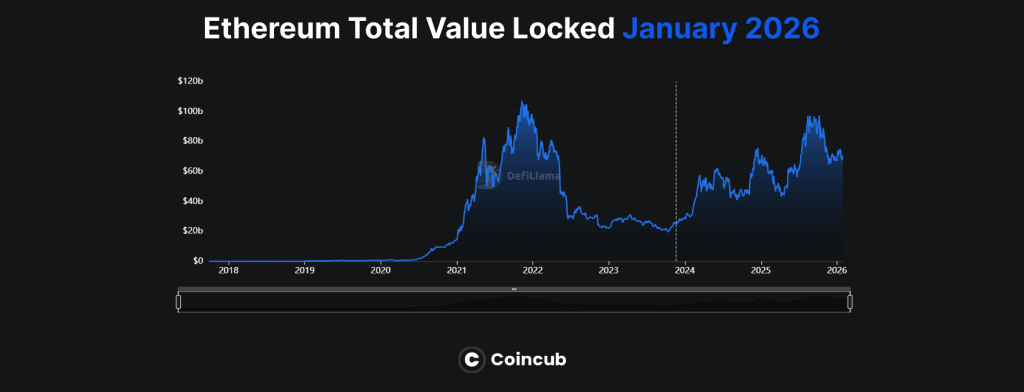
Ethereum’s ecosystem metrics paint a picture of steady maturity. Total Value Locked (TVL) across DeFi protocols built on Ethereum and its Layer-2 rollups sits near $100 billion, according to DefiLlama data.
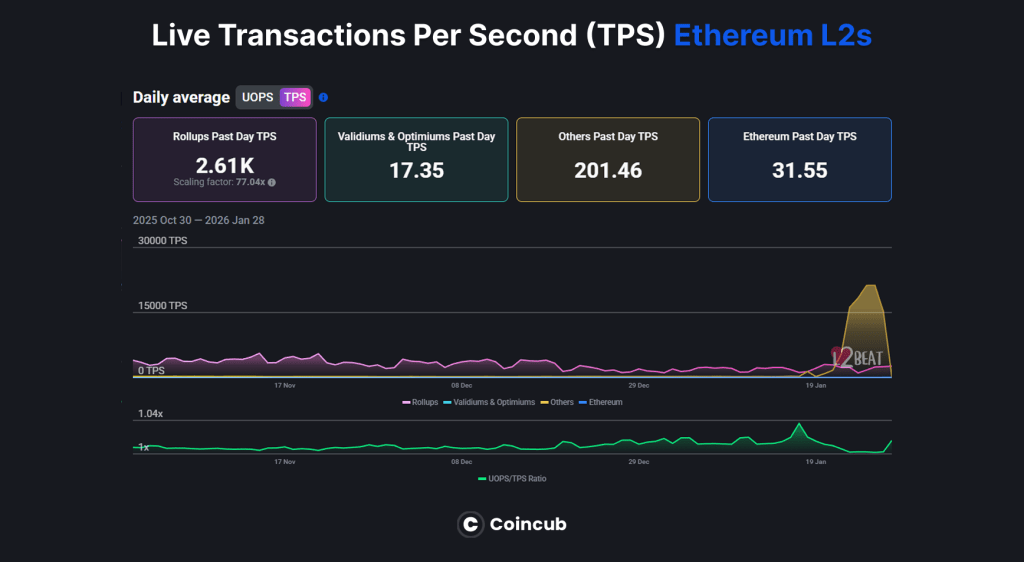
NFT volumes, though lower than during the 2021 mania, have stabilized with consistent activity on marketplaces like OpenSea and Blur. Layer-2 networks such as Arbitrum, Base, Optimism, and Polygon now process the majority of daily transactions, collectively handling more than ten times the throughput of the Ethereum mainnet. Meanwhile, validator participation continues to grow, surpassing 1.2 million active validators and securing over 30 million ETH in staking contracts.
The Merge and subsequent Shanghai upgrade reshaped Ethereum’s economics. Proof of stake reduced annual issuance by more than 85 percent, and the burn mechanism introduced in EIP-1559 continues to remove ETH from circulation. During periods of high network activity, Ethereum experiences net deflation, reinforcing its “ultrasound money” narrative and adding long-term pressure on supply.
Ethereum’s price performance also reflects its macro environment. The coin still moves in tandem with Bitcoin, revealing its sensitivity to global liquidity cycles. When central banks tighten policy, capital outflows hit speculative assets first, including crypto. When liquidity returns, Ethereum tends to outperform due to its yield-bearing nature and ecosystem depth.
Ultimately, Ethereum’s path toward $100,000 will not hinge on hype or social sentiment. It will depend on the network’s ability to sustain deflationary pressure, drive real economic activity through Layer-2 scaling, and remain the default platform for decentralized finance and tokenized assets. Fundamentals will decide its trajectory.
The Bull Case: Ethereum Will Reach $100k
3.1 Ethereum as a Global Settlement Layer
Ethereum’s greatest strength lies in its role as the security backbone of decentralized finance. Every major onchain asset, lending protocol, and stablecoin network depends in some way on Ethereum’s consensus layer for settlement and trust. Billions of dollars move daily across DeFi applications built on Ethereum or its scaling solutions, and those transactions ultimately settle on Layer 1, secured by a global network of validators. This base layer functions as a digital equivalent of the global banking infrastructure, neutral, auditable, and censorship-resistant.
The rise of Layer-2 rollups like Optimism, Arbitrum, Base, and zkSync has expanded Ethereum’s economic footprint. These rollups execute transactions offchain, compress them, and settle proofs on Ethereum’s mainnet. This creates a powerful feedback loop: more L2 usage generates more settlement fees on Layer 1, driving up ETH demand for gas and security. As rollup adoption accelerates, Ethereum earns a growing share of transaction revenue without congesting its base layer.
Ethereum’s design philosophy, often called the modular blockchain thesis, separates execution, settlement, and data availability. In this model, Ethereum becomes the world’s security anchor, a base layer where finality, credibility, and immutability exist. Whether users interact through consumer-friendly L2s or institutional rollups, ETH remains the currency that guarantees settlement integrity.
Looking forward, this structure carries enormous revenue potential. Each rollup batch submission, validator withdrawal, and staking transaction consumes ETH as gas. With rollup ecosystems now hosting everything from DeFi markets to onchain social networks, Ethereum’s transactional gravity is expanding. If the network maintains its position as the global settlement standard for digital value, ETH could command premiums similar to the dollar’s role in traditional finance. This long-term structural demand provides the foundation for the $100,000 narrative.
3.2 ETH as Ultrasound Money
Ethereum’s economic model changed forever after EIP-1559 and the Merge. Before these upgrades, ETH followed an inflationary trajectory similar to most proof-of-work coins. Post-Merge, it became a low-inflation asset with deflationary tendencies. The network now burns a portion of every transaction fee, permanently removing ETH from circulation. During periods of high network activity, the burn rate can surpass issuance, causing total supply to shrink.
This dynamic forms the core of the “ultrasound money” thesis. Unlike Bitcoin, which has fixed supply but no burn, Ethereum’s supply flexes with demand. As more users transact, more ETH disappears from the system. This self-reinforcing scarcity resembles a modern digital version of a gold standard, programmatic, transparent, and tied directly to network utility.
At the same time, staking introduces an additional yield component. Validators earn rewards for securing the network, typically between 3% and 5% annually, depending on total staked supply and transaction volume. This transforms ETH into a productive asset, blending qualities of a bond and a commodity. Holders can stake to earn passive income while benefiting from potential appreciation due to supply contraction.
Compared with Bitcoin’s fixed halving schedule, Ethereum’s burn-and-stake model responds dynamically to user activity. This makes it more adaptable to economic cycles and potentially more valuable as a monetary asset. The “digital oil” narrative that once described ETH’s utility is evolving into “digital money” and “digital yield.” In an economy where financial infrastructure runs onchain, assets that produce yield and retain scarcity will dominate. ETH’s design positions it as one of the few assets capable of fulfilling that role.
3.3 Institutional Adoption and Tokenized Assets
Ethereum’s future may depend less on retail enthusiasm and more on institutional integration. Over the past two years, major financial players have begun experimenting with tokenized assets on Ethereum-based networks. BlackRock, JPMorgan, and Franklin Templeton have all tested or deployed tokenized treasury products using Ethereum infrastructure. These tokenized instruments represent trillions in potential onchain capital once adoption matures.
The reason is straightforward. Ethereum offers interoperability, transparency, and programmable compliance that traditional systems lack. A bond or fund issued as an ERC-20 token can settle instantly, audit itself, and interact with smart contracts for collateral or yield generation. The demand for tokenized treasuries, money market funds, and stablecoins on Ethereum has surged because it combines regulatory-grade trust with the flexibility of blockchain.
This shift also connects Ethereum directly to the traditional financial system. As banks, asset managers, and payment companies launch products on Ethereum, they create indirect demand for ETH. Each tokenized asset transaction requires gas, each custodian must secure collateral, and each settlement event increases validator activity.
In the long term, Ethereum could evolve into a universal settlement network for both digital and traditional assets. If tokenized assets reach even 10 percent of the global bond and equity markets, Ethereum’s underlying token would experience sustained, structural demand unlike anything seen in crypto before. That influx of institutional liquidity could push ETH’s valuation into multi-trillion-dollar territory, bringing the $100,000 scenario into focus.
3.4 The Network Effect and Developer Dominance
Ethereum’s most powerful advantage lies in its developer network. No other blockchain comes close in terms of active contributors, tool maturity, or ecosystem diversity. Over 30 percent of all Web3 developers build on Ethereum or its rollups, ensuring continuous innovation and security improvements. From zero-knowledge proofs to account abstraction, nearly every major technical advancement in blockchain originates within the Ethereum ecosystem before spreading outward.
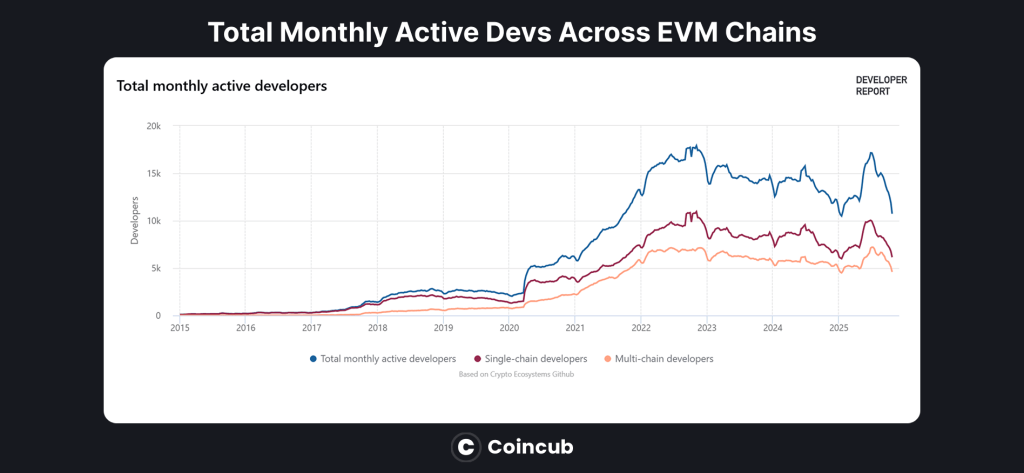
This developer dominance forms a self-sustaining cycle. More builders create more applications, which attract more users, which generate higher network fees and validator rewards. Competing chains often match Ethereum’s performance metrics but fail to replicate its depth of infrastructure or credibility. In crypto, talent compounds faster than capital, and Ethereum’s lead on this front has only grown.
Technological progress continues at a deliberate but steady pace. Upcoming upgrades like Danksharding, Verkle trees, and stateless clients will drastically improve scalability and lower costs while preserving decentralization. These changes will make Ethereum more efficient without sacrificing the security guarantees that define its brand.
This network effect, combining human capital, institutional trust, and technical resilience, represents a core pillar of the bull thesis. Even if competitors outperform Ethereum in certain metrics, few can match its combination of security, liquidity, and community governance. Over time, these qualities create an economic moat difficult to disrupt.
3.5 The Macro Catalyst
Ethereum’s potential for explosive growth remains tied to macroeconomic liquidity cycles. Historically, ETH has rallied during periods of monetary easing, especially after central banks reverse rate hikes. Lower interest rates reduce the opportunity cost of holding yield-bearing crypto assets and increase risk appetite across markets. In such conditions, Ethereum often leads the altcoin rally because it sits at the intersection of technology, finance, and yield.
The introduction of spot Ethereum ETFs in major markets could further amplify this effect. Institutional investors that previously avoided direct crypto exposure may gain access through regulated products, adding fresh inflows. Combined with staking rewards and deflationary mechanics, this institutional demand could create a supply squeeze unlike previous cycles.
Stablecoin adoption provides another macro tailwind. The majority of global stablecoin volume, whether USDC, USDT, or new entrants, is still issued or bridged through Ethereum-compatible networks. Each transfer or minting event indirectly drives ETH utility and fee consumption.
Finally, the geopolitical context matters. In an era of currency debasement and capital controls, Ethereum’s neutral settlement layer could attract nations, corporations, and individuals seeking reliable alternatives. If global finance shifts toward onchain transparency, Ethereum could stand at its core. Under those conditions, the $100,000 target transforms from speculation into a reflection of economic migration toward programmable money.
The Bear Case: Ethereum Will Not Reach $100k
4.1 Scaling and Fragmentation Risks
Ethereum’s biggest weakness is its complexity. While the modular architecture allows flexibility, it also creates fragmentation. Users face a maze of Layer-2 networks, bridges, and token standards that complicate the experience. Liquidity is scattered across dozens of rollups like Arbitrum, Optimism, Base, zkSync, and Scroll. Each one uses unique bridging systems, leading to inefficiencies and security vulnerabilities. In practice, this undermines Ethereum’s claim of being a unified global settlement layer.
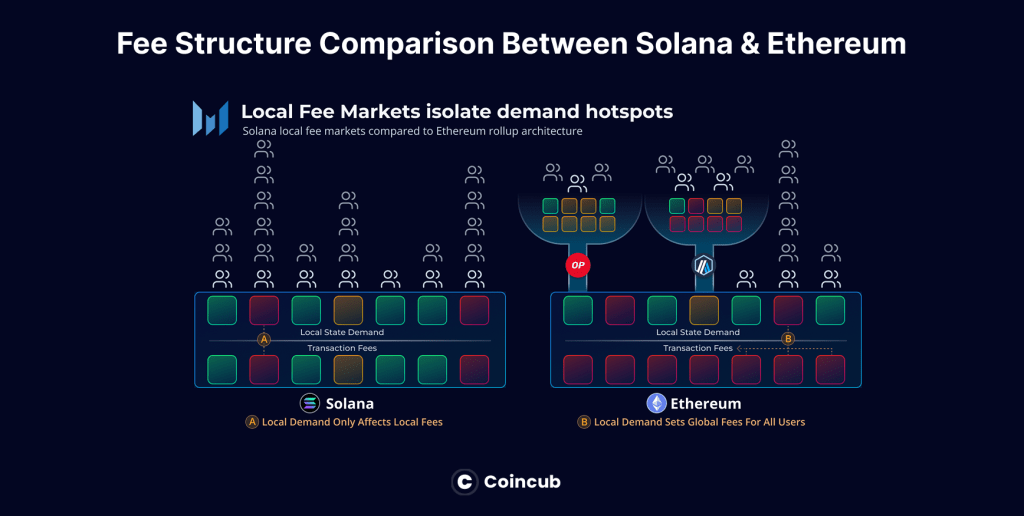
The issue extends beyond usability. Rollups rely on Ethereum for settlement but compete for users, liquidity, and developer attention. This fragmentation leads to diluted network effects and increases systemic risk. A bridge exploit or sequencer failure in one rollup can ripple through the entire ecosystem, damaging Ethereum’s credibility as a secure foundation.
Meanwhile, Ethereum’s roadmap remains slow-moving. Full sharding and data availability improvements, key to long-term scalability, have been delayed multiple times. This has opened the door for monolithic chains like Solana to advance rapidly. Solana’s single-layer architecture offers simplicity and speed that institutions increasingly value. Western Union’s decision to launch its USDPT stablecoin on Solana reflects that preference. Solana’s low fees, high throughput, and integrated architecture make it more practical for real-world financial applications that demand predictable performance.
If Solana, Aptos, or Sui continue to improve reliability while maintaining low costs, Ethereum could lose relevance in use cases that require real-time finality, such as payments and retail finance. Ethereum may remain dominant in DeFi and high-value settlement, but faster, more efficient chains could chip away at its market share before the $100,000 dream ever materializes.
4.2 Regulatory Uncertainty
The path to $100,000 ETH depends heavily on regulatory clarity, which remains elusive. In the United States, the SEC’s ambiguous stance on whether ETH is a security still hangs over the market. After the Merge shifted Ethereum from proof of work to proof of stake, regulators began questioning whether staking rewards constitute investment contracts. Any classification of ETH as a security could restrict exchange listings, institutional adoption, and even staking participation within the U.S.
In Europe, the MiCA framework provides more clarity but adds compliance burdens. Staking providers and DeFi protocols operating in the EU must register as Virtual Asset Service Providers (VASPs) and implement stringent KYC/AML controls. This adds friction to Ethereum’s permissionless model, potentially discouraging smaller participants. The same trend appears globally, as countries from Singapore to Canada explore similar requirements.
For institutional investors, these rules matter. Regulatory uncertainty reduces the incentive to hold ETH directly, especially when custodial staking could be treated as a regulated financial service. As a result, large asset managers may prefer exposure through derivative products or ETFs, which limit the supply impact on the network itself.
If global regulators impose strict reporting or compliance obligations on staking, Ethereum’s yield advantage could erode. Without staking as a major driver of demand, ETH’s valuation ceiling would flatten. In that scenario, the idea of a $12 trillion network becomes far harder to justify.
4.3 Economic Reality Check
For Ethereum to reach $100,000 per token, its market capitalization would exceed $12 trillion. That figure is greater than the current market value of gold and nearly half the GDP of the United States. Even with optimistic assumptions about global tokenization and DeFi adoption, sustaining such a valuation would require unprecedented levels of institutional and sovereign participation.
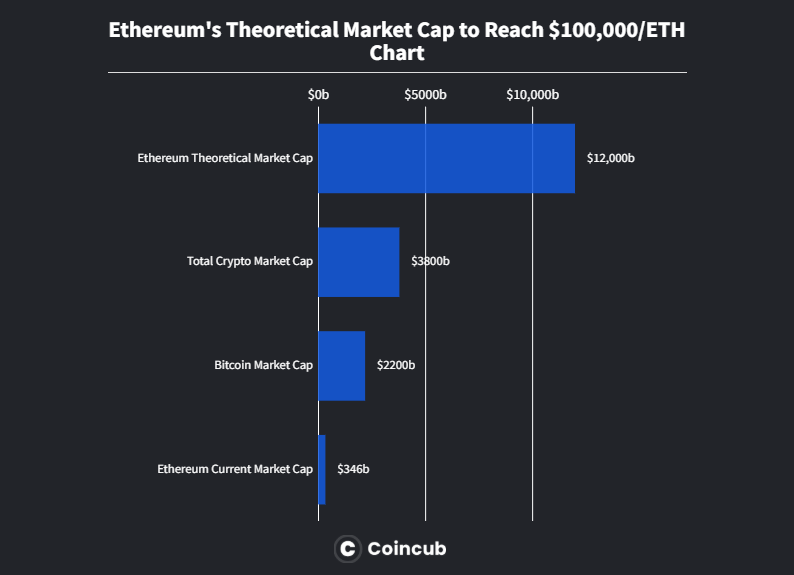
At present, the entire cryptocurrency market combined is worth roughly $2.5 trillion. Even if Ethereum captured 60 percent of that value, an extremely bullish scenario, it would still represent less than $2 trillion. For ETH to appreciate fiftyfold from its 2026 level, it would need continuous inflows of hundreds of billions annually, alongside exponential network growth.
Investors must also consider demographics and capital allocation behavior. Institutional investors treat ETH as a risk asset correlated with tech stocks, not as a monetary reserve like gold. Pension funds and sovereign wealth funds move slowly, requiring clear regulation and liquidity guarantees before deploying serious capital. Without that alignment, Ethereum’s adoption curve could plateau far below the levels implied by a $100,000 valuation.
This economic reality tempers the bull narrative. Ethereum can grow substantially as an infrastructure layer, but its token price reflects global liquidity, investor psychology, and opportunity cost. Even under ideal macro conditions, reaching a $12 trillion market cap could take decades, not years.
4.4 Competition and Technological Fatigue
Ethereum’s long-term dominance is not guaranteed. The competition has caught up, and in some cases, surpassed it in key performance metrics. Solana has emerged as the most credible challenger, delivering over 60,000 transactions per second with negligible fees. Its technical efficiency and developer resurgence have attracted both consumer and institutional projects. Partnerships with payment processors like Visa and Western Union illustrate that Solana’s architecture aligns better with high-volume financial use cases.
Beyond Solana, ecosystems like Cosmos and Avalanche offer alternative visions. Cosmos focuses on interoperability through its IBC protocol, creating a network of sovereign blockchains that communicate seamlessly. Avalanche promotes customizable subnets that appeal to enterprises seeking control without giving up decentralization. Each model presents a different challenge to Ethereum’s “fat protocol” thesis, which assumes value accrues to the base layer.
Ethereum’s slower pace of UX improvements and complex rollup structure can lead to developer fatigue. Builders often choose faster, cheaper environments where user onboarding is simpler. This fragmentation risks pushing innovation away from Ethereum’s core.
In a multichain future, value could disperse rather than concentrate. Ethereum may remain the most secure and composable chain, but not necessarily the most used. If transaction activity and developer talent continue to diversify across networks, ETH’s dominance, and by extension, its long-term valuation potential, could steadily decline. The bear case argues that the future of crypto will be collaborative, not monopolistic, and in that world, Ethereum’s ceiling might be lower than believers expect.
Realistic Pathways and Timelines for Ethereum to Hit $100,000
For Ethereum to reach $100,000 by 2030, a very specific chain of events must unfold. First, global DeFi adoption would need to accelerate beyond today’s niche participation. Major financial institutions, payment networks, and even governments would have to rely on Ethereum or its rollups for settlement. This means trillions in tokenized assets, real-world collateral, and stablecoins flowing through Ethereum infrastructure daily. Second, spot Ethereum ETFs across the U.S., EU, and Asia would need to attract sustained inflows, turning ETH into a recognized institutional asset alongside Bitcoin and gold. Third, Layer-2 scaling fees and settlement volumes must rise significantly, creating consistent burn pressure that makes ETH truly deflationary. Only when supply contracts while demand broadens could $100,000 ETH become mathematically feasible.
A more realistic outlook places Ethereum between $10,000 and $25,000 by the end of this decade. This range assumes steady network adoption, regulatory clarity in key markets, and modest ETF participation. Under these conditions, Ethereum would remain the dominant smart contract platform but without the exponential growth needed for a multi-trillion-dollar valuation.
However, both acceleration and derailment are possible. Rapid progress in tokenized finance, coupled with central banks adopting onchain settlement, could propel ETH faster than expected. On the other hand, strict regulation, major smart contract exploits, or a superior alternative like Solana achieving widespread adoption could cap its upside.
For investors, the lesson is discipline. Ethereum’s story is about yield, security, and infrastructure, not price fantasies. Those who treat ETH as a productive, yield-bearing asset rather than a speculative token are best positioned to benefit from its evolution, regardless of whether it stops at $10,000 or reaches six figures.
Final Thoughts on Ethereum Reaching $100,000
Ethereum stands as the most credible non-Bitcoin network in existence. It has survived market crashes, regulatory threats, and countless competitors while maintaining its status as the backbone of decentralized finance. Its ecosystem now spans from institutional-grade tokenization to experimental gaming economies, proving that Ethereum is more than a blockchain, it is programmable infrastructure for a digital financial system.
The idea of a $100,000 ETH is not impossible, but it remains extremely improbable without a structural shift in global finance. For that milestone to materialize, governments, corporations, and markets would need to integrate Ethereum’s rails as standard infrastructure. That means tokenized treasuries, cross-border settlements, and financial instruments built directly onchain, with ETH serving as the universal settlement currency.
Whether or not that future arrives, Ethereum has already crossed a critical threshold. It is no longer a speculative side project, it is financial infrastructure in motion. The network produces real yield, burns real value, and underpins real markets.
In the end, Ethereum’s success will not be defined by the number on a price chart but by its role in shaping how money, identity, and data interact in the digital age. The future of ETH depends less on how high it climbs, and more on how deeply it embeds itself into the machinery of global value exchange. At the end of the day, the crypto industry has surprised the world countless times, who’s to say that it won’t surprise us again?
Frequently Asked Questions (FAQ)
What is Ethereum's price in 2026? +
As of mid-2026, Ethereum trades in roughly the 1,750 to 1,800 dollar range, with a market capitalization near 233 billion dollars. The price stayed below earlier-cycle highs as liquidity tightened, so always confirm with a live source before relying on a figure.
What market cap would Ethereum need to reach $100,000? +
For ETH to reach 100,000 dollars, its market capitalization would need to exceed 12 trillion dollars, more than the total value of all gold and far above the entire crypto market today. This is why a six-figure ETH is considered possible only over the very long term.
How much will 1 Ethereum be worth in 2030? +
Ethereum could trade between $5,000 and $12,000 by 2030, depending on global adoption, staking yields, and regulatory clarity surrounding decentralized finance and institutional demand.
Can Ethereum hit $50,000? +
Ethereum could reach $50,000 if global adoption of decentralized finance and tokenized assets accelerates, transaction fees drop through scaling upgrades, and institutional investment rivals Bitcoin’s market demand over the next decade.
Can Ethereum reach $1 million? +
No. Reaching $1 million per ETH is highly unlikely under current market structures. It would require global crypto adoption, trillions in capital inflows, and Ethereum capturing a dominant share of all digital and financial infrastructure. Even then, Ethereum would require over $100 trillion in market cap to reach such a price.
Can Ethereum overtake Bitcoin? +
Although highly unlikely, Ethereum could overtake Bitcoin in market capitalization if decentralized finance, tokenization, and smart contract adoption grow faster than Bitcoin’s store-of-value appeal, though Bitcoin’s brand dominance and limited supply still give it a major advantage.
Will Ethereum ever get to 100,000? +
Ethereum reaching $100,000 is possible but unlikely without massive institutional adoption, mainstream tokenization, and global DeFi growth, and outperforming competitors. It would require a market cap above $10 trillion, placing it near the total value of today’s global equities.