Buy a Licensed Company
  Explore VASP Data
  Talk to an Expert

 Atis Shala
Atis is a senior analyst and community lead with four years of experience in crypto. He has a bachelor from the Rochester Institute of Technology.
Atis Shala
Atis is a senior analyst and community lead with four years of experience in crypto. He has a bachelor from the Rochester Institute of Technology.
AI and Smart Contracts: Decentralized Automation
Artificial intelligence (AI) is advancing extremely fast. Models that once required supercomputers now run on consumer hardware. They generate text, analyze markets, predict patterns, and adapt in real time. This accessibility has pushed AI into every sector, from medicine to finance, and its influence is growing daily.
Blockchain, on the other hand, solved a different problem. It redefined trust in a digital environment, allowing strangers to transact and coordinate without intermediaries. At the heart of this web3, digital era are smart contracts: pieces of code that execute automatically when conditions are met. They are transparent, tamper-resistant, and enforce rules with mathematical certainty.
The real breakthrough comes when AI and smart contracts interlap. AI provides intelligence, interpretation, and adaptability while smart contracts provide trust, execution, and immutability. Together, they open a design space that neither can unlock alone.

Consider oracles, which feed real-world data to blockchains. Traditional oracles are rigid data pipes. An AI-powered oracle, however, can filter noise, detect fraud, and weigh sources for accuracy. In decentralized finance, AI could optimize lending rates or predict volatility, making protocols safer and more efficient; in gaming, AI-driven agents could interact with players, while contracts enforce ownership of assets; in governance, AI could summarize proposals and simulate outcomes, empowering token holders to make informed decisions. Because of these facts, and many more that we won’t get into, the combination of AI and blockchain technology opened a whole new spectrum of tools and apps for the average user.
This vision is not without risk, however. AI models are usually not transparent and prone to bias, while smart contracts are usually irreversible once deployed or executed. Over-automation could trigger catastrophic losses if unchecked. Transparency, human oversight, and gradual adoption will be essential until a certain point.
Still, the fusion of AI and smart contracts points toward a new era: decentralized systems that don’t just follow inflexible logic but adapt intelligently to the world around them.
What Are Smart Contracts?
Before we get into their overlap with AI, let’s take a brief look at what smart contracts actually are and how they work.
A smart contract is a self-executing piece of code that lives on a blockchain. It carries out instructions exactly as written, without the need for a central authority to oversee the process. Ethereum brought the idea into the mainstream, but today the same mechanism powers ecosystems like Solana and Avalanche.
What makes smart contracts powerful is their reliability. Once conditions are set, they automatically trigger the agreed action. That could mean releasing collateral after a loan is repaid, transferring tokens once a purchase is made, or distributing rewards in a staking pool. Every step is enforced by the blockchain itself, not by a third party. This design makes them transparent, since the code is visible to anyone who wants to audit it, and immutable, since once deployed they are incredibly difficult – virtually impossible if done right – to change. Their execution is trustless, which means users don’t need to rely on intermediaries. The rules are locked in and guaranteed by the network.
These qualities have shaped the crypto ecosystem. Smart contracts made decentralized finance possible, allowing traders to borrow, lend, and swap assets without banks. They gave rise to decentralized exchanges, NFT marketplaces, and decentralized autonomous organizations. In each case, the contract provides the foundation of trust, removing friction from interactions in the web3 space and enabling new forms of coordination.
But these contracts remain bound by their deterministic nature. They do not think or adapt. They cannot weigh context or make judgments. If the instructions are incomplete or the inputs uncertain, the contract cannot improvise. This is where artificial intelligence becomes a natural complement. AI can interpret uncertainty, process vast data sets, and make predictive judgments, while smart contracts can enforce rules and execute decisions. If executed carefully, this combination is more powerful than anything that we already have in the industry.
What AI Brings to the Table
So, essentially, artificial intelligence is not bound by strict code like smart contracts are. Instead, it thrives in fluid environments where outcomes are uncertain and variables constantly shift. What makes AI powerful is not just the data it processes but the way it interprets that data, assigning probabilities, weighing possibilities, and reaching conclusions that are rarely black and white. This flexibility allows it to operate in domains that resist strict definitions.
If we were to simplify the difference between the two, here’s an analogy. Think of AI as an adaptive lens. Where a blockchain contract only sees a narrow, predefined set of conditions, an AI model scans the entire landscape, noticing correlations and anomalies that might escape deterministic logic. It does not simply react but anticipates, reshaping its output as new information floods in. The process resembles intuition, though built on vast computation.
Another dimension of AI’s strength lies in its ability to transform complexity into clarity. Financial markets, for example, generate waves of conflicting signals. An AI system can filter this noise, highlight meaningful trends, and even detect hidden drivers behind price action. In creative contexts, the same mechanisms generate text, images, or strategies that feel distinctly human in their fluidity.
Yet AI is not without boundaries. It produces results that are convincing but not always correct, a reminder of its probabilistic core. Unlike the certainty of a contract enforced by a blockchain, its conclusions must be judged in context. This tension is precisely why the intersection with smart contracts is compelling as one side brings reasoning and adaptability, the other enforces execution with absolute integrity.
Together, they create an unusual combo. AI imagines and interprets. Smart contracts verify and enforce.
AI and Smart Contracts
Dynamic Oracles
The real power of combining AI with smart contracts emerges once you consider how these systems connect to the outside world. A contract by itself can only act on what it sees onchain. Since AI’s strength is thriving in uncertain environments, that becomes essential when applied to oracles, the lifelines that feed smart contracts with real-world information.
Traditional oracles behave like pipelines. They move data from point A to point B without context. Reliable enough when markets are calm, but fragile when conditions turn unpredictable. Here, AI adds a layer of interpretation. It can sift through conflicting feeds, separate indicators from noise, and judge whether incoming information deserves to be trusted. Simply put, from mere relays to intelligent filters.
In practice, this changes the reliability of entire ecosystems. A decentralized insurance contract, for example, does not just rely on a timestamped flight delay from one source. An AI-enhanced oracle could weigh airport logs, weather data, and even cross-check airline announcements to verify the claim. The result is a contract that enforces rules with blockchain certainty, while leaning on AI’s ability to recognize truth in complexity.
Adaptive DeFi Strategies
If smarter oracles make contracts more aware of the world, adaptive strategies make them more responsive to it. DeFi has always been built on logic carved into code: collateral ratios, yield formulas, liquidation thresholds. These rules give stability, but they are unsustainable in markets that never stop shifting.
AI offers a way to inject foresight into systems that otherwise only react. Instead of waiting for stress to break them, protocols could lean on predictive models that sense turbulence ahead of time. Imagine a lending platform where interest rates shift not only with supply and demand, but also with forecasts of future volatility, fed through intelligent oracles. The contract still enforces the rules, but the rules themselves breathe with the market.
For traders, that could mean fairer pricing and fewer shocks. For protocols, it could be the difference between stability and uncertainty.
Smarter Governance in DAOs
Governance has always been the promise and the weakness of decentralized systems. Giving token holders a voice sounds ideal, but in practice participation is thin and the process drags. Many members tune out because the material is overwhelming or the implications are unclear. The result is often a handful of voters steering massive treasuries with little understanding of what’s going on.
In this case, AI helps reframe that same information. A proposal buried in technical language could be translated into summaries that show the stakes at a glance. Instead of scrolling through dozens of pages, members would see the trade-offs, risks, and modeled outcomes in digestible form.
AI Agents as Onchain Actors
So, we have established that AI can guide governance. Now, the next step would be letting it act within the system itself. Picture autonomous agents operating as full participants in the onchain economy. These agents could manage liquidity positions, trade across protocols, or even negotiate with other agents, all executed through smart contracts. Unlike human users, they would not tire, lose focus, or miss opportunities that appear for only seconds.
The idea may sound futuristic, but it really isn’t that far fetched. AI can make decisions in uncertain environments, and smart contracts can enforce those decisions without compromise. Together they create AI agents that think probabilistically yet operate within the rules. While we are still early, such a combo on a large scale could result in markets that never sleep and organizations that evolve continuously.
DeFAI, for example, already deploys intelligent agents that autonomously navigate DeFi. These agents continuously monitor data, adjust strategies, and rebalance investments without constant human oversight. The future is already here.
Gaming and Virtual Economies
Gaming is quickly becoming one of the most interesting sectors of crypto where AI agents and smart contracts intersect. In Web3 games, AI can control non-player characters that respond dynamically to players, while contracts verify ownership of items and enforce scarcity. Projects like Star Atlas are already experimenting with vast virtual economies where assets are tokenized and governed fully onchain.
Meanwhile, a decentralized protocol known as Altered State Machine gives players the ability to train AI agents that compete in sports or strategy games, creating characters that learn over time. The combination means worlds that feel alive. Instead of scripted environments, these ecosystems adapt, creating economies that are both playful and real.
Compliance and Regulation
The European Union is known to be the big bad compliance wolf for the crypto industry, especially after the MiCA framework. However, they have also released the AI Act that classifies AI uses by risk level. High-risk systems face strict oversight and transparency standards, with penalties of up to seven percent of global revenue for non-compliance.
The law applies to providers even outside the EU if their systems operate there. In parallel, jurisdictions like California have advanced AI safety bills, including measures to require explicit disclosure when AI mimics real people. There is still a long way to go before clear, positive frameworks exist for both AI and smart contracts, and for how they may be used together. Until then, builders will continue to explore and experiment, as they should.
What Are Some AI Projects in Crypto?
Allora Network
At the heart of decentralized AI lies Allora Network, a protocol designed to aggregate and refine machine learning models from a distributed community. It brings transparency by having multiple AI models compete, collaborate, and validate predictions collectively, making it a self-improving system built on the Cosmos blockchain.
Allora extends beyond raw computation; it aligns incentives so that the most accurate contributors earn rewards, offering a cryptographically verifiable basis for AI outputs.
What makes Allora especially compelling is its integration with tools like Coinbase AgentKit, enabling AI agents to autonomously execute smart contract-based transactions. With this, developers can build agents that reason, act, and transact onchain, leveraging both the collective intelligence of Allora and the secure execution layer of smart contracts.
The Graph
While not an AI model itself, The Graph plays an essential role in enabling AI-driven smart contracts to function. AI systems are only as effective as the information they process, and smart contracts require reliable onchain and off-chain inputs to execute correctly. Without structured, trustworthy data, both become fragile. The Graph fills that gap by acting as a decentralized indexing protocol for blockchain data.
Through its system of subgraphs, developers can query and retrieve blockchain events in real time, with results guaranteed by cryptographic proofs. For AI, this is invaluable. Intelligent agents operating onchain can call The Graph to fetch historical or live market data, token balances, governance records, or NFT metadata in a structured, machine-readable way. Smart contracts then consume this data with confidence, knowing it has been indexed transparently and without reliance on a single data provider.
This positions The Graph as the quiet backbone for AI-powered oracles, trading bots, and governance tools. For example, an AI-enhanced oracle could pull indexed liquidity data from The Graph, process it to forecast volatility, and then feed those insights into a lending protocol’s smart contracts. The contract enforces execution, while AI interprets and predicts, and The Graph ensures the data pipeline remains tamper-proof.
In this sense, The Graph makes the integration of AI and smart contracts practical. By standardizing access to blockchain data, it allows AI agents and decentralized applications to reason, decide, and act in real time with a foundation of clean, verifiable information.
Ten Protocol
Among the emerging projects that perfectly illustrate the fusion of AI and smart contracts, TEN Protocol stands out. It is a Layer-2 solution on Ethereum that introduces something few others offer: confidential smart contract execution paired with AI-native architecture. TEN achieves this using Trusted Execution Environments (TEEs), the same hardware-secured enclaves endorsed by banks and large technology firms.
What sets TEN apart in the AI-smart contract intersection is its concept of confidential rollups. Smart contracts and even user agents run inside these secure enclaves, meaning contract code, data inputs, and state remain private, even from the operators themselves.
On top of that, TEN supports AI-native agents, where each user can have a personal, autonomous AI agent living inside a TEE. These agents can manage assets, engage with dApps, make recommendations, and transact while maintaining privacy and immutability.
A flagship application illustrating TEN’s power is House of TEN, a fully onchain poker game where AI agents play with encrypted hands, utilize real randomness, and execute bets securely without any off-chain logic. Developers also benefit from TEN’s “smart transparency” model, allowing them to control what data remains private, what is revealed later, and what stays public. This enables confidential DeFi, dark pools, or private gaming using familiar Solidity tools.
In sum, TEN Protocol creates an environment where AI and smart contracts coalesce: intelligent agents operate within encrypted, verifiably secure smart contracts. As such, it’s a practical framework for private, autonomous, and trustworthy Web3 applications.
NEAR Protocol (NEAR)
NEAR Protocol approaches the AI and smart contract intersection from a different angle. Rather than embedding AI models directly into contracts, NEAR positions itself as the execution layer for AI-native applications. It is designed to let autonomous agents operate seamlessly within a blockchain environment, handling everything from identity and data routing to transaction settlement.
For AI systems to function onchain, they need more than raw computation. They need a framework that allows them to act, coordinate, and finalize decisions without friction. NEAR provides this by giving developers tools to build apps where AI agents interact directly with smart contracts. These agents can trigger financial transactions, participate in governance, or manage digital assets, while the contracts guarantee execution and immutability.
This design reflects NEAR’s emphasis on usability. Its architecture is developer-friendly, scalable, and adaptable, making it possible to connect AI decision-making with blockchain enforcement in a straightforward way. For example, an AI-powered recommendation engine could run off-chain but execute trades or asset reallocations securely through NEAR smart contracts. The intelligence comes from AI, the certainty from the blockchain, and NEAR acts as the bridge between the two.
By enabling autonomous systems to operate as first-class citizens within Web3, NEAR paves the way for AI-driven economies that remain transparent, accountable, and trustless.
Internet Computer Protocol (ICP)
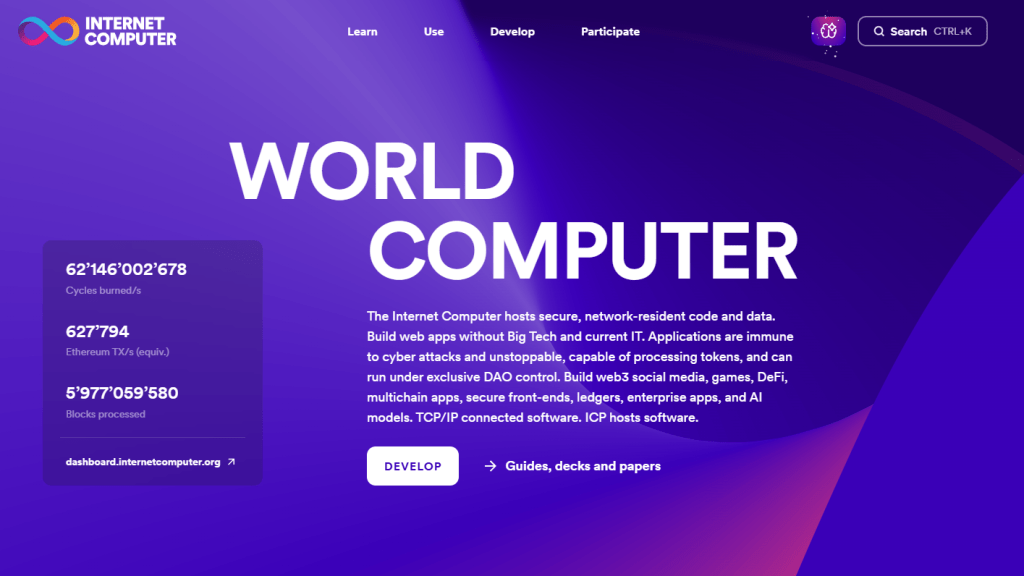
Internet Computer Protocol (ICP) is among the rare blockchains that allow AI models to run directly onchain as smart contracts, blurring the line between decentralized code and intelligent systems. It’s the only public network built to host AI in tamper-proof, autonomous “smart contract” form.
ICP’s smart contracts, known as “canisters,” support substantial memory resources and are enough to host image classifiers and smaller language models such as Llama 3 (8B) entirely onchain. That means AI inference happens within the blockchain’s execution environment, ensuring results are verifiable and immutable.
Building on this, ICP supports fully autonomous AI agents. These agents can interact with multiple networks, including Ethereum and Bitcoin, via Chain Fusion, letting onchain AI communicate and operate across ecosystems.
This architecture sets the stage for a decentralized “AI agent economy,” where models can transact, collaborate, and evolve confidently within the rules of smart contracts.
ICP’s design enables a truly integrated AI ecosystem where intelligence and execution fuse seamlessly. No off-chain middleware. No third-party validators needed to enforce outcomes. AI models live inside the chain itself, evolving, acting, and executing.
ChainGPT (CGPT)
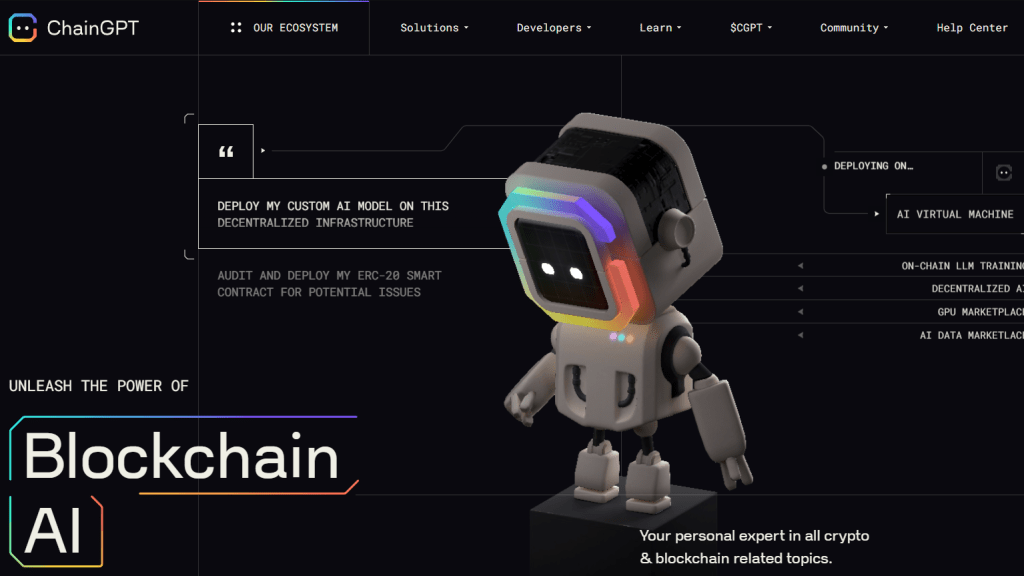
ChainGPT places artificial intelligence at the heart of smart contract creation and security. Rather than hosting AI within the blockchain itself, ChainGPT offers on-demand smart contract generation, auditing, and assistance. This effectively turns AI into a powerful development companion for Web3 builders.
At its core is Solidity LLM, a specialized language model trained on high-quality smart contract code, security vulnerabilities, real-world examples, and industry best practices. It can generate robust, multi-chain contracts, from ERC-20 tokens to NFT marketplaces or AMM DEXs, with a few natural-language prompts. This means developers can prototype and deploy custom contracts in under a minute.
ChainGPT also includes an AI-powered smart contract auditor. Before deploying, users can run an AI scan to detect bugs, security flaws, and coding anomalies. Unlike time-intensive manual audits, this tool delivers quick, cost-effective feedback with cross-chain support that spans BNB Chain, Ethereum, Arbitrum, Avalanche, and more.
Beyond development, ChainGPT extends AI assistance through a suite of tools: AI chatbots for natural-language queries, NFT generators, trading assistants, and even a browser extension (“CryptoGuard”) that flags phishing sites and malicious smart contracts. All these services integrate with the $CGPT token and DAO, weaving AI utility with governance and incentives.
The Risks of AI Smart Contracts
The idea of merging AI with smart contracts is quite amazing, and until today, we’ve seen a lot of developers combining those two almost perfectly. However, the risks cannot be ignored.
One of the biggest concerns is transparency. Blockchains are designed to be auditable, with every rule and transaction visible on a public ledger. AI models, by contrast, are often non-transparent. Their decision-making processes are buried in layers of computation that even their creators struggle to fully explain. Combining these two systems introduces new trust problems as users may rely on a contract whose logic they can see, but whose inputs come from an algorithm they cannot fully understand.
Another big challenge is bias. AI systems reflect the data they are trained on, and if that data carries distortions or blind spots, the results will too. A predictive model feeding an oracle could favor certain outcomes, subtly tilting markets in ways that benefit some actors while disadvantaging others. Even the possibility of such an event removes fairness from the equation.
Security is also a major issue. Smart contracts already carry risks of exploits when written carelessly. Adding AI widens the attack surface. Adversarial inputs could trick models into delivering faulty information, which in turn could trigger unintended financial outcomes onchain.
Ultimately, the biggest of AI smart contracts is likely going to be regulations. Governments are still grappling with crypto’s legal boundaries. Layering AI into the mix adds complexity that regulators are only beginning to address.
The Future of AI and Smart Contracts
Bearish Scenario
The bearish outcome for AI smart contracts is one where enthusiasm burns bright but fades quickly. The concept is great – merge adaptive intelligence with rigid, trustless code – but is it achievable. The very differences that make AI and smart contracts appear complementary could also make them incompatible.
One of the first stumbling blocks would be transparency. Blockchains promise clear, auditable rules. AI, however, operates as a black box. If a lending protocol bases its risk models on an AI-driven oracle, users may not understand why rates suddenly spike or why collateral was liquidated. This lack of clarity erodes trust, the foundation of decentralized finance. Traders and developers alike may retreat to simpler, more predictable systems.
Security failures could accelerate this decline. Imagine an adversarial attack where malicious actors feed corrupted data into an AI oracle. The model misclassifies market conditions, triggering widespread liquidations across a lending platform. Billions in value could evaporate in minutes. Once such an event occurs, confidence is difficult to rebuild. Investors scarred by a catastrophic collapse may refuse to touch AI-enhanced systems again.
Regulation would only deepen the struggle. Governments already view crypto with suspicion. The opacity of AI models adds another layer of risk, providing regulators with justification to impose sweeping restrictions. A global framework could emerge that requires explainability for all AI systems, a standard incompatible with many current models. If protocols cannot comply, they may shut down or be forced into obscure jurisdictions with little liquidity.
In this world, AI and smart contracts remain an interesting experiment but fail to secure lasting adoption. Projects pivot back to traditional oracles and deterministic code, and the notion of onchain AI becomes a footnote in crypto history a promise that proved too complex to deliver.
Realistic Scenario
The most plausible future for AI and smart contracts lies somewhere between collapse and domination. Adoption does happen, but not evenly, and not without setbacks. Certain applications thrive, while others stall under technical, social, or regulatory weight.
In this world, early experiments reveal both promise and fragility. AI oracles improve reliability in some areas, filtering data for insurance claims or sports betting markets, but stumble in high-stakes financial environments where even small errors can spark outsized losses. A few protocols suffer from exploits that shake confidence, yet the industry learns from these failures, introducing better safeguards and hybrid designs where human oversight is built into automated systems.
DeFi platforms cautiously integrate AI. Rather than handing full control to autonomous agents, they use AI for advisory roles: suggesting optimal collateral ratios, predicting liquidity crunches, or highlighting systemic risks. Final execution remains governed by deterministic rules. This compromise balances innovation with predictability, allowing traders to benefit from AI’s foresight without ceding full control.
DAOs, meanwhile, find AI most useful as an interpreter rather than a decision-maker. Summaries, sentiment analysis, and outcome modeling boost participation, though final votes remain in human hands. Gaming emerges as the boldest frontier, with AI-driven agents enriching virtual economies where the stakes are entertainment rather than financial stability.
Regulation lands somewhere in the middle. Strict requirements emerge for financial protocols, slowing experimentation, while lighter rules apply to creative and social applications. Some regions embrace the technology, while others ban it outright, creating a fragmented global map.
Overall, AI and smart contracts carve out meaningful niches without rewriting the entire ecosystem. They enhance Web3 rather than define it, leaving space for both human judgment and machine intelligence to coexist. Progress is steady, imperfect, and deeply uneven… but real.
Bullish Scenario
In the most optimistic version of the future, AI and smart contracts evolve from experimental hybrids into the foundation of decentralized systems. Early challenges of transparency and security are addressed through open-sourced AI models, verifiable training data, and new standards for accountability. Rather than being black boxes, these models come with audit trails that show how conclusions are reached. This transparency restores the trust that skeptics feared would be lost.
DeFi becomes the clearest success story. Lending platforms run on adaptive risk engines, with AI oracles scanning thousands of signals across markets. Instead of waiting for volatility to strike, contracts adjust collateral ratios and interest rates preemptively, stabilizing entire ecosystems. Market crashes that once cascaded into liquidations are softened by predictive systems that act in real time. Traders benefit from resilient platforms that protect capital while still delivering competitive returns.
DAOs also flourish under this model. Proposals are not just summarized but simulated across multiple scenarios, allowing communities to see the long-term consequences of each choice. Engagement rises because token holders feel empowered by clarity, and governance evolves into a dynamic, informed process.
Meanwhile, gaming and virtual economies become living laboratories for AI agents. Players train characters with unique personalities and skills, while ownership of these agents is secured by smart contracts. These experiences spill into broader economies, where onchain AI agents act as autonomous treasurers, traders, or even negotiators between organizations.
Crucially, regulators adapt rather than resist. The EU’s AI Act and similar laws around the world expand to recognize decentralized compliance systems, rewarding projects that prove both safe and auditable. With governments onboard, capital flows into the space. AI-powered contracts become not just an option but the standard. What began as an experiment grows into the backbone of Web3 itself.
Final Thought on the AI Smart Contracts
Artificial intelligence and smart contracts sit at the crossroads of two of the most transformative technologies of our time. AI learns, interprets, and adapts. Smart contracts enforce, verify, and guarantee. Alone, each has already proven its disruptive power. Together, they open an entirely new canvas for building decentralized systems that are both intelligent and incorruptible.
The road ahead will not be simple. Experiments will fail, regulators will intervene, and security challenges will test even the strongest protocols. Some projects may vanish, while others evolve into the pioneers that set new standards. This is the natural course of innovation. Just as early internet applications looked crude compared to what came after, the first iterations of AI-driven contracts will seem limited when viewed in hindsight.
What matters is the direction of travel. Each year, models grow faster and more accessible, while blockchains become more scalable and composable. The momentum is undeniable. We are moving toward systems that combine foresight with enforcement, adaptability with trust.
Whether the outcome reflects the bearish, realistic, or bullish path, one truth is clear: the overlap of AI and smart contracts will shape the next wave of Web3. Even if adoption begins in narrow niches like gaming, governance support, or advisory tools in finance, the lessons learned will ripple outward.
The promise of decentralized automation is not just efficiency or profit. It is about creating digital systems that can think, decide, and act without losing the transparency and fairness that blockchain introduced. If builders and regulators can strike the right balance, the fusion of AI and smart contracts could mark the beginning of an era where intelligence and trust finally share the same stage.
Frequently Asked Questions (FAQs)
What is an AI smart contract?
An AI smart contract combines blockchain automation with artificial intelligence, enabling digital agreements that adapt, learn, and self-execute. Unlike traditional smart contracts with fixed logic, AI-powered versions analyze data, adjust terms dynamically, and make autonomous decisions, enhancing efficiency, flexibility, and trustless execution.
Which crypto is backed by AI?
Many cryptos use AI. SingularityNET (AGIX) for decentralized AI services, Fetch.ai (FET) for autonomous agents, and Numerai (NMR) for AI-driven hedge fund models, just to name a few.
How is AI used in smart contracts?
AI improves smart contracts by enabling adaptive logic, real-time data analysis, and predictive automation. This allows contracts to evolve and optimize execution, making them intelligent and powering autonomous decisions.
Is blockchain replaced by AI?
No, AI doesn’t replace blockchain. Blockchain secures decentralized records, while AI processes and interprets data. Together, they improve upon each other.
Can AI replace smart contracts?
No. AI cannot enforce rules on a blockchain. Smart contracts are needed for execution and trust, while AI only enhances decision-making. However, AI powered smart contracts might one day replace smart contracts as we know them today.
Are there projects combining AI and smart contracts today?
Yes. Oracle providers, AI-DAO projects, and experimental DeFi bots are already testing these ideas. Most are in early stages.
Is AI and smart contracts safe?
Not yet at scale. Over-automation and model bias are serious risks. Human oversight remains essential.
How do AI smart contracts help traders?
Smarter risk management, adaptive yields, and AI-driven insights could make trading safer and more efficient.
Will regulators allow it?
Not sure. Regulators are cautious with both AI and crypto. The combination will demand stricter oversight.