Buy a Licensed Company
  Explore VASP Data
  Talk to an Expert

 Atis Shala
Atis is a senior analyst and community lead with four years of experience in crypto. He has a bachelor from the Rochester Institute of Technology.
Atis Shala
Atis is a senior analyst and community lead with four years of experience in crypto. He has a bachelor from the Rochester Institute of Technology.
Stocks on the Blockchain: The Rise of Onchain S&P 500 Trading
- Tokenization eliminates traditional market hours, geographic restrictions, and T+1 settlement delays, allowing investors worldwide to trade the S&P 500 around the clock via near-instant atomic swaps.
- Rather than reinventing the index, most current tokenized S&P 500 assets use a “wrapped” model, where traditional ETF shares are held by a regulated custodian and mapped 1:1 to digital tokens on a public blockchain.
- Unlike traditional stocks that sit idle, tokenized equities act as “money Legos.” They can interoperate with decentralized finance (DeFi) protocols, allowing investors to use their S&P 500 exposure as loan collateral or supply it to liquidity pools for additional yield.
- Major traditional finance players (like S&P DJI and BlackRock) are actively validating this space. They utilize permissioned smart contracts to automatically enforce strict KYC/AML regulations, blending blockchain transparency with TradFi legal standards.
- The onchain S&P 500 is just the beginning. Analysts project the tokenized Real World Asset (RWA) market will reach $16 trillion by 2030, marking the inevitable convergence of legacy finance and decentralized architecture.
Tokenizing Stocks
Picture this scenario. It is 3:59 PM on a Friday afternoon in New York. You decide to buy shares of an S&P 500 ETF. You confirm the order. The market closes one minute later. Your trade executes, but ownership does not transfer until Monday under the current T+1 settlement system. If a market holiday falls on Monday, you wait until Tuesday. Your capital sits in limbo over the weekend, exposed to counterparty risk, while markets in Tokyo and London open and close without your participation.
This is the architecture of traditional equity markets. They run from 9:30 AM to 4:00 PM Eastern Time, Monday through Friday, on business days only. Investors outside North America must navigate time zone misalignments, currency conversion barriers, and foreign brokerage restrictions just to access U.S. equities. An investor in Lagos cannot simply open a U.S. brokerage account over a lunch break. Compliance friction, minimum deposit requirements, and geographic restrictions often make it functionally impossible.
These barriers have persisted for decades, not because they serve investors well, but because legacy infrastructure made them unavoidable. That infrastructure is now changing fast.

Real World Assets Go Onchain
Real World Asset (RWA) tokenization is moving traditional financial instruments onto public blockchain networks. The S&P 500, representing roughly 80% of total U.S. market capitalization, sits at the center of this transformation. Startups and institutional players alike are converting this benchmark index into a programmable digital asset. Anyone with an internet connection and a verified identity can access it at any hour, on any day, from virtually anywhere in the world.
A New Financial Layer
Tokenizing the S&P 500 goes well beyond switching one database for another. It merges the reliability and regulatory credibility of traditional equities with the speed, transparency, and 24/7 access that blockchain networks provide. These two financial worlds have operated separately for decades. Now they are converging into a single, more powerful layer. The result is a product that legacy brokerages simply cannot replicate.
How Do You Tokenize an Index?
Native vs. Non-Native: The Wrapped Model
Most tokenized S&P 500 products in circulation today use what practitioners call the “wrapped” model. Backed Finance, one of the sector’s leading issuers, offers a product called bCSPX. Here is how the mechanics work. A regulated custodian holds traditional ETF shares, such as shares in the iShares Core S&P 500 ETF (IVV) or Vanguard’s VOO, in an off-chain custody account. For every dollar of ETF shares that enters the custody vault, the protocol mints an equivalent number of tokens onchain. Each token carries a 1:1 claim on the underlying ETF holdings.
A “native” tokenization model would require the index to exist onchain from scratch, with no underlying traditional fund structure. Issuers and regulators are still working through the legal and technical requirements for that approach. For now, the wrapped model dominates. It builds on existing regulated infrastructure and allows compliant access without requiring a complete reinvention of how indexes function. The custody layer provides investors with a familiar safety net while the blockchain layer delivers new capabilities on top.
The Role of Oracles
A fundamental challenge arises immediately. How does a smart contract learn the real-time price of the S&P 500? Blockchains cannot read external data on their own. A smart contract has no ability to call a financial data API or query a stock exchange feed directly.
Oracle networks solve this problem. Chainlink, the dominant oracle provider in the RWA space, aggregates price data from multiple professional data providers. It validates the results across independent node operators and delivers a single, tamper-resistant price feed onchain. Smart contracts managing tokenized S&P 500 products draw from these feeds to handle collateral valuations, margin calls, and automated settlements. A compromise of this oracle layer would have cascading consequences across the entire token ecosystem. This is why cryptographic security and decentralization of oracle networks remain a top engineering priority for every major issuer in the space.
The 24/7 Advantage: Global Accessibility
Borderless Trading
Consider an investor in Jakarta, Indonesia. Accessing U.S. equities through a local brokerage involves converting rupiah to dollars, navigating cross-border transfer fees, complying with capital controls, and maintaining a minimum account balance with a foreign institution. Many brokers refuse international retail clients entirely. The friction is enormous, and for most people, the effort outweighs the perceived benefit.
Tokenized S&P 500 products reduce this friction to a near-minimum. After completing a one-time KYC verification on a compliant platform, an investor needs only a crypto wallet and an internet connection to purchase and hold exposure to the index. The token trades around the clock, seven days a week. No time zone mismatch affects access. No brokerage relationship is required beyond initial onboarding.
The scale of this opportunity is substantial. The World Bank estimates that over 1.4 billion adults globally remain without access to formal banking services. A significant share of this population already owns a smartphone. Blockchain-based financial products provide a genuine pathway to long-term wealth accumulation for people that traditional institutions have consistently excluded.
Instant Settlement and Atomic Swaps
Traditional equity markets route trades through central clearinghouses. The Depository Trust and Clearing Corporation handles this function for U.S. equities. The clearinghouse verifies each trade, manages counterparty risk, and finalizes settlement after a mandatory waiting period. The T+1 system the SEC adopted in 2024 shortened this from two business days to one. Progress, certainly, but a delay still exists and counterparty exposure still accumulates during that window.
Blockchain transactions use atomic swaps to eliminate this delay entirely. An atomic swap is a transaction structure in which the asset transfer and the payment execute simultaneously within a single, indivisible block confirmation. Either both transfers complete together, or neither completes at all. There is no settlement lag. There is no exposure to counterparty default between execution and finalization. Capital moves at the speed of a block, currently around 12 seconds on Ethereum.
Defi Composability: Stocks as Money Legos
Beyond Just Holding
A standard S&P 500 ETF held in a traditional brokerage account generates returns in two ways: price appreciation and dividend distributions. The asset sits in the account, largely inert, until the investor sells it. Some brokerages offer securities lending programs that pay small fees for lending shares to short sellers, but participation is optional and the returns modest.
Tokenized S&P 500 holdings open a fundamentally different range of possibilities. Because these tokens follow the ERC-20 standard or equivalent onchain token specifications, they interoperate natively with the entire decentralized finance (DeFi) ecosystem. Developers call this property composability. The analogy that has stuck within the industry is “money Legos.” Different protocols snap together to create new financial structures, and tokenized equities become a building block in that system.
Concrete Use Cases
Deposit tokenized S&P 500 tokens into a decentralized lending protocol like Aave or Morpho, and the protocol accepts them as collateral. It extends a stablecoin loan against the deposited position. The investor maintains full price exposure to the S&P 500 while accessing liquid capital to deploy elsewhere. The borrowed stablecoins can cover real-world expenses, fund another investment, or enter a separate yield strategy.
Alternatively, an investor can supply tokenized S&P 500 tokens to an automated market maker (AMM). The AMM uses this liquidity to facilitate trades between other users and distributes a portion of the trading fees back to liquidity providers. The tokenized holding now generates yield from trading activity on top of any organic appreciation in the underlying index.
These mechanisms were simply unavailable to retail investors holding traditional ETFs. No clearinghouse, custodian, or legacy broker offered them. DeFi composability turns a passive index investment into an active, yield-generating instrument. That distinction alone marks a step-change in how individual investors can manage wealth.
| Feature | Traditional S&P 500 ETF | Tokenized S&P 500 Token |
| Trading Hours | 9:30 AM to 4:00 PM ET, weekdays | 24/7, 365 days per year |
| Settlement Time | T+1 (next business day) | Near-instant via atomic swap |
| Geographic Access | Limited by broker jurisdiction | Global with one-time KYC |
| Minimum Investment | Varies, often $1 to $500+ | Varies by platform, often $1+ |
| DeFi Composability | None | Full ERC-20 interoperability |
| Custody | Broker or custodian holds shares | Self-custody or platform custody |
| Compliance Enforcement | Centralized brokerage account | Permissioned smart contract |
| Dividend Handling | Distributed to brokerage account | Protocol-dependent mechanism |
The Institutional Invasion: Wall Street in Web3
The Centrifuge x S&P DJI Milestone
In 2025, Centrifuge and S&P Dow Jones Indices announced a landmark partnership. Together they built a “Proof-of-Index” framework, the first arrangement in which S&P DJI formally licensed a decentralized infrastructure provider to create a canonical onchain representation of its indexes.
The significance of this development goes beyond the technical architecture. S&P DJI is the organization that computes and publishes the S&P 500 itself. When S&P DJI puts its name on an onchain index version, it directly answers the legitimacy question that institutional investors, compliance officers, and regulators have been raising for years. Earlier tokenized products relied on unofficial price feeds and third-party data aggregators. This partnership creates an authoritative, legally defensible onchain data source for the first time.
Other institutional players have followed closely. BlackRock launched its BUIDL tokenized money market fund on Ethereum in 2024, accumulating over $500 million in assets within its first year. Franklin Templeton has operated a tokenized government money market fund on multiple public chains since 2021. Fidelity filed for a tokenized Treasury fund in 2025. The institutional signal grows louder each quarter.
Privacy and Compliance
The most persistent regulatory concern around tokenized securities has been KYC and AML enforcement. Securities laws in virtually every major jurisdiction require issuers to verify buyer identity and restrict access across certain countries. Traditional brokerages handle this through centralized account systems. Modern platforms resolve this tension through permissioned smart contracts.
The smart contract itself encodes the transfer rules. A wallet must hold a valid onchain credential, issued after successful KYC verification, before the contract allows it to send or receive the token. If regulators revoke a credential or a user’s verification lapses, the contract blocks transfers from that address automatically. No manual intervention from an administrator is necessary.
Ondo Finance, Backed Finance, and Securitize all use variations of this model. Regulators in Switzerland under the DLT Act, across the EU under MiCA, and in Singapore under the MAS digital asset framework have reviewed these compliance architectures and issued workable guidance. The permissioned smart contract approach reconciles blockchain transparency with regulatory requirements in a way that gives institutional legal teams the clarity they need to participate.
Final Thoughts on Onchain Stocks: The Inevitable Merger?
The S&P 500 carries the full weight of American corporate capitalism behind it. Bringing it onchain delivers a clear statement about where the financial system is heading. The world’s most closely watched equity benchmark now has a programmable, blockchain-native form, and that form changes what investors can do with it.
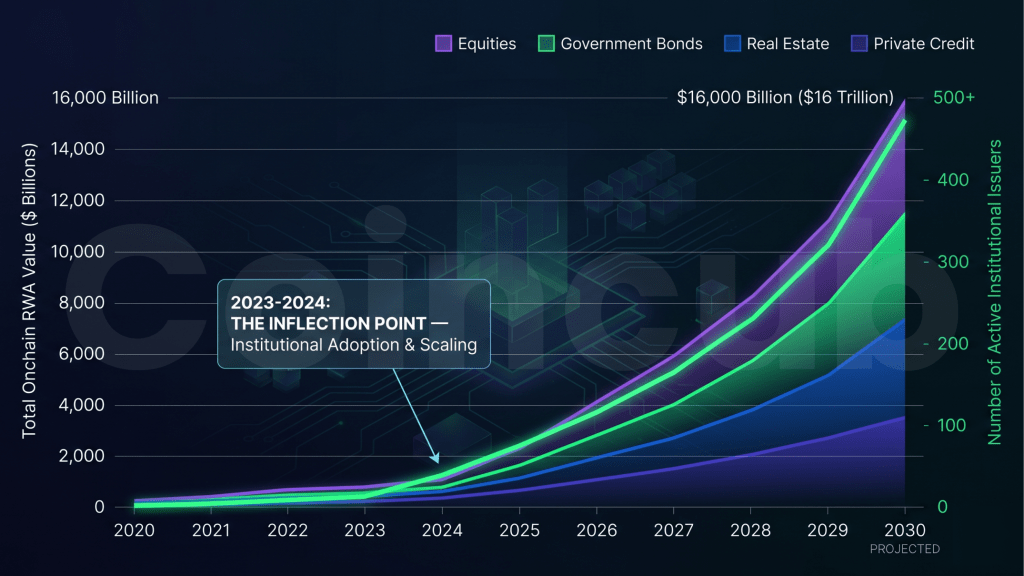
This development represents the opening chapter, not the final one. Analysts at institutions including Boston Consulting Group estimate that tokenized real-world assets could reach $16 trillion by 2030. Bonds, real estate, private equity, and commodities are all moving through the same tokenization pipeline. The S&P 500 validates the model for everything that follows.
TradFi and DeFi are converging layers of a single global financial infrastructure. The speed and transparency of blockchain, combined with the liquidity and credibility of traditional equities, produces a system more capable than either could build alone.
Within the next decade, trading a stock without blockchain infrastructure will feel as outdated as calling a stockbroker on a landline to place an order. The settlement rails are built. The institutional validation has arrived. The global audience is ready and waiting.
The trading day, as we have known it, is ending.
Frequently Asked Questions (FAQs)
What does onchain mean in stocks?
Onchain stocks mean that traditional company shares are digitally represented as tokens on a blockchain. This allows the stock or ETF to be traded, tracked, and settled using blockchain infrastructure rather than traditional brokerage databases and clearinghouses.
What are the top 5 crypto stocks?
The top five crypto stocks to watch in 2026 typically include major industry players like MicroStrategy (MSTR), Coinbase (COIN), Riot Platforms (RIOT), Marathon Digital (MARA), and Bitdeer (BTDR). These public companies focus on crypto holding, exchange services, and mining.
Is it safe to buy tokenized stocks?
Buying tokenized stocks is generally safe if you use regulated platforms that hold real 1:1 underlying assets with licensed custodians. However, they carry unique risks, including smart contract vulnerabilities, regulatory uncertainty, and reliance on the custodian’s security.
Which companies have tokenized stocks?
Several major companies have their shares tokenized by third-party issuers, including Tesla (TSLAX), Alphabet (GOOGLX), Nvidia (NVDAX), Apple (AAPLX), and MicroStrategy (MSTRX). Platforms like Backed Finance, Swarm Markets, and Dinari facilitate these tokenized representations of real-world equities.
Are stocks on the blockchain?
Yes, stocks are increasingly moving onto the blockchain through tokenization. While most are wrapped tokens backed 1:1 by traditional shares held in offchain custody, native onchain issuance is also developing, enabling 24/7 trading, faster settlement, and global access.