Buy a Licensed Company
  Explore VASP Data
  Talk to an Expert

 Atis Shala
Atis is a senior analyst and community lead with four years of experience in crypto. He has a bachelor from the Rochester Institute of Technology.
Atis Shala
Atis is a senior analyst and community lead with four years of experience in crypto. He has a bachelor from the Rochester Institute of Technology.
Tokenized Licenses: The Future of Onchain Compliance
- Tokenized licenses replace manual legacy allowlists with automated legal permissions embedded directly into smart contracts. These rules execute instantly upon any transfer attempt.
- Standard ERC20 tokens fail institutional requirements due to their identity blindness. The ERC3643 standard and ONCHAINID framework solve this by binding verifiable credentials to specific wallets.
- Decentralized oracles feed external legal data to smart contracts. This infrastructure allows automated systems to respond instantly to shifting sanctions or changing accreditation statuses.
- Zero knowledge cryptography enables users to prove regulatory compliance without exposing sensitive personal details on a public ledger. This satisfies both institutional confidentiality and strict audit demands.
- Tokenized licenses supply the mandatory compliance infrastructure required to scale Real World Asset tokenization and verify hardware operators within decentralized physical infrastructure networks.
- Authorized forced transfer mechanisms allow issuers to freeze or recover assets when legally required. This functionality proves that blockchain immutability and regulatory compliance are fully compatible.
The Future of Onchain Compliance
Decentralized finance moves at a pace that traditional regulatory frameworks were never designed to match. In the time it takes a compliance officer to process a single KYC filing, a smart contract can execute thousands of transactions, settle cross-border transfers, and redistribute yield to a global pool of participants. This gap between technological velocity and regulatory readiness has created one of the most significant friction points in Web3’s maturation: the absence of programmable, legally coherent compliance infrastructure.
Tokenized licenses fill that gap. A tokenized license is a programmable, onchain legal permission; a credential embedded directly in a blockchain token that encodes who may hold it, transfer it, and interact with it under what legal conditions. Unlike static allowlists or offchain permission databases, tokenized licenses travel with the asset itself, executing compliance rules autonomously at the smart contract layer every time a transfer is attempted.
The thesis driving institutional adoption is straightforward: unlocking capital from banks, asset managers, pension funds, and sovereign wealth vehicles requires compliance to be automated, auditable, and inseparable from the financial instrument. Tokenized licenses accomplish exactly that, baking regulatory adherence into the architecture of value transfer rather than treating it as an afterthought bolted on from outside the protocol.

The Bottleneck of Legacy Compliance in Web3
The compliance infrastructure inherited from traditional finance was designed for batch processing, correspondent banking, and centralized custodians. Grafted onto blockchain networks, it produced a patchwork of offchain allowlists, manual KYC portals, and audit snapshots that fundamentally contradict the real-time nature of onchain settlement.
Current KYC and AML workflows impose friction at every stage. A user seeking access to a regulated DeFi protocol must submit identity documents to a third-party provider, wait for manual review, receive offchain approval, and then have an administrator update an onchain list. This process takes days, relies on centralized intermediaries who become single points of failure, and produces compliance data perpetually out of sync with blockchain state. When a user’s regulatory status changes, because they move jurisdictions or fail a periodic AML screening, the onchain record often reflects no update until a human operator intervenes.
The Standard for Permissionless Transfer
The standard ERC-20 specification compounds these problems structurally. ERC-20 was designed for permissionless transfer: any wallet can receive any token from any sender without identity verification at the protocol level. For retail assets and governance tokens, this is a feature. For securities, licensed financial products, and regulated real-world assets, it is a critical deficiency. ERC-20 tokens carry no information about who holds them, whether those holders are accredited investors, whether they are in sanctioned jurisdictions, or whether transfer caps imposed by securities law have been respected.
The consequences extend beyond regulatory risk to direct financial liability. Non-compliant liquidity pools that inadvertently include sanctioned addresses or allow unaccredited investors to acquire regulated securities expose protocol operators to enforcement actions, asset freezes, and reputational damage severe enough to collapse institutional partnerships. Several prominent DeFi protocols have already received enforcement inquiries from the SEC and OFAC precisely because their smart contracts had no mechanism to distinguish permissible counterparties from impermissible ones.
The Operational Costs as a Challenge
The operational cost of manual allowlisting as a workaround is also prohibitive at scale. Maintaining a permissioned list across multiple chains, time zones, and regulatory jurisdictions requires dedicated compliance personnel, legal review, and continuous database synchronization, viable for a fifty-participant pilot, not for a tokenized bond issuance with five thousand holders across twelve jurisdictions.
Building compliant financial infrastructure on identity-agnostic token standards is a structural mismatch. Tokenized licenses resolve it by making identity and permission verification an intrinsic function of the transfer mechanism itself.
| Feature | Legacy Compliance Workflows | Tokenized Licenses (Onchain) |
| Execution Speed | Manual processing taking days or weeks. | Instant execution at the smart contract layer. |
| Enforcement | Reactive, relying on post-trade audits and rollbacks. | Proactive, preventing non-compliant transfers before settlement. |
| Data Security | Relies on centralized honeypots of sensitive user data. | Utilizes zero-knowledge proofs to maintain data privacy. |
| Interoperability | Fragmented across isolated institutional databases. | Travels seamlessly with the asset across decentralized protocols. |
The Architecture of Trust: ERC-3643 and Smart Oracles
The technical foundation of tokenized licenses rests on two converging pillars: the ERC-3643 token standard and a new generation of smart oracle infrastructure. Together, they transform token transfers from simple balance updates into compliance-verified state transitions.
ERC-3643, originally developed by Tokeny Solutions and now maintained as an open standard, was purpose-built to address ERC-20’s identity blindness. The standard introduces a compliance module architecture in which every transfer is automatically intercepted by smart contracts that verify identity and permission conditions before the transaction settles. If any condition fails, the transfer reverts, atomically, at the protocol layer, with no human intervention and no possibility of bypass.
At the center of ERC-3643’s identity model is ONCHAINID, an open-source framework that assigns each participant a blockchain-based identity contract. Rather than managing a list of permitted wallet addresses, which can change when keys are rotated or wallets are compromised, ONCHAINID binds identity to a persistent smart contract that aggregates verified claims from trusted issuers. A claim might attest that its holder has passed KYC, qualifies as an accredited investor under U.S. Regulation D, or resides in the EU for MiFID II purposes. These claims are issued by regulated verification providers, cryptographically signed, and stored in the identity contract.
When a transfer is initiated, the compliance module queries the sender’s and receiver’s ONCHAINID contracts, checks the relevant claims against the issuance rules encoded at deployment, and allows the transfer only if all conditions are satisfied. Jurisdiction checks, accreditation thresholds, transfer caps, lock-up periods, and AML flags are all evaluated in a single atomic transaction. One failed condition halts the transfer entirely.
Decentralized Oracles
Decentralized oracles make this system responsive to the real world. Smart contracts are deterministic systems sealed from external data. To enforce rules that depend on offchain legal information, whether a jurisdiction is newly sanctioned, whether a user still qualifies for a given investment tier, whether a licensed operator’s hardware certification remains valid, the contract must receive that data from a trusted external source. Decentralized oracle networks fulfill this function by aggregating data from independent node operators, reaching consensus, and delivering cryptographically attested feeds to smart contracts on demand.
In the context of tokenized licenses, oracles connect the static logic encoded at deployment to the continuously shifting landscape of regulatory requirements. An oracle network can monitor OFAC, EU, and UN sanctions databases simultaneously, push updates to onchain compliance registers the moment a new listing is added, and trigger transfer restrictions across every affected holding within seconds, a response speed no manual compliance operation can match.
Privacy-Preserving Compliance via Zero-Knowledge Technology
One persistent criticism of identity-centric blockchain systems is the tension between public ledger transparency and institutional data privacy. If compliance verification requires broadcasting sensitive personal information to a public network, the cure is worse than the disease. Financial institutions, their clients, and their regulators all have compelling reasons to ensure that eligibility checks do not simultaneously expose underlying identity data to anyone capable of querying the blockchain.
Zero-knowledge proof cryptography resolves this tension directly. A zero-knowledge proof allows one party to prove a statement is true without revealing why it is true. Applied to compliance, a user can prove they satisfy a credential requirement, eligible jurisdiction, accredited investor status, passing AML threshold, without revealing their name, passport number, address, or financial details to the smart contract or any external observer.
The mechanism works through commitment schemes and cryptographic verification circuits. A trusted identity issuer attests to a set of facts about a user and issues a credential anchored to their ONCHAINID contract. When the user initiates a transfer, they generate a zero-knowledge proof locally, on their own device, demonstrating that their stored credential satisfies the required compliance criteria. The smart contract verifies the mathematical validity of the proof without accessing the underlying data. The transfer is approved or rejected based on the proof’s validity alone, with no sensitive personal information left on the public chain.
Privacy as a Moat
Several privacy-focused Layer 1 blockchains and Layer 2 rollups have integrated this capability at the protocol level. Aztec Network and Polygon Miden, for instance, have built zero-knowledge execution environments in which private and public state coexist within the same consensus layer, allowing issuers to deploy tokenized licenses that publicly verify compliance events while keeping associated identity data entirely private, satisfying both regulatory auditability and institutional confidentiality requirements.
The practical significance for institutional adoption is substantial. Pension funds and sovereign wealth managers operate under fiduciary obligations that prohibit exposing beneficiary data to uncontrolled third parties. Banks governed by GDPR face explicit liability if personal data is stored in systems they cannot control or delete. Zero-knowledge compliance verification means that identity proofs exist on the chain as mathematical assertions rather than data records, rendering GDPR’s right to erasure compatible with blockchain immutability. A credential can be revoked at the issuer level without modifying any public chain state; zero-knowledge proofs generated from it immediately cease to be valid for new transfers.
Real-World Applications: From RWAs to DePIN
The tokenized license market in 2026 is being driven by two converging forces: the rapid institutionalization of Real World Asset (RWA) tokenization and the parallel emergence of Decentralized Physical Infrastructure Networks (DePIN) as legitimate, capital-intensive asset classes.
RWA tokenization has moved decisively from pilot programs to live production across real estate, private credit, treasury bills, etc. The global tokenized RWA market surpassed $15 billion in total value locked in 2025, with projections above $50 billion within three years. These instruments carry mandatory compliance overhead. A tokenized real estate fund structured as a REIT equivalent must enforce SEC Regulation A+ investor caps, ensure no single holder exceeds ownership thresholds triggering mandatory disclosure, and restrict transfers to investors in jurisdictions where the offering is registered or exempted.
Without tokenized licenses, enforcing these requirements across thousands of wallets demands continuous legal monitoring, manual transfer blocks, and constant risk that a compliant holding becomes non-compliant as circumstances change. With ERC-3643 compliance modules, enforcement is automatic. A real estate token deployed with jurisdiction restrictions simply refuses to settle any transfer where the receiving wallet’s ONCHAINID lacks a valid claim from an approved verification provider confirming eligible residency.
Private Credit Markets
Private credit markets present an equally compelling use case. Institutional lenders tokenizing loan portfolios must enforce transfer restrictions to accredited investors, maintain accurate beneficial ownership records, and ensure secondary market activity does not create unregistered securities offerings. Tokenized licenses provide the mechanism for all three functions simultaneously, making private credit tokenization legally viable at scale.
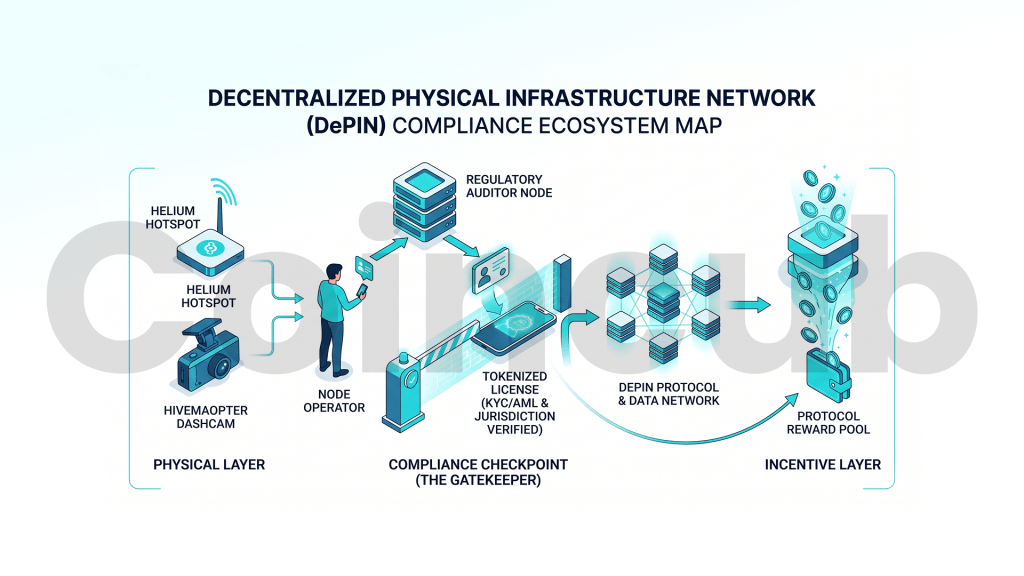
DePIN networks introduce a distinct application that extends beyond investor eligibility into operator certification and hardware compliance. Networks like Helium and Hivemapper distribute rewards to node operators who contribute physical hardware. As these networks grow and begin serving enterprise clients with SLA requirements, node quality and regulatory compliance become economically significant. A node operator wishing to participate in a licensed DePIN network must first obtain a credential from an authorized auditor confirming their hardware meets technical specifications, their jurisdiction permits the relevant infrastructure operation, and they have satisfied applicable data-handling requirements.
The network’s smart contract reward system verifies this credential before calculating or transferring any rewards. Nodes without valid licenses receive nothing, regardless of technical contribution, a strong economic incentive for compliance that enforces itself without any central administrator policing the network.
Legal Enforceability and Sovereign Recourse
Blockchain immutability, the guarantee that no central authority can unilaterally alter or reverse a confirmed transaction, is foundational to the censorship resistance that makes public blockchains valuable. It also creates a direct conflict with the legal reality that regulated financial instruments must remain subject to sovereign processes: court-ordered freezes, regulatory seizures, and key recovery when a private key is lost.
The ERC-3643 architecture resolves this conflict through forced transfer, an administrative function reserved exclusively for the token issuer or a designated compliance administrator that moves a token balance without the private key signature that would normally authorize the transaction. Its use is governed by the issuer’s compliance policy, typically requiring multi-signature authorization from a designated quorum, and it generates a fully auditable onchain record of the action taken, the authority that authorized it, and the legal basis cited.
Forced transfers serve several practical functions. When a court orders seizure of a tokenized asset as part of a civil judgment or criminal forfeiture, the issuer can execute a forced transfer to a court-designated wallet with full onchain transparency. In another example, when an investor loses private key access through device failure, theft, or death, the issuer can recover the asset following a legally prescribed identity verification process. When a wallet is confirmed compromised, the issuer can freeze and recover tokens immediately.
Forced Transfer Functionality & Blockchain Sovereignty
Critics argue that forced transfer functionality undermines blockchain sovereignty. This conflates two distinct properties. Immutability means the historical record cannot be altered or deleted, not that no new transactions can ever be created by authorized parties. Forced transfers create new transactions that are themselves immutable. The entire action is permanently and publicly recorded, producing an audit trail more transparent than any equivalent process in traditional finance, where asset seizures frequently occur through opaque back-channel communications between custodians and regulators.
Legal recognition of onchain licenses is advancing in parallel. Singapore, Switzerland, the UAE, and the EU under its MiCA framework have enacted or are enacting provisions recognizing the legal validity of tokenized securities and compliance actions executed through smart contract mechanisms. This regulatory convergence is narrowing the gap between onchain compliance events and their legal enforceability, giving institutional issuers the certainty required to deploy meaningful capital.
Final Thoughts on the Future of Tokenized Licenses
Tokenized licenses represent a fundamental redesign of how compliance interacts with financial infrastructure. By embedding identity verification, transfer restrictions, and regulatory attestations directly into the smart contract layer through ERC-3643 and ONCHAINID, the industry has produced a mechanism simultaneously more rigorous and more efficient than any manual process it replaces. Zero-knowledge proofs ensure this rigor does not come at the cost of privacy; decentralized oracles ensure compliance rules respond to the real world in real time.
The applications driving adoption in 2026, tokenized real estate, private credit, treasury instruments, and DePIN infrastructure, demonstrate that demand for programmatic compliance is both broad and deep. Institutional capital does not flow into ecosystems it cannot audit, restrict, or recover from. Tokenized licenses provide all three capabilities without compromising settlement finality or transparency.
Forced transfer mechanisms and growing legal recognition of onchain compliance events confirm that the binary between blockchain sovereignty and legal enforceability was always a false choice. The two properties are compatible, and their combination is precisely what institutional finance requires. This points toward an ecosystem where every asset, participant, and transfer carries cryptographically verified identity and compliance within the protocol. This would be a significant step towards becoming the dominant infrastructure for global capital markets.
Frequently Asked Questions (FAQs)
What is tokenization with example?
Tokenization is the process of converting physical or digital assets into blockchain-based tokens. So, we can divide a $1M real estate property into 1,000 tokens worth $1,000 each, allowing fractional ownership onchain.
What is tokenized crypto?
Tokenized crypto refers to digital representations of real-world assets or other blockchain currencies operating on a specific network. Examples include Wrapped Bitcoin on Ethereum or fiat-backed stablecoins like USDC, bridging external value directly into decentralized finance ecosystems.
What is a crypto license?
A crypto license is a legal authorization granted by a regulatory body allowing businesses to operate cryptocurrency services. It ensures companies comply with local financial laws, anti-money laundering regulations, and strict customer protection standards.
What crypto is best for tokenization?
Ethereum remains the best crypto for tokenization due to its dominant liquidity, battle-tested smart contracts, and established ERC-3643 compliance standards. However, institutional networks like Polygon and Avalanche are increasingly popular for processing high-volume, low-cost asset tokenization securely.