Buy a Licensed Company
  Explore VASP Data
  Talk to an Expert

 Dren Hima
 is Head of Research at Coincub, leading research across digital asset regulation, licensing, market structure, tokenization and institutional adoption.
Dren Hima
Dren Hima is Head of Research at Coincub, leading research across digital asset regulation, licensing, market structure, tokenization and institutional adoption.
Filecoin Price Prediction 2026-2030: The AI Data Cloud Pivot
- Filecoin’s price collapse came from bad token dynamics. FIL was hit by heavy vesting unlocks, inflation, and a decline in mining-related demand after the 2021 cycle.
- 2026 is important because the story starts changing here. The end of the worst vesting pressure, plus the Filecoin Onchain Cloud rollout, could shift attention from subsidized storage to paid usage.
- The real question is monetization. Filecoin already has scale. What is crucial now is whether that scale turns into enterprise demand that actually affects FIL.
- AI is a possible tailwind. Filecoin fits the “verifiable data” angle well, but a big AI market does not automatically translate into strong demand for FIL.
- FIL still looks like a high-risk infrastructure bet. The upside exists, but it depends on adoption, token capture, lower inflation pressure, and clearer regulation.
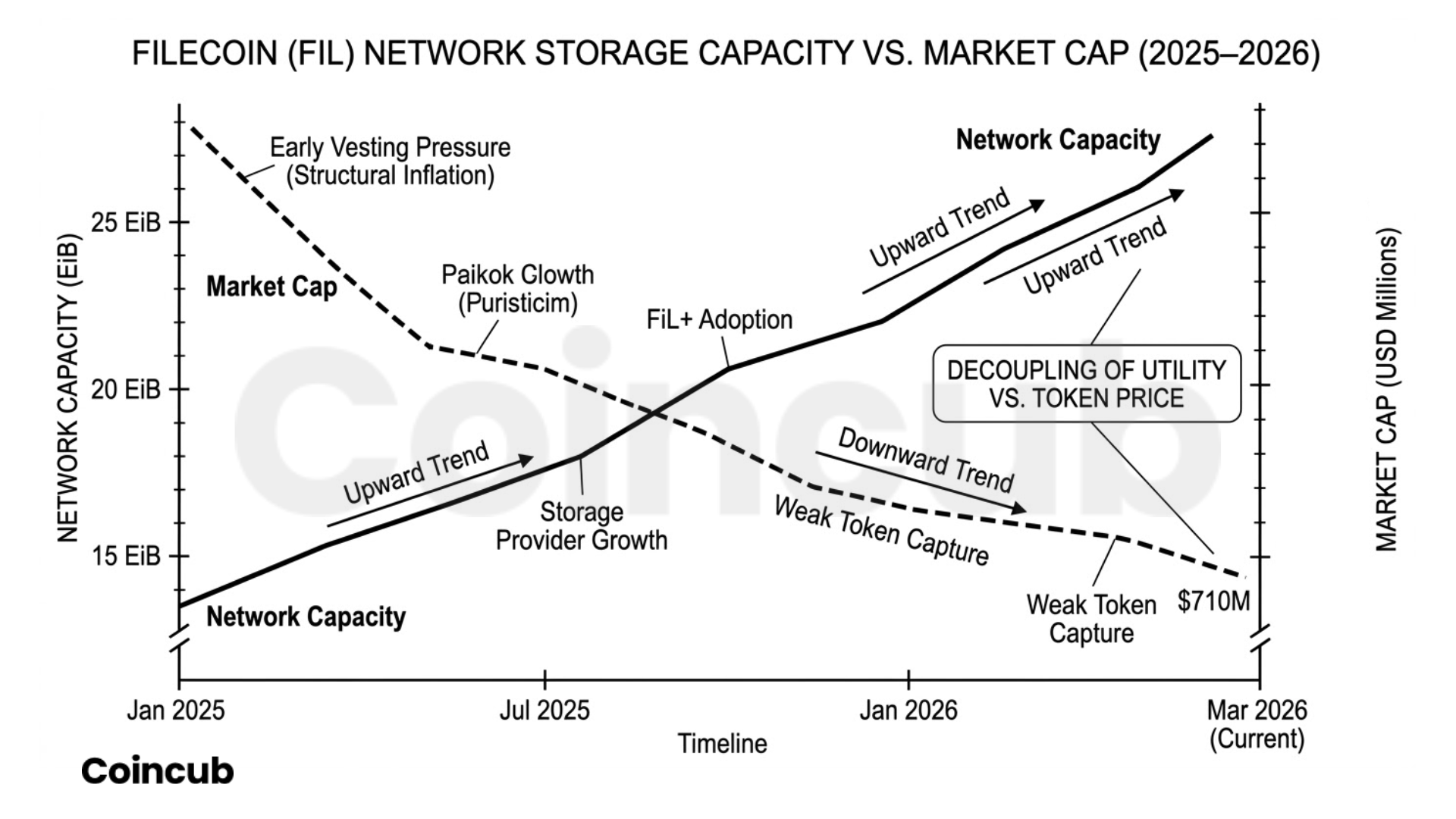
Filecoin (FIL) has experienced a 99% drawdown from its 2021 highs. The network currently secures over 25 Exbibytes of global storage space, but the token price has remained entirely decoupled from this hardware capacity.
The primary focus of this forecast is whether Filecoin’s transition from an incentivized storage network into a programmable infrastructure layer can turn its massive hardware capacity into actual paying customers, and whether that usage can create enough demand to affect the token’s price.
Current Market Snapshot

- Current Price: ~$0.93 USD
- Market Capitalization: ~$710 Million
- Circulating Supply: ~762 Million FIL
- All-Time High: $237.24 (April 2021)
- Network Capacity: >25 Exbibytes
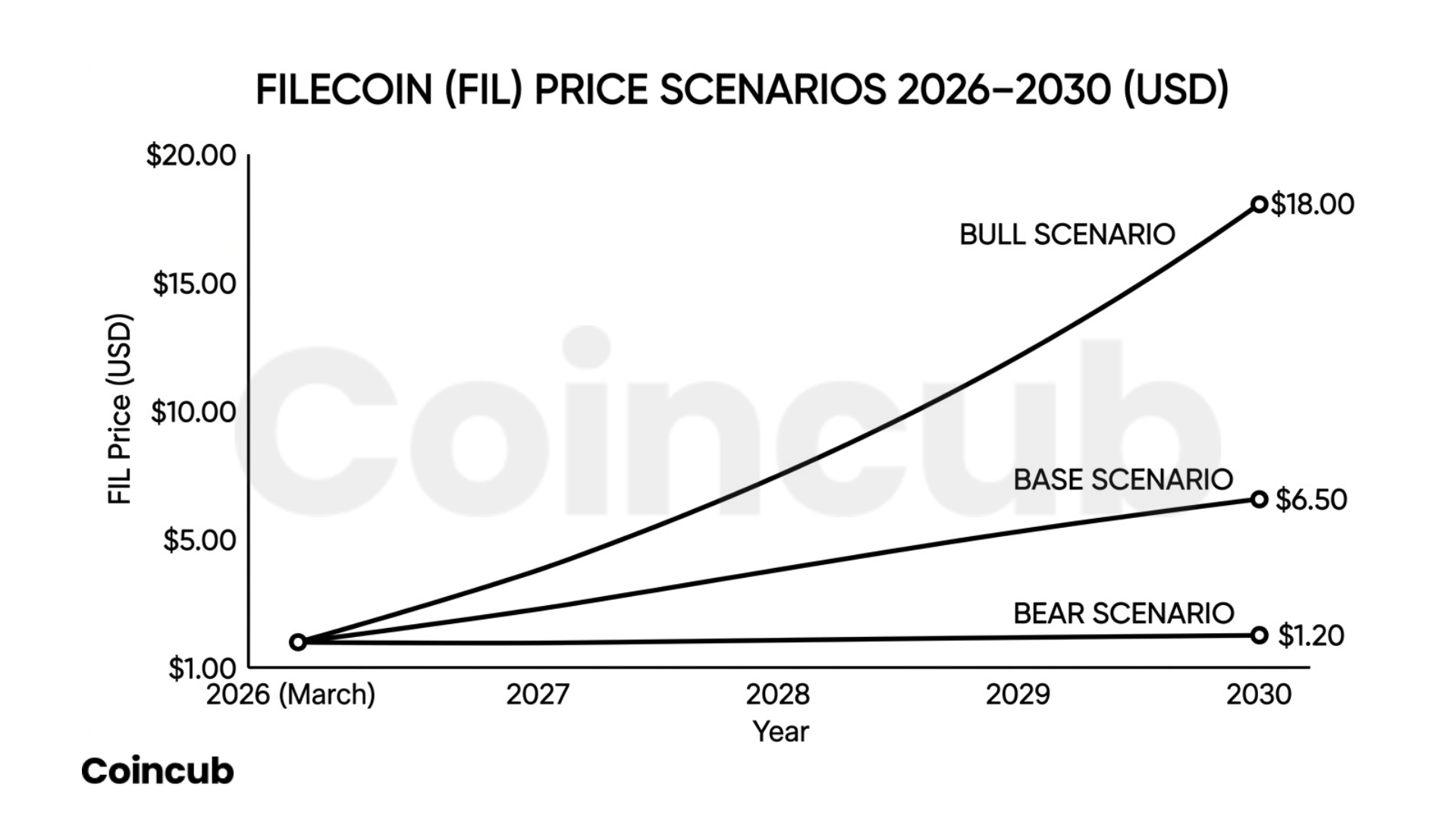
| Year | Bear Scenario (Low) | Base Scenario (Average) | Bull Scenario (High) |
| 2026 | $0.80 | $1.55 | $3.40 |
| 2027 | $1.10 | $2.80 | $6.50 |
| 2028 | $1.15 | $4.20 | $9.80 |
| 2030 | $1.20 | $6.50 | $18.00 |
What is Filecoin?
Filecoin is a decentralized storage network where users pay providers in FIL tokens to host and retrieve data. The network guarantees data integrity through cryptographic proofs that continuously verify that a client’s files remain intact over time.
While the underlying storage capacity was established years ago, the protocol is currently being worked on to improve its usability. Historically, Filecoin functioned strictly as “cold storage,” cheap, but slow and complex to access.
The 2026 rollout of the Filecoin Onchain Cloud (FOC) attempts to change this by hiding the heavy cryptography from developers. A central component of this upgrade is the F3 (Fast Finality) rollout. Previously, achieving transaction finality on Filecoin took roughly 7.5 hours; F3 cuts this to under 60 seconds. This shift allows applications to function on Filecoin without the long delays that historically kept developers away.
Price History
Following its mainnet launch, FIL hit an all-time high of $237.24 in early 2021. This peak was not driven by organic enterprise data storage, but by speculative demand from regional mining operations. Because the protocol requires storage providers to stake FIL as collateral to mine, massive mining farms aggressively bought the token to secure their operations during a period of very low circulating supply. When mining profitability dropped, this artificial demand vanished.
From 2022 through 2025, the network was defined by heavy token inflation. The protocol enforced continuous unlocks of early investor and team vesting schedules. Token emissions vastly outpaced the organic demand for blockspace. Retail buyers absorbed this venture capital sell pressure for years, breaking market trust that the project is still trying to repair today.
What Changes in 2026
The core narrative for Filecoin in 2026 is the attempt to replace protocol subsidies with real revenue.
Historically, miners were incentivized by block rewards simply to store data, leading to a high volume of low-value information being uploaded just to capture network emissions. The current focus is entirely on paid deals. Recent network data indicates that active storage from paid deals has stabilized at approximately 1,110 PiB, signaling a shift toward genuine dataset commitments.
To support this, the network introduced the USDFC stablecoin. Businesses generally avoid using volatile crypto for daily expenses. By allowing enterprises to negotiate service agreements and pay for storage in fiat-pegged terms, Filecoin is trying to remove the friction of crypto volatility from the enterprise onboarding process.
Tokenomics and Supply Pressure
A look at Filecoin’s internal supply dynamics is necessary to ground any future price targets. The setup improves if emissions slow and network usage starts to burn more tokens.
Filecoin has a theoretical maximum supply of 2 billion tokens. The circulating supply sits at roughly 762 million FIL. The network experienced high inflation throughout 2024 and 2025, adding roughly 100-115 million new FIL tokens annually.
The guaranteed sell pressure from early venture capital backers is concluding. The vesting schedules for early SAFT investors have run their course. While entities like Protocol Labs operate on extended linear schedules, the worst of the speculative overhang that suppressed the asset’s price for the last four years is ending. Filecoin prints new tokens daily based on network capacity and time. To offset this inflation, it burns tokens through base transaction fees and network penalties. Currently, the fee burn relies heavily on penalizing storage providers rather than pure transactional demand. For FIL to become deflationary, on-chain activity must accelerate each day to outpace the daily minting rate.
Storage providers must lock FIL to operate. If enterprise onboarding succeeds and total data stored scales up, more FIL gets locked out of circulation, which physically tightens the available market supply.
The Adoption and AI Cloud Thesis
Filecoin is positioning itself as a storage backend for the AI data market. The premise is a big market, uncertain capture.
Modern AI models require massive datasets, and as AI agents execute autonomous workflows, they need persistent memory. If an AI model’s training data is altered without detection, it degrades the model’s performance. Filecoin provides cryptographic proof that training data remains intact.
Integrations are occurring to target this specific niche. Platforms like Akave Cloud operate as decentralized storage solutions natively integrated with data warehouses like Snowflake. If AI developers prioritize verifiable data provenance over traditional servers, Filecoin has the infrastructure scale to support them.
What Needs to Go Right
For the token to recover toward the $2.00 to $5.00 range, several operational conditions must be met:
The network must prove that its active storage scales because clients are actually paying for the service, rather than storage providers subsidizing deals to farm block rewards.
Building on blockchain storage is hard. The new developer tools (like the Synapse SDK) must successfully hide the blockchain complexity so standard developers can use the network easily.
Usage must generate enough base transaction fees to burn FIL meaningfully and offset the daily inflation rate.
What Could Go Wrong
Even if the technology functions as intended, several risks could suppress the token’s value.
Network utility does not automatically guarantee token price appreciation. If enterprises pay for storage primarily in USDFC stablecoins, the actual FIL required for “gas” to execute those contracts might be negligible. The network could hypothetically handle massive amounts of enterprise data, while the FIL token experiences very low buying pressure, rendering it a poor proxy for the network’s adoption.
Amazon AWS, Google Cloud, and Microsoft Azure are well-established, reliable, and cost-effective for bulk storage. Enterprise hesitation toward blockchain-based storage is high. If the cost and complexity of migrating data pipelines to Filecoin outweigh the perceived benefit of “verifiable cryptography,” the network will struggle to capture market share.
The U.S. Securities and Exchange Commission (SEC) has repeatedly cited FIL as a potential unregistered security. While the SEC’s Crypto Task Force launched a series of roundtables in 2026 to discuss clearer rules for digital assets, definitive legal safety has not been established. Until FIL is explicitly cleared, U.S. institutional capital will likely remain restricted.
Filecoin Price Prediction 2026-2030
Our valuation logic balances Filecoin’s hardware scale against its historical dilution. The following ranges assume that the circulating supply tightens, but acknowledge the steep difficulty of onboarding traditional enterprises to Web3 infrastructure.
2026: The Transition Year
With early investor vesting ending, a move back toward the $1.50 to $2.50 range is possible, but it relies on early FOC adoption actually panning out. This is not guaranteed. If the network struggles to onboard non-crypto clients, or if SEC scrutiny intensifies without resolution, the token could easily slip back below $0.80 and stay there.
2027-2028: Infrastructure Integration
This path assumes emissions slow down and fee burns pick up. However, this is not a smooth glide path. It requires the AI data narrative to translate into actual terabytes stored and paid for. If the network becomes a standard backend for these datasets, mid-single-digit performance is achievable. If developers find the tooling too hard to use, the token will likely stagnate near the lower bounds.
2029-2030: Cloud Market Share
The bull case depends on Filecoin winning a small but meaningful slice of the global cloud storage market. That is a massive leap. If the network successfully bridges the gap to Web2 enterprises, the collateral lockups and gas burns could drive the price to double digits. But if Filecoin remains a niche tool for crypto-native archiving, it will likely trade near the bottom of this forecast.
Filecoin vs. Other Decentralized Storage
Filecoin vs. Arweave
The core difference is economic design and upfront cost. Arweave uses an endowment model for permanent storage. Users pay a single upfront fee (roughly $10 per GB), making it well-suited for lightweight, immutable records such as NFT metadata. However, the high initial cost makes it difficult to sell to enterprises managing dynamic, multi-terabyte datasets. Filecoin uses a contract model that mirrors traditional cloud providers, costing fractions of a cent per GB, making it a more familiar pitch for massive-scale, temporary data lakes.
Filecoin vs. Storj
Storj is currently much easier to sell to traditional businesses. Storj defaults to client-side encryption, uses standard erasure coding, allows fiat payments natively, and offers static pricing. Filecoin, by contrast, requires clients to negotiate dynamic contracts and navigate complex cryptographic proofs. While Filecoin’s programmability allows developers to build smart contracts directly on the storage layer, it introduces complexity that Storj intentionally avoids.
| Network | Main Use Case | Pricing Model | Best For | Main Limitation |
| Filecoin | Large-scale decentralized storage, programmable storage, and AI-related data workflows | Contract-based, ongoing storage agreements | Projects and enterprises that need scalable storage with verification and more flexible usage models | Higher complexity, harder onboarding, and token value do not automatically rise with network usage |
| Arweave | Permanent data storage | One-time upfront payment | NFT metadata, archives, public records, and content that should remain online permanently | Expensive for large or frequently changing datasets |
| Storj | Decentralized object storage with Web2-style usability | Usage-based pricing is closer to traditional cloud billing | Businesses that want simpler, cloud-compatible, decentralized storage | Less crypto-native programmability and fewer on-chain use cases than Filecoin |
Is Filecoin a Good Investment?
Filecoin trades far below its earlier cycle highs, but the discount only plays a role if the network can convert its raw capacity into paid usage.
The token’s supply issues are easing as the era of extreme venture-capital vesting draws to a close. The network is also pivoting toward the AI data market with tools designed to reduce developer friction. However, scale alone has not translated into token strength. Investors must weigh the potential of the new cloud upgrades against the risks of Web2 incumbent dominance, ongoing regulatory ambiguity, and the real possibility that network usage fails to capture value for the FIL token itself. It remains a high-risk infrastructure play suited for long-term horizons rather than short-term speculation.
Frequently Asked Questions (FAQ)
What is Filecoin?
Filecoin is a decentralized storage network where users pay providers to store and retrieve data, with cryptographic proofs used to verify that the data remains intact.
Why did Filecoin fall so much from its all-time high?
The 2021 move was driven by temporary mining-related demand and low circulating supply. After that, FIL faced years of inflation, vesting unlocks, and weak organic demand.
What is the Filecoin Onchain Cloud?
The Filecoin Onchain Cloud is Filecoin’s push to make the network easier to use for real applications by reducing complexity, improving finality, and supporting more practical enterprise workflows.
Why does 2026 matter for Filecoin?
2026 is important because the worst of the early-investor sell pressure is fading, and the network is trying to prove it can generate real paid demand rather than relying on incentives.
Can Filecoin benefit from AI growth?
Possibly. Filecoin is trying to position itself as a storage backend for AI-related data, especially where data integrity and verifiability are important.
What is the biggest risk for FIL holders?
The biggest risk is that network usage grows without creating enough demand for the FIL token itself. In that case, adoption may improve while price performance stays weak.
Can Filecoin become deflationary?
Only if token burns and locked collateral start to play a role more than new issuance. Right now, that outcome still depends on much stronger real activity.
Is Filecoin better than Arweave?
They solve different problems. Arweave is built more for permanent storage, while Filecoin is better positioned for large-scale, contract-based storage.
Is Filecoin better than Storj?
Filecoin is more ambitious and more programmable, but Storj is easier for traditional businesses to understand and adopt.
Can Filecoin reach $100 again?
That looks very unlikely in the near term. With the current circulating supply, a $100 FIL price would require a very large market cap and much stronger adoption than the network has today.