Buy a Licensed Company
  Explore VASP Data
  Talk to an Expert

 Dren Hima
 is Head of Research at Coincub, leading research across digital asset regulation, licensing, market structure, tokenization and institutional adoption.
Dren Hima
Dren Hima is Head of Research at Coincub, leading research across digital asset regulation, licensing, market structure, tokenization and institutional adoption.
Powering the AI Era: Data Centers, Grid Politics and SMRs
- Power is now the real bottleneck for AI. The issue is no longer just chips. AI infrastructure is running into hard limits on electricity, grid access, and interconnection timelines.
- Bitcoin miners are becoming AI infrastructure plays. The strongest miners are no longer relying only on mining economics. They are using land, power contracts, and grid access to move into HPC and AI hosting.
- SMRs are a future solution, not a live one. The pipeline is real, but the commercial reality is still early. Most Western SMR projects tied to AI or hyperscalers will not be operational until the 2030s.
- Behind-the-meter power is creating political conflict. Tech companies want dedicated power. Grid operators and ratepayers do not want those projects shifting transmission or backup costs onto the public.
- Fuel, permits, and local opposition are slowing the buildout. HALEU shortages, long regulatory timelines, water use concerns, and state-level pushback are all major constraints on nuclear-powered AI expansion
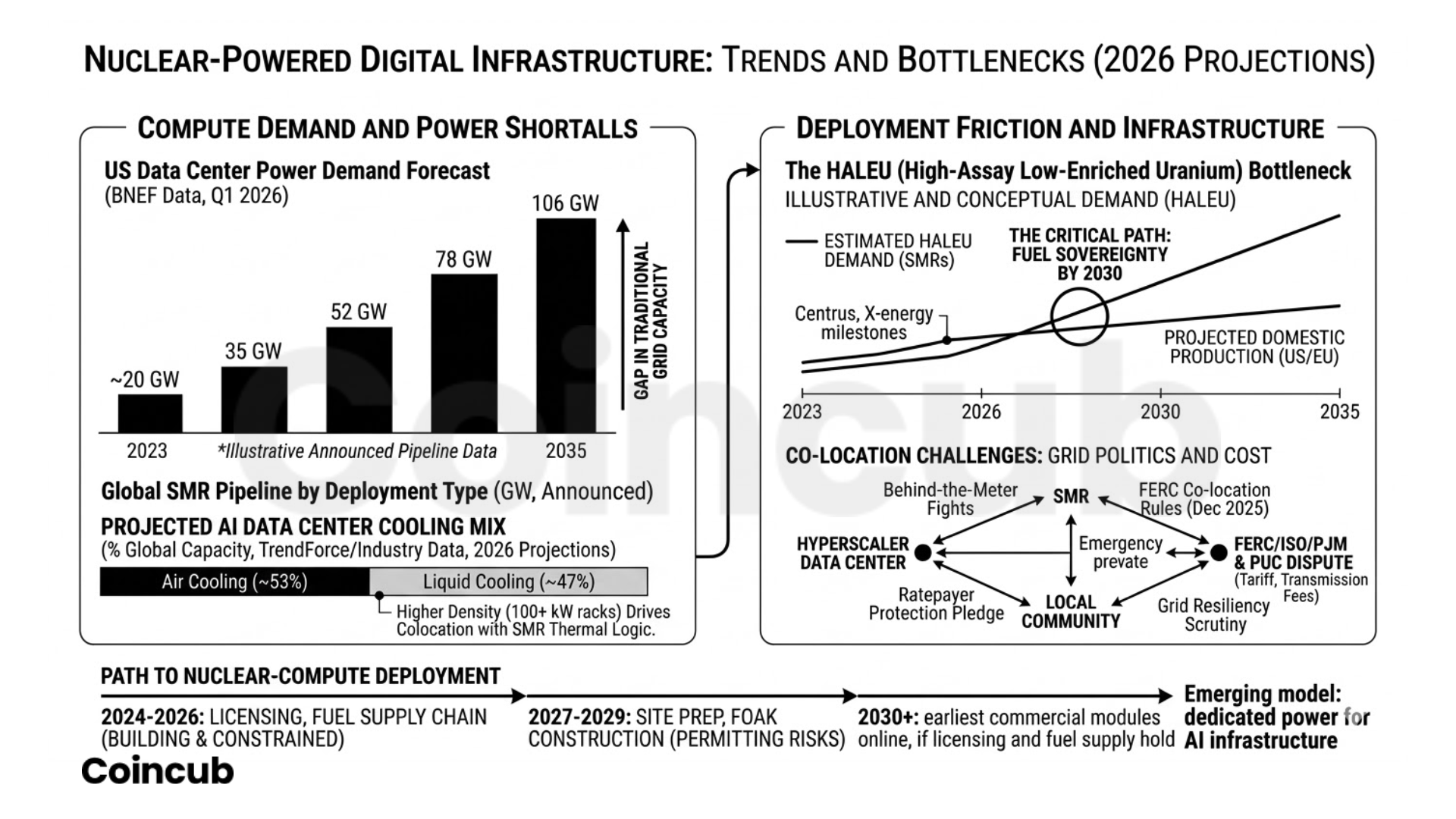
The primary constraint for the AI industry in 2026 is no longer chip availability, but rather it is physical power. The rapid scale of generative AI inference has hit the limits of the current power grid. According to BloombergNEF, U.S. data center power demand is on track to reach 106 gigawatts (GW) by 2035, a 36% upward revision from their forecast published in early 2025.
With grid interconnection wait times now exceeding five years in primary data center markets, technology companies are increasingly looking to develop their own on-site power generation. This necessity has sparked a commercial push for Small Modular Reactors (SMRs). The logic is that SMRs could provide reliable, zero-carbon power without the massive land requirements of solar farms or the multi-decade construction timelines associated with traditional large-scale nuclear plants.
While institutional cryptocurrency mining companies are often the entry point for this market, their role has fundamentally changed. Most are no longer just miners; they are acting as digital real estate developers, converting sites with secured power interconnections into high-density AI data centers.

However, the path to a nuclear-powered digital economy is not as smooth as corporate press releases suggest. The industry is currently dealing with a shortage of advanced nuclear fuel, evolving regulations for “behind-the-meter” generation, and growing local opposition to the massive water and land requirements of these facilities. This report separates operational reality from future pipeline projects to map the current state of the market.
Bitcoin Mining Transitioning to AI Infrastructure
Institutional Bitcoin miners secured massive power pipelines and land rights years before the AI boom. Today, the economics of mining are under pressure from rising network difficulty and the 2024 block reward halving. In response, many publicly listed miners are reallocating their power capacity toward AI colocation and high-performance computing (HPC).
The financial logic is based on more stable margins. AI hosting contracts typically yield operating margins between 80 and 90%, providing fixed-rate revenue that contrasts with Bitcoin price volatility. On a per-megawatt basis, AI infrastructure currently generates roughly three times the revenue of traditional mining. Consequently, some analysts expect that for miners successfully making this pivot, mining will account for less than 20% of total revenue by the end of 2026.
Current operational shifts include:
- Core Scientific (CORZ): By early 2026, Core Scientific energized approximately 350 megawatts (MW) of HPC capacity, with nearly 200 MW actively billing. To fund this, the company sold roughly 1,900 Bitcoins for $175 million in January and secured a loan facility from Morgan Stanley that could scale to $1 billion.
- CleanSpark (CLSK): The company closed a $1.15 billion convertible notes offering in late 2025 to fund its expansion. In February 2026, it closed on a second Texas campus, adding 300 MW of capacity to its portfolio, bringing its total to over 1.8 GW.
- Nautilus Cryptomine: This Pennsylvania facility remains a primary example of behind-the-meter nuclear integration, drawing up to 300 MW directly from the Susquehanna nuclear plant. However, as of October 2024, TeraWulf exited its minority stake in the project, which is now fully controlled by Talen Energy.
While the ultimate goal for many of these converted facilities is to host on-site SMRs, the current reality is that they are primarily using existing grid connections or legacy nuclear plants to capture the immediate AI market.
Economics of Firm Power vs. Renewables
AI data centers require “firm” power that runs 24/7. When evaluating technologies for this purpose, developers use the Levelized Cost of Electricity (LCOE), which measures the lifetime costs of a plant relative to its total energy output.
On paper, SMRs are competitive over a long horizon. While traditional new-build nuclear in the U.S. has an unsubsidized LCOE of $141-$220/MWh, SMRs aim to reduce it through factory-based manufacturing. A 60-year techno-economic model indicates that, at a 3% discount rate, an SMR facility could achieve an LCOE of approximately $66-$67/MWh. For comparison, providing 24/7 power from solar and wind requires massive battery or pumped-hydro storage. Because renewable assets typically need replacement every 25 years, they would have to be rebuilt twice to match the 60-year life of an SMR, driving the renewable-plus-storage LCOE up to roughly $88/MWh under the same conditions.
In practice, these numbers are highly contested. The nuclear industry has a history of major cost overruns, exemplified by the canceled UAMPS project with NuScale. In that case, target power prices rose from an initial $58/MWh to roughly $89/MWh (with nominal estimates as high as $137/MWh) before the project was abandoned. Critics argue that until the first commercial SMR is operational in the West, these low LCOE projections remain theoretical.
The Friction of Behind-the-Meter (BTM) Deployment
Building a reactor “behind the meter” allows a facility to avoid some grid transmission charges. However, this is creating significant conflict with grid operators and other ratepayers.
Challengers in the PJM market argued that a proposed Amazon data center at a nuclear site would shift an estimated $140 million in transmission costs to other customers. In response, the Federal Energy Regulatory Commission (FERC) ruled on December 18, 2025, that PJM must establish clear rules for co-located loads. This ruling mandates that BTM facilities pay for the grid services they rely on, such as frequency regulation and backup power, meaning they cannot completely disconnect from the macro-grid’s financial oversight.
Hyperscaler Nuclear Pipeline
Technology conglomerates are committing billions to nuclear power, but there is a clear gap between corporate announcements and actual operations.
Forward-looking deals dominate the current pipeline:
- Amazon has partnered with X-energy to deploy 5 GW of capacity by 2039.
- Meta has agreements with TerraPower, Vistra, and Oklo for up to 6.6 GW, including a 1.2 GW powerhouse campus in Ohio.
- Google signed an agreement with Kairos Power for 500 MW.
Despite these announcements, as of early 2026, no commercial SMRs are currently powering data centers in the United States.
Operating SMRs are currently limited to state-backed projects abroad. China’s HTR-PM reactor at Shidao Bay began commercial operation in December 2023. Russia continues to operate its Akademik Lomonosov floating nuclear plant, which has provided electricity and heating since 2019. In the West, projects are just entering the permit phase. For example, TerraPower received its NRC construction permit for the Kemmerer, Wyoming, site only in March 2026. Most Western hyperscaler deals are for power that will not exist until the early 2030s.
Nuclear Infrastructure for AI: What Is Live vs What Is Still Pipeline
| Segment | Status in 2026 | What is actually happening | Main constraint |
| Legacy nuclear powering digital infrastructure | Live | Some digital infrastructure sites already draw power from existing large nuclear plants | Limited site availability, grid politics, transmission rules |
| Bitcoin miner to AI/HPC conversion | Live and accelerating | Public miners are repurposing powered sites for AI hosting and colocation | Retrofit costs, client demand, and cooling upgrades |
| SMR agreements with hyperscalers | Announced, not operational | Amazon, Google, Meta, and others have signed major nuclear-related agreements | Long construction timelines, permitting, and fuel supply |
| Western commercial SMRs for AI data centers | Not live yet | No commercial SMR is currently powering a U.S. data center | Licensing, first-of-a-kind project risk, and financing |
| HALEU fuel supply chain | Early-stage buildout | Domestic production and fabrication are starting to scale | Enrichment capacity remains too limited |
| Behind-the-meter nuclear for AI campuses | Strategically attractive, politically contested | Developers want dedicated on-site power, but regulators and ratepayers are pushing back | Cost-shifting concerns, tariff disputes, backup-grid reliance |
| Thermal integration between reactors and AI campuses | Technically viable, early-stage | SMRs could support chillers and waste-heat reuse in future integrated campuses | Engineering complexity, deployment timing, and site design |
| Large-scale SMR-powered AI buildout in the West | Early 2030s at best | Most projects remain in permitting or pre-construction | Fuel, permitting, local opposition, execution risk |
How Data Center Cooling Physically Integrates with Reactors
As AI workloads move toward inference, server rack power densities are reaching 100 kilowatts (kW). Standard air cooling cannot manage this heat, leading to a surge in liquid cooling technologies. TrendForce estimates that liquid cooling penetration for AI chips will reach 47% by the end of 2026.
Co-locating an SMR with a data center allows for thermal integration. SMRs produce high-quality process heat that can be used to run absorption chillers. These chillers provide the chilled water needed for a data center’s cooling loops without drawing additional electricity from the grid.
Additionally, the 35°C-45°C waste heat generated by servers is being repurposed for district heating. In Poland, a joint working group between the data center association and SMR developer OSGE is designing campuses that inject this waste heat into municipal grids, aiming for a total system efficiency of over 80%.
However, reactors face “load-following” challenges. Constantly ramping power up and down to match data center demand causes thermal cycling, which can induce mechanical fatigue in reactor components. To solve this, some designs, such as TerraPower’s Natrium, use molten-salt storage tanks to absorb excess heat without forcing the reactor core to throttle its output.
Regulatory and Supply Chain Roadblocks
The timeline for SMRs is currently limited by two factors: the availability of advanced fuel and regulatory timelines.
The HALEU Shortfall
Most advanced non-light-water SMRs require High-Assay Low-Enriched Uranium (HALEU), enriched to 5-20%. Historically, Russia was the only commercial supplier. Decoupling from Russian supply has caused major delays, including a two-year setback for the Wyoming Natrium project.
The U.S. needs approximately 40,000 kilograms of HALEU by 2030, but domestic production is still minimal. Centrus Energy reached a production mark of 900 kilograms at its Ohio facility in early 2026. While TRISO-X recently received a license to commercially fabricate HALEU fuel in Tennessee (the first new fuel facility license in over 50 years), the enrichment capacity required to feed these plants remains a significant bottleneck.
Regulatory Modernization
The Nuclear Regulatory Commission (NRC) was designed to oversee large reactors, not modular 50-MW units. The 2024 ADVANCE Act mandated that the NRC streamline its processes. By late 2025, the agency had completed 30 of its 36 required milestones, including establishing lower hourly fees for advanced reactor applicants starting in FY 2026. A proposed rule specifically for factory-fabricated microreactors is expected by the end of March 2026, though a full safety review still takes years.
Community Reaction
The environmental and social footprint of these projects is causing local friction over water rights and economic fairness.
Water Competition and Moratoriums
Both SMRs and liquid-cooled data centers are water-intensive. In 2023, U.S. data centers consumed roughly 66 billion liters of water. In water-stressed areas like Texas and Arizona, this creates competition with local agriculture and residents.
In response, state legislatures are slowing down. By early 2026, at least 12 states (including Georgia, Maryland, Michigan, and Pennsylvania) had introduced or announced legislative bills proposing formal moratoriums or pauses on new data center construction until grid and environmental impacts are studied.
The Ratepayer Protection Pledge
BTM nuclear projects are often viewed as “private goods” because the electricity they generate is used exclusively for corporate data centers. At the same time, the local community absorbs the safety and resource risks.
To address concerns that these massive projects will drive up residential utility rates, seven major tech companies signed a “Ratepayer Protection Pledge” at the White House on March 4, 2026. They committed to paying the full cost of any power generation and grid upgrades their data centers require. However, critics and environmental groups point out that the pledge is voluntary and lacks a federal enforcement mechanism, leaving communities vulnerable if project costs increase.
Frequently Asked Questions (FAQ)
Why are AI data centers suddenly focused on power?
AI inference workloads require huge amounts of electricity around the clock. In many markets, grid access is now slower and harder to secure than compute hardware itself.
Why are Bitcoin miners moving into AI hosting?
They already control sites with land, power infrastructure, and interconnection rights. That makes them well-positioned to lease capacity to AI and HPC clients.
Do SMRs currently power any U.S. AI data centers?
No. As of early 2026, there are no commercial SMRs powering data centers in the United States. Most current “nuclear-powered” digital infrastructure still relies on legacy nuclear plants.
Why are SMRs getting so much attention?
They promise firm, zero-carbon power in a smaller format than traditional nuclear plants. That makes them attractive for campuses that want a dedicated generation near the point of use.
What is behind-the-meter power?
It means generating electricity directly at or near the facility so the operator relies less on the broader transmission grid. It can reduce exposure to grid congestion, but it does not remove regulatory scrutiny.
Why is HALEU such a big issue?
Many advanced SMR designs need High-Assay Low-Enriched Uranium. The U.S. still lacks a large-scale domestic supply, creating a major bottleneck for deployment.
Why not just use natural gas instead of waiting for nuclear?
Gas is faster to deploy, but it creates a problem for hyperscalers trying to meet climate targets. Many see gas as a short-term bridge, not the long-term answer.
Are SMRs actually cheaper than renewables?
They may be competitive over a long timeframe on paper, especially when firm 24/7 power is the goal. But those economics remain unproven until commercial SMRs are actually built and operated at scale.
Why are communities pushing back on these projects?
The concerns are local and practical: water use, land pressure, noise, safety concerns, and the fear that public infrastructure costs will rise to support private data centers.
What is the biggest gap between headlines and reality?
The market is full of large announcements and partnership deals, but very little of that nuclear capacity exists yet. The pipeline is growing, but live deployment is still limited.