


 Buy a Licensed Company
  Explore VASP Data
  Talk to an Expert

 Atis Shala
Atis is a senior analyst and community lead with four years of experience in crypto. He has a bachelor from the Rochester Institute of Technology.
Atis Shala
Atis is a senior analyst and community lead with four years of experience in crypto. He has a bachelor from the Rochester Institute of Technology.
AI vs. Bitcoin: The Battle for Global Data Center Supremacy
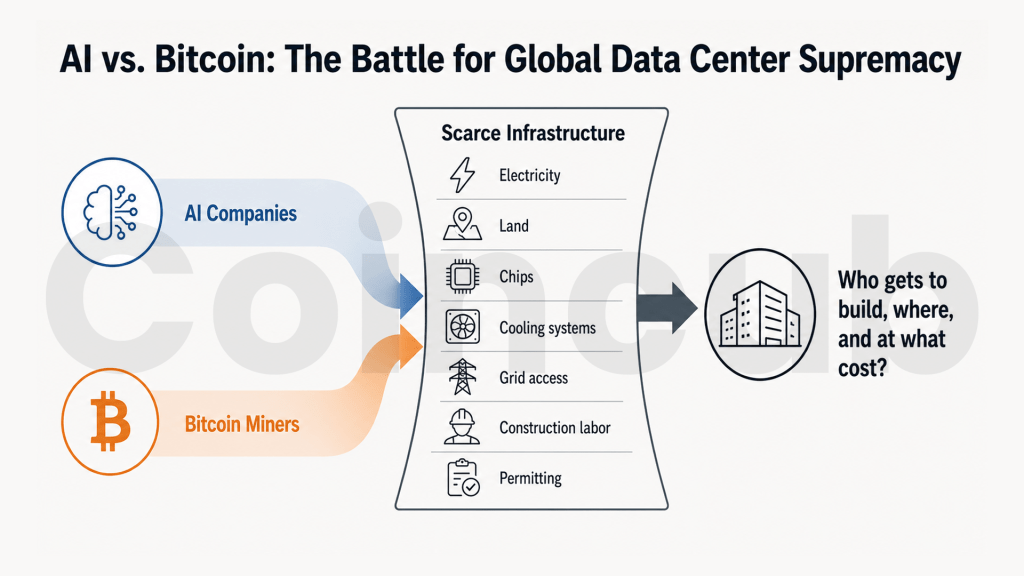
- AI companies and Bitcoin miners are now competing for the same physical foundations of the digital economy: electricity, land, chips, cooling systems, grid access, and finished data center capacity.
- AI holds the stronger position in premium data centers because it can pay more, supports higher value workloads, and benefits from deeper corporate and political backing.
- Bitcoin mining remains relevant because it can operate flexibly, move into remote locations, and use cheap or stranded energy that AI facilities often cannot access.
- Electricity is the central bottleneck. The companies that secure large scale, reliable power without triggering regulatory or community resistance will shape the next phase of digital infrastructure.
- The most likely outcome is a split market. AI will dominate high end, grid connected capacity, while Bitcoin mining will survive in lower cost, more flexible energy niches.
The Battle for Global Data Centers
Two of the most ambitious digital industries on the planet are fighting over the same physical resources. Artificial intelligence companies and Bitcoin miners both need electricity, land, advanced chips, cooling systems, grid access, and finished data center capacity. There is too little of each to satisfy every new project now being proposed.
At first glance, this looks like a clash between software driven industries. In practice, it is a contest over concrete, copper, power lines, substations, and cooling systems. AI enters the contest with formidable institutional momentum. It has deep pocketed corporate buyers, supportive policymakers, and workloads that justify premium prices.
Bitcoin miners bring a different kind of strength. They are nimble, comfortable operating at the edges of the grid, and highly familiar with energy markets. The result is a reordering of who gets to build, where they get to build, and what they must pay for access to power.

Why This Fight Matters Now
The timing matters because AI demand has triggered the largest wave of data center construction in history. Hyperscalers and startups are racing to secure compute capacity years in advance. At the same time, Bitcoin mining remains one of the most energy intensive digital industries in the world, consuming power on the scale of mid sized nations.
Both sectors are chasing the same prize: cheap, reliable electricity delivered at enormous scale. That shared appetite is pulling many outside parties into the contest. Local grid operators must decide which loads to connect first. Investors are repricing companies based on their exposure to AI infrastructure or Bitcoin mining. Regulators face pressure to set rules on permitting, emissions, and energy priority. Communities are asking whether scarce power should serve large computing facilities at all.
The Short Answer
AI is likely to dominate premium data center capacity. It commands deeper and more durable corporate demand, enjoys stronger political support, and runs higher value workloads that generate far more revenue per megawatt than Bitcoin hashing can.
When a hyperscaler and a miner bid for the same grid connection, the hyperscaler usually has the advantage. It can pay more and can promise the kind of economic activity that politicians want to promote.
Bitcoin miners still have a durable role. They can set up in remote regions that AI operators avoid, strike flexible power arrangements that traditional tenants cannot match, and power down within seconds when the grid is stressed. That interruptibility is a genuine asset for system operators.
The most useful way to understand this battle is as a repricing and reorganization of global compute infrastructure. Each type of workload is being pushed toward the place and power source where it fits best.
Shared Infrastructure: Why AI and Bitcoin Are Competing
The competition exists because the two industries overlap almost everywhere it counts. Both require massive computing facilities filled with specialized hardware. Both draw far more power than a conventional office or factory. Both depend on continuous electricity consumption, which makes power one of the most important cost drivers in their budgets.
They also need much of the same supporting infrastructure. Industrial cooling systems must remove heat. Transformers and substations must step electricity down to usable levels. Large tracts of land must be secured. Grid interconnections must be approved and built, often over a period of several years.
The overlap extends beyond power. Construction crews, electrical contractors, and specialized technical labor are all in short supply. A worker building an AI campus is unavailable to a mining project. Both industries also search for similar locations: areas with low energy costs, available capacity, cooperative regulators, and climates or geographies that make cooling easier.
The deeper lesson is that the digital economy is increasingly governed by physical bottlenecks. Data, algorithms, and blockchains may feel weightless, but their growth runs into the hard limits of generation, transmission, land, equipment, labor, and construction timelines.
Key Differences Between AI Data Centers and Bitcoin Mining Sites
Despite the overlap, AI data centers and Bitcoin mining sites operate under very different technical and commercial requirements. AI workloads, especially large model training, demand clusters of expensive GPUs, ultra fast networking, low latency, and very high uptime. A training run that fails because a node drops can waste days of work and millions of dollars.
Bitcoin mining relies on ASIC machines built for one task: computing hashes as cheaply as possible. Miners need power and cooling, but they require far less sophisticated networking than AI clusters.
That difference shapes the entire facility. AI sites are more expensive, more complex, and harder to design and operate because every component must support reliability and performance. Mining sites can be more modular. Some are built from containerized units and can be moved when local economics change.
AI customers such as enterprises, research labs, and governments expect enterprise grade reliability backed by contractual guarantees. Bitcoin miners can tolerate interruptions because a paused machine simply stops earning revenue for a period of time.
AI and Bitcoin compete fiercely for power, but they do not always compete for the same quality of facility. A site that works well for hashing may be unsuitable for AI. A site built for AI may be too expensive for mining.
AI Data Centers vs. Bitcoin Mining Sites
| Category | AI Data Centers | Bitcoin Mining Sites |
| Primary hardware | GPUs and high performance networking equipment | ASIC miners built for hashing |
| Power needs | Reliable, firm, long term electricity supply | Cheapest available power, including stranded or underused energy |
| Uptime requirements | Very high, with enterprise grade guarantees | More flexible, with interruptions often tolerable |
| Facility complexity | High, due to cooling, networking, redundancy, and security needs | Lower, often modular and easier to relocate |
| Best locations | Grid connected sites near fiber, customers, and technical talent | Remote or low cost energy regions |
| Revenue model | Long term contracts and higher value compute workloads | Bitcoin production tied to price, difficulty, rewards, and power costs |
| Main advantage | Ability to pay for premium capacity | Flexibility and ability to monetize otherwise wasted power |
Power: The Core Battleground
Electricity is the binding constraint for both industries. It is also the arena where the contest is decided. There is too little cheap, reliable, grid connected power to satisfy every buyer, and the gap is widening as AI demand grows. AI firms need reliable, long term power contracts. They are building facilities designed to run at high utilization for a decade or more. They will pay a premium for firm, round the clock supply, and some are willing to finance new generation directly.
Bitcoin miners follow a different strategy. They search for cheap, stranded, or underused energy, including flared gas, curtailed wind, surplus hydro, and power that would otherwise be wasted because no other buyer is positioned to use it. This makes miners attractive to grid operators in specific situations. They can offer flexible load that switches off within moments during peak demand. That ability can help balance the system and absorb excess renewable generation.
The decision is also political. Communities are asking whether limited power should go to AI, Bitcoin, factories, homes, hospitals, transit, or other public needs. Energy policy, permitting rules, and grid upgrades will determine who gets priority and how quickly new capacity comes online. The core argument is simple: the winner will be the operator that secures power at scale while avoiding the political and community backlash that can stall projects for years.
Why Bitcoin Miners Are Pivoting Toward AI
Faced with AI buyers that can outbid them for premium power, many Bitcoin miners are exploring ways to serve the AI boom directly. Some are moving into AI hosting and high performance computing, using their experience with large, power hungry facilities to serve a new class of customer.
The appeal is straightforward. AI contracts can offer steadier and more predictable revenue than Bitcoin mining. Mining income swings with the Bitcoin price, network difficulty, block reward halvings, and energy costs. Those forces can turn a profitable quarter into a painful one with little warning.
An AI hosting agreement with a creditworthy tenant can look far more stable. Miners also bring valuable assets to the table. They may already control land, power contracts, and grid interconnections that took years to secure. They also have operational experience running large energy intensive sites.
Those advantages matter because grid access is one of the scarcest resources in the digital economy. By moving into AI, miners can reduce pure exposure to Bitcoin price cycles and build a business closer to recurring infrastructure income. Bitcoin miners may end up playing several roles at once. In some markets, they will compete with AI firms. In others, they will supply capacity. In still others, they may become partners.
Limits of Converting Mining Sites Into AI Facilities
The pivot toward AI has limits. Turning a mine into an AI campus is difficult and expensive. AI data centers require much stronger cooling for dense GPU clusters, advanced networking fabrics, tighter physical and digital security, and deeper redundancy than most mining sites provide.
Each upgrade requires capital. The GPU clusters themselves demand far more investment than racks of ASICs. The commercial requirements are also tougher. Enterprise AI clients expect formal service level agreements, uptime commitments, and penalties when performance falls short. Many miners have limited experience operating under those standards.
Location can also be a problem. A site chosen for remote, cheap, stranded power may sit too far from the fiber connectivity and population centers preferred by latency sensitive AI workloads. Electrical infrastructure built for steady hashing may also require expensive reengineering to support high performance computing.
Cheap power is a valuable starting point, but it does not automatically turn a miner into an AI infrastructure company. The gap between owning energy assets and delivering enterprise compute is wide. Crossing it takes capital, technical talent, operational discipline, and time.
Investor Stakes: Which Model Looks Stronger?
For investors, the two business models offer different trade offs. AI infrastructure offers the prospect of long term contracts, predictable demand, and steadier cash flow. Markets often reward those qualities with higher valuations.
Bitcoin mining offers a different kind of upside. During a Bitcoin bull market, rising prices can lift a miner’s revenue faster than any hosting contract. That upside comes with significant volatility.
Mining revenue depends on the Bitcoin price, network difficulty, block rewards, and energy costs. These variables can move against an operator quickly. AI hosting can offer smoother results, but only for companies that can fund heavy capital spending and execute technically demanding builds.
Markets have already begun to separate credible AI infrastructure stories from weaker ones. Miners with real contracts, strong power assets, capable teams, and credible financing are treated differently from companies that simply add AI language to a press release.
The question for the sector is whether these companies are becoming diversified infrastructure firms with durable new revenue streams, or whether some are chasing the hottest technology theme to support their stock price.
Political and Environmental Pressure
Power and capital are major constraints, but political permission is becoming just as important. Both AI and Bitcoin face criticism over energy consumption, water use, emissions, land use, and strain on local grids.
The two industries face different public narratives. AI tends to attract more support because it is associated with productivity, scientific research, national security, and economic competitiveness. Bitcoin mining draws sharper skepticism because its social value is more contested and harder for the public to connect to everyday benefits.
The friction is often local. Residents near large computing facilities raise concerns about cooling fan noise, water consumption, gas fired power, visual impact, land use, and the effect of large new loads on shared electricity systems.
Operators that want to keep building will need to offer more in return. That may include renewable energy commitments, demand response participation, grid support, transparent job creation, tax revenue, and other verifiable community benefits.
Political permission may soon matter as much as power access. A project with a signed power contract can still fail in a zoning hearing.
What Happens Next With Global Data Centers
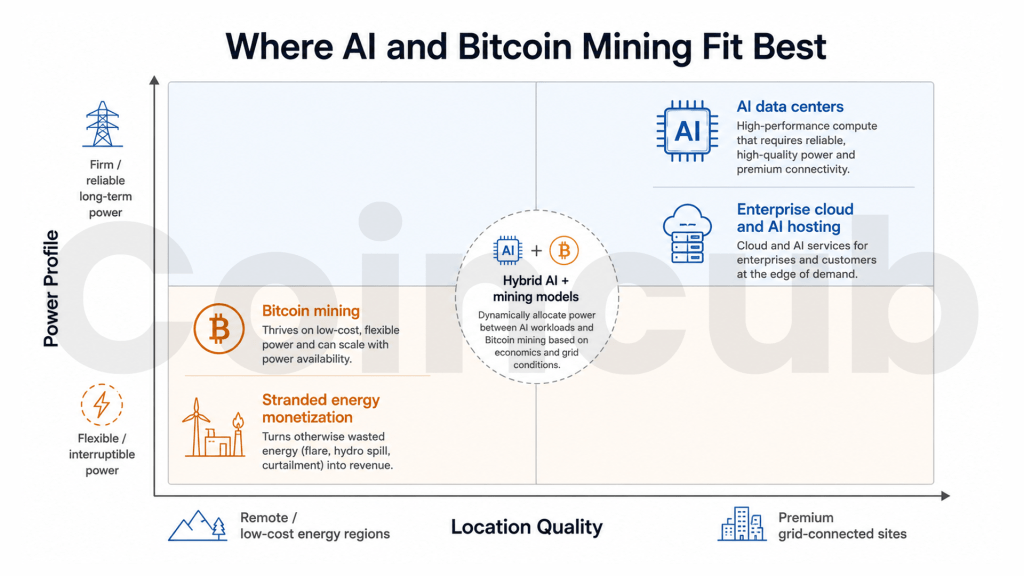
The most probable outcome is segmentation. AI is positioned to absorb premium, grid connected data center capacity. That includes the best sites, the firmest power, and locations near fiber, customers, and technical talent. AI can pay the most for those assets.
Bitcoin miners, priced out of many prime locations, are likely to move further toward remote, flexible, and low cost energy sources that AI operators are less willing to use. They will continue monetizing power that might otherwise be wasted.
Between those two poles, more miners will attempt hybrid AI and mining models. Some will run both workloads and shift capital or capacity based on changing economics. Some will succeed because they control valuable power assets and hard to replicate interconnections. Others will struggle with the capital costs and technical demands of serving enterprise AI clients.
Governments are likely to play a larger role through permitting decisions, tax incentives, energy policy, and grid planning. Public policy will increasingly influence which workloads receive priority and where large computing campuses can be built. The market will probably split into tiers and niches, each suited to a different combination of workload, location, reliability, and power source.
The Future of Global Data Centers in Regards to AI vs. Bitcoin
AI is better positioned to capture the highest value part of the data center race. Its workloads generate far more revenue per unit of power consumed. It attracts deeper and more creditworthy corporate demand. It aligns more clearly with economic and security priorities that governments are eager to advance. When premium capacity is allocated, AI will usually stand first in line.
Bitcoin mining still has a useful and durable role. Mining operations are more flexible than AI campuses. They can monetize energy in remote locations where few other buyers exist. They can also serve as interruptible load that helps grid operators manage peaks and absorb intermittent renewables.
Those are real economic functions. The bottom line is a division of territory: AI is likely to dominate premium, grid connected infrastructure, while Bitcoin endures in places where flexibility, remoteness, and rock bottom power costs matter most.
The contest between AI and Bitcoin reaches far beyond technology. It is a story about electricity, land, cooling, chips, capital, and political approval. These are the physical foundations on which the digital economy now rests.
As that foundation is repriced and rebuilt, AI is poised to become the preferred tenant for the world’s most advanced data centers. It will claim many of the best sites and the most reliable power arrangements.
Bitcoin mining will continue to evolve. It is likely to become more specialized, more flexible, and more deeply integrated with energy markets. Its strongest role may be as a buyer of last resort for power that would otherwise be stranded or wasted.
The two industries will coexist, each occupying the ground best suited to its economics. The next phase of digital power will be decided by code, capital, and control over the infrastructure behind it.
Frequently Asked Questions (FAQs)
What is the Bitcoin AI?
Bitcoin AI refers to the integration of artificial intelligence technologies with the Bitcoin network. It involves using machine learning algorithms to optimize trading strategies, enhance security protocols, analyze market sentiment, and improve blockchain efficiency for better transaction processing.
Can AI replace Bitcoin?
No, AI cannot replace Bitcoin because they serve entirely different fundamental purposes. Bitcoin is a decentralized digital currency and store of value secured by cryptography, whereas artificial intelligence is a technology designed for advanced data processing and automated decision-making.
How will AI affect Bitcoin?
AI will significantly affect Bitcoin by optimizing mining energy consumption, improving fraud detection, and enabling advanced algorithmic trading. Machine learning models can analyze vast amounts of blockchain data, providing deeper market insights and enhancing the network’s overall operational efficiency.
Can AI predict Bitcoin?
AI can analyze historical market data, social sentiment, and trading trends to forecast potential Bitcoin price movements. However, it cannot predict prices with absolute certainty due to the cryptocurrency market’s extreme volatility and susceptibility to unpredictable global macroeconomic events.
Will AI ever crack Bitcoin?
Current artificial intelligence cannot crack Bitcoin’s SHA-256 cryptographic security. While future advancements combining AI with quantum computing could theoretically pose threats, the Bitcoin network would proactively undergo defensive protocol upgrades to quantum-resistant algorithms long before a critical breach occurs.