


 Buy a Licensed Company
  Explore VASP Data
  Talk to an Expert

 Atis Shala
Atis is a senior analyst and community lead with four years of experience in crypto. He has a bachelor from the Rochester Institute of Technology.
Atis Shala
Atis is a senior analyst and community lead with four years of experience in crypto. He has a bachelor from the Rochester Institute of Technology.
ASIC vs. GPU Crypto Mining: Hardware Comparison Guide
The cryptocurrency mining landscape of 2026 represents a mature, industrialized sector. The days when a single laptop could generate significant Bitcoin rewards from a bedroom are gone. Today, the industry hinges on specialized hardware efficiency and thermodynamic management. Investors must choose between two primary paths: the raw, uncompromising power of Application-Specific Integrated Circuits (ASICs) or the versatile, multi-functional utility of Graphics Processing Units (GPUs). This guide breaks down the technical and economic realities of both, providing a blueprint for hardware acquisition in the current market.
The Evolution of Hashing Hardware
Cryptocurrency mining provides the computational security required for Proof of Work (PoW) blockchains. In the early 2010s, miners relied on Central Processing Units (CPUs), but the network soon outpaced the general-purpose capabilities of standard computer processors. The market shifted toward GPUs because their parallel processing architecture handled the repetitive math of cryptography with far greater efficiency.
Eventually, the demand for even higher throughput led to the birth of the ASIC. These machines do not run operating systems, render video, or browse the web. They perform one task: solving a specific cryptographic algorithm. This specialization created a fork in the mining community that remains the defining characteristic of the industry today. One path leads toward industrial-scale efficiency, while the other maintains a foothold in decentralization and flexibility.

Narrowing the Focus: The Core Conflict
While both hardware types serve the same fundamental goal of securing a network and earning rewards, they operate on different philosophies. ASICs dominate high-cap assets like Bitcoin (BTC) and Litecoin (LTC). Conversely, GPUs remain the primary tool for experimental altcoins, new Web3 protocols, and miners who value the ability to pivot between different projects.
The choice between them involves more than just comparing hash rates. It requires an understanding of energy costs, hardware longevity, and the potential for technological obsolescence.
Technical Context: Algorithms and Efficiency
To understand the hardware, one must first understand the algorithm. Every PoW cryptocurrency uses a specific mathematical “puzzle” that miners must solve.
SHA-256 (Bitcoin): This algorithm requires massive brute-force power. It is “compute-bound,” meaning the faster a chip can cycle through numbers, the better it performs. ASICs are the undisputed kings here.
Ethash and ProgPow (ETC and others): These algorithms are often “memory-bound.” They require high-speed access to Random Access Memory (RAM) rather than just raw logic speed. GPUs excel in this area due to their sophisticated memory controllers.
Memory-Bound Algorithms (KawPow and Karlsenhash): These algorithms require high-speed access to Random Access Memory (RAM) rather than just raw logic speed. GPUs excel in this area due to their sophisticated memory controllers. Furthermore, this memory advantage translates directly into the Decentralized Physical Infrastructure Networks (DePIN) sector, allowing miners to rent GPU VRAM for AI model training.
KHeavyHash (Kaspa): This algorithm provides the definitive case study of hardware evolution. Kaspa launched as a highly profitable GPU coin, but hardware manufacturers introduced the first specialized ASICs in April 2023. Today, industrial ASICs completely dominate the Kaspa network, forcing GPU miners to migrate toward newer, ASIC-resistant projects.
Efficiency Metrics (Joules per Terahash)
In 2026, we measure success in Joules per Terahash. This metric defines how much energy a machine consumes to produce a specific amount of work. As electricity prices rise globally, the rating determines which miners stay online during market downturns and which must pull the plug.
Hardware Analysis: ASICs (The Purpose-Built Scalpels)
ASICs represent the pinnacle of mining performance. Manufacturers like Bitmain, MicroBT, and Canaan design these units from the silicon up to be the most efficient hashing machines on the planet.
Current Market Leaders (Early 2026)
The 2026 hardware cycle features machines that have definitively breached the 10 Joules per Terahash efficiency barrier. The introduction of hydro-cooling systems represents the new standard for industrial operations.
| Model | Hash Rate | Power Consumption | Efficiency |
| Bitmain Antminer S23 Hydro | 580 TH/s | 5510W | 9.5 J/TH |
| MicroBT WhatsMiner M66S++ | 356 TH/s | 5518W | 15.5 J/TH |
| Canaan Avalon 1566 | 185 TH/s | 3200W | 17.3 J/TH |
The Advantages of ASIC Mining
- Extreme Efficiency: No GPU can compete with an ASIC on a “per-hash” energy basis. An Antminer S23 produces more Bitcoin-securing power than thousands of high-end GPUs combined.
- Plug-and-Play Simplicity: Most ASICs come as “all-in-one” units. You provide power, connect an Ethernet cable, and point the machine to a mining pool.
- Space Density: An ASIC miner packs a massive amount of computing power into a relatively small chassis, allowing for dense configurations in professional data centers.
The Disadvantages of ASIC Mining
- Rigidity: If you buy a Bitcoin ASIC, you can only mine SHA-256 coins. If the Bitcoin network changes its algorithm or the coin’s value crashes, the hardware becomes a “paperweight.”
- Rapid Obsolescence: ASIC manufacturers release new generations frequently. A machine that is top-tier today might become unprofitable in 18 to 24 months as network difficulty rises.
- Noise and Heat: These machines sound like jet engines. They require specialized cooling and acoustic management, making them unsuitable for most residential environments.
Hardware Analysis: GPUs
GPU mining utilizes the same graphics cards that gamers and AI researchers use. This dual-use nature provides a unique safety net for miners.
Current Market Leaders
In 2026, the market revolves around the NVIDIA RTX 50-series and high-end AMD Radeon cards.
NVIDIA RTX 5090: This card features 32GB of VRAM and remains the gold standard for memory-intensive mining and AI workloads.
AMD Radeon RX 8900 XTX: Known for superior efficiency on certain memory-bound algorithms, this card offers a better price-to-performance ratio for mid-scale rigs.
The Advantages of GPU Mining
- Flexibility: GPU miners can switch between dozens of different cryptocurrencies at the click of a button. When Ravencoin is more profitable than Ergo, the miner pivots instantly.
- Resale Value: Unlike ASICs, GPUs have a massive secondary market. You can sell your mining cards to gamers, video editors, or AI startups. This “exit strategy” significantly lowers the risk of the initial investment.
- The AI Pivot: A major trend in 2026 involves “DePIN” (Decentralized Physical Infrastructure Networks). GPU owners can now rent their computing power to AI companies for model training, often earning more than they would from traditional mining.
The Disadvantages of GPU Mining
- High Complexity: Building a GPU rig requires motherboards, CPUs, RAM, risers, and power distribution units. Managing drivers and BIOS settings demands technical expertise.
- Low Efficiency: Compared to ASICs, GPUs waste a lot of energy on components that don’t contribute to hashing, such as video output logic and general-purpose registers.
- Fragility: GPU rigs have many points of failure. A single faulty riser or a driver conflict can take down an entire eight-card rig.
Comparative Analysis: The Investor’s Matrix
Choosing between these two hardware types requires an honest assessment of your resources and goals. Use the table below to evaluate your position.
Decision Framework
| Feature | ASIC Winner | GPU Winner |
| Initial ROI Speed | ASIC | – |
| Hardware Longevity | – | GPU |
| Low Noise Requirements | – | GPU |
| Industrial Scalability | ASIC | – |
| Resale Protection | – | GPU |
| Energy Efficiency | ASIC | – |
Profitability Calculations
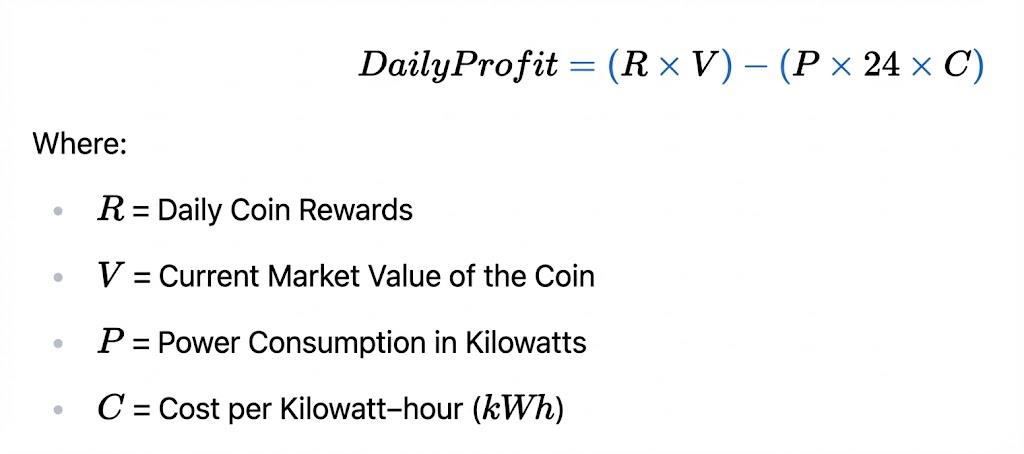
In 2026, the break-even electricity price for an NVIDIA RTX 5090 mining traditional altcoins hovers around $0.04 per kilowatt-hour. In stark contrast, the top-tier Bitmain Antminer S23 Hydro maintains profitability at electricity prices up to $0.11 per kilowatt-hour. This superior efficiency metric allows industrial operators to survive extended market downturns and weather network difficulty spikes.
Operational Reality: Maintenance and Environment
Hardware choice dictates your daily life as a miner. ASICs require industrial-grade power infrastructure. A single high-end ASIC pulls nearly 3500 Watts, which exceeds the capacity of a standard 15-amp residential circuit in many countries. You likely need a 240V outlet, similar to what a clothes dryer or electric oven uses.
GPU rigs are more “home-friendly” in terms of power draw per unit, but they generate significant ambient heat. A six-card rig can easily raise the temperature of a medium-sized room by 10 degrees Celsius within an hour. Professional miners in 2026 increasingly use immersion cooling, where hardware is submerged in a non-conductive dielectric fluid. This technology eliminates noise and extends the life of the chips by maintaining a perfectly stable temperature.
The Path Forward for ASIC vs. GPU Crypto Mining in 2026
The “ASIC vs. GPU” debate no longer has a single correct answer. Instead, the market has bifurcated into two distinct business models.
If you have access to cheap, industrial-scale electricity and want to treat mining as a high-volume commodity business, ASICs are your only viable option. They provide the efficiency required to survive the “difficulty ribbons” and halving events that define the Bitcoin economy.
If you are a hobbyist, a technologist, or an investor who wants to hedge against market volatility, GPU mining offers a safer, more versatile entry point. The ability to pivot into AI compute or sell the hardware to the gaming market provides a level of capital protection that ASICs simply cannot match.
The most successful miners of 2026 often employ a hybrid strategy. they use ASICs for steady, long-term accumulation of “blue chip” assets like Bitcoin, while maintaining a fleet of GPUs to capture the high-upside volatility of emerging Web3 protocols.
Frequently Asked Questions (FAQ)
Can I still mine Bitcoin with a GPU in 2026?
Technically, yes; practically, no. The network difficulty is so high that the electricity cost to mine Bitcoin with a GPU would be thousands of times higher than the value of the Bitcoin you earn. You would effectively be losing money every second the machine runs.
What is the expected lifespan of a mining GPU?
Under proper conditions (clean environment, stable temperatures, undervolted settings), a high-quality GPU can last five to seven years. However, its “economic lifespan” in mining is usually shorter, as more efficient cards eventually make older models unprofitable.
Are ASICs more profitable than GPUs?
Currently, ASICs offer higher daily revenue potential due to their efficiency. However, they carry higher risk. If the specific coin they mine loses value, the ASIC loses value. GPUs carry less risk because they retain value across multiple industries.
Is home mining still possible?
Home mining remains possible with GPUs or “silent” ASIC models like the Avalon Mini series. However, standard industrial ASICs are too loud and power-hungry for a typical residential living space.
Why is AI compute important for GPU miners?
As PoW rewards fluctuate, AI platforms like Render or Akash allow GPU owners to rent their chips for tasks like 3D rendering or machine learning. This provides a diverse income stream that isn’t strictly tied to cryptocurrency prices.