Buy a Licensed Company
  Explore VASP Data
  Talk to an Expert

 Atis Shala
Atis is a senior analyst and community lead with four years of experience in crypto. He has a bachelor from the Rochester Institute of Technology.
Atis Shala
Atis is a senior analyst and community lead with four years of experience in crypto. He has a bachelor from the Rochester Institute of Technology.
Decoding Bitcoin’s Halving Cycle: Do Historical Price Patterns Still Matter?

- Bitcoin’s halving cycle still matters, but it should be treated as historical context rather than a reliable price forecast.
- Past halvings were followed by major bull markets, but those rallies also depended on demand-side catalysts such as retail adoption, ICO speculation, pandemic-era liquidity, and institutional buying.
- The direct supply shock from each halving has weakened as Bitcoin’s market capitalization, liquidity, and trading volume have grown.
- Today’s Bitcoin market is more influenced by ETFs, macro conditions, regulation, derivatives, and institutional behavior than in earlier cycles.
- Investors should watch real-time demand, liquidity, ETF flows, miner behavior, and onchain signals instead of relying on the four-year calendar alone.
Bitcoin Halvings & Bull Markets
Bitcoin halvings have historically been followed by major bull markets, and that track record made the four-year cycle one of crypto’s most repeated ideas. Yet the market that produced those rallies has changed in deep ways. Institutional investors now hold real positions, spot Bitcoin ETFs have opened access through brokerage and retirement accounts, macro policy and regulation move prices, miner economics have matured, and Bitcoin’s market capitalization is far larger than a decade ago. Each force complicates the old cycle story.
The central answer here is that historical price patterns still matter, but they belong in the category of context rather than reliable forecast. The halving cycle remains one of Bitcoin’s most important narratives, and it still shapes how people think about scarcity and timing. Its predictive power, however, has weakened as the market matured. Treating the halving as a guaranteed countdown to higher prices ignores how much the demand side has shifted.
Why This Debate Matters Now
The halving debate is not academic, because real money is positioned around it. Traders still use the halving calendar to frame price expectations, anchoring targets and timelines to the moment new supply gets cut. Long-term investors treat halvings as confirmation of Bitcoin’s scarcity thesis, viewing each reward reduction as proof that issuance keeps tightening on schedule.

Analysts are split. Some argue the four-year cycle remains the dominant rhythm of the asset, while others believe it is fading as participation broadens and the market deepens. That disagreement has sharpened because the environment now includes stronger institutional participation and more macro sensitivity, with Bitcoin reacting visibly to interest rates and liquidity. This article works through the question in stages: what happened after past halvings, why those patterns formed, what has structurally changed, and which signals investors might watch instead of the calendar alone.
The Short Answer: Historical Patterns Matter, But Less Than Before
Halvings still reduce the rate of new Bitcoin supply. They still reinforce the scarcity narrative at the center of Bitcoin’s investment case, and they still influence investor psychology by providing a scheduled, widely watched event. The important caveat is that the direct supply shock is smaller now than in earlier cycles, because the issuance removed by a halving has shrunk relative to market size and trading volume.
At the same time, Bitcoin has become more liquid, more institutionalized, and more closely tied to global risk appetite. Historical cycles remain useful for context, showing how scarcity, psychology, and demand have interacted before. As a standalone trading model, they encourage confidence in conditions that may not repeat. The halving is still relevant, but it is no longer enough to explain Bitcoin’s price by itself.
Quick Background: What Is Bitcoin Halving?
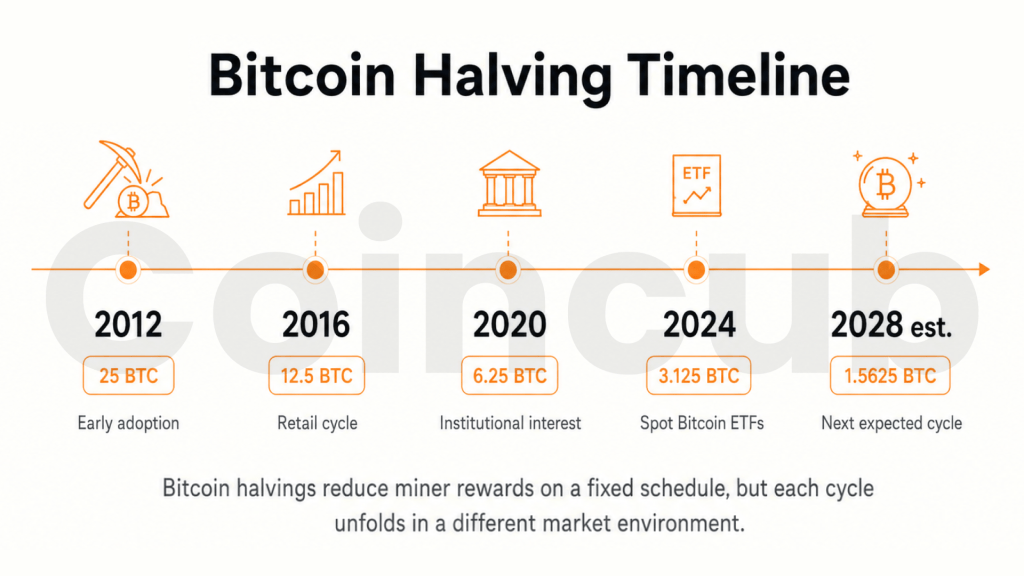
Bitcoin runs on a network of miners who validate transactions and group them into blocks. In exchange for securing the network, miners receive newly created Bitcoin as a block reward, which is how fresh coins enter circulation. Roughly every four years, the protocol cuts that block reward in half. This event is the halving, and each one lowers the pace at which new Bitcoin is mined, slowing the flow of new supply step by step.
The rule is written directly into Bitcoin’s code, so it happens automatically and predictably without any committee or central bank deciding to trigger it. The schedule points toward a hard limit, since Bitcoin’s total supply is capped at 21 million coins. Halvings draw attention because they make Bitcoin’s issuance transparent and increasingly scarce. Anyone can see how much new supply will be created and when the next reduction arrives, which turns each halving into a recurring milestone the market watches closely.
Why Halving Became Bitcoin’s Core Market Narrative
The halving became central because it captures Bitcoin’s defining feature in a single, easy event. The monetary policy is transparent and rules based, set in advance and visible to everyone. That contrasts with fiat currencies, where issuance is managed by central banks that can expand or contract the money supply.
Because no authority controls Bitcoin’s issuance, the halving gives investors a clean scarcity story they can grasp without technical background. Each halving turns into a major media moment and market event, complete with countdowns and renewed attention. Over three cycles, the roughly four-year rhythm has shaped the vocabulary traders use, organizing talk of tops, bottoms, and accumulation around the halving date. The narrative draws strength from how its pieces fit: scarcity provides the thesis, miner economics add a supply-side mechanism, and investor psychology supplies the emotional engine. The halving matters because of supply mechanics and because markets respond to compelling stories.
Historical Pattern: What Happened After Previous Halvings?
| Halving | Market Context | What Happened Afterward | Main Takeaway |
| 2012 halving | Bitcoin was still a niche asset with thin liquidity and a small market cap. | The post-halving rally was dramatic in percentage terms and brought Bitcoin wider attention. | The supply cut mattered more because the market was small and easier to move. |
| 2016 halving | Bitcoin was more established but still largely retail-driven. | The 2017 bull market followed, boosted by ICO speculation and rising crypto awareness. | The halving helped frame the cycle, but demand and speculation amplified the rally. |
| 2020 halving | Bitcoin entered a macro environment shaped by stimulus, low rates, and growing institutional interest. | The rally into 2021 coincided with pandemic-era liquidity and broader risk appetite. | The cycle was influenced by both halving expectations and unusually strong macro tailwinds. |
Across all three cases, the surface pattern is clear: each halving was followed by a major rally. But the drivers were not identical. Early adoption, speculative excess, liquidity conditions, and institutional demand all played important roles, which means the halving should be read as one part of the cycle rather than the only cause.
Correlation vs. Causation: Did Halvings Cause the Bull Markets?
A price rally after a halving does not, on its own, prove the halving caused it. The halving reduces new issuance, but price depends on both supply and demand, and the demand side has done much of the heavy lifting. Every previous bull market coincided with forces unrelated to the block reward: early adoption in 2013, ICO speculation and surging awareness in 2017, and extraordinary monetary liquidity plus the first serious institutional buying in 2021.
Bitcoin’s reflexive nature adds complication, since rising prices attract attention, attention pulls in buyers, and buyers push prices higher. Within that loop, the halving may act as a trigger that starts a move, an amplifier that strengthens a trend, or a narrative anchor that gives traders a reason to expect a cycle. Those roles are hard to separate with only three examples. Halvings may help set the stage, while demand determines whether the stage produces a bull market.
Why Historical Patterns May Still Matter
There are solid reasons to keep historical patterns in the analysis. The strongest argument starts with predictability, since the halving is programmed into the protocol and its effect on issuance is known in advance. New supply genuinely declines at each event, which keeps Bitcoin’s fixed-supply narrative central to its investment case.
That narrative shapes behavior. Long-term holders who believe in scarcity may grow even less willing to sell as issuance tightens, which removes coins from active circulation. Miners receive fewer coins per block, and over time that can change how much they sell. Traders and analysts continue to watch the post-halving windows that produced past rallies, which means a large share of participants are looking at the same calendar and reference points. That shared attention is itself a force, because market psychology can become self-reinforcing when enough participants expect a cycle and position for it. None of this guarantees a repeat. The key point is measured: even if the mechanical supply impact has shrunk, the psychological and narrative effect can still shape market behavior in meaningful ways.
Why This Cycle May Be Different
The case for caution rests on how much the market has changed. The most basic factor is size. Bitcoin’s market capitalization is far larger than in earlier cycles, so the capital required to produce the same percentage gains has grown enormously. A move that once needed a few billion dollars of inflows might now require many times that. Market access has also been transformed. Spot Bitcoin ETFs let investors gain exposure through familiar brokerage and retirement platforms, changing who can buy and how demand reaches the asset. That brings in institutional buyers who may behave very differently from retail traders, allocating according to portfolio models and risk budgets rather than cycle enthusiasm.
Derivatives markets have become deeper and more sophisticated, which can alter how price discovery happens. Macro conditions exert a stronger pull as well, since interest rates, liquidity, inflation expectations, and the strength of the dollar can support or pressure Bitcoin in ways that may overwhelm a supply change. Regulatory developments add another layer, because clarity or crackdowns shape institutional confidence. Miner economics introduce short-term stress too, since reward reductions squeeze revenue and can force selling until the network adjusts. Taken together, these changes do not erase the halving. They reframe it. The halving still matters, but Bitcoin now trades in a more mature, institutional, and macro-sensitive environment where the cycle competes with many other drivers.
The Supply Shock Debate
A central question is whether the direct supply effect is weakening. In the early years, a halving removed a large amount of new issuance relative to Bitcoin’s market size, so the reduction landed hard against a thin market. Today the same mechanical cut is small when measured against total trading volume and a market capitalization in the hundreds of billions of dollars.
On that basis, some analysts argue the halving is increasingly priced in, since everyone knows when it will happen, so rational markets should absorb the information in advance. Others push back, noting that predictable does not mean irrelevant. If demand rises while new supply falls, even a smaller issuance reduction can have an outsized effect. Supply held by long-term investors tightens available liquidity further, since dormant coins are effectively removed from the tradeable float. The relevant issue extends beyond new supply to liquid supply. The pure mechanical shock may be weaker, but the broader supply-demand setup can still become powerful if demand increases.
The Role of ETFs and Institutional Demand
Spot Bitcoin ETFs may be the single most important structural change in this cycle. By packaging Bitcoin into a familiar product, they make it accessible through brokerage and retirement platforms, reaching investors who would never open a crypto exchange account. That creates demand separate from crypto-native retail buying, pulling in capital from advisors and institutions that allocate based on portfolio strategy, inflation hedging, or diversification. ETF demand can also front-run the halving narrative, with flows arriving ahead of the event and changing the supply-demand balance before the reward drops.
Those flows cut both ways. Large sustained inflows can reinforce a post-halving advance by absorbing supply, while persistent outflows can drain support and weaken any rally. Institutions may bring more disciplined risk management, trimming and rebalancing methodically, which could reduce the extreme boom and bust behavior of past cycles. There is a deeper implication. As participation grows, Bitcoin may increasingly behave like a macro-sensitive asset that responds to liquidity and rates rather than a pure crypto-cycle asset. If institutional demand becomes the dominant driver, does the halving cycle become secondary?
Macro Conditions: The Factor That Can Override the Cycle
Macro conditions shape the demand side that decides whether a halving matters. Bitcoin has tended to perform best when liquidity is expanding and investors are willing to take risk, since that environment pushes capital toward higher-return, higher-volatility assets. The reverse also holds. Higher interest rates raise the appeal of safe yields and can reduce appetite for speculative positions. A strong U.S. dollar tends to weigh on risk assets broadly.
Inflation narratives can support Bitcoin when investors treat it as a scarce alternative asset, but that support depends on belief and can fade if the market decides Bitcoin trades as a risk asset instead. Beyond these levers, central bank policy, recession fears, and global liquidity can influence Bitcoin more powerfully than the issuance schedule does in any given year. The 2020 to 2021 cycle is the clearest illustration, since the flood of liquidity lifted Bitcoin alongside many other assets. The lesson is direct. A halving that arrives without supportive demand conditions may not produce results like previous cycles. The halving may influence supply, while macro conditions shape demand.
Miner Economics After the Halving
Miner behavior adds a practical market-structure dimension. After each halving, miners earn fewer Bitcoin per block, which cuts their revenue unless price rises enough to offset the smaller reward. When price does not climb fast enough, the squeeze falls hardest on less efficient operators, and some may shut down machines or sell reserves, adding supply at an inconvenient moment.
Public mining companies have more tools to manage the transition, including access to capital markets, treasury management, and operational efficiency. The effects run in both directions. Miner selling can create short-term pressure right after a halving, yet the exit of weaker miners can also stabilize the network as production concentrates among efficient operators. Mining difficulty recalibrates automatically as hash rate changes, helping the network find a new equilibrium. Miner behavior does not determine the whole cycle, but it can affect short-term supply and market sentiment.
Onchain Signals to Watch
Onchain data offers a way to test whether a cycle is behaving as history suggests. Long-term holder supply shows how many coins are held by investors who rarely sell, with rising balances suggesting a tightening float. Exchange balances indicate how much Bitcoin sits ready to sell, with falling balances often read as accumulation. Miner reserves reveal whether miners are holding or distributing. Realized price reflects the aggregate cost basis of the network, while MVRV-style indicators compare market value to realized value to gauge whether the market looks stretched.
Dormant coin movement flags when long-idle coins become active, hinting at profit-taking. Stablecoin liquidity signals buying power waiting on the sidelines, ETF flows add the institutional demand picture, and open interest and funding rates show how much leverage has built up. Read together, these signals help assess whether familiar cycle behavior is repeating or breaking down. The best analysis combines halving history with real-time evidence of demand, liquidity, leverage, and holder behavior.
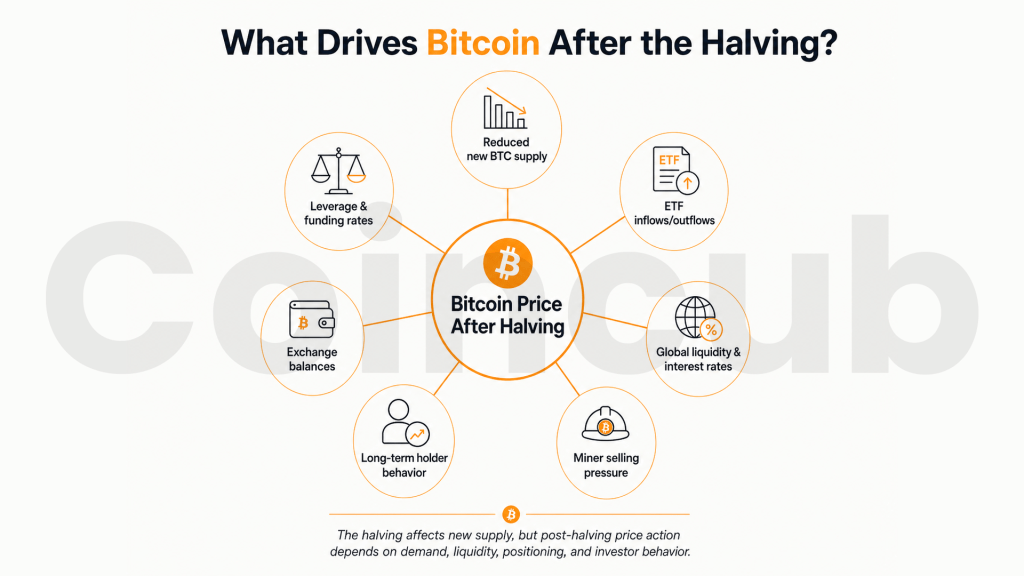
What Investors Should Watch Instead of Just the Calendar
| Signal to Watch | Why It Matters |
| ETF flows | Sustained inflows can absorb available Bitcoin supply, while outflows may weaken price support. |
| Long-term holder behavior | Accumulation can tighten the liquid supply, while distribution may signal profit-taking. |
| Exchange balances | Falling balances often suggest investors are moving coins into storage, while rising balances can indicate more potential selling pressure. |
| Miner reserves and selling | Miners may sell more after a halving if revenue falls and price does not rise enough to offset it. |
| Global liquidity and rates | Easier financial conditions can support risk assets, while tight liquidity and high rates can limit demand. |
| Leverage and funding rates | Excessive leverage can make rallies fragile and increase the risk of sharp liquidations. |
| Regulatory headlines | Policy changes can quickly affect investor confidence, institutional access, and market sentiment. |
The halving date still matters, but it should not be the only signal investors follow. A stronger read comes from combining halving history with real-time evidence of demand, liquidity, miner behavior, holder activity, and leverage.
The Risk of Overfitting the Four-Year Cycle
There is real danger in leaning too hard on the four-year cycle. Three major historical cycles do not provide enough data to build a guaranteed model. With so few examples, it becomes easy to draw a confident line through points that may not represent a stable rule. Investors compound this by cherry-picking dates that fit the story while ignoring how much conditions differed across each episode.
Widely traded patterns also tend to become less profitable as more participants front-run the same expected move. Market maturity adds complication, because as Bitcoin grows larger and more liquid, volatility can compress and the extreme swings of the early years may soften. External shocks make matters less predictable still, since a regulatory action or macro crisis can disrupt even a strong tendency. The reasoning that says this happened before, so it must happen again, is exactly the overconfidence that gets investors into trouble.
Bullish Case: Why the Cycle Could Still Repeat
There is a credible optimistic scenario. Supply issuance falls again at the halving, keeping the scarcity story intact. If ETF and institutional demand remain strong, that steady flow of new buying can absorb available supply and push the market higher, much as fresh demand did before. Long-term holders add to the setup when they keep their coins illiquid, since a tightening float means even moderate buying has an amplified effect on price.
Supportive macro liquidity would strengthen the case, lifting appetite for risk assets. As prices rise, retail interest often returns later in the cycle, bringing momentum that powered past rallies. In this view, the market follows a familiar path because enough structural pieces remain intact: declining issuance, durable demand, illiquid long-term supply, and a recognizable psychological cycle.
Bearish or Neutral Case: Why the Pattern Could Break
The skeptical scenario is just as coherent. Its starting point is that the halving may already be priced in, since a fully anticipated event can be absorbed ahead of time, leaving little fuel for a surge. The case strengthens if ETF demand slows or reverses, removing a key pillar of support. Tight macro conditions would compound the problem, as high rates and constrained liquidity reduce appetite for speculative assets. Long-term holders introduce risk if they sell into strength, and regulatory or geopolitical shocks can hurt sentiment quickly. Bitcoin’s much larger market capitalization also limits how far it can climb in percentage terms. A post-halving rally is not guaranteed, and investors who treat one as inevitable risk real disappointment.
Final Thoughts on Bitcoin Halving: Do Historical Price Patterns Still Matter?
So do historical price patterns still matter? They do, but their role has changed. Halving history remains useful for understanding Bitcoin’s rhythm, the supply narrative that anchors its investment case, and the investor psychology that turns a scheduled event into a market story. It also provides a framework for studying how previous cycles developed. What it does not provide is a precise roadmap.
The honest position holds several ideas at once. Halving history is context, not destiny. Supply reduction matters most when demand is strong, which means the halving’s effect depends heavily on conditions outside the protocol. Modern Bitcoin analysis has to include ETFs, macro liquidity, derivatives, regulation, miner economics, and onchain data. The four-year cycle may still exist as a tendency, but it has become less clean and less predictable as the market matured. The practical conclusion is to use the halving as a lens rather than a forecast.
Bitcoin’s halving cycle remains one of the most important features of the asset, but its meaning is evolving. In the early years, it was easy to view the halving as the dominant event in Bitcoin’s market cycle. Today it is better understood as one force among many. The fixed supply schedule still matters, and history still shapes expectations, yet the market has grown deeper, more institutional, and far more exposed to global financial conditions than a decade ago.
ETFs, macro liquidity, derivatives, regulation, and miner economics now share the stage, and at times they can overwhelm the halving. The past still matters. For Bitcoin investors, the future will likely be shaped by how halving history interacts with a market that no longer looks like the past.
Frequently Asked Questions (FAQs)
What is the Bitcoin halving cycle?
The Bitcoin halving cycle is the recurring event when Bitcoin mining rewards are cut in half. It happens roughly every four years and reduces the rate of new BTC entering circulation, reinforcing Bitcoin’s fixed-supply design.
Why is Bitcoin halving every 4 years?
Bitcoin halving happens about every four years because the network cuts miner rewards every 210,000 blocks. Since blocks are mined roughly every 10 minutes, this schedule works out to approximately four years between halving events.
Is 2028 the last Bitcoin halving?
No, 2028 is not the last Bitcoin halving. Bitcoin halvings are expected to continue roughly every four years until the block reward becomes extremely small, with the final bitcoin projected to be mined around 2140.
How does Bitcoin halving affect the crypto market?
Bitcoin halving can affect the crypto market by reducing new BTC supply and increasing scarcity narratives. Historically, halvings have supported bullish sentiment, but price outcomes also depend on demand, liquidity, macro conditions, regulation, and investor behavior.
What are the long-term effects of halving?
The long-term effects of halving include slower Bitcoin supply growth, greater scarcity, and increased reliance on transaction fees for miner revenue. Over time, halvings may strengthen Bitcoin’s store-of-value narrative but also pressure mining profitability.