Buy a Licensed Company
  Explore VASP Data
  Talk to an Expert

 Dren Hima
 is Head of Research at Coincub, leading research across digital asset regulation, licensing, market structure, tokenization and institutional adoption.
Dren Hima
Dren Hima is Head of Research at Coincub, leading research across digital asset regulation, licensing, market structure, tokenization and institutional adoption.
Who Owns the Most Bitcoin? It Depends What You Mean by “Own”

- “Largest holder” splits into three incompatible rankings: single addresses (a Binance cold wallet at ~248,598 BTC), onchain clusters (Coinbase at ~981,000 BTC), and beneficial ownership (Satoshi’s 1.096M attributed BTC). Never sum them.
- The richest addresses are exchange vaults. The top 100 hold ~14% of supply, but most of that is customer deposits matched almost 1:1 against withdrawal liabilities.
- The single most-quoted number is the least verified. Satoshi’s 1.096M is a probabilistic Patoshi cluster with no filing and no signed transaction behind it.
- 2026 proved ETF and corporate holdings are not sticky. IBIT peaked near 803,000 BTC in April then bled to ~735,000; Strategy turned seller, offloading 3,588 BTC for $216M in July.
- Real liquidity risk is disclosed and regulated. It comes from redemptions, fee-driven migration, treasury cash needs, and forfeiture sales.
The answer to who owns the most bitcoin is that the question has three answers, and they do not agree with each other.
Looking at single addresses, at the top of the list is a Binance cold wallet holding roughly 248,598 BTC. Ask it about onchain clusters, meaning the sets of addresses that one controller appears to run, and the leaderboard fills up with exchanges and custodians. Ask it about beneficial ownership, who carries the economic claim, and the ranking rearranges again around Satoshi Nakamoto, Strategy, and the US spot-ETF complex. Same chain, same coins, three different kings depending on which lens you hold up.
That distinction does the entire analytical work here, and most “richest bitcoin” content quietly collapses all three into one dramatic leaderboard. The output reads impressive and tells you very little, because a cold wallet stuffed with customer deposits is a liability warehouse dressed up as a fortune, and treating it as one person’s wealth is the single most common mistake in this topic.

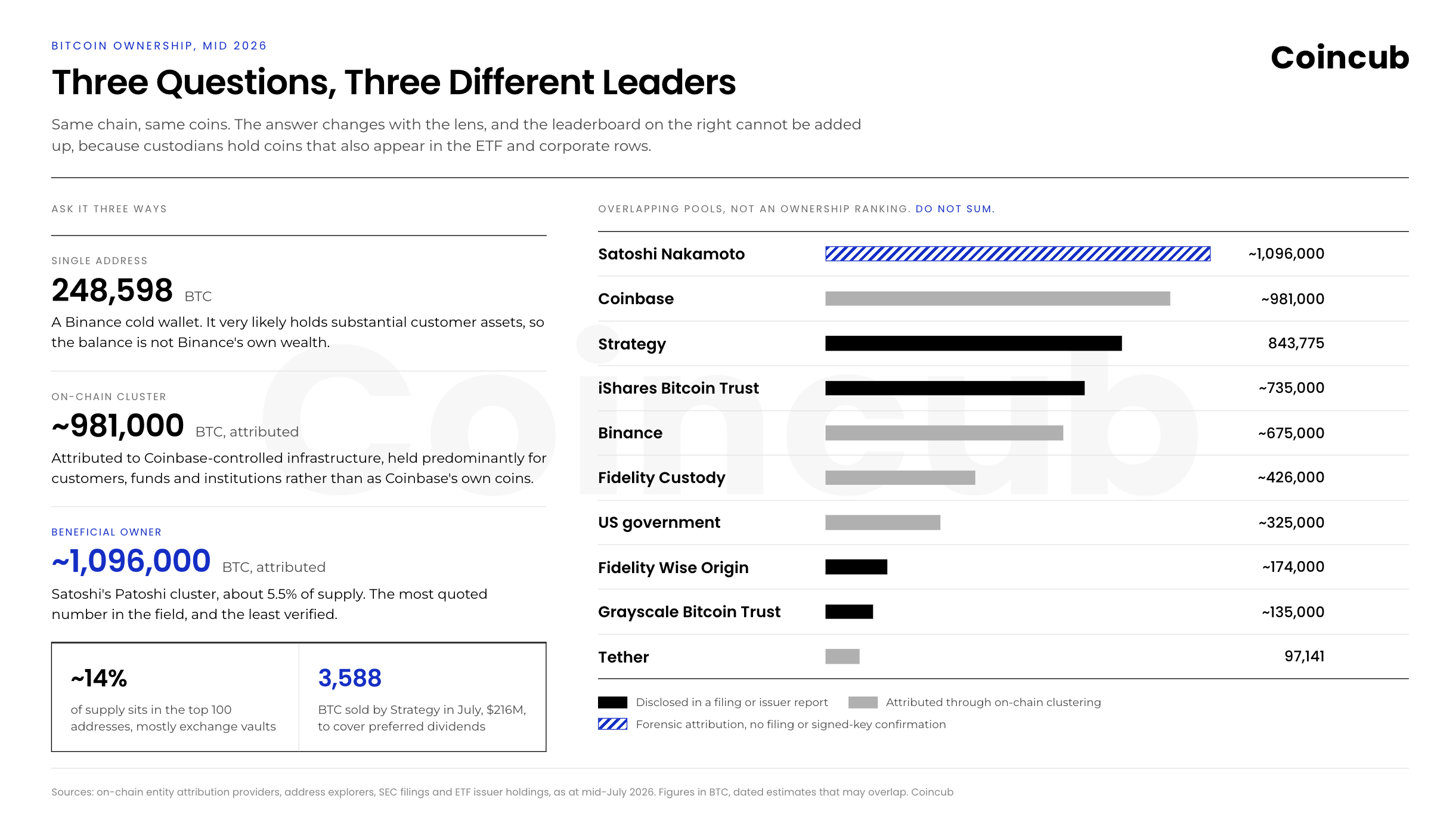
The cluster ranking, and why you cannot add it up
The mid-2026 order of large BTC pools looks like this, priced against a bitcoin trading around $65,000 in late July:
- Satoshi Nakamoto, about 1,096,000 BTC, attributed to the Patoshi early-mining cluster
- Coinbase, about 981,000 BTC, an exchange-and-custody cluster
- Strategy, 843,775 BTC, disclosed corporate treasury
- BlackRock’s IBIT, about 735,000 BTC, ETF beneficial holdings
- Binance, about 675,000 BTC, exchange reserve cluster
- Fidelity Custody, about 426,000 BTC, custodian cluster
- US government, about 325,000 BTC, sovereign seizure wallets
- Fidelity’s FBTC, about 174,000 BTC, ETF beneficial holdings
- Grayscale’s GBTC, about 135,000 BTC, ETF beneficial holdings
- Tether, 97,141 BTC, corporate reserve bucket
The one rule that keeps this list honest is that you must never sum it, because several of those rows are the same coins counted twice. Coinbase and Fidelity Custody hold bitcoin on behalf of ETFs, corporates, and retail customers, and Strategy itself routes part of its stack through Fidelity custody, so a coin can sit inside a custodian cluster and inside an ETF row and inside a corporate treasury at the same time. The practical way to read the table is as two overlapping questions stacked on one page, with one being who controls large pools of BTC onchain and the other being who is publicly disclosed as the economic owner of large pools of BTC. Those are different populations, and the custodians are where they blur.
Arkham’s 2026 holder map attributes 1.096 million BTC to the Patoshi cluster, roughly 5.5% of the 21 million supply, mined across about 22,000 early blocks and almost entirely dormant since. That is a beneficial owner with no exchange, no filing, and no signed message from the keys, and it still outranks every institution on the chain by a wide margin.
The UK government’s seizure wallets hold around 61,245 BTC on Arkham’s attribution, Grayscale’s Bitcoin Mini Trust reported 48,172 BTC on its own issuer page, MARA carries close to 39,000 BTC once its disclosed balance is combined with the custody adjustment, and Tesla still shows 11,509 BTC in its March 2026 10-Q, unchanged for quarters. None of these move the top of the ranking, but they show the same disclosed-versus-attributed split in miniature, with the corporate filers giving you a number you can stand on and the sovereign wallets giving you a balance whose disposal authority and inter-agency routing stay opaque.
The address leaderboard is a map of vaults
Address-level rankings distort even harder than entity rankings, because exchanges keep customer assets in a handful of enormous cold wallets, so the richest addresses are operational vaults rather than single-owner treasure. The richest bitcoin address, tracked by BitInfoCharts, is Binance’s 34xp4 cold wallet at around 248,598 BTC, and the next several belong to Binance again, Robinhood, Bitfinex, and Tether’s reserve management. The top 100 addresses together hold somewhere around 14% of all bitcoin, which sounds like extreme concentration until you remember that most of that balance is matched almost one-for-one against customer withdrawal liabilities.
Read that way, the address leaderboard is a statement about operational concentration and nothing about personal wealth. It is exactly why Satoshi can be the largest beneficially attributed holder while never appearing near the top of the single-address table, and why Binance can dominate the address table while its own balance sheet claim on those coins is close to zero. Quoting the richest-address list as evidence of personal wealth confuses custody infrastructure with ownership, and it happens constantly.
Three confidence tiers, and Satoshi lives in the shakiest one
Not every number in this space deserves the same trust, and the useful discipline is to sort each holder into disclosed, attributed, or unidentified before quoting it. Disclosed means a legal owner reported the balance in a filing or an issuer page, which is where Strategy, IBIT, FBTC, GBTC, and Tesla’s small stack sit, resting on SEC documents and fund dashboards rather than wallet inference. Attributed means strong onchain evidence links addresses to an entity that has not fully published those wallets, which covers Coinbase, Binance, Fidelity Custody, the sovereign seizure clusters, and Tether’s reserve. Unidentified means the balance is visible and the owner is not, which describes the dormant whales that show up on explorers with no name behind them.
Chainalysis leans on the common-input, or co-spend, heuristic as the most established clustering signal, and Glassnode is explicit that its exchange metrics depend on a continuously updated label set, so the “history” can change as the labels improve. Sarah Meiklejohn’s 2013 work on clustering and re-identification is the foundation everyone still builds on, and the later literature that revisited those heuristics found they under- and over-cluster depending on the era and the address-management style of the entity being tracked. Mixing, CoinJoin-style behaviour, one-time change addresses, and OTC settlement all punch holes in the picture, so even a clean-looking time series should be read as a continuously refined estimate rather than a census.
Glassnode’s total BTC exchange-balance metric reads around 420,690 BTC on labelled addresses, a figure the firm has revised upward more than once during 2026 as it captured more balance at venues it already tracked and added exchanges it had missed, which means a year-over-year “exchange reserves fell” chart can partly reflect better labelling rather than real coins leaving. The omnibus custody problem sits underneath all of it, because a single custodial deposit address can hold coins that belong to hundreds of unrelated clients, so clustering it correctly still tells you nothing about who owns what inside it. The test that separates a good attribution from a lazy one is whether it survives being asked who the coins are for, and most exchange and custodian rows fail that test by design.
Satoshi is the sharpest case of a number everyone quotes as fact while it sits in the softest tier. The 1.096 million figure is a probabilistic cluster built on the Patoshi pattern first identified by Sergio Demian Lerner rather than a registration statement or a signed transaction, and it is the best estimate available precisely because there is nothing firmer to replace it. It is worth stating plainly that the largest holder on every list is also the least verified, and the field has quietly agreed to treat a forensic inference as the anchor of the whole ranking.
The exchanges are custodians, and proof-of-reserve is not net worth
The most persistent misread in the cluster table is treating exchange balances as the exchange’s money. Binance frames its proof-of-reserve disclosures as evidence that user assets are backed 1:1 and held in custody, which is a statement about matching customer liabilities rather than corporate equity. Coinbase draws the same line in its own disclosures, separating customer crypto held under UCC Article 8 from Coinbase-owned crypto and stating that customer financial assets are not the property of Coinbase. So when Coinbase’s cluster shows roughly 981,000 BTC, the overwhelming share of that is other people’s bitcoin sitting in Coinbase’s vaults, including a large slice of the US spot-ETF complex it custodies.
This is where the beneficial-ownership lens earns its keep, because it strips the custodians back out and leaves the actual claimants. Once you do that, the concentration story softens considerably. The genuinely large economic owners are Satoshi, whose coins do not move, Strategy, whose position is disclosed to the share, and the ETF cohort, whose holdings are visible daily and are really thousands of underlying investors wearing one ticker. The picture that survives the custodial adjustment is meaningfully less concentrated than the raw address and cluster tables imply.
If you build a sample that deliberately avoids double-counting the exchanges and custodians, keeping only Satoshi, the disclosed corporate treasuries, the major spot ETFs, the sovereign wallets, and Tether’s reserve, then the weightings tell a more interesting story than any single leaderboard. The ETFs and funds come out as the largest bloc at roughly 31%, individuals and early miners sit right behind at about 30% on the strength of Satoshi alone, public companies land near 25% led by Strategy, sovereigns take around 11%, and private-company reserves round out the last 3%. Two of those five buckets are effectively one holder each, since Satoshi is the whole individual column and Strategy is most of the corporate one, which is the concentration worth worrying about, sitting inside the disclosed and quasi-disclosed set rather than in the anonymous whales people instinctively fear.
What moved over the last year
The last twelve months split into three forces pulling against each other, with corporate accumulation running hot into early 2026, ETF demand peaking and then bleeding, and governments and reserves moving selectively. Strategy is the clearest single-entity thread. Its stack climbed from 597,325 BTC in mid-2025 to 818,334 BTC by late April 2026 and on to 843,775 BTC, and then the accumulator turned seller, offloading 3,588 BTC for about $216 million in early July to cover preferred dividends and rebuild liquidity before pausing further bitcoin transactions. The most famous permabull on the corporate side became a structured seller the moment its capital stack demanded cash, which is the single most useful data point in the whole year for anyone modelling supply.
IBIT tells the ETF version of the same arc. BlackRock’s fund held around 700,000 BTC in mid-2025, pushed to roughly 803,000 BTC by late April 2026, then slid back toward 735,000 by mid-July before inflows resumed late in the month. The longer arc still marks the ETF cohort as the dominant source of structural new demand since launch, and the 2026 retrace from the April peak shows that the wrapper redeems in size when macro conditions turn, so it is a two-way valve rather than a one-way sink. GBTC ran the opposite direction almost without pause, grinding down from 185,099 BTC in mid-2025 to around 135,000 by mid-July 2026 as fee-sensitive money kept rotating out of the 1.5% legacy trust into cheaper products.
The GBTC bleed is the most legible fee story in the complex, and it has now cost Grayscale its rank, with the original trust sitting fourth by assets behind IBIT, FBTC, and ARK’s ARKB after years of leading the category it invented. A 1.5% expense ratio against 0.25% at Fidelity is not a rounding difference over a multi-year hold, and the migration it drove is a reminder that ETF holdings are not sticky treasury positions but pools that chase basis points and unwind the moment a cheaper wrapper exists. That is the structural point the whole cohort keeps proving through 2026, because the same investors who supplied the demand that lifted IBIT to its April peak are the ones who pulled it back down when sentiment cooled, and none of that supply behaves like a long-term holder even when the aggregate ETF line looks like one.
Governments and reserves supplied the rest of the movement. US wallets transferred roughly $288 million of seized bitcoin and ether to Coinbase Prime in mid-July, drawn from the BTC-e and Ryan Farace seizures, which sat awkwardly against the administration’s stated policy of treating seized BTC as a strategic reserve rather than a sale pool. Bhutan kept quietly unloading, selling roughly 70% of its stack over eighteen months down to about 3,500 BTC and possibly halting its mining operation. Tether went the other way and kept stacking, adding to its reserve past 97,000 BTC under its policy of routing up to 15% of realised operating profit into bitcoin.
The real liquidity risk is disclosed and regulated
Custodial concentration produces a very different risk profile from beneficial-owner concentration, and conflating the two leads people to worry about the wrong thing. A large share of institutional bitcoin now sits inside a small number of operational stacks, mainly Coinbase and Fidelity-related custody, which improves ETF settlement reliability while concentrating operational, legal, and cybersecurity risk into a few points of failure. Fund materials are candid about this, with Fidelity noting that FBTC is not registered under the 1940 Act or the Commodity Exchange Act, so holders do not get the protections of a conventional registered fund, and every spot-ETF prospectus flags custodian breach and protocol failure as live risks to fund assets.
The liquidity that can hit the tape comes through a different channel than the one the whale-watchers stare at. Dormant holdings like the Patoshi cluster function as an overhang narrative rather than daily supply, because coins that have not moved in fifteen years are not about to become sell pressure on a Tuesday, and the more careful academic treatment of the “Satoshi overhang” argues the bear mechanics are far more bounded than the popular version assumes. The bitcoin that genuinely moves markets is the disclosed, regulated, operationally centralised kind that sells for structured reasons, meaning ETF redemptions, sponsors trimming to pay fees, corporate treasuries raising cash, and governments executing forfeiture sales. Strategy’s July pivot and GBTC’s yearlong bleed are both examples of exactly that, and neither came from a mystery wallet.
Sovereign wallets deserve their own line, because their market effect runs through sentiment more than size. The US government’s 325,000 BTC is small against bitcoin’s full capitalisation, but a transfer to a prime broker reads to the market as a possible sale regardless of the stated policy, which is why the July Coinbase Prime move drew more attention than its dollar value warranted. Order-flow psychology reacts to the destination of a transfer, and a seizure wallet touching an exchange rail will move expectations even when nothing is sold.
The reserve policy makes the ambiguity worse rather than better, because the administration has said seized BTC should be held and not liquidated while the custody architecture and onboarding procedures behind that pledge were never spelled out, so a routine transfer to Coinbase Prime lands in a gray zone where the market cannot tell housekeeping from the first step of a sale. Bhutan is the counterexample that shows what a real sovereign seller looks like, moving coins to exchanges in tranches and steadily cutting its stack by roughly 70% while insisting nothing dramatic was happening. The lesson from both is that sovereign supply is legible only in hindsight, and the wallets tell you a transfer occurred long before anyone tells you why.
The honest read
Address concentration looks extreme and mostly reflects omnibus custody, so it overstates real ownership badly. Beneficial concentration is genuinely meaningful, but it lives in a short list of Satoshi, Strategy, and the ETF complex, and it is a good deal thinner than the richest-address tables suggest once the custodians are removed. The largest holder on paper is a forensic inference that never moves, the largest disclosed corporate holder just proved it will sell under pressure, and the largest address is a stranger’s deposits.
When a number comes from a filing or an issuer, let it lead. When it comes from clustering, label it attributed and price in the heuristic’s blind spots. When it comes from an explorer alone, treat it as a balance fact with no owner attached. Hold that line and the question of who owns the most bitcoin stops being a single leaderboard and becomes what it always was, which is three different questions wearing one headline.
Frequently Asked Questions (FAQ)
Who owns the most bitcoin in 2026? +
It depends on the definition. By attributed onchain cluster, Satoshi Nakamoto's Patoshi holdings (~1.096M BTC) lead. By disclosed corporate treasury, Strategy leads at 843,775 BTC. By single address, a Binance cold wallet (~248,598 BTC) tops the list.
Does Coinbase own 981,000 BTC? +
No. That cluster is bitcoin Coinbase custodies on behalf of ETFs, corporates, and retail customers, held as customer property under UCC Article 8 rather than as Coinbase's own coins.
How much bitcoin does Strategy hold? +
843,775 BTC as of mid-July 2026, after selling 3,588 BTC for about $216 million in early July to cover preferred dividends.
Is Satoshi's bitcoin balance confirmed? +
No. It is a forensic attribution based on the Patoshi mining pattern. It is the best available estimate.
Why can't you add up the biggest holders? +
Because custodians like Coinbase and Fidelity hold coins that also appear in ETF and corporate-treasury rows, so the same bitcoin gets counted more than once across the list.