


 Buy a Licensed Company
  Explore VASP Data
  Talk to an Expert

 Atis Shala
Atis is a senior analyst and community lead with four years of experience in crypto. He has a bachelor from the Rochester Institute of Technology.
Atis Shala
Atis is a senior analyst and community lead with four years of experience in crypto. He has a bachelor from the Rochester Institute of Technology.
AI Due Diligence in M&A
Corporate mergers and acquisitions in the crypto space carry immense financial weight. Major cryptocurrency exchanges and decentralized finance protocols aggressively acquire smaller startups. These industry giants buy up competitors to capture market share, absorb innovative technology, and secure top-tier engineering talent. However, the corporate matchmaking process involves severe risks. Before buyers sign any final contracts, they must look deep under the hood of the target company. We call this critical inspection period due diligence.
Historically, the due diligence process relied entirely on human stamina. Armies of lawyers, accountants, and technical experts spent weeks combing through virtual data rooms. They read thousands of static files, analyzed complex smart contracts, and cross-referenced endless balance sheets to uncover hidden liabilities. A single missed detail carries catastrophic consequences in the Web3 sector. If a buyer overlooks a vulnerability in a decentralized lending protocol or misses a regulatory red flag in a token generation event, the acquiring company could face total financial ruin overnight. Human analysts frequently miss microscopic details when fatigued. The modern cryptocurrency landscape simply moves too fast for traditional, manual review methods. The stakes require a much sharper, faster approach to auditing target companies.
Enter Artificial Intelligence
Artificial intelligence completely disrupts this high-stakes environment. Advanced machine learning algorithms rewrite the rules of corporate matchmaking from the ground up. Dealmakers no longer rely solely on rooms full of junior lawyers manually reading static PDF files. Instead, artificial intelligence sits at the very center of modern dealmaking.

This technological shift provides deal teams with unprecedented speed and accuracy. Algorithms ingest massive datasets in seconds. They recognize hidden patterns, flag unusual legal clauses, and predict potential market risks before human analysts even finish their morning coffee. By automating the most tedious aspects of the review process, these intelligent systems free up human experts to focus on high-level strategy and complex negotiations. Buyers who leverage this technology gain a massive competitive advantage. They close deals faster, price assets more accurately, and identify fatal flaws long before they commit their capital to an acquisition.
The Dual Meaning of AI Due Diligence
When modern dealmakers discuss AI due diligence, they actually refer to two distinct, equally critical concepts. The phrase carries a dual meaning in the contemporary corporate landscape, and buyers must master both angles to execute a successful acquisition.
The first category involves using machine learning software as a high-powered tool. In this scenario, the acquiring company deploys artificial intelligence to speed up the traditional due diligence process. The software acts as an automated investigator. It scans millions of pages of corporate documents, analyzes complex blockchain ledgers, and highlights financial discrepancies. The AI serves the deal team by processing information at superhuman speeds.
The second category involves conducting a specialized technical audit on a target company that builds or relies upon artificial intelligence products. In this scenario, the AI represents the asset itself. If a major cryptocurrency exchange decides to buy a Web3 analytics startup that uses neural networks to predict market trends, the exchange must evaluate the quality of those specific neural networks. The buyer must inspect the underlying code, verify the training data, and ensure the target company actually owns the intellectual property it claims to sell.
Combining these two categories creates the ultimate due diligence framework. The acquiring firm uses intelligent software to vet the deal while simultaneously dissecting the underlying artificial intelligence of the target startup.
AI as the Ultimate Auditing Tool
Let us examine the software tool aspect first. Artificial intelligence acts as the ultimate auditing mechanism for the modern deal team. The technology uncovers the truth about a target company with ruthless efficiency.
Natural language processing models instantly scan thousands of supplier contracts, employee agreements, and terms of service documents. These models look for non-standard language. If a vendor contract contains an unusual termination clause that could bankrupt the target company post-acquisition, the software flags the document immediately. Human lawyers then review only the highest-risk files rather than reading every single page in the data room.
In the cryptocurrency sector, machine learning algorithms perform complex on-chain analysis. These algorithms trace thousands of cryptocurrency transactions across multiple blockchains in real time. They spot hidden treasury risks, identify commingled funds, and map out the entire financial history of a decentralized protocol. If a target startup quietly moved millions of dollars in stablecoins to an offshore, unregulated entity, the artificial intelligence will highlight the exact transaction path.
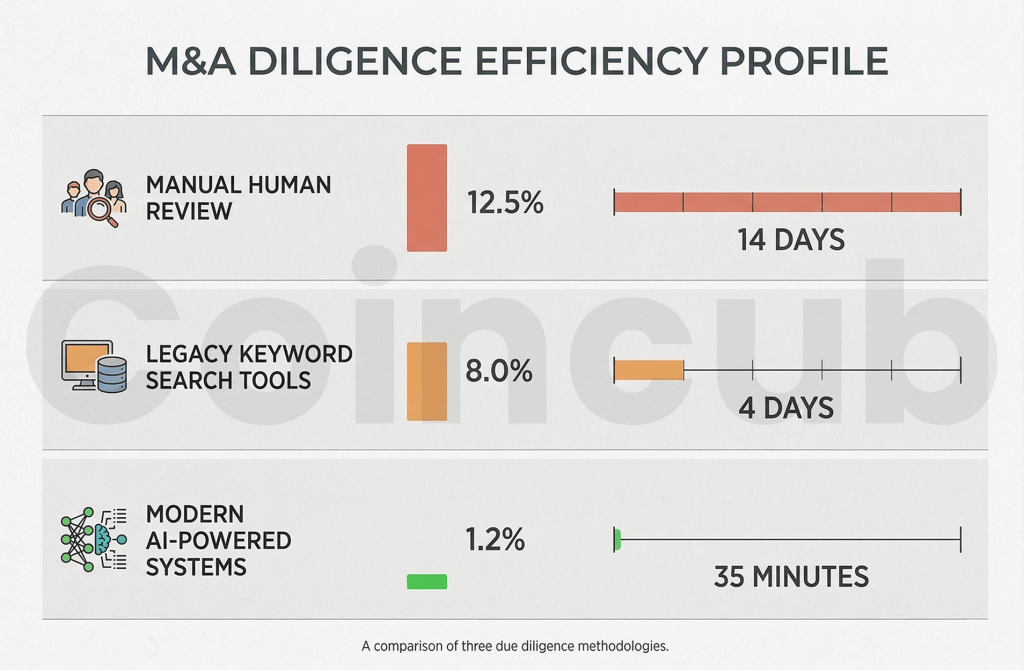
The performance gap between legacy methods and modern software grows wider every year. We can visualize this massive shift in efficiency through a comparative chart.
| Diligence Category | The AI-Driven Approach |
| Contract Review | Natural language models instantly highlight non-standard liability clauses. |
| Financial Audits | Algorithms automatically flag irregular accounting patterns and off-chain discrepancies. |
| Smart Contract Code | Security models scan entire Web3 codebases for hidden vulnerabilities and backdoors. |
| On-Chain Forensics | Machine learning maps out wallet interactions to detect wash trading or illicit funding. |
By deploying these tools, acquiring firms eliminate the blind spots that traditionally plague complex mergers.
Vetting the AI Target
We must now flip the perspective. Acquiring an AI-based Web3 startup introduces a massive web of legal and technical risks. When a buyer purchases a machine learning protocol, they inherit every single flaw baked into that system. Vetting the target company requires a completely specialized approach.
Data provenance stands as the absolute most critical risk factor. An artificial intelligence model only holds value if it learns from high-quality, legally acquired data. The auditing team must demand exact proof of origin for the training datasets. If a startup trained its neural networks by scraping copyrighted material, private user data, or protected financial records without explicit legal permission, the system represents a ticking time bomb. The moment the acquisition closes, the buyer instantly inherits that toxic liability and faces devastating copyright infringement lawsuits.
Intellectual property ownership presents another massive hurdle. In the open-source culture of Web3, developers frequently borrow code from other projects. The acquiring company must ensure the target startup actually holds the legal rights to the algorithms they intend to sell. Auditors use specialized software to scan the target’s entire code repository. This scan cross-references the codebase against millions of public repositories to detect unlicensed open-source components.
Furthermore, the deal team must test the actual performance of the neural networks. A startup might claim their algorithmic trading bot generates consistent alpha during bear markets. The buyer cannot simply trust the marketing pitch. Technical auditors run isolated stress tests to verify the accuracy and reliability of the models under extreme market volatility. They check for model degradation, ensuring the artificial intelligence does not lose its predictive power over time. If the underlying code relies on a black-box architecture that even the founders cannot fully explain, the buyer must heavily discount the value of the technology.
Regulatory Compliance and Bias
Beyond technical flaws, algorithmic bias and regulatory compliance present immediate threats to any corporate merger. Governments around the world have established strict legal frameworks to govern artificial intelligence and cryptocurrency. In 2026, navigating these regulations requires extreme precision.
The European Union enforces the Markets in Crypto-Assets (MiCA) regulation alongside the comprehensive AI Act. These frameworks demand absolute transparency. If an acquiring entity buys an artificial intelligence tool that helps assess decentralized lending risks, regulators will scrutinize the logic of that tool. If the algorithms rely on biased training data, the software might unfairly deny loans to specific demographics or overcharge certain users. Regulators will aggressively penalize the acquiring company for deploying discriminatory technology.
The due diligence team must conduct rigorous algorithmic bias testing. They feed the target models specific control data to ensure the outputs remain fair, neutral, and legally compliant. If the models show an inherent bias toward certain types of collateral or specific wallet histories without logical financial justification, the engineering team must rewrite the algorithms completely.
Compliance checks also extend to data privacy laws. Startups often play fast and loose with user information during their early growth phases. The acquiring company must verify that the target business fully complied with global privacy standards, like the General Data Protection Regulation (GDPR), when collecting the data used to train their models. If the startup violated privacy laws, the buyer must purge the tainted data and retrain the models from scratch. This retraining process costs millions of dollars and delays product launches indefinitely. Thorough regulatory due diligence ensures the buyer understands exactly what they are purchasing and prevents the new parent company from absorbing massive government fines.
Valuation and Post-Acquisition Integration
The results of the technical and regulatory audits directly impact the final purchase price of the target company. Due diligence does not exist in a vacuum. It connects directly to the actual money changing hands and the future operations of the business.
A clean technical audit drastically increases the final valuation of the startup. If the target company proves it owns pristine training data, demonstrates unbiased algorithms, and holds clear intellectual property rights, the buyer pays a premium for the asset. The buyer knows they can deploy the technology immediately without spending capital on legal defense or code remediation.
Conversely, uncovering undocumented liabilities forces the buyer to completely restructure the deal. If the due diligence software reveals poor data rights or black-box algorithms, the buyer holds all the leverage. The acquiring firm will demand a significantly lower purchase price to offset the anticipated legal and engineering costs. In extreme cases, where the intellectual property proves totally toxic, the buyer will simply walk away from the negotiation table.
Post-acquisition integration also depends heavily on the initial audit. The buyer needs a clear roadmap to merge the newly acquired neural networks into their existing product ecosystem. The technical diligence report provides the exact blueprint for this integration, ensuring the target technology actually fits within the broader corporate strategy.
The New Standard for Crypto Dealmakers
Artificial intelligence represents the new, undeniable standard for corporate dealmakers in the Web3 sector. The technology absolutely amplifies human judgment rather than replacing it entirely. Software handles the heavy lifting of data extraction, pattern recognition, and code analysis, but seasoned professionals still negotiate the final terms and dictate the ultimate business strategy.
The days of relying solely on manual document review have officially ended. Cryptocurrency exchanges, venture capital firms, and decentralized protocols that ignore these modern capabilities will simply move too slowly to compete. They will overpay for flawed assets, inherit toxic legal liabilities, and lose high-value acquisitions to faster, more technologically advanced rivals. To survive and thrive in the modern era of corporate consolidation, buyers must embrace intelligent software to ruthlessly uncover the truth before they sign on the dotted line.
Frequently Asked Questions (FAQ)
What happens if the due diligence software misses a critical liability?
Artificial intelligence drastically reduces the error rate, but it does not achieve absolute perfection. If the software misses a critical liability, the human legal team usually catches it during their focused review of flagged documents. If both the software and the humans miss the liability, the acquiring company absorbs the financial damage. This reality highlights why buyers use AI to augment human experts, rather than replacing them completely.
How do you verify the data provenance of an open-source AI model?
Auditors utilize specialized code-scanning software to cross-reference the model against known databases of copyrighted material. They also demand rigorous documentation from the startup founders. The target company must produce legal licensing agreements, data scraping logs, and vendor contracts to prove they obtained every piece of training data legally.
Do regulators require AI audits for all crypto mergers?
Regulators do not explicitly mandate a specific type of AI audit for every single merger. However, frameworks like the EU AI Act strictly govern the deployment of high-risk machine learning systems. If a crypto company buys an AI startup and deploys its technology, the acquiring company bears full legal responsibility for compliance. Therefore, conducting an audit remains a critical business necessity, even if a regulator does not specifically order it during the acquisition phase.
How long does an AI-powered due diligence process actually take?
While legacy manual reviews often take several months, AI-powered systems can scan millions of documents and trace complex on-chain data in a matter of days or even hours. The exact timeline depends entirely on the size of the target company and the complexity of its underlying codebase.