Buy a Licensed Company
  Explore VASP Data
  Talk to an Expert

 Dren Hima
 is Head of Research at Coincub, leading research across digital asset regulation, licensing, market structure, tokenization and institutional adoption.
Dren Hima
Dren Hima is Head of Research at Coincub, leading research across digital asset regulation, licensing, market structure, tokenization and institutional adoption.
Uniswap (UNI) Price Prediction 2026-2030: Can the Fee Switch Drive UNI Higher?
- UNI’s investment case changed in late 2025. The fee switch gave the token a direct link to protocol activity.
- The burn mechanism is the core bull case. If trading fees and Unichain sequencer fees continue to buy and burn UNI, supply pressure could tighten over time.
- LP retention is the main risk. If liquidity providers leave for better incentives elsewhere, volume drops, and the whole value-accrual thesis weakens.
- Unichain means more than the market may think. It is a new fee source tied directly to UNI’s long-term economics.
- UNI does not reprice on narrative alone. The token is likely to move higher only if on-chain behavior, burn rates, and volume trends demonstrate that the model works in practice.
The UNI token forces investors to answer a basic question: how do you value a protocol that processes over $100 billion a month but only recently started paying its token holders? Historically, Uniswap operated under a model in which liquidity providers captured all swap fees, leaving governance token holders with voting rights but no direct economic return. During that era, UNI traded mostly on brand recognition, governance optionality, and general DeFi momentum.
This structure shifted in late 2025 with the passage of the “UNIfication” governance proposal. The proposal activated a protocol fee switch, routing a portion of exchange fees (alongside sequencer fees from the newly launched Unichain Layer-2) through a programmatic token-burning mechanism. If the burn actually stays active and meaningful, the market has a reason to value UNI on protocol economics and network usage.
This piece forecasts the price trajectory of Uniswap (UNI) for the 2026-2030 period. By separating recent, verified protocol upgrades from forward-looking market interpretations, this analysis explores the conditions required for the token’s future market performance.

Current Market Snapshot
- Current Price: ~$3.68
- All-Time High: ~$44.92 (May 2021)
- Market Cap: ~$2.3 Billion
- Circulating Supply: ~633 Million UNI
Key Calls and Scenario Projections:
- 2026: The current year tests the reality of the UNIfication burn mechanism. As protocol and sequencer fees begin to reduce the circulating supply, models suggest UNI could transition toward a valuation based on actual network revenue, targeting a base recovery range of $7.50-$10.00.
- 2030: Following a projected cyclical peak in 2028-2029, our 2030 forecast accounts for a broader cryptocurrency market reset. While sustained supply reduction could keep the base price significantly higher than today’s levels ($22.00), a macro bear market could push the floor back down to the $5.00 range.
What is Uniswap?
At its core, Uniswap is a decentralized exchange (DEX) that allows users to trade cryptocurrencies directly from their wallets without a central intermediary. Instead of relying on traditional order books managed by a centralized company, it uses Automated Market Maker (AMM) smart contracts and crowdsourced liquidity pools. Users who deposit their crypto into these pools (Liquidity Providers, or LPs) earn fees when other people trade against their assets.
While that foundation remains the same today, recent technological upgrades have shifted Uniswap’s design from a simple exchange into a broader developer platform and routing network.
Uniswap V4 & Hooks
Launched on mainnet in January 2025, Uniswap V4 introduced two major architectural changes: the Singleton contract and programmable “Hooks”. The Singleton model consolidates all liquidity pools into a single smart contract, relying on “flash accounting” to reduce the gas costs of creating new pools by up to 99%. Hooks are external smart contracts that developers can attach to liquidity pools to execute custom logic before or after swaps. By late 2025, over 5,000 V4 hooks had been initialized on-chain.
V4 shifts Uniswap from a static AMM into a highly customizable platform. Hooks allow for dynamic fees, automated impermanent loss hedging, and on-chain limit orders without requiring developers to fork the core protocol. This customizability theoretically creates “stickier” liquidity, as third-party developers build their unique trading features directly on top of Uniswap’s baseline liquidity rather than launching competing exchanges.
Unichain Layer-2
In early 2025, Uniswap launched Unichain, an Ethereum Layer-2 scaling solution built on the Optimism Superchain using the OP Stack. Unichain utilizes a consensus mechanism developed with Flashbots called Rollup-Boost, designed to enable
Unichain serves as a dedicated execution environment for high-frequency trading, allowing Uniswap to offer a low-latency user experience that competes directly with alternative Layer-1 networks like Solana, while capturing network sequencer fees for the protocol.
Price History and Current Performance
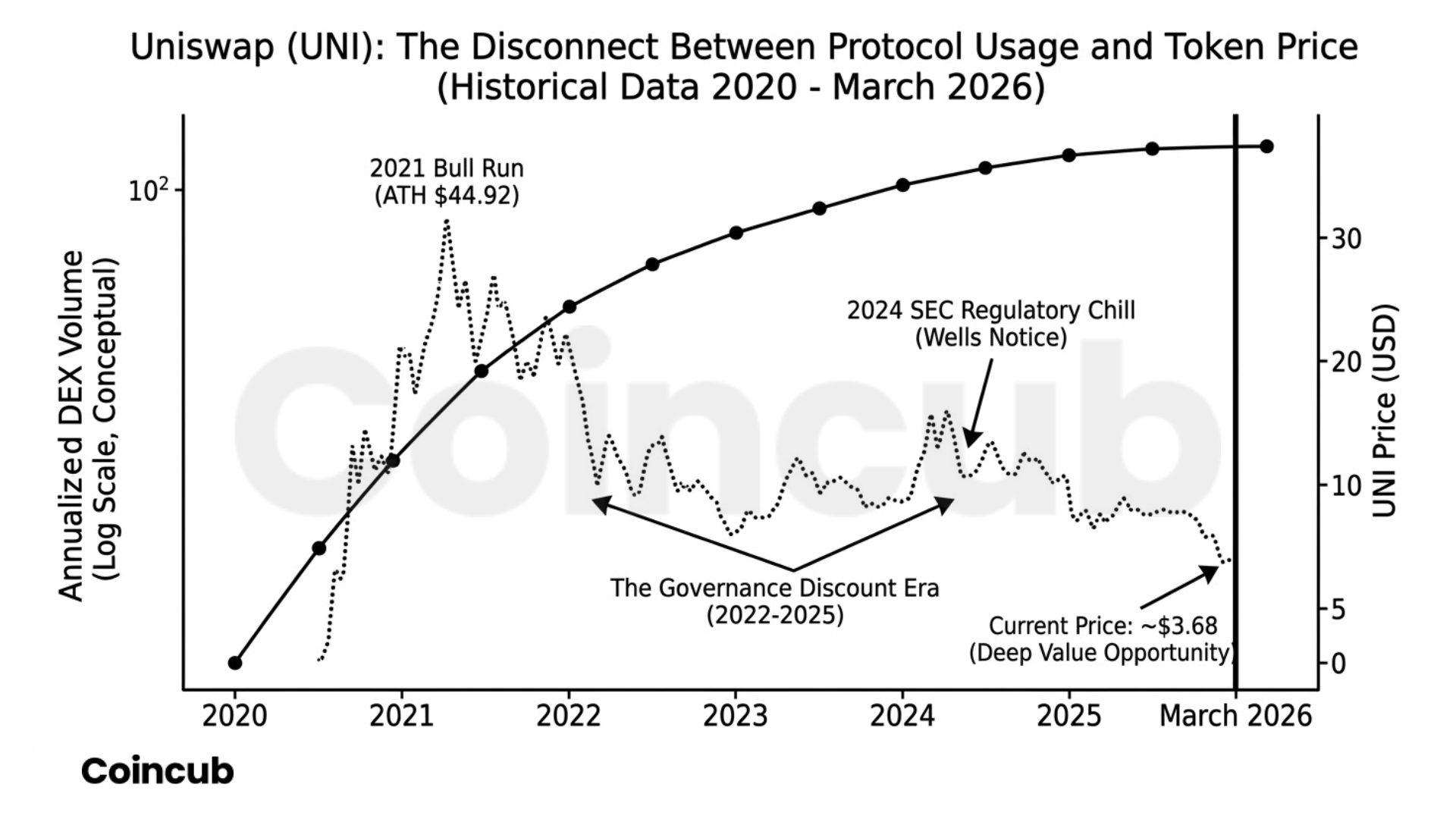
UNI launched in September 2020 via a retroactive airdrop. During the 2021 crypto bull market, fueled by zero-interest-rate policies and retail adoption, UNI surged from under $5.00 to an all-time high of $44.92. During the 2022 bear market, the token retraced heavily, consolidating in the $3.00-$5.00 range.
Throughout 2024 and 2025, UNI faced significant headwinds. The SEC issued a Wells Notice to Uniswap Labs in early 2024, suppressing institutional interest. Concurrently, a massive retail market rotation toward Solana meme coins drew highly active retail liquidity away from the Ethereum ecosystem. By the end of 2025, UNI had dropped to $5.63, and as of March 2026, it trades near $3.68. This pricing reflects a persistent disconnect between the protocol’s high trading volume and the token’s secondary market valuation.
Factors That Could Impact UNI
To understand UNI’s potential price action, we must separate the recent fundamental upgrades from the market conditions required for those upgrades actually to impact the token’s price.
The UNIfication Proposal (The “Fee Switch”)
In late 2025, the Uniswap DAO passed the UNIfication proposal. According to the proposal and on-chain data, this governance action executed the following:
- Protocol Fees: Activated fees on V2 and core V3 pools. On V2, the standard 0.30% fee was split (0.25% remains with LPs, while 0.05% goes to the protocol).
- Sequencer Fees: Directed net sequencer fees from the Unichain L2 into the protocol.
- The Burn Mechanism: Routed these collected fees into smart contracts (the TokenJar and Firepit) built specifically to buy and permanently burn UNI tokens.
- Retroactive Burn: The protocol permanently destroyed 100 million UNI tokens from the treasury (roughly 10% of the total supply) to compensate for the historical absence of fees.
- Growth Budget: Allocated 20 million UNI annually to fund protocol development, while Uniswap Labs removed fees on its front-end interfaces.
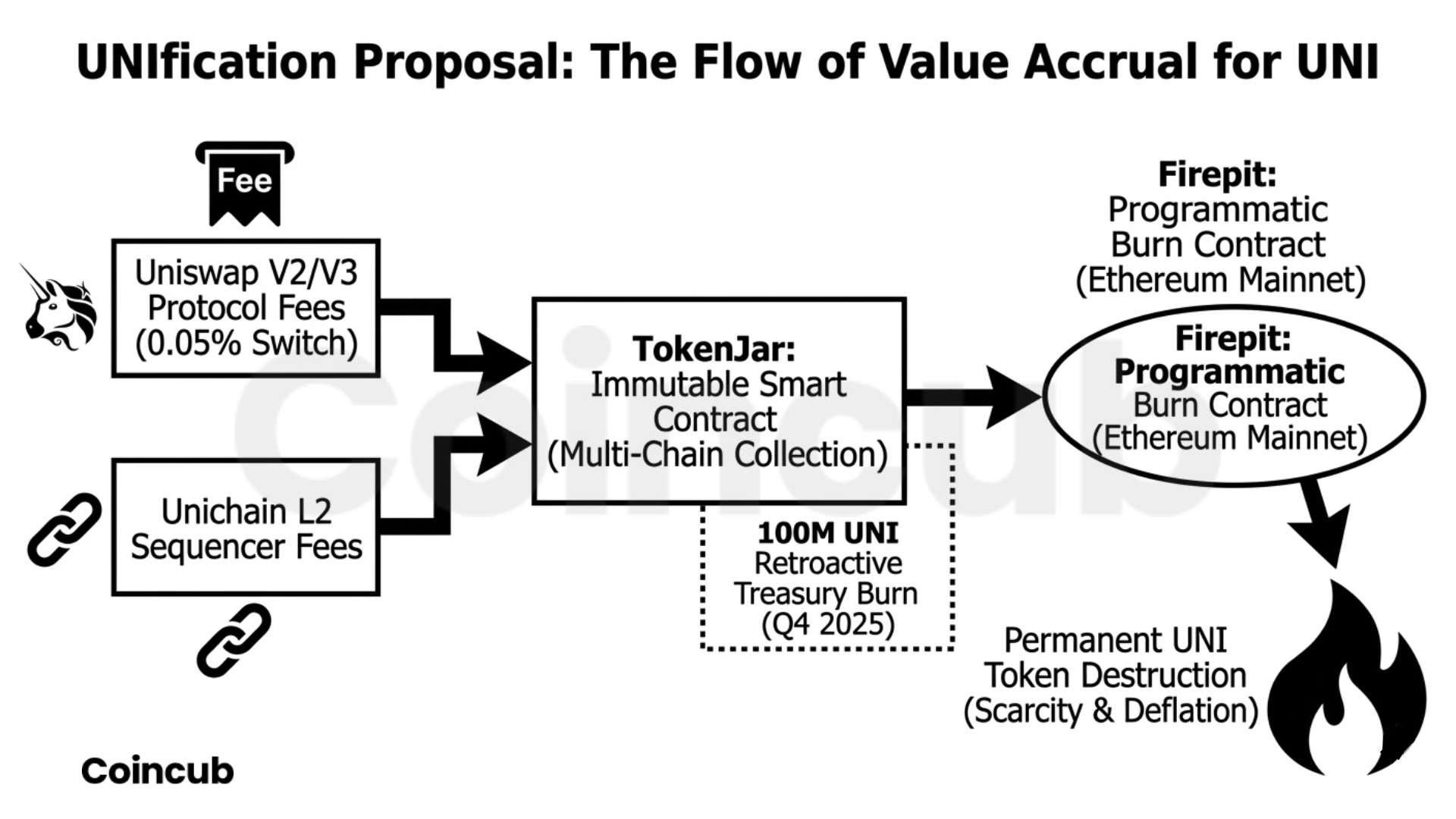
Uniswap previously had huge usage but weak economics for token holders. The new structure tries to redirect a fraction of that trading activity into token holder value. Every time someone swaps on certain pools or transacts on Unichain, a micro-percentage of the fee is used to buy UNI on the open market and destroy it. This acts as a permanent, automated buyer.
However, this only works if fee generation is large and consistent. The protocol is also issuing 20 million UNI a year to fund its growth budget. Early data from the first 12 days of the fee switch indicated an annualized protocol revenue run-rate of roughly $26 million to $27 million. This equated to an annualized burn rate of roughly 4-5 million UNI (excluding the one-time 100M burn). If trading volume drops or the burn rate fails to eventually outpace the 20 million new tokens being spent in the market, supply will actually expand, and the bullish narrative will break down.
| Factor | What it does | Why it matters for UNI | Main risk |
| Fee switch | Redirects part of the protocol activity into the protocol treasury instead of leaving all economics with LPs | Gives UNI a clearer link to real platform usage | If fee capture stays too small, the market may ignore it |
| UNI buybacks and burns | Uses protocol revenue to buy and remove UNI from circulation | Reduces supply over time and strengthens the value-accrual thesis | Burns may be too small to offset emissions or matter at scale |
| Unichain sequencer fees | Adds a new revenue stream tied to activity on Uniswap’s own chain | Expands the token’s economic base beyond swap fees alone | Adoption may stay weak if users and builders do not migrate |
| V4 hooks | Lets developers build custom pool logic, such as dynamic fees and automated strategies | Makes Uniswap more flexible and helps defend market share | Better infrastructure does not guarantee a higher token value |
| LP retention | Determines whether liquidity stays deep enough for strong trading volume | UNI needs healthy volume for the fee-switch model to work | LPs may move to rivals with better incentives |
| Institutional access | Makes Uniswap more usable for regulated or larger participants | Could support more durable volume and stronger long-term usage | Regulatory clarity can shift, and adoption may stay limited |
| Competitive positioning | Measures how well Uniswap holds up against Raydium, Aerodrome, and other DEXs | Market share is what turns token design into real cash flow | Stronger rivals can pressure volume, fees, and liquidity |
The Battle for Liquidity Providers (The Bear Case)
Uniswap’s market share is heavily contested. On Solana, Raydium captures a significant high-frequency retail volume. On the Base L2 network, Aerodrome utilizes an incentive-heavy tokenomics model and has captured over $1 billion in Total Value Locked (TVL). Furthermore, Dromos Labs announced a merger of Aerodrome and Velodrome into a unified MetaDEX called Aero, targeting a Q2 2026 launch to compete more broadly across Ethereum networks.
The biggest threat to Uniswap’s price is the loss of its Liquidity Providers (LPs). DEX strength is about liquidity depth, low slippage, execution quality, and where traders decide to route their orders. By activating the 0.05% protocol fee cut on V2 (and taking a fraction of V3 fees), Uniswap is effectively taxing its LPs to pay UNI token holders.
If LPs feel they are not earning enough trading fees to justify the risk of impermanent loss, they will migrate their capital to highly subsidized competitors like Aerodrome. If Uniswap loses its liquidity depth, traders will suffer worse execution prices and route their trades elsewhere. A drop in trading volume directly starves the UNI burn mechanism.
The market has heard versions of “value accrual is coming” before. UNI does not get re-rated just because governance flipped a switch. It gets re-rated if traders, LPs, and routing behavior actually make that switch economically meaningful. Uniswap is betting that V4 Hooks (such as automated impermanent loss hedging) and Unichain’s MEV protections will make LPing more profitable by default, offsetting the new protocol tax. If they are wrong, the fee switch helps token holders on paper while weakening the exchange itself.
The Shifting Regulatory Cloud
The regulatory environment for DeFi has altered significantly in the past year. In July 2025, the U.S. passed the GENIUS Act, providing a federal regulatory framework for stablecoins. In late 2025, Uniswap governance adopted a Wyoming Decentralized Unincorporated Nonprofit Association (DUNA) structure (named DUNI), granting the DAO legal recognition and liability protection. Finally, in February 2025, the SEC officially closed its multi-year investigation into Uniswap Labs without taking enforcement action.
The closure of the SEC investigation and the establishment of DUNI remove the protocol’s primary existential threat. While this does not mean traditional finance will flood into DeFi overnight, early integrations are already happening. In February 2026, Uniswap Labs partnered with Securitize to make BlackRock’s $2.1 billion tokenized treasury fund (BUIDL) available for trading on UniswapX, with BlackRock acquiring an undisclosed amount of UNI tokens to participate in governance.
Sustained institutional adoption requires this regulatory truce to hold. Any reversal in U.S. policy regarding DeFi front-ends would immediately reintroduce risk premiums to UNI’s valuation.
Uniswap Price Prediction 2026-2030
For years, UNI traded primarily on governance optionality and its status as a proxy for broader DeFi market momentum. Now that the model has changed, the market may start pricing the token based on expected burn rates, fee capture efficiency, LP retention metrics, and Unichain usage. That does not make UNI easy to value, but it changes what investors should watch.
Uniswap Price Prediction 2026
The market tests the reality of the UNIfication burn mechanism. The permanent removal of 100 million UNI tokens from the treasury eliminated a major supply overhang, while the daily burning of fees establishes a baseline for modeling the network’s actual revenue.
- Low ($3.10): Unichain fails to capture meaningful L2 volume, and LP flight to competitors like Aerodrome reduces Uniswap’s TVL. The burn rate fails to offset the 20 million UNI growth emissions, suppressing the price.
- Average ($7.50): Trading volumes remain stable, and Unichain establishes a solid foothold, capturing around 10-15% of L2 volume. The burn mechanism works as intended, pushing UNI out of its current suppression.
- High ($14.00): Institutional capital, spurred by the SEC case closure and BlackRock’s entry, flows heavily into V4 KYC-gated pools. Retail speculation returns to Ethereum L2s, pushing the burn rate higher and creating an acute supply shock.
Uniswap Price Prediction 2027-2028
V4 hooks mature from experimental plugins to standardized DeFi infrastructure.
For targets in the $15.00 to $30.00 range to materialize during this window, specific adoption metrics must be hit. First, Unichain must successfully leverage its 250ms block times to capture high-frequency trading volume previously routed to alternative L-1s like Solana. Second, V4 hooks focused on dynamic fees and impermanent loss protection must prove successful at retaining LPs, ensuring that the protocol fee extraction does not degrade market depth. If these hold, the incoming sequencer fees will steadily reduce the UNI supply as the broader crypto market enters a projected cyclical peak in 2028.
Uniswap Price Prediction 2029-2030
The Narrative: The long-term forecast relies heavily on the compounding effects of supply reduction over a five-year horizon, adjusted for standard crypto market cycles.
To challenge previous valuation peaks ($40.00+), annualized trading volume across all Uniswap deployments must scale into the trillions, vastly increasing the daily burn rate. Unichain must become the default routing layer for the Ethereum ecosystem, making sequencer fee revenue a massive contributor to the TokenJar. Furthermore, the DUNI wrapper must successfully bridge traditional finance, bringing hundreds of billions in tokenized real-world assets (RWAs) to be traded exclusively on the Uniswap rails.
The 2030 Cycle Reset:
You will notice the 2030 “Low” target drops significantly compared to 2029. Because cryptocurrency markets historically follow four-year liquidity cycles, our 2030 forecast accounts for a potential post-peak reset. Even if Uniswap executes perfectly and the burn mechanism removes millions of tokens, a broader macro bear market in 2030 could drag the entire sector down. This is why the floor resets to the $5.00 range, reflecting a cyclical bottom rather than a failure of the protocol.
| Year | Low | Average | High |
| 2026 | $3.10 | $7.50 | $14.00 |
| 2027 | $4.50 | $15.00 | $25.00 |
| 2028 | $6.50 | $18.50 | $32.00 |
| 2029 | $9.00 | $20.00 | $38.00 |
| 2030 | $5.00 | $22.00 | $45.00+ |
Uniswap vs. Other DEXs
The decentralized exchange sector is no longer about ideological differentiation; it is a battle for execution, liquidity, and value capture.
- Raydium (Speed and Retail Flow): Operating on Solana, Raydium uses a hybrid AMM and order-book model optimized for ultra-fast, low-cost retail trading. It wins by capturing the high-frequency “meme coin” demographic, where sub-cent fees are more important than institutional security.
- Aerodrome (LP Incentives): Aerodrome dominates the Base network using an inflationary ve(3,3) tokenomic model. It wins by heavily rewarding liquidity providers with continuous token emissions and governance bribes. With the upcoming Aero MetaDEX launch, they aim to take this highly subsidized LP model directly to the Ethereum mainnet.
- Uniswap (Infrastructure and Security): Uniswap counters speed through its Unichain L2 and counters LP incentives through V4’s capital efficiency. It wins by being the most secure, deeply integrated baseline infrastructure in DeFi, attempting to capture value through its programmatic burn mechanism rather than inflating its token to pay for liquidity.
Is Uniswap a Good Investment?
Evaluating UNI in 2026 requires understanding that its underlying economic model has changed.
The UNIfication proposal links protocol success to token value. By routing Unichain sequencer fees and mainnet protocol fees into a burn contract, UNI now benefits from high trading volume. The resolution of the SEC investigation and the legal protection provided by the DUNI wrapper clear the path for institutional integration, as evidenced by early moves by asset managers such as BlackRock. If volume holds, the supply drops.
The activation of protocol fees inherently reduces the baseline yield for Liquidity Providers. If V4 hooks and Unichain do not provide enough capital efficiency to offset this fee extraction, LPs will migrate to highly incentivized competitors like Aerodrome. A drop in TVL leads to worse trade execution, lower volume, and ultimately, a stalling of the UNI burn mechanism.
UNI needs proof that the fee switch changes behavior on-chain. It is best suited for investors who want to track daily burn rates, LP retention metrics, and Unichain volume, rather than those seeking short-term speculative momentum.
UNI is highly liquid and available on major centralized cryptocurrency exchanges (Coinbase, Binance, Kraken) and natively via decentralized interfaces. For long-term security, hardware wallets (Ledger, Trezor) are recommended to keep private keys offline. Active participants looking to vote in DUNI governance or provide V4 liquidity can use non-custodial browser wallets (e.g., MetaMask, Uniswap Wallet).
Frequently Asked Questions (FAQ)
What is the Uniswap fee switch?
The fee switch routes a portion of trading and protocol-related fees to the protocol, rather than leaving all fees with liquidity providers.
How does the fee switch affect UNI?
It gives UNI a clearer economic link to Uniswap activity by funding token buybacks and burns.
Why is Unichain important for UNI?
Unichain adds sequencer fee revenue, which can support the burn mechanism and strengthen UNI’s value-accrual model.
What are Uniswap V4 hooks?
Hooks are custom smart contracts that let developers add features such as dynamic fees, limit orders, and liquidity protections to pools.
Why hasn’t UNI rallied harder yet?
The market still wants proof that fee burns are large and sustainable enough to matter after accounting for emissions and competition.
What is the biggest risk to the UNI bull case?
Liquidity providers could move to rival DEXs with stronger incentives, reducing Uniswap’s depth, volume, and burn potential.
Can UNI reach its old all-time high again?
It can, but only if volume scales sharply, Unichain becomes meaningful, and the burn mechanism materially changes supply dynamics.
Is UNI a good long-term investment?
It can be, but only for investors willing to track protocol revenue, burn rates, LP retention, and market-share trends.
Is UNI still just a governance token?
Not in the same way as before. The new structure gives it a stronger economic angle, though the market is still testing it.
What should investors watch most in 2026?
Burn rate, Unichain usage, liquidity retention, and whether Uniswap can keep volume strong while taking a cut for the protocol.