


 Buy a Licensed Company
  Explore VASP Data
  Talk to an Expert
 Buy a registered Canadian MSB

Comprehensive cold storage solution combining strong security, wide asset support, and flexible connectivity options.
| Founded | 2015 |
| Headquarters | France |
| Wallet Type | Cold Wallet |
| Models Available | Nano S Plus, Nano X, Flex, Stax |
| Chains Supported | 5,500+ cryptocurrencies and tokens |
| Connectivity | USB-C, Bluetooth (Nano X, Flex, Stax), NFC (Flex) |
| Backup & Recovery | 24-word BIP39 seed phrase; optional Ledger Recover service (KYC required) |
| Companion App | Ledger Live (Desktop & Mobile) |
| Customer Support | AI chatbot, email, social media support |
| Deposit/Receive Methods | On-chain crypto transfers; no fiat deposits |
| Price & Fees | $65–$335 depending on model; standard network fees apply |
Ledger has been a key player in crypto security since 2014. It offers hardware wallets designed to keep private keys offline, reducing exposure to hacking and malware. These devices act as physical vaults, requiring manual confirmation for transactions, which limits unauthorized access.
Hardware wallets have become essential for anyone serious about safeguarding digital assets. Unlike software wallets that remain connected to the internet, hardware wallets isolate sensitive information, providing a secure environment even when used with compromised computers.
Ledger’s reputation stems from millions of devices sold worldwide and a broad ecosystem that includes the Ledger Live app for managing thousands of cryptocurrencies, NFTs, and staking options. The company’s partnerships with major exchanges and NFT marketplaces have made it a trusted choice for a wide range of users.
Its product range covers entry-level models focused on affordability and simplicity, as well as premium devices that add touchscreens, wireless connectivity, and enhanced usability. This versatility allows Ledger to meet diverse needs while maintaining a consistent focus on security.
Despite facing challenges such as past data incidents, Ledger’s hardware itself remains secure and its internal security team actively monitors and updates defenses. In 2025, Ledger continues to be a central figure in the hardware wallet space, offering tools that balance convenience, control, and protection for digital asset holders.
Ledger was founded in 2014 by a team of experts in embedded security and cryptocurrency. Their goal was to create hardware solutions that make storing digital assets safer and easier. Early on, the company gained traction as one of the first to offer secure offline key storage for the growing Bitcoin community.
By 2018, Ledger had sold over one million wallets. The company expanded its product range and developed Ledger Live, a companion app that simplifies managing a large variety of cryptocurrencies and NFTs. Partnerships with major players like Binance, Crypto.com, and OpenSea extended Ledger’s reach into exchanges and NFT marketplaces, reinforcing its role in the broader crypto ecosystem.
The company’s internal security team, Donjon, continuously tests products and systems to prevent new threats. Despite incidents, Ledger’s hardware wallets themselves have not been compromised. This ongoing vigilance supports Ledger’s reputation as a leader in hardware security.
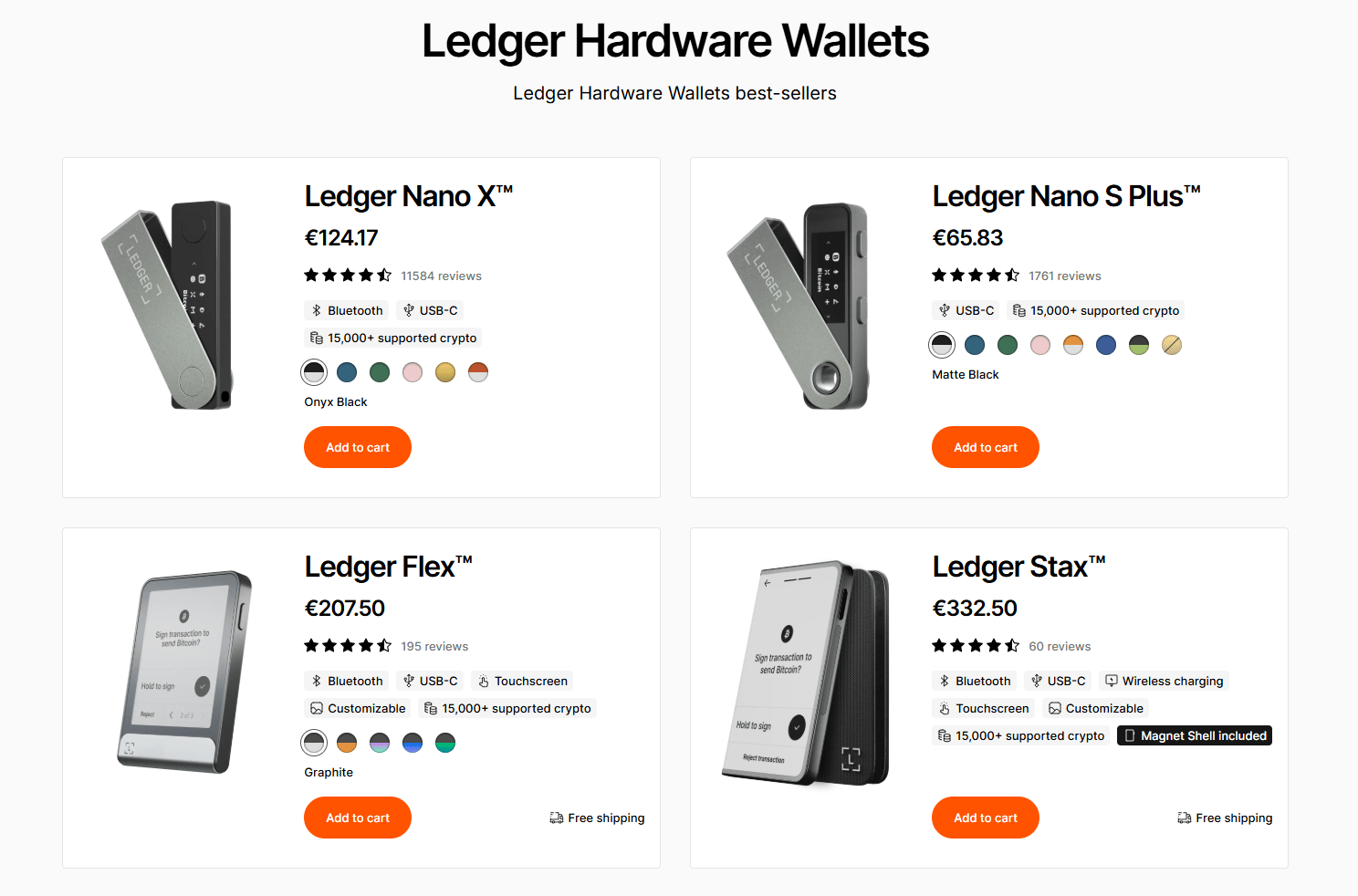
Ledger offers four main hardware wallet models in 2025, each designed to suit different user needs and budgets. The Nano S Plus serves as an entry-level option. It features a compact design with a 128×64-pixel OLED screen and a CC EAL5+/EAL6+ certified Secure Element chip. The device connects via USB-C and stores up to 100 crypto apps. It appeals to beginners and users seeking a secure, affordable cold storage solution without Bluetooth connectivity.
The Nano X builds on this with Bluetooth support, allowing wireless connection to the Ledger Live mobile app. It has a larger OLED display, a built-in battery lasting up to four hours, and also supports up to 100 crypto apps. The Nano X targets mobile users who want to manage assets on the go but comes with a higher price point and a non-replaceable battery.
Launched in 2024, the Ledger Flex introduced a 2.84-inch E Ink touchscreen supporting 16 grayscale levels. It combines USB-C, Bluetooth 5.2, and NFC connectivity, running on a CC EAL6+ Secure Element chip. With around 1.7 MB of storage, it can hold 10 to 12 crypto apps. The Flex includes a Protection Mode that locks the device when security threats are detected. This model suits users who value touchscreen usability and portability but don’t require extensive app storage or wireless charging.
The Ledger Stax, released in 2023, targets active crypto traders and NFT enthusiasts. It features a premium 3.7-inch curved E Ink touchscreen, Bluetooth and USB-C connectivity, and wireless charging. With storage for up to 5,000 cryptocurrencies, it offers the largest capacity among Ledger models. Customizable lock screens allow displaying NFTs or images, adding a personal touch. The Stax combines convenience with top-tier security but carries a premium price that may not fit smaller portfolios.
Beyond hardware, Ledger’s ecosystem includes the Ledger Live app for desktop and mobile, which manages crypto, NFTs, staking, and swaps. Ledger Recover offers encrypted cloud backup of recovery phrases but requires KYC, raising privacy discussions. Physical backups like the Cryptosteel Capsule provide durable offline seed phrase storage, protecting against physical damage.
Ledger wallets store private keys offline, making them cold storage devices that protect assets from online threats like hacking and malware. The core security comes from a Secure Element chip, certified to CC EAL5+ or EAL6+ standards: the same grade used in passports and banking cards. This chip isolates and encrypts private keys, ensuring they never leave the device.
Transactions are created through the Ledger Live app, which serves as the interface for managing cryptocurrencies, NFTs, staking, and swaps. When users initiate a transaction, it is sent from the app to the hardware wallet. The device then requires physical confirmation, either by pressing buttons (Nano S Plus, Nano X) or tapping the touchscreen (Flex, Stax), to approve or reject the transaction. This step prevents unauthorized remote access, as signing can only occur with the user’s direct input.
Ledger devices use a PIN code for unlocking. Users set a 4 to 8-digit PIN during setup. Entering the wrong PIN three times in a row triggers an automatic factory reset, wiping private keys to prevent brute-force attacks. This adds a layer of defense against physical theft.
Backup and recovery rely on a 24-word seed phrase following the BIP39 standard. The seed phrase lets users restore access to their funds on any compatible wallet if the device is lost or damaged. Ledger also offers the Ledger Recover service, which encrypts and splits the recovery phrase across trusted parties for optional cloud backup but requires identity verification.
Visit Ledger
Ledger’s proprietary BOLOS operating system further isolates crypto apps within the device. Each app runs in a separate environment, preventing one compromised app from affecting others. BOLOS also controls access permissions, blocking unauthorized operations. The combination of Secure Element and BOLOS creates a layered defense against attacks.
While the companion apps are open source, the device firmware remains closed source. This limits independent audits and community verification. Some users and privacy advocates prefer open-source firmware for transparency. Ledger’s choice favors stability and control but requires trust in the company’s internal security practices.
Ledger Recover offers an encrypted cloud backup service for recovery phrases. It splits the phrase into shards stored by trusted third parties. Users must complete KYC verification to use this service, raising concerns about privacy and centralization. Critics argue this compromises the trustless nature of cold storage and introduces new risks.
Ledger faced two notable security incidents in recent years. In 2020, a marketing database leak exposed customer contact information but not private keys. In 2023, a supply chain phishing attack targeted users via a compromised software library, leading to unauthorized transactions. Ledger responded quickly, patched vulnerabilities, and compensated affected users. These events highlighted ecosystem risks beyond the hardware itself.
Visit Ledger
Buying a Ledger wallet from official sources is essential to avoid tampered devices. The safest option is purchasing directly from Ledger’s website or authorized resellers. Avoid third-party sellers on marketplaces to protect your investment.
To begin setup, connect the device to a computer or mobile device using USB-C or Bluetooth where supported. Download and install the Ledger Live app from ledger.com. Open the app and follow on-screen prompts to initialize the device.
During initialization, set a 4 to 8-digit PIN code. This PIN secures the device from unauthorized access. The wallet then generates a 24-word recovery phrase, which appears one word at a time. Write this phrase down carefully on the provided recovery sheet and store it securely offline. Confirm each word on the device to ensure the phrase is accurate. Losing this recovery phrase means permanent loss of access to your assets.
Once set up, use Ledger Live to install crypto apps corresponding to the assets you plan to manage. Due to limited storage on some models, you may need to uninstall apps to add new ones, but your funds remain safe on the blockchain.
Ledger supports a wide range of cryptocurrencies and tokens. Its devices can manage over 5,500 assets, covering major coins like Bitcoin, Ethereum, and XRP, as well as thousands of ERC-20 tokens. This broad support suits users with diverse portfolios and those who invest in emerging projects. For tokens not natively supported by Ledger Live, integration with third-party wallets such as MetaMask or Rabby expands access to additional assets and blockchain networks.
NFT management is built into Ledger Live, allowing users to securely store and view Ethereum and Polygon-based NFTs. The app displays NFT metadata and images, making it easier to track collections while keeping private keys offline. Customizable lock screens on the Flex and Stax models let users display favorite NFTs directly on their devices.
Staking options are available within Ledger Live for coins like Ethereum (via Lido), Polkadot, Tezos, Solana, and Cosmos. Users can earn rewards without moving their funds to exchanges, retaining full control over their assets. Ledger connects with various third-party providers to facilitate staking and lending services while maintaining security through offline transaction approval.
Ledger devices offer flexible connectivity. USB-C cables provide wired connections compatible with desktops and mobile devices. Bluetooth is available on the Nano X, Flex, and Stax, enabling wireless use with smartphones. The Flex adds NFC support, which works with accessories like the Ledger Recovery Key for secure offline backups. While Bluetooth adds convenience, using a wired connection remains the most secure option.
Ledger Live, available on desktop and mobile, serves as a comprehensive management platform. It supports portfolio tracking, buying and selling crypto through integrated providers, token swapping, staking, and NFT viewing. The app also syncs accounts across devices and offers market analysis tools and crypto tax calculation features. The interface balances usability for beginners with features attractive to advanced users.
Ledger Academy offers extensive educational resources covering blockchain basics, wallet security, asset management, and DeFi. This library supports users at all experience levels, helping them understand complex topics without jargon. It complements Ledger’s hardware and software by empowering users to make informed decisions about their crypto assets.
Managing assets involves sending, receiving, swapping, or staking through Ledger Live. Every transaction must be physically approved on the hardware wallet by pressing buttons or using the touchscreen. This step ensures that signing can only occur with your explicit consent.
If you lose your device or it becomes damaged, the recovery phrase enables you to restore your wallet on a new Ledger or compatible device. Inputting the 24 words recreates your private keys, giving full access to your funds.
Ledger’s main competitor in hardware wallets is Trezor, developed by SatoshiLabs. The Trezor Model T offers a color touchscreen and supports over 1,000 cryptocurrencies. Its open-source firmware appeals to users who prioritize transparency and community auditing. However, it lacks a Secure Element chip, which Ledger includes as a core security component. The Model T connects via USB-C but does not offer Bluetooth, limiting mobile convenience compared to Ledger’s Nano X, Flex, and Stax models.
Compared to these, Ledger supports over 5,500 assets, significantly more than Trezor. Ledger’s Bluetooth-enabled devices add mobile flexibility absent in Trezor’s lineup. Its premium models, Flex and Stax, feature E Ink touchscreens and wireless charging, pushing the envelope on usability and design.
Ledger fits a range of users with different needs. Beginners benefit from the Nano S Plus, which offers strong security and a straightforward setup at an affordable price. Its lack of Bluetooth simplifies the device and reduces attack surfaces for users new to hardware wallets.
Mobile users who want to manage assets on the go will appreciate the Nano X, Flex, or Stax. These models include Bluetooth connectivity, allowing wireless pairing with the Ledger Live app on smartphones. The Flex and Stax add touchscreens and additional features like NFC or wireless charging for enhanced convenience.
NFT collectors and DeFi enthusiasts find value in the Flex and Stax models, which support Ethereum and Polygon NFTs and integrate smoothly with decentralized applications via Ledger Live and third-party wallets. The customizable lock screens on these devices also appeal to users who want a personalized experience.
Long-term holders who prioritize security over convenience can choose any Ledger device, as all provide cold storage with certified Secure Element chips. Those who prefer simplicity and minimal interaction might lean toward the Nano S Plus.
Premium buyers seeking the latest technology and design may select the Ledger Stax. Its large curved E Ink touchscreen, wireless charging, and high asset capacity make it suited for active traders and power users.
Ledger remains one of the leading hardware wallet providers in 2025. Its products combine strong security through certified Secure Element chips with broad cryptocurrency support and a versatile device lineup. The integration with Ledger Live offers a comprehensive platform for managing assets, NFTs, staking, and swaps across desktop and mobile.
Strengths include wide asset compatibility, mobile-friendly connectivity options like Bluetooth, and modern features found in the Flex and Stax models. Ledger’s reputation is backed by millions of wallets sold and ongoing internal security efforts. Educational resources add value for users at all levels.
At the same time, Ledger has limitations. The closed-source firmware on devices limits transparency. The Ledger Recover service introduces centralized risks that may concern privacy-focused users. Some models have limited app storage, and non-replaceable batteries could lead to future device replacements. Customer support remains primarily digital, with no phone or live chat options.
Visit Ledger
Yes. Ledger devices use certified Secure Element chips and keep private keys offline. Physical confirmation is required for every transaction, reducing risks of hacking.
Yes. Ledger Live supports staking for coins like Ethereum (via Lido), Polkadot, Tezos, Solana, and others without moving assets to exchanges.
Ledger supports over 5,500 coins and tokens, covering major cryptocurrencies and thousands of ERC-20 tokens. Third-party wallets expand asset access further.
An optional backup service that encrypts your recovery phrase and stores it across trusted parties. It requires KYC verification, which raises privacy concerns for some users.
Yes. Ledger Live allows secure storage, viewing, and transferring of Ethereum and Polygon NFTs.
You can restore your wallet and funds using your 24-word recovery phrase on any compatible device.
Ledger uses encryption for Bluetooth connections, but wired USB-C remains more secure. Bluetooth adds convenience for mobile use.
Beginners can start with the Nano S Plus. Mobile users benefit from the Nano X or Flex. Power users and NFT collectors may prefer the premium Stax.
Yes. Ledger Live integrates with third-party providers to let you buy crypto using fiat currencies, subject to their fees and KYC requirements.
Visit LedgerSubscribe to our newsletter, you are in very good company











 Canada
  Australia