Buy a Licensed Company
  Explore VASP Data
  Talk to an Expert

 Dren Hima
 is Head of Research at Coincub, leading research across digital asset regulation, licensing, market structure, tokenization and institutional adoption.
Dren Hima
Dren Hima is Head of Research at Coincub, leading research across digital asset regulation, licensing, market structure, tokenization and institutional adoption.
Fetch.ai (FET) Price Prediction 2026-2030: Can ASI Recover?
- Fetch.ai is now part of the ASI story. The token still trades as FET on most exchanges, even though the broader network is branded around the Artificial Superintelligence Alliance.
- FET was hit by broader crypto weakness, as well as forced liquidations and the fallout from Ocean Protocol’s exit.
- The recovery case depends on real usage. The bullish thesis only works if autonomous agents, AI tools, and decentralized compute actually attract paying users.
- CUDOS means more than most people think. The compute layer gives ASI a more complete stack rather than just an AI narrative token with no infrastructure behind it.
- FET is still a high-risk AI proxy. It has upside if decentralized AI becomes useful at scale, but governance issues, regulation, and Big Tech competition still make it speculative.
Fetch.ai (FET) currently trades near $0.20 as of September 2026. Following its peak during the 2024 AI market surge, the token lost over 90% of its value amid macroeconomic tightening and internal ecosystem restructuring. This article examines the fundamental shifts within the Artificial Superintelligence Alliance (ASI). It evaluates whether the network’s pivot from speculative expansion to actual software delivery supports a price recovery between 2026 and 2030.
Current Market Snapshot
- Current Price: ~$0.20
- All-Time High: $3.47 (March 2024).
- Market Cap: ~$420 Million (Rank ~#95).
Key Calls and Scenario Projections:

- 2026: A year focused on stabilization. With the forced treasury liquidations of 2025 largely concluded, the token price is looking for a floor. With most of the year gone and the token holding near $0.18, the realistic 2026 ceiling sits closer to the $0.30-$0.45 band, and clearing $0.45 needs a genuine AI bid returning to the sector.
- 2030: Long-term maturity. If autonomous AI agents become standard software tools for business operations, FET’s role in paying for network transactions could drive sustained buying pressure. In an optimistic market environment, increased network usage could support a return toward the $6.00 to $12.00 range.
What is the Artificial Superintelligence Alliance?
The Mega-Merger (Fetch + Ocean + SingularityNET + CUDOS)
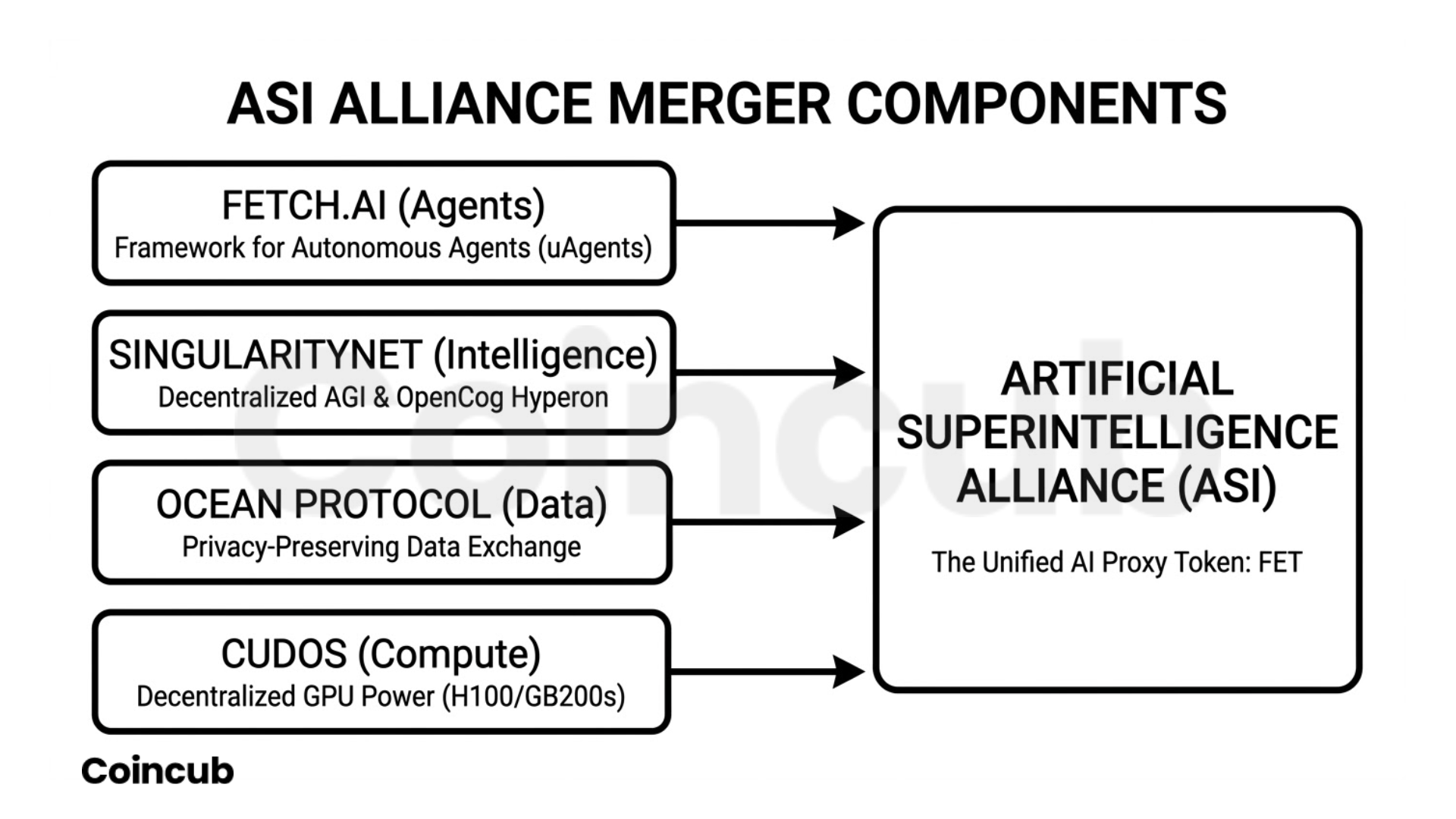
The Artificial Superintelligence Alliance (ASI) was formed in 2024 to pool the resources of major decentralized AI projects. The stated goal was to create an open-source technology stack capable of competing with centralized tech companies. The original merger combined three distinct layers of the AI ecosystem:
- Fetch.ai: Provided the autonomous economic agents (AEAs) and deployment software.
- SingularityNET: Contributed its research on Artificial General Intelligence (AGI) alongside its decentralized marketplace for AI services.
- Ocean Protocol: Supplied the foundational framework for data exchange and monetization, allowing users to share datasets securely.
In late 2024, the alliance expanded to include CUDOS, a decentralized cloud computing network. This integration moved 30 CUDOS validators into the Fetch.ai mainnet. This step added distributed GPUs to the ASI ecosystem, allowing the alliance to offer AI inference and raw computing power directly to its developer base.
Unifying these disparate organizations, however, proved difficult. In October 2025, the Ocean Protocol Foundation formally withdrew from the alliance. Ocean Protocol’s leadership cited a desire for independent funding and control over its specific tokenomics as the primary reasons for stepping away. Fetch.ai, SingularityNET, and CUDOS currently remain united under the ASI banner and continue to manage the shared network.
The Token: FET vs. ASI
A persistent point of friction for investors has been the network’s token ticker. The alliance initially planned a two-phase token migration process. Phase 1 successfully merged SingularityNET’s AGIX and Ocean Protocol’s OCEAN into Fetch.ai’s existing FET token using predetermined, fixed conversion rates.
Phase 2 was intended to rebrand the FET token to a new “ASI” ticker across all smart contracts and cryptocurrency exchanges. However, several major centralized exchanges, including Coinbase and Kraken, opted not to support the complex contract migration on the backend. As a result, the unified token retained the original Fetch.ai smart contract and continues to trade under the “FET” ticker across most platforms. While the network’s branding has shifted to ASI, purchasing FET remains the primary way to invest in the network.
FET Price History
During the first quarter of 2024, the broader artificial intelligence sector experienced a massive surge in valuation, driven heavily by Nvidia’s earnings growth and rapid product updates from consumer AI companies. As one of the oldest and most recognizable AI-focused cryptocurrencies, FET absorbed a significant portion of this capital rotation. This market enthusiasm pushed the token to an all-time high of $3.47 in March 2024.
Over the following 30 months, FET lost roughly 95% of its peak value. While part of this decline mirrored the broader cooling of the cryptocurrency market, FET’s specific price action was dragged down by two distinct liquidity events:
- The Interactive Strength (TRNR) Default: Fetch.ai previously entered into a debt facility with Interactive Strength Inc. (TRNR) and institutional market makers. When the price of FET fell below the required collateral thresholds set out in the agreement, the creditors accelerated the notes. According to TRNR’s SEC filings, this default forced the delivery of nearly 83 million FET tokens to creditors, sparking massive liquidations that mechanically drove down the price.
- Ocean Protocol’s Exit: Following Ocean Protocol’s departure from the alliance in October 2025, disputes arose over how the community treasury would be handled. Fetch.ai CEO Humayun Sheikh publicly pointed to on-chain data alleging that Ocean leadership converted 661 million OCEAN into 286 million FET, moving a significant portion to centralized exchanges. While Ocean maintained its right to operate independently and use the tokens for its own community, this public fallout and the associated token movement significantly impacted market confidence and order book depth.
- The dispute did not stay a public argument for long. Fetch.ai filed legal claims over the FET that Ocean had moved, and by late October 2025 both sides had agreed to stand down, with Ocean returning 286 million FET and Fetch.ai dropping every claim and covering the legal costs. The settlement removed a live legal overhang, though the damage to confidence in alliance governance had already been done.
Factors That May Impact FET / ASI
With the token merger finalized and the forced liquidations largely behind us, FET’s price action in 2026 will depend on actual network utilization and broader technology sector trends.
The Macro AI Narrative
FET’s price movements historically track the traditional tech sector. Speculative cycles generated by hardware manufacturers and Web2 software developers routinely spill over into AI-focused cryptocurrencies.
CEO Jensen Huang emphasized that the industry is entering the “agentic AI” era.
NemoClaw, Nvidia’s open framework for orchestrating autonomous software agents across enterprise workflows, shipped in June 2026 and gave developers a mainstream reference implementation for the agent stack. Because Fetch.ai has spent years building infrastructure specifically tailored for autonomous economic agents, mainstream enterprise validation of this exact technology acts as a macro tailwind for FET. When traditional tech validates the use case, investors often look to crypto proxies like FET for sector exposure.
Autonomous Agent Adoption (Real-World Utility)
For FET to sustain a higher valuation, its network architecture must be adopted by traditional businesses. Fetch.ai uses its Agentverse platform and the ASI: One language model to deploy these agents.
In 2025, Freight Technologies (Fr8Tech), a publicly traded logistics company, announced a pilot program deploying Fetch.ai’s voice agents into its transportation management software. The goal was to automate the extraction of unstructured logistics data. In its initial pilot testing disclosures, Fr8Tech reported that the ASI1-Fast Agent achieved a 69% exact-match rate when compared with human-verified responses for extracting data such as license plate numbers and tractor IDs. The system also utilized LiveKit WebRTC for real-time communication. If more logistics or software companies integrate these agents into their daily operations, the network will require FET tokens to execute transactions, creating consistent structural demand for the token.
Decentralized GPU Compute (CUDOS Integration)
AI development requires substantial GPU computing power. The integration of CUDOS provides the ASI network with a functional physical infrastructure layer.
Through ASI:Cloud, developers can rent distributed GPU clusters for model training or inference. The alliance has positioned this decentralized approach as a lower-cost alternative to major cloud providers. Alliance documentation estimates that renting premium hardware like NVIDIA H100s via CUDOS can run roughly 50% cheaper than equivalent AWS contracts, though exact savings vary with network availability. The ability to rent high-tier hardware without traditional corporate contracts appeals to Web3 developers. Paying for this compute time with the native FET token helps reduce the circulating supply in the open market, supporting its underlying value.
ASI Chain, the alliance’s own Layer 1, is designed around multi-agent execution rather than general-purpose smart contracts, using the MeTTa kernel for concurrent computation and a Casper-family consensus for throughput. A devnet is live for early testing, testnet is targeted for 2026, and the alliance has pointed to late 2026 or early 2027 for mainnet. If it ships on that schedule, FET stops being a token bolted onto a Cosmos chain and becomes the settlement asset for a network built specifically for the workloads the alliance keeps promising.
| Factor | Why it matters | What supports the case | What could limit it |
|---|---|---|---|
| Autonomous AI agents | Fetch.ai’s core thesis depends on agents being used for real tasks | Agentverse, ASI:One, and early enterprise pilots such as logistics automation | Low business adoption, weak reliability, or limited need outside niche use cases |
| Decentralized GPU compute | AI products need compute, and CUDOS gives ASI an infrastructure layer instead of just a token narrative | ASI:Cloud, distributed GPU access, lower-cost positioning versus centralized providers | Inconsistent pricing, weaker performance, or lack of developer demand |
| Enterprise adoption | Real usage matters more than crypto hype over the long term | Pilots like Fr8Tech show that the stack can be tested in real workflows | Pilot programs may not convert into recurring production usage |
| Token supply structure | Supply matters because it affects dilution and long-term pressure on the token | Around 85% of the max supply is already circulating, reducing future unlock risk | High circulating supply alone does not create demand if network usage stays weak |
| Earn & Burn mechanics | Deflation only matters if actual activity is happening on-chain | Network-based token removal can support value if usage grows | The mechanism has little impact if transaction volume remains low |
| AI market sentiment | FET still trades partly as an AI proxy, so broader sector excitement matters | Strong AI narratives can bring capital back into the token | Hype can fade quickly, especially if traditional AI stocks lose momentum |
| Governance and alliance stability | Trust matters after the Ocean exit and treasury-related fallout | Fetch.ai, SingularityNET, and CUDOS remain under the ASI banner | More internal friction could damage confidence again |
| Regulation | Autonomous systems face more scrutiny than many other crypto sectors | Clearer frameworks could help serious enterprise adoption over time | Rules like the EU AI Act may make decentralized compliance harder |
| Competition | ASI is competing with both crypto-native projects and Big Tech | Vertical integration across agents, compute, and infrastructure is a real angle | Microsoft, Google, OpenAI, Render, and Bittensor all have stronger positions in parts of the stack |
FET Price Prediction 2026-2030
The long-term forecast for FET requires evaluating the network’s ability to transition from a speculative idea to software that developers actually pay to use. The table and analysis below map a progressive recovery path based on adoption metrics, deflationary token mechanics, and consensus technical targets.
FET Price Prediction 2026
The primary theme for 2026 is stabilization. The market has largely absorbed the excess supply from the TRNR debt defaults and the Ocean Protocol exit. As the ASI mainnet matures and tools like ASI:Cloud secure their initial user bases, FET has the potential to recover from its recent lows slowly.
With only the fourth quarter left to run and the token near $0.18, a baseline close somewhere around $0.24 looks reasonable if developer adoption meets expectations and the broader crypto market avoids a severe drawdown. A renewed AI bull run paired with verifiable enterprise usage could carry it to the $0.45 area before year end. If the network fails to attract B2B adoption and traders abandon the AI narrative, $0.12 becomes the level to watch.
FET Price Prediction 2027-2028
The 2027-2028 period will test whether decentralized AI infrastructure can scale effectively. If ASI’s autonomous agents become standard tools for supply chain optimization or DeFi operations, transaction volume will increase. Furthermore, the Alliance’s stated $50 million “Earn & Burn” program is designed to systematically reduce the token supply in circulation based on network revenue.
As utility increases and the token supply contracts, the price is expected to trend upward. Assuming the technology proves reliable, the average price could push past the $0.80-$1.90 range. In a highly favorable environment where decentralized compute demand outpaces supply, technical models project the token could reach $5.50 by the end of 2028.
FET Price Prediction 2029-2030
By 2030, the market for AI infrastructure is projected to be fully established, with the discourse shifting toward Artificial General Intelligence (AGI). If the ASI Alliance succeeds in providing a viable alternative to Big Tech monopolies, FET will serve as the standard currency for automated B2B software payments across its network.
Under a baseline scenario in which Fetch.ai maintains a solid niche in the enterprise market, the token targets an average price of $4.30 to $6.70. If widespread enterprise integration occurs globally due to AGI infrastructure demands, FET could reclaim its historical momentum and push toward $12.45 or higher as utility outpaces the capped supply.
| Year | Bear Scenario (Low) | Base Scenario (Average) | Bull Scenario (High) |
|---|---|---|---|
| 2026 | $0.12 | $0.24 | $0.45 |
| 2027 | $0.17 | $0.82 | $2.14 |
| 2028 | $0.46 | $1.93 | $5.53 |
| 2029 | $1.40 | $4.30 | $8.05 |
| 2030 | $2.12 | $6.78 | $12.45 |
FET vs. Other AI Cryptos
Comparing FET to other top-tier AI networks helps clarify its specific market position and technical architecture. Understanding these distinctions is crucial because they highlight exactly where Fetch.ai has a competitive edge, and where it falls short.
Bittensor currently commands a significant portion of the market share in the decentralized AI sector. TAO operates on a unique subnet architecture where thousands of independent machine learning models compete to produce the most accurate outputs (such as text generation or data analysis) and are rewarded accordingly.
TAO is focused primarily on the decentralized training and scoring of machine learning models. Fetch.ai, however, focuses heavily on deployment and execution. ASI provides the agents that actually interact with APIs, perform automated tasks, and act on data within the real economy. If a company wants to train a model, it might look to TAO. If they want to deploy a bot to automatically book logistics shipments, they look to Fetch.ai.
The Render Network is a decentralized physical infrastructure network that distributes idle GPU power. Render’s architecture was initially optimized for 3D rendering and visual effects for major studios, though it has increasingly been used for generative AI workloads.
While the ASI Alliance (via CUDOS) also offers a decentralized GPU marketplace, it is not strictly a compute-as-a-service protocol like Render. ASI aims to be a fully integrated platform where its compute layer natively powers its own large language models and autonomous agents, rather than just renting out raw hardware to third parties. Fetch’s edge is its vertical integration; its weakness is that Render currently has deeper ties to the traditional visual effects and media industries.
Is FET a Good Investment?
Evaluating FET requires weighing its established network architecture against notable execution and regulatory risks.
The ASI Alliance combines AI agents, decentralized compute, and blockchain infrastructure into a single, active software stack. With 85% of the token supply already circulating, the asset avoids the heavy dilution risks that frequently suppress the prices of newer crypto projects. Tangible business integrations, such as the Fr8Tech logistics pilot, indicate that the technology has real-world applications outside of crypto speculation. Furthermore, the $50 million “Earn & Burn” program systematically reduces the token supply in circulation based on network revenue, creating a deflationary backdrop. After a 93% price correction, the token trades at a steep discount relative to its historical valuation.
Decentralized networks face intense competition from heavily funded traditional tech companies like Microsoft, Google, and OpenAI. These Web2 giants offer simpler procurement processes and established legal frameworks for enterprise clients. Additionally, the ASI Alliance has suffered recent reputational damage; the TRNR debt liquidations and the public exit of Ocean Protocol created significant market instability and eroded trust in the project’s governance.
Finally, regulatory hurdles present a massive risk. The EU AI Act classifies certain autonomous decision-making systems as high-risk and demands human oversight, data logging, and accountability measures, though the Digital Omnibus agreed in May 2026 pushed the compliance date for standalone high-risk systems out to December 2027, with AI embedded in regulated products following in August 2028. The extra runway buys time for compliance work without changing what the obligations eventually require. Decentralized agent networks, by their very nature, spread computation across anonymous nodes, making it exceptionally difficult to comply with the EU’s centralized liability requirements.
FET is a high-beta asset tied directly to the growth of the artificial intelligence sector. It appeals to investors seeking exposure to AI infrastructure without purchasing traditional equities. However, its long-term viability depends strictly on its ability to attract consistent workloads to its network and navigate a complex, hardening regulatory environment.
How to Buy and Store FET
Acquiring FET requires navigating a somewhat fragmented exchange landscape. Because the planned ticker migration to “ASI” stalled on major platforms, liquidity remains heavily concentrated in the legacy FET token. It continues to trade actively on tier-1 centralized exchanges, including Binance, Kraken, and Coinbase.
Institutional and retail buyers typically use regulated fiat on-ramps and crypto-friendly banks to bypass the compliance friction often associated with AI-linked digital assets. Before allocating capital, market participants should closely monitor the USA and other major jurisdictions, as shifting definitions of autonomous AI systems and decentralized compute could trigger sudden delistings from exchanges or liquidity shifts in specific regions.
Custody strategy largely depends on an investor’s timeline and goals. Leaving assets on centralized exchanges exposes holders to counterparty risk, making cold storage solutions (like Ledger or Trezor) the standard for long-term, macro holdings.
However, investors looking to capture the network’s baseline inflation yield often move their funds to the native ASI Wallet. By holding tokens in this non-custodial interface, users can delegate their stake directly to network validators. This process supports the alliance’s underlying compute infrastructure while allowing token holders to earn a passive return that currently hovers around 7% APY.
Frequently Asked Questions (FAQ)
What is Fetch.ai (FET)? +
Fetch.ai is a blockchain project focused on autonomous AI agents, machine-to-machine interactions, and decentralized infrastructure for AI-based applications.
Is FET the same as ASI? +
Mostly yes. ASI is the alliance brand, while FET remains the token ticker used across most major exchanges.
Why did FET fall so hard after 2024? +
The drop came from a mix of crypto market weakness, forced liquidations tied to treasury and debt issues, and loss of confidence after internal alliance friction.
What could push FET higher between 2026 and 2030? +
The main drivers are real enterprise adoption, more demand for agent-based software, greater use of ASI:Cloud compute, and stronger overall AI market sentiment.
What are the biggest risks for FET? +
Competition from Microsoft, Google, and OpenAI, weak enterprise adoption, governance concerns, and stricter AI regulation are the main risks.
Can FET reach its all-time high again? +
It is possible, but only if the network proves it can convert AI hype into real usage and sustained token demand.
What role does CUDOS play in the ASI ecosystem? +
CUDOS adds a decentralized GPU and cloud computing infrastructure, enabling ASI to offer more than just agent tools and model access.
Where can you buy FET? +
FET is available on major exchanges such as Binance, Kraken, and Coinbase, though availability can vary by region.
Is FET a long-term investment or a short-term trade? +
It can be both, but the long-term case depends far more on adoption than on hype cycles.
What is the core investment thesis behind FET? +
The thesis is simple: if decentralized AI agents and computing become useful enough for real business workloads, FET could benefit as the token tied to that network activity.