



 Buy a Licensed Company
  Explore VASP Data
  Talk to an Expert

 Atis Shala
Atis is a senior analyst and community lead with four years of experience in crypto. He has a bachelor from the Rochester Institute of Technology.
Atis Shala
Atis is a senior analyst and community lead with four years of experience in crypto. He has a bachelor from the Rochester Institute of Technology.
RegTech vs. SupTech: Staying Compliant Through AI
The global financial system is currently witnessing a collision of two distinct eras. On one side stands the cryptocurrency industry, a sector defined by permissionless innovation, millisecond transaction speeds, and a decentralized ethos that often actively resists authority. On the other side stands the global regulatory framework, a system built on centralized gatekeepers, identity verification, and banking laws written decades before the internet existed. For years, this disconnect created a chaotic environment where enforcement was sporadic and compliance was largely theoretical. However, that era is ending. We are now entering a period of algorithmic enforcement where the primary mechanism for governance is not the gavel but the code.
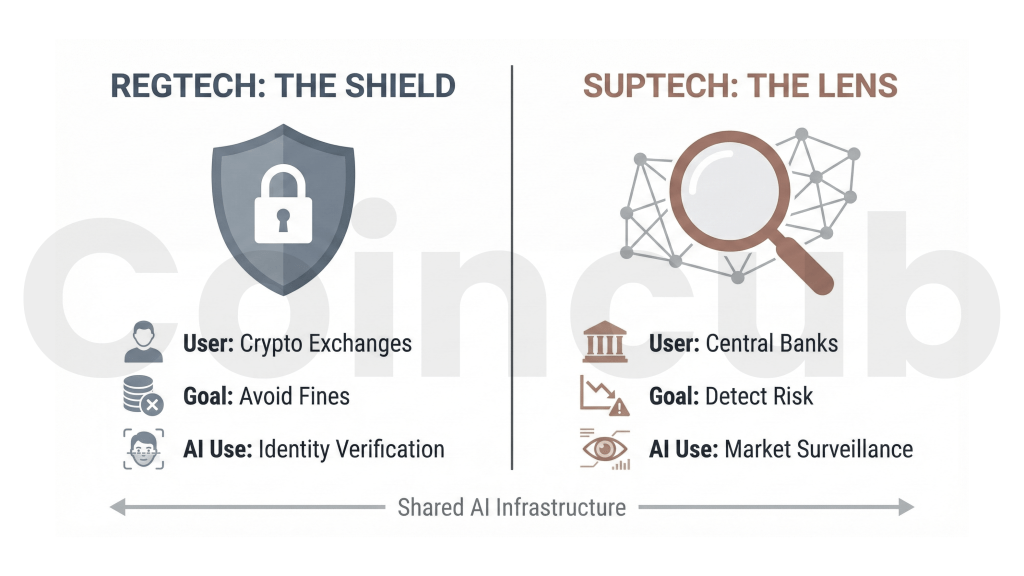
This transition is being driven by two powerful, opposing, yet complementary forces: Regulatory Technology (RegTech) and Supervisory Technology (SupTech). While these terms are frequently conflated by industry outsiders, they represent two different sides of the compliance battleground.
RegTech is the digital shield used by private institutions. It is the suite of technologies that allows crypto exchanges, custodians, and decentralized finance (DeFi) protocols to navigate an increasingly complex web of jurisdictional rules. Its primary goal is efficiency and protection. It helps companies screen users, monitor transactions for suspicious activity, and automate the reporting process to avoid catastrophic fines.

SupTech is the digital lens used by public authorities. It is the technology deployed by central banks, securities commissions, and financial conduct authorities to oversee the market. Its primary goal is systemic stability and surveillance. It allows regulators to ingest massive datasets, spot market manipulation in real time, and predict financial contagion before it spreads to the broader economy.
Do We Need RegTech and SupTech?
The necessity for these technologies arises from a simple mathematical reality: human oversight is no longer possible. In a market where billions of dollars move across borders in seconds, manual compliance checks are futile. The volume of data generated by blockchain networks exceeds the processing capacity of any human analyst team. Consequently, Artificial Intelligence (AI) has emerged as the critical infrastructure for both sectors. AI is not merely an enhancement to existing compliance workflows. It is the only tool capable of bridging the gap between the chaotic speed of crypto and the rigid requirements of the law.
Throughout this article, we will explore how these two forces interact. We will examine how RegTech focuses on the micro-level compliance of individual transactions while SupTech focuses on the macro-level health of the market. This is not just a story about software updates. It is an analysis of how AI is fundamentally reshaping the relationship between the state and the sovereign individual.
Why Does the RegTech vs SupTech Split Exists?
To understand the sudden ascendancy of RegTech and SupTech, one must first appreciate the unique friction that defines the modern financial landscape. Cryptocurrency was born from a desire for pseudonymity and decentralization. It was architected to operate outside the traditional banking rails, relying on code rather than intermediaries to settle value. Financial regulation, conversely, is built almost entirely on identity, centralization, and accountability. This fundamental mismatch created a “regulatory gap” that persisted for over a decade.
For years, this gap allowed the crypto industry to operate in a gray zone. Regulators were effectively blind to onchain activity, and crypto companies were often willfully ignorant of traditional banking laws like the Bank Secrecy Act or the Travel Rule. However, as institutional capital entered the fray and the market capitalization of crypto swelled into the trillions, the stakes changed dramatically. Governments could no longer ignore a major asset class, and crypto companies realized that sustainable growth required playing by the rules.
The Birth of RegTech
This realization birthed the RegTech imperative. For a crypto exchange like Coinbase, Kraken, or Binance, compliance is an existential challenge. They must screen millions of transactions daily for links to sanctioned entities, such as North Korean hacker groups or known money laundering rings. Doing this manually would require an army of analysts larger than the company itself. Furthermore, the cost of failure is absolute. Regulatory fines can amount to billions of dollars, and executives face the real prospect of prison time for compliance failures.
RegTech emerged as the private sector’s response to this logistical nightmare. It automates the burden of obedience. It allows these companies to translate vague legal requirements into binary code that can stop a dirty transaction before it is confirmed on the blockchain. In this context, RegTech acts as a defensive shield. It is a cost center for the business, deployed to protect the firm from the wrath of the state.
The Birth of SupTech
On the other side of the equation lies the SupTech imperative. For a regulator like the Securities and Exchange Commission (SEC) or the European Securities and Markets Authority (ESMA), the challenge is visibility. In the traditional stock market, regulators have direct, standardized feeds to centralized exchanges. In the crypto economy, trading happens on decentralized protocols scattered across thousands of nodes globally. Regulators cannot simply subpoena a central server because, in many cases, there is no central server.
SupTech provides the necessary tools to scrape blockchains, aggregate fragmented data, and see market manipulation in real time. It represents a digital transformation for the public sector. Historically, supervision was retrospective. A bank would fail, and regulators would spend months performing an autopsy to find out why. With SupTech, supervision becomes predictive. Regulators use these tools to model market stress tests. If a major stablecoin begins to de-peg, SupTech tools trigger alerts immediately, allowing regulators to intervene before the contagion spreads to the broader economy.
In this macro view, we see the first major divergence between the two fields. RegTech is about efficiency and defense for the private entity. SupTech is about oversight and stability for the public authority. Both are responses to the same problem, the complexity and speed of crypto, but they are viewed from opposite sides of the table.
This dynamic creates a technological arms race. When regulators deploy better SupTech tools that can trace “privacy coins” or mixer transactions, companies must upgrade their RegTech to ensure they are not facilitating transactions that the regulator can now see are illicit. The result is a cycle of rapid innovation where the standard for compliance is constantly being raised by the capabilities of the technology itself.
AI and Machine Learning Models on RegTech and SupTech
While the legal motivations for RegTech and SupTech differ, their technological underpinnings are remarkably similar. Both sectors rely on the same fundamental breakthroughs in artificial intelligence, yet they deploy them with vastly different scopes. To understand this, we must first acknowledge a critical nuance: SupTech is not exclusive to crypto. Central banks have long used basic forms of it to monitor traditional banking stability. However, the cryptographic nature of digital assets, where data is public yet pseudonymous, has forced SupTech to evolve from a passive reporting tool into an aggressive, AI-driven hunter.
The war between compliance and evasion is fought primarily with two classes of algorithms: Natural Language Processing (NLP) and Graph Neural Networks (GNNs).
Data Ingestion: The Fuel Behind the Tech
The first divergence lies in the data source.
- RegTech operates in a walled garden. Its AI models are trained on private, highly granular user data: passport scans, selfie videos, IP addresses, and device fingerprints. It sees deeply into a single user’s identity but is often blind to that user’s activity on other platforms.
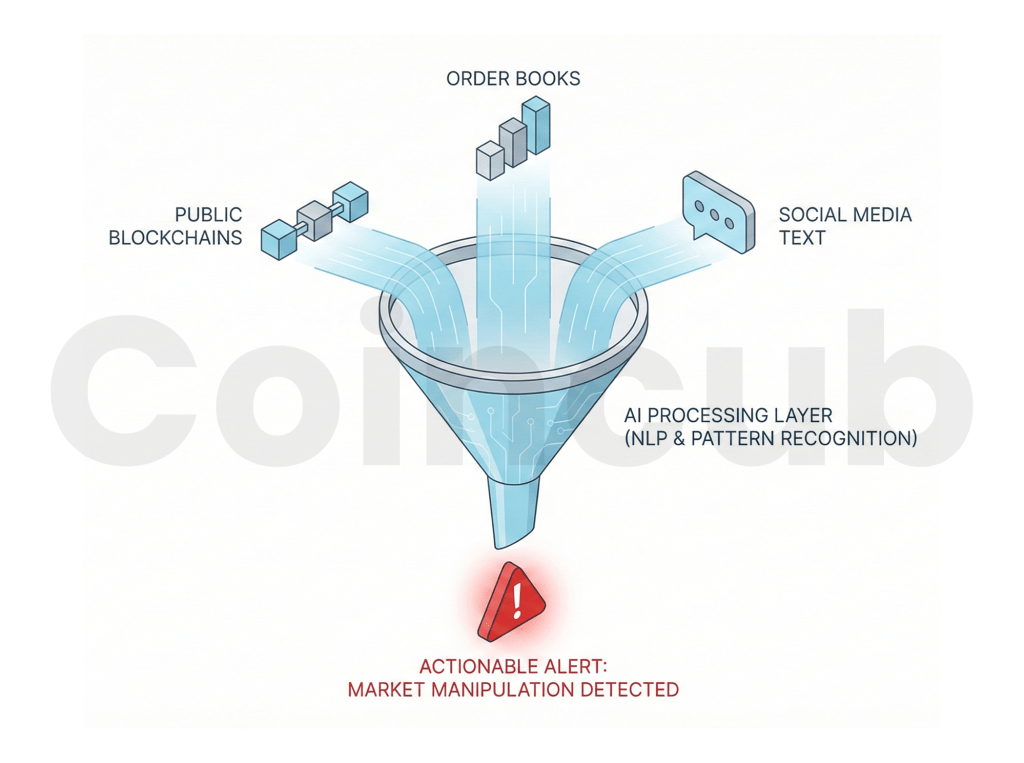
- SupTech operates in the open wild. Its models ingest data from public blockchains (Bitcoin, Ethereum, Solana), combined with unstructured data from the open web (X, Reddit, Telegram). It sees broadly across the entire market but lacks the private identity keys held by the exchanges.
Natural Language Processing (NLP): The Listener
In the chaotic world of crypto, text is as important as code.
For RegTech, NLP is an efficiency engine. Regulatory frameworks are not static; they change daily across hundreds of jurisdictions. A global exchange cannot manually track every minor update to the MiCA framework in Europe or the BSA in the United States. RegTech platforms use NLP to scrape global regulatory registries, parse complex legal prose, and automatically update internal compliance rules. If Singapore bans a specific type of derivative token, the NLP engine detects the legal text and pushes a code update to block Singaporean users from accessing that product, often before human lawyers have finished their morning coffee.
For SupTech, NLP is a surveillance weapon. Crypto markets are uniquely sentiment-driven. Scams like “rug pulls” and “pump-and-dump” schemes are almost always coordinated in public chat rooms before they happen onchain. Regulators use NLP to scan millions of messages on Discord and Telegram. Sentiment analysis algorithms look for linguistic markers of coordination, bot-like repetition of specific phrases (“to the moon,” “guaranteed 100x”) combined with artificial urgency. When the AI detects a localized spike in positive sentiment for a token with no fundamental news, it flags the asset for manipulation investigation.
Graph Neural Networks (GNNs): The Map Maker
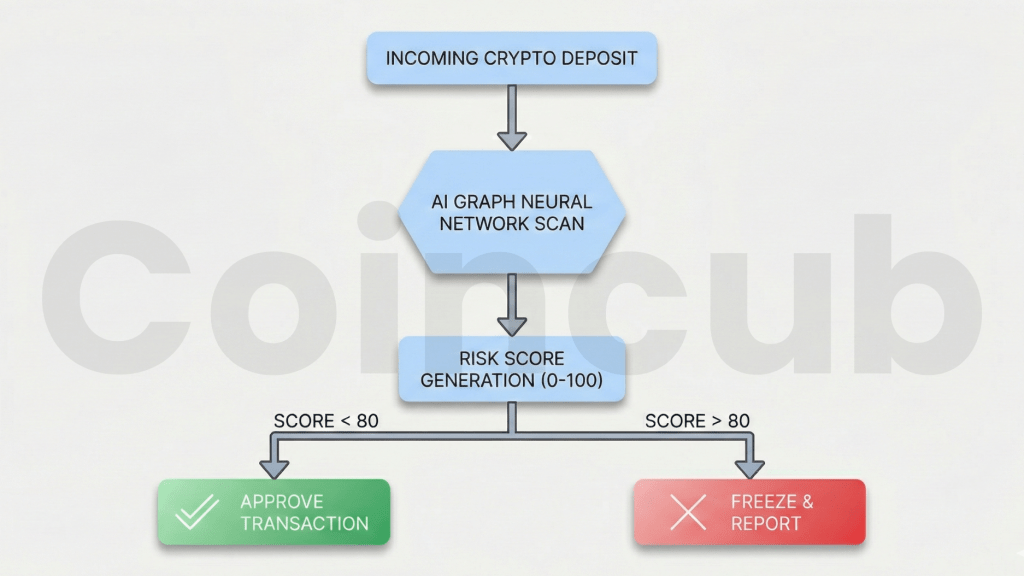
If NLP listens to the people, GNNs watch the money. This is the heavy artillery of crypto compliance. Traditional machine learning handles rows and columns (tabular data) well. But crypto transactions are not rows; they are a web of interconnected nodes (wallets) and edges (transactions).
RegTech uses GNNs to perform “taint analysis” on incoming deposits. When a user deposits Bitcoin, the GNN traces that coin’s history back hundreds of hops. It asks questions like, “Did this wallet receive funds from a wallet that received funds from a mixer that was funded by a hack three years ago?” By mapping the neighbor relationships of the depositing wallet, the AI assigns a risk score. If the score crosses a threshold, the assets are frozen automatically.
SupTech applies GNNs to model systemic contagion. The collapse of entities like FTX or the Terra ecosystem revealed that the crypto market is highly incestuous, everyone lends to everyone. Regulators use GNNs to build a “shadow map” of the ecosystem. By aggregating data from multiple exchanges, they can see if a specific entity is over-leveraged across the entire network. If a large whale begins to liquidate positions on three different exchanges simultaneously, the GNN detects the pattern as a potential liquidation cascade, alerting supervisors to a liquidity crisis in real-time.
Specific Applications of RegTech and SupTech
The theoretical models discussed previously translate into very real, high stakes applications on the front lines of crypto compliance. We will now examine how these tools function in practice across three critical battlegrounds.
The first major conflict zone involves identity. Cryptocurrency networks are natively pseudonymous. Users are represented by alphanumeric strings rather than legal names. Overcoming this anonymity is the primary objective for both private compliance teams and public enforcers.
For private companies relying on RegTech, this battle is fought at the front door during the Know Your Customer process. Crypto exchanges must verify the identity of every new user quickly and accurately. Modern RegTech platforms utilize advanced Computer Vision and biometric liveness detection to achieve this. When a user uploads a government identification card and a selfie video, artificial intelligence analyzes the geometric features of the face to ensure a match. Crucially, the AI tests for liveness to defeat sophisticated deepfakes and presentation attacks. The system analyzes micro expressions, skin texture reflections, and even the subtle pulse of blood beneath the skin to confirm a living human is present. This biometric data is then cross referenced with global watchlists in milliseconds.
Regulators and the Convergence of RegTech with SupTech
Regulators approach the identity problem from a completely different angle. Their SupTech tools are designed to de-anonymize bad actors who actively try to hide their tracks. When hackers steal funds, they frequently route the digital assets through privacy protocols or coin mixers to obfuscate the trail. SupTech platforms employ complex heuristic clustering algorithms to break this privacy shield. These AI models analyze network metadata, transaction timings, and precise withdrawal amounts to probabilistically link an anonymous deposit to an anonymous withdrawal. The algorithms also monitor IP addresses and node interactions to map the physical locations of suspected criminals. RegTech confirms the identity of a willing participant at the onboarding stage. SupTech attempts to unmask an unwilling participant hiding deep within the blockchain network.
Once a user enters the ecosystem, the focus shifts to monitoring their behavior. The speed of digital asset transfers requires automated systems capable of making instantaneous decisions.
RegTech as a Real-Time AML Checker
RegTech handles Anti Money Laundering obligations through real time transaction scoring. Every time a user initiates a transfer, the AI evaluates the destination wallet against vast databases of known threat actors. The system calculates a risk score based on the historical associations of that wallet address. If a user attempts to send Bitcoin to an address previously linked to ransomware payments, the RegTech software automatically blocks the transfer and flags the account for human review. The AI continuously learns from new threat intelligence feeds, updating its risk parameters daily to adapt to new criminal typologies. This preventative action keeps illicit funds out of the legitimate financial system.
SupTech monitors behavior on a macro scale to ensure market integrity. Regulators are primarily concerned with market manipulation tactics like wash trading, spoofing, and layering. These abusive strategies involve placing fake orders to create a false impression of market demand. Because crypto trading is fragmented across dozens of independent exchanges, manipulating the price of an asset is relatively easy for well funded syndicates. SupTech AI aggregates order book data from multiple global exchanges into a single consolidated feed. Machine learning algorithms scan this massive dataset for artificial trading patterns. The AI can identify coordinated clusters of fake orders designed to artificially inflate token prices, allowing regulators to pinpoint the manipulators. RegTech looks at the individual flow of money to prevent money laundering. SupTech looks at the aggregate flow of orders to prevent systemic market abuse.
RegTech vs. SupTech in Code
The final operational theater involves the underlying code of the crypto industry. In decentralized finance, financial agreements are executed by smart contracts rather than human intermediaries. A flaw in this code can result in the instantaneous theft of millions of dollars.
RegTech solutions address this risk through automated pre deployment auditing. Private companies use AI tools to run symbolic execution and formal verification on their smart contracts before launching them to the public. The artificial intelligence rapidly tests millions of potential input combinations to identify vulnerabilities, such as reentrancy flaws or logic errors. The objective is to secure the code against potential exploits proactively.
SupTech utilizes AI for post event forensic analysis. When a decentralized protocol suffers a catastrophic hack, regulators deploy supervisory tools to dissect the exploit. The AI reconstructs the exact sequence of smart contract calls that led to the vulnerability. Supervisors then use these forensic insights to track the stolen assets as the hacker attempts to move them across different blockchains using cross chain bridges. RegTech operates as a preventative measure to secure the perimeter. SupTech acts as a detective mechanism to investigate the crime and trace the fallout.
Here is the fifth section of the article, focusing on a smoother, more natural progression of ideas.
RegTech and SupTech: The Future of Compliance
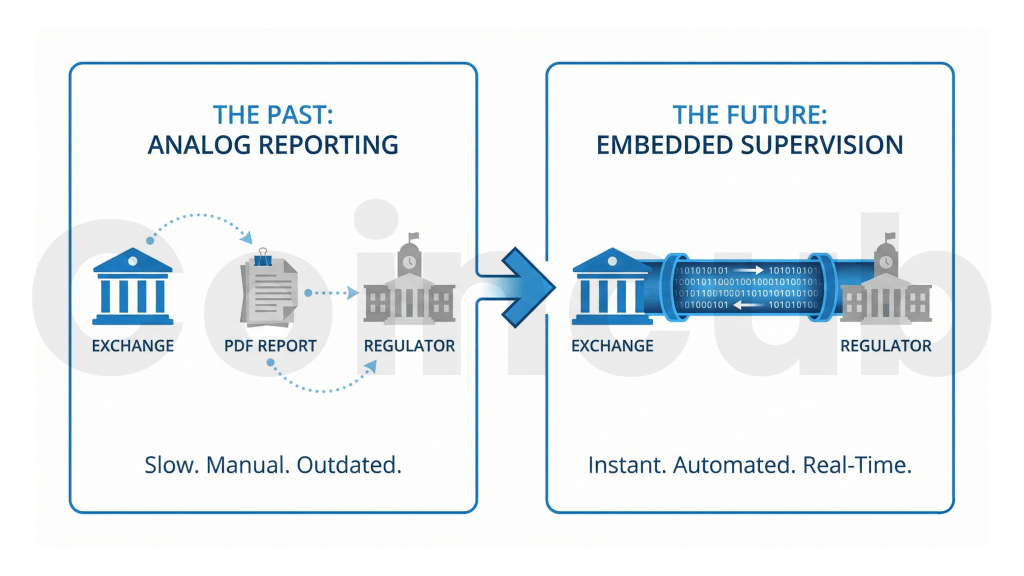
As we look toward the horizon of decentralized finance, the strict boundaries separating regulatory technology from supervisory technology are beginning to dissolve. The current paradigm is highly inefficient. Private companies spend millions of dollars generating massive compliance reports, and public agencies spend millions building systems to decipher those exact same reports. This adversarial game is slowly giving way to a unified approach. The industry is moving toward a technological convergence where compliance is built directly into the financial infrastructure itself.
The first major step in this evolution is the adoption of machine-readable regulation. Historically, when a government agency updated a financial law, they published a lengthy text document. Legal teams at crypto exchanges would read the document, interpret the new rules, and then instruct their software engineers to update the platform’s internal code. This manual translation process is incredibly slow and highly prone to human error.
In the near future, regulators will simply publish new rules as executable code or API specifications. When a regulatory body adjusts a reporting threshold or sanctions a new digital wallet, they will deploy that update to a shared network. A crypto company’s internal RegTech systems will automatically pull this code and instantly update their own compliance parameters. The regulator provides the digital blueprint, and the private entity’s software automatically conforms to it without requiring human intervention.
Embedded Supervision
The ultimate expression of this convergence is a concept known as embedded supervision. This represents the holy grail of crypto regulation. Currently, compliance is a periodic event. A company compiles a spreadsheet at the end of the month and sends it to the government. Embedded supervision transforms this process into a continuous, real-time flow of information.
In this model, the regulatory authority maintains a secure, read-only node directly connected to the private company’s internal network or the underlying blockchain protocol.
What Does This Mean For Companies?
For the private firm, their RegTech completely eliminates the need for manual reporting because the required data is permanently accessible. For the public authority, their SupTech can pull live metrics regarding exchange solvency, user balances, and transaction flows at any given second. This allows regulators to conduct real-time Proof of Reserves audits. They can cryptographically verify that an exchange actually holds the customer assets they claim to hold, eliminating the need to wait for an annual audit from a third-party accounting firm.
Artificial intelligence plays a crucial role in making this shared ecosystem function. Raw data flowing continuously from an exchange to a regulator is useless without immediate context. AI models bridge this gap by categorizing and standardizing the data on the fly. They act as the automated connective tissue between the private ledger and the public oversight dashboard.
This shared data environment fundamentally changes the relationship between the crypto industry and the state. The dynamic shifts away from defensive posturing and moves toward collaborative monitoring. The technology ensures that both sides are looking at the exact same truth at the exact same time.
Frequently Asked Questions (FAQs)
What is the difference between RegTech and SupTech?
RegTech, or Regulatory Technology, helps private financial institutions automate compliance tasks and manage internal regulatory risks efficiently. SupTech, or Supervisory Technology, is deployed by government oversight agencies to monitor these same institutions, aggregate market-wide data, and enforce financial regulations proactively
What does SupTech mean?
SupTech stands for Supervisory Technology. It refers to the advanced technologies, such as artificial intelligence and machine learning, used by public regulatory authorities. These tools help agencies collect massive amounts of financial data, detect market manipulation, and supervise the global financial system more effectively.
What is SupTech in banking?
In banking, SupTech allows central banks and financial watchdogs to digitize their oversight capabilities. Authorities use these digital tools to pull real-time solvency data directly from bank ledgers, run automated stress tests, and identify systemic risks before a major bank failure occurs.
What is the difference between RegTech and fintech?
Fintech, or Financial Technology, focuses on innovating how consumers and businesses access financial services like mobile banking or digital lending. RegTech is a specialized sub-sector of fintech built specifically to help those financial companies navigate complex legal requirements and maintain strict regulatory compliance.
What is an example of RegTech?
An excellent example of RegTech is an automated identity verification platform used by a cryptocurrency exchange. When a new user signs up, the software uses artificial intelligence to scan their passport and perform a biometric facial recognition check against global anti-money laundering watchlists instantly.









