Buy a Licensed Company
  Explore VASP Data
  Talk to an Expert

 Dren Hima
 is Head of Research at Coincub, leading research across digital asset regulation, licensing, market structure, tokenization and institutional adoption.
Dren Hima
Dren Hima is Head of Research at Coincub, leading research across digital asset regulation, licensing, market structure, tokenization and institutional adoption.
AI for VASP and CASP Applications: Faster Licensing, Fewer Denials

- Regulators reject crypto applications for basic reasons, weak AML controls, vague risk assessments, and missing evidence, not because the business model is “too new.”
- AI helps most with drafting and structuring, but the real win is packaging proof, control matrices, versioned evidence, and audit-ready artifacts.
- FATF definitions and the Travel Rule set the baseline, but each jurisdiction labels and enforces authorization differently, UK AML registration, EU MiCA CASP, NYDFS BitLicense, VARA VASP.
- SupTech means your application gets screened by machines first, formatting, completeness, and internal consistency matter before a human reviewer even engages.
- Public AI tools create two risks you can’t explain away later, hallucinated legal content and privilege leakage. Enterprise tooling, retrieval, citations, and human review are mandatory.
Securing regulatory approval to operate a digital asset enterprise is a highly formalized, documentation-intensive process. Following industry disruptions in 2022, global financial authorities shifted from a posture of observation to rigorous enforcement. Today, acquiring a Virtual Asset Service Provider (VASP) license, a Crypto-Asset Service Provider (CASP) authorization, or a regional equivalent is a standard requirement for market access, institutional partnerships, and banking integration.
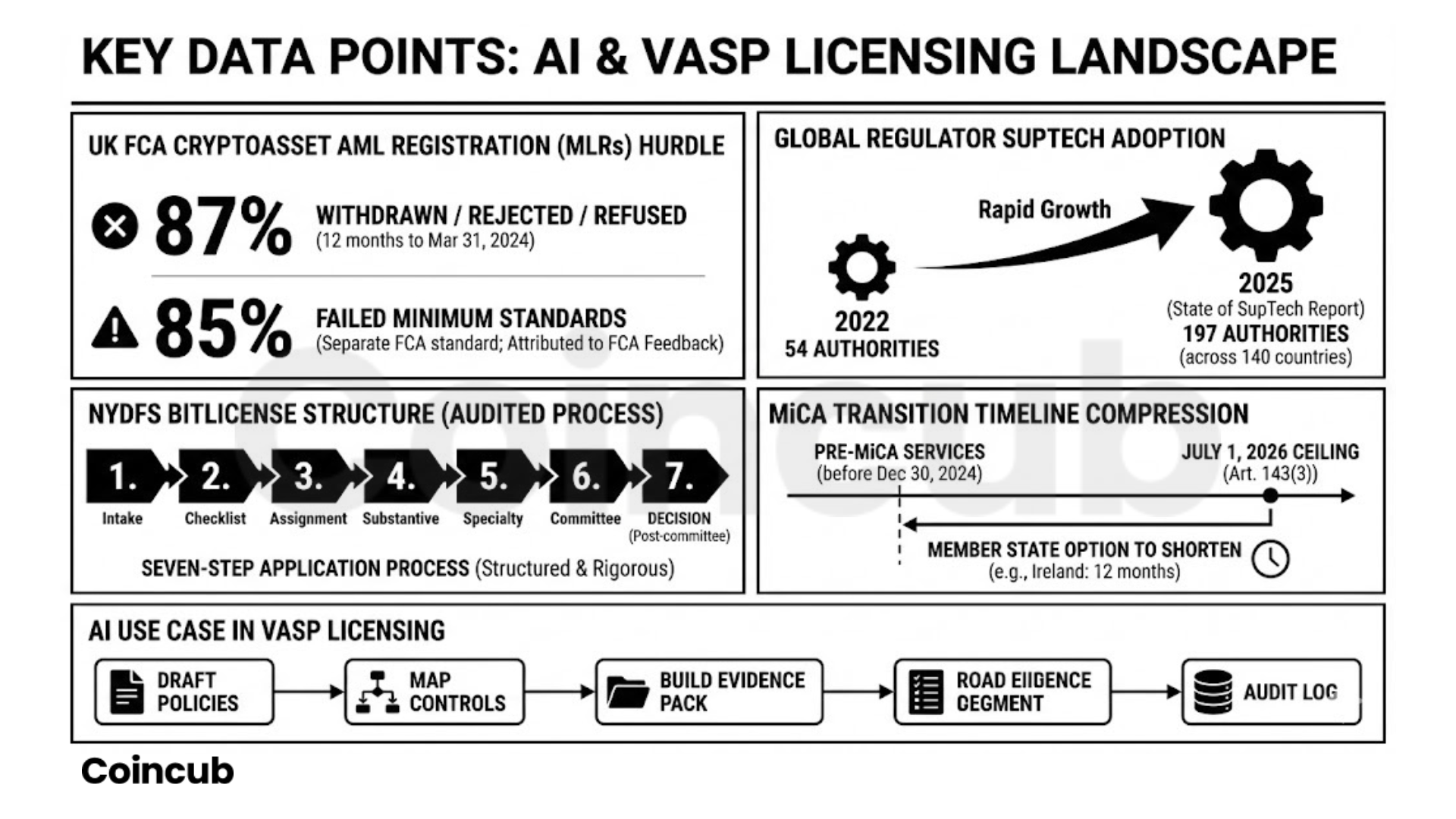
The barrier to entry is intentionally high, focusing on the applicant’s ability to demonstrate robust, operationalized Anti-Money Laundering (AML) and Counter-Terrorist Financing (CTF) controls. Regulators expect precise documentation detailing corporate governance, transaction monitoring, and risk assessment frameworks. When applications lack this precision, the denial rates are significant. In the United Kingdom, for instance, the Financial Conduct Authority (FCA) reported that over 87% of crypto registration applications were withdrawn, rejected, or refused in the 12 months ending March 2024, primarily due to weak money laundering controls. According to the Treasury Committee, approximately 85% of applicants failed to meet the minimum required standards.
To manage the volume and complexity of these regulatory requirements, compliance departments and specialized legal consultancies are integrating Artificial Intelligence (AI) and Regulatory Technology (RegTech) into their workflows. These tools are utilized to accelerate the drafting of foundational policies, map internal controls to statutory requirements, and package evidence for regulatory review.

Foundational Frameworks and Terminology
The architecture of global digital asset compliance is established by the Financial Action Task Force (FATF), which designs standards to combat money laundering and terrorist financing.
Under FATF guidelines, a Virtual Asset Service Provider (VASP) is any business that conducts one or more of the following activities on behalf of another person: exchange between virtual assets and fiat currencies, exchange between one or more forms of virtual assets, transfer of virtual assets, safekeeping and/or administration of virtual assets, or participation in and provision of financial services related to an issuer’s offer and/or sale of a virtual asset.
To secure global authorization, applicants must align their operations with FATF Recommendations 15 and 16. Recommendation 16, universally known as the “Travel Rule,” mandates the collection, verification, and transmission of sender and recipient data for virtual asset transfers. While the FATF de minimis threshold is generally set at USD/EUR 1,000, specific jurisdictions apply varied limits; the United States, for example, commonly enforces a $3,000 threshold under the Bank Secrecy Act.
It is important to note that regulatory terminology varies significantly by jurisdiction. While “VASP” is the FATF standard, the actual authorization process differs:
- United Kingdom: Firms apply for “cryptoasset AML registration” under the Money Laundering, Terrorist Financing and Transfer of Funds (Information on the Payer) Regulations 2017 (MLRs). This is an AML supervision registration rather than a full prudential licensing regime.
- European Union: Firms apply for a Crypto-Asset Service Provider (CASP) authorization under the Markets in Crypto-Assets (MiCA) regulation.
- United States (New York): Firms apply for a “BitLicense,” a bespoke, comprehensive regulatory framework administered by the New York State Department of Financial Services (NYDFS).
- United Arab Emirates (Dubai): Firms apply for a VASP License issued by the Virtual Assets Regulatory Authority (VARA).
Jurisdictional Decision Criteria and Landscape
Selecting the appropriate regulatory domicile requires a systematic evaluation of strategic trade-offs. Compliance teams generally utilize a decision framework evaluating six core criteria:
| Criteria | What regulators/banks look for | Evidence you’ll need |
| Banking Access | Likelihood of securing tier-one fiat banking relationships based on the regulator’s reputation. | Verifiable proof of continuous AML compliance and tech-stack maturity. |
| Substance Requirements | Expectations regarding local physical offices, resident directors, and in-country compliance staff. | Org chart, lease agreements, local MLRO contracts, resident director CVs. |
| Timeline Risk | Historical averages for application processing and regulatory feedback loops. | Project runway models and regulatory correspondence logs. |
| Capital Expenditure (Capex) | Minimum capitalization rules and ongoing liquidity requirements. | Capital calculation, liquidity plan, runway model, stress test. |
| Enforcement Posture | The regulator’s historical approach to audits, fines, and remediation. | Proven incident response plans and compliance history. |
| Retail Permissions | Restrictions on offering specific products (e.g., derivatives, yield products) to retail consumers. | Customer terms and conditions, risk disclosures, product perimeter memos. |
The following table outlines the parameters of prominent licensing jurisdictions:
| Jurisdiction | Primary Regulator | Framework | Capital Minimums | Estimated Timeline | Strategic Characteristics |
| European Union | National Competent Authorities (e.g., CBI, AMF) | MiCA (CASP) | €50,000 to €150,000 depending on services. | 4 to 9 months. | Grants passporting rights across the EU/EEA. Replaces fragmented national AML registrations. |
| United States (New York) | NYDFS | BitLicense | Dynamic, assessed based on business model risks. | 12+ months. | Highly rigorous framework requiring extensive cybersecurity, AML, and financial stability audits. |
| Singapore | MAS | PSA (MPI/SPI) | S100,000toS250,000 base capital. | 6 to 12+ months. | Focuses heavily on stringent technological risk rules, consumer protection, and strict corporate governance. |
| Hong Kong | SFC | VATP License | ≥ HKD 5 million paid-up capital. | 6 to 12+ months. | Permits regulated retail trading under strict investor-protection controls. |
| United Arab Emirates (Dubai) | VARA | VASP License | Activity-based capital requirements. | 4 to 9 months. | Requires physical office presence and distinct approvals (Approval to Incorporate followed by Full Market Product License). |
Navigating the EU MiCA Transition
The European Union’s transition to the Markets in Crypto-Assets (MiCA) regulation replaces the patchwork of national crypto service regimes and AML-style registrations many firms relied on pre-MiCA, and introduces a single CASP authorization with passporting. AML obligations still sit alongside that authorization.
The transition phase presents distinct structural challenges. A legacy AML registration is not equivalent to a MiCA authorization, and there is no simplified “top-up” process to convert one to the other. The European Securities and Markets Authority (ESMA) permits a grandfathering clause allowing entities that provided crypto-asset services under national laws before December 30, 2024, to continue operating until July 1, 2026, or until their MiCA application is processed. Despite this, individual Member States have the authority to shorten this transitional period; states like Ireland have reduced it to 12 months, requiring firms to align their operational timelines with local transposition laws carefully. Furthermore, ESMA’s supervisory briefings explicitly mandate that applicant CASPs demonstrate robust local substance, effective outsourcing controls, and executive management with proven technical knowledge of the crypto ecosystem.
What Regulators Test: Review Hotspots and Artifacts
While high-level policies are necessary, regulators focus their substantive reviews on specific operational artifacts that prove controls are genuinely embedded. To pass scrutiny, a VASP application must explicitly address these six review hotspots with the correct evidence:
- Governance: The application must include a detailed organizational chart, Senior Management Function (SMF) or fit-and-proper assessment packs, and formal committee minutes templates.
- AML Program: Regulators will look for a customized Business-Wide Risk Assessment (BWRA), clear customer risk scoring methodologies, Enhanced Due Diligence (EDD) triggers, and a defined sanctions screening workflow.
- Transaction Monitoring: Submissions must feature a comprehensive scenarios library, mathematical calibration and testing evidence, and alert Quality Assurance (QA) logs.
- Custody & Safeguarding: Firms must document wallet operations, key management architecture, and detailed incident runbooks.
- Outsourcing: This requires vendor due diligence packs, executed Service Level Agreements (SLAs), documented audit rights, and actionable exit plans.
- Financial Resources: Regulators require verifiable capital calculations, a structured liquidity plan, an operational runway model, and rigorous stress-test scenarios.
Application Automation and Evidence Packaging
The sheer volume of documentation required to satisfy regulatory scrutiny across those hotspots makes manual drafting highly inefficient. Enterprise compliance teams are deploying specialized AI tools to automate the creation and structuring of application materials.
AI Document Assembly
Drafting core documents (such as Business-wide Risk Assessments (BWRA), customer due diligence policies, incident response plans, and IT security frameworks) requires synthesizing internal business logic with external statutory requirements. AI-powered drafting platforms ingest the applicant’s specific operational data and map it against regional legal standards to generate customized policy drafts.
For example, tools designed specifically for the European market, such as MiCAHub, utilize agentic AI for document assembly. Scheduled for a Q1 2026 launch, the vendor publicly claims that its platform offers instant MiCA scoping to determine the exact CASP classification and automated gap analysis, generating application packages that it estimates reduce preparation costs by 60% to 80%. By utilizing specialized, pre-trained models, organizations can ensure their initial drafts are structurally aligned with the expectations of the targeted National Competent Authority (NCA).
Automated Rule Mapping and the Control Matrix
Beyond initial drafting, AI is utilized for continuous regulatory alignment. RegTech solutions employ Natural Language Processing (NLP) to parse newly issued regulatory texts—such as updated FATF guidance or ESMA technical standards—and map these external rules directly to an organization’s internal controls.
This intelligent mapping identifies which internal policies are subject to the new rules, highlighting compliance gaps and suggesting remedial actions. To successfully package this for a regulator, the application dossier should include a control mapping pack. This pack serves as a critical defense during follow-up inquiries and must include: a control matrix that maps each statutory requirement directly to the internal control, its owner, and the evidence link; a versioned document index; and a detailed change log for any AI-assisted application components to ensure total auditability.
SupTech: The Automated Regulator
Digital asset enterprises must recognize that human analysts do not solely review their applications. Financial authorities worldwide are investing heavily in Supervisory Technology (SupTech) to process the surge in licensing applications and monitor market integrity. According to the State of SupTech Report 2025, 197 financial authorities across 140 countries have deployed at least one SupTech solution, a substantial increase from 54 authorities in 2022.
Regulators utilize AI to execute algorithmic triage. For example, the European Central Bank (ECB) developed the “Virtual Lab,” a cloud-based SupTech platform that facilitates remote collaboration and AI-driven data analysis across the Single Supervisory Mechanism, supporting thousands of supervisors. SupTech architectures commonly include document analyzers that scan corporate submissions, instantly flagging omitted data, structural inconsistencies, or high-risk geographic exposures for deeper human review.
In the United States, the New York Department of Financial Services (NYDFS) utilizes a highly structured seven-step process for BitLicense applications: Intake, Checklist Review, Application Assignment, Substantive Review, Specialty Reviews, Ready for Committee, and Post-Committee Approval. During the Specialty Review phase, the NYDFS deploys subject matter experts in Bank Secrecy Act (BSA)/AML, financial strength, and cybersecurity to scrutinize the applicant’s models. In modern supervisory environments, these human experts are increasingly supported by automated data validation tools that verify the mathematical and structural integrity of the submitted applications. Consequently, applications must be meticulously formatted to pass initial automated screening before reaching substantive human review.
Operational AI Safety: Privilege and Hallucinations
While AI drastically improves drafting efficiency, its use in legal and regulatory contexts introduces severe operational risks. If compliance teams fail to implement strict AI governance, they risk submitting flawed applications or waiving essential legal protections.
The Threat of Hallucinations
Generative Large Language Models (LLMs) operate probabilistically, meaning they predict the most likely next word in a sequence rather than retrieving verified facts. This architecture routinely results in “hallucinations,” the fabrication of non-existent statutes, case law, or regulatory guidelines that appear authoritative. Including hallucinated citations or fabricated compliance procedures in a VASP application will result in a high likelihood of refusal or a regulatory “stop-the-clock” on the application timeline, accompanied by severe reputational damage with the regulator.
Attorney-Client Privilege and Work Product Vulnerabilities
A critical risk involves the inadvertent waiver of confidentiality when using public AI models. In the landmark case United States v. Heppner, Judge Rakoff of the U.S. District Court for the Southern District of New York (SDNY) ruled that defense strategy documents generated by a defendant using a publicly available generative AI platform (Claude) were not protected by attorney-client privilege or the work product doctrine.
The court noted that the communications were not between the client and counsel, and that the AI platform’s terms of service explicitly reserved the right to share user data with third parties, destroying any reasonable expectation of confidentiality. Furthermore, because the client generated the materials independently (without counsel’s direction or involvement), the work product doctrine did not apply.
For crypto enterprises drafting VASP applications, the implications are profound. Inputting proprietary financial models, internal risk assessments, or draft compliance policies into consumer-grade AI platforms can legally expose that data to discovery by regulators or law enforcement.
A Concrete Workflow for Safe AI Integration
To safely utilize AI for regulatory compliance, organizations must implement a strict operational workflow:
- Enterprise-Grade Tooling: Utilize only secure, closed-environment AI platforms that explicitly guarantee zero data retention and prohibit the use of client inputs for model training.
- Authoritative Retrieval: Ground the AI’s output in verified, primary-source regulatory documents (e.g., specific ESMA technical standards or FCA handbooks) rather than relying solely on the model’s baseline training data.
- Mandatory Citation: Require the AI to cite the specific paragraph and page number of the provided source documents for every regulatory claim it generates.
- Dual Review and Versioning: Treat AI output strictly as a first draft. Implement a mandatory “human-in-the-loop” review process in which a qualified compliance officer verifies each control narrative against primary legislation.
- Audit Trails: Maintain comprehensive logs that detail which parts of the application were AI-generated, the prompts used, and the human oversight applied, to satisfy future regulatory inquiries regarding AI governance.
Governing Crypto AI Agents Under AML Frameworks
The intersection of decentralized finance and autonomous AI has created a new compliance challenge: Crypto AI Agents. These are autonomous software programs executing financial transactions, optimizing yields, or managing liquidity pools on blockchain networks.
From a regulatory perspective, deploying or hosting these agents raises complex questions about control, ownership, and the identification of the obliged entity. The FATF explicitly advises that automating a financial process, such as routing transactions through a smart contract or an AI agent, does not relieve the controlling party of its AML obligations. If a VASP maintains influence over a protocol, sets its operational parameters, holds an administrative key, or collects fees from the agent’s activity, the VASP remains legally responsible for enforcing customer due diligence and transaction monitoring.
To manage these risks, compliance departments must establish clear governance frameworks for autonomous agents. They should look to initiatives such as the AI Agent Standards Initiative launched by the National Institute of Standards and Technology (NIST) and its Center for AI Standards and Innovation (CAISI). This initiative focuses on facilitating industry-led development of agent standards, advancing research on AI agent security and identity, and ensuring secure interoperability. VASPs interacting with agentic protocols must design transaction-monitoring systems capable of risk-scoring machine-to-machine payments and verifying the ultimate human beneficiaries who supply capital to the agents.
Continuous Compliance and Ongoing Monitoring
Securing a VASP or CASP authorization is the beginning of the regulatory lifecycle. Financial authorities expect risk assessments to function dynamically, responding to market changes in real time.
Licensed entities must implement continuous transaction monitoring and wallet screening to detect suspicious activity, such as interactions with sanctioned entities or attempts to evade KYC requirements. RegTech platforms leverage blockchain clustering heuristics to trace fund flows, identify indirect exposure to high-risk jurisdictions, and automate the generation of Suspicious Activity Reports (SARs). Maintaining this technological infrastructure is not only a regulatory mandate but also a commercial necessity, as traditional banking partners require verifiable proof of continuous AML compliance before providing critical fiat banking services.
Frequently Asked Questions (FAQ)
What is the difference between a VASP license and a CASP authorization?
VASP (Virtual Asset Service Provider) is the broad, international term established by the FATF. CASP (Crypto-Asset Service Provider) is the specific legal designation utilized within the European Union under the Markets in Crypto-Assets (MiCA) regulation. While the core AML objectives are similar, a CASP authorization grants passporting rights to operate across the entire EU internal market, whereas traditional VASP licenses (or AML registrations) are generally limited to the issuing national jurisdiction.
Why are crypto registration applications frequently denied?
Applications are most commonly denied, refused, or withdrawn due to weak or poorly designed AML and CTF controls. Regulators look for comprehensive Business-wide Risk Assessments, effective customer due diligence procedures, and robust transaction monitoring capabilities. In the UK, the FCA reported that over 87% of applications failed to secure registration during the 2023/24 period due to these deficiencies.
How do compliance teams use GenAI in the application process?
Compliance teams use closed, enterprise-grade generative AI to accelerate the drafting of mandatory policies, such as incident response plans and governance frameworks. AI is also used to map new regulatory updates against existing internal controls to identify gaps. To maintain accuracy, these tools must be used within a strict “human-in-the-loop” workflow that includes citation verification and manual review.
What are the legal risks of using public AI tools for compliance work?
Using public, consumer-grade AI tools can result in waiving the attorney-client privilege and exposing confidential corporate data. In United States v. Heppner, a federal court ruled that legal documents drafted using a public AI platform were discoverable and not protected by privilege or the work product doctrine. Firms must use secure systems that guarantee data privacy.
How do regulators evaluate applications?
Regulators increasingly deploy Supervisory Technology (SupTech). This includes data analytics and machine learning tools that automatically scan application submissions for missing information, structural inconsistencies, and high-risk indicators. Applications must be meticulously structured to pass these initial automated reviews before undergoing substantive evaluation by human subject matter experts.
Are businesses responsible for the actions of autonomous Crypto AI Agents?
Yes. Regulatory guidance, including from the FATF, clarifies that automating a process does not relieve a business of its legal obligations. If a licensed entity controls, influences, or profits from an autonomous AI agent or smart contract, that entity must enforce appropriate AML controls, transaction monitoring, and risk management protocols regarding the agent’s activities.