


 Buy a Licensed Company
  Explore VASP Data
  Talk to an Expert

 Dren Hima
 is Head of Research at Coincub, leading research across digital asset regulation, licensing, market structure, tokenization and institutional adoption.
Dren Hima
Dren Hima is Head of Research at Coincub, leading research across digital asset regulation, licensing, market structure, tokenization and institutional adoption.
Crypto Chart Patterns Explained

Summary
- Crypto chart patterns help traders interpret crypto’s 24/7 volatility by identifying areas of likely support, resistance, and breakouts.
- Reversal, continuation, and bilateral patterns provide different insights: spotting trend changes, confirming existing moves, or signaling uncertainty.
- Pattern recognition works best when paired with volume, momentum indicators, and confirmation before entering a trade.
- Risk management is essential since no pattern guarantees success.
- Patterns tilt probabilities in your favor, but they remain tools, not certainties; consistent practice builds real trading skill.
Crypto chart patterns are visual formations created by the price movements of digital assets. They appear on candlestick, line, or bar charts and are used to anticipate where the market might move next. Traders rely on them to spot potential breakouts, reversals, or periods of consolidation, making them one of the most practical tools in technical analysis.
In traditional markets, chart patterns have been studied for decades and often develop within set trading hours. Crypto markets are different. Prices move around the clock, volatility is sharper, and sentiment can flip in an instant. The same head and shoulders formation that signals a trend reversal in equities can play out much faster in Bitcoin or Ethereum because of constant trading and speculative pressure. Patterns that take weeks to form on a stock chart may appear over a few days or even hours in crypto. This speed adds opportunity, but also risk.
Chart patterns should never be treated as certainty. They provide probabilities based on how similar setups behaved in the past. A double bottom might carry an 80 percent success rate in historical tests, but there will always be situations where it fails. Market-moving news, sudden liquidations, or whale activity can override even the most textbook formation.

For traders, the value lies in combining these patterns with confirmation tools such as trading volume, RSI, or moving averages. Recognizing them can create an edge, but discipline and risk management are equally important. Mastering chart patterns is less about predicting the future with accuracy and more about improving the odds of making informed decisions in a market known for its unpredictability.
Basics of Chart Patterns and Technical Analysis
Technical analysis is the practice of studying price charts to anticipate market movements. Instead of focusing on project fundamentals or news, it relies on historical price action and trading behavior. Chart patterns are central to this approach because they capture the psychology of buyers and sellers over time. When a price repeatedly tests the same level, stalls, or accelerates, these shifts in sentiment show up as identifiable formations that traders can use as signals.
Two concepts form the foundation of almost every pattern: support and resistance. Support represents a price level where buyers are consistently willing to step in, preventing further decline. Resistance is the opposite, a level where selling pressure stalls upward movement. Patterns like double bottoms and ascending triangles are built around how the price reacts at these levels. Breakouts occur when one side finally overpowers the other, pushing price through support or resistance and often triggering a strong move.
Volume adds another layer of confirmation. A breakout without meaningful volume can be a false signal, as it may lack the conviction needed to sustain a move. When volume spikes align with a breakout, the probability of the pattern playing out as expected is much higher. Many traders watch for this alignment before committing to a position.
Timeframes also shape how reliable a pattern is. Intraday charts such as the 15-minute or one-hour view are popular among day traders who seek quick entries and exits. These shorter intervals provide frequent signals but can be noisy, with higher chances of false breakouts. Daily charts offer a clearer picture for swing traders who hold positions for days or weeks, while weekly and monthly charts are typically used by long-term investors identifying broader market trends.
Patterns identified on longer timeframes generally carry greater weight. A head and shoulders that develops over weeks on a daily chart is more significant than the same formation on a 15-minute chart. Longer patterns reflect more trading activity, more capital committed, and therefore a stronger indication of market sentiment. For this reason, many beginners are advised to start with daily or four-hour charts before moving into shorter intervals that demand constant monitoring and faster decision-making.
Categories of Chart Patterns
Chart patterns fall into three broad categories: reversal, continuation, and bilateral. Each tells a different story about market sentiment and has its own role in trading decisions.
Reversal patterns signal a potential change in direction. They often appear after a prolonged move, showing that momentum is fading and the opposite side of the market is starting to take control. Common examples include Head and Shoulders, Double Tops and Bottoms, and Rising or Falling Wedges. These patterns are especially valuable for spotting turning points in highly volatile crypto markets.
Continuation patterns suggest that the prevailing trend is likely to resume after a pause. They reflect periods of consolidation where traders temporarily balance out buying and selling pressure before the trend reasserts itself. Flags, Pennants, Triangles, and Channels fall into this group. In fast-moving markets, continuation setups give traders a way to enter existing trends with defined risk.
Bilateral patterns are less clear, as they can break in either direction. The most common example is the Symmetrical Triangle, where price narrows between converging trendlines until a breakout occurs. These patterns demand extra caution, since confirmation is required before taking a position. Traders often wait for volume-supported breakouts before committing.
| Category | Examples | Implication |
| Reversal | Head & Shoulders, Double Top/Bottom, Wedges | Trend is likely to change direction |
| Continuation | Flags, Pennants, Triangles (trend context), Channels | Pause before resumption of trend |
| Bilateral | Symmetrical Triangle, Diamonds | Breakout possible either way; confirmation needed |
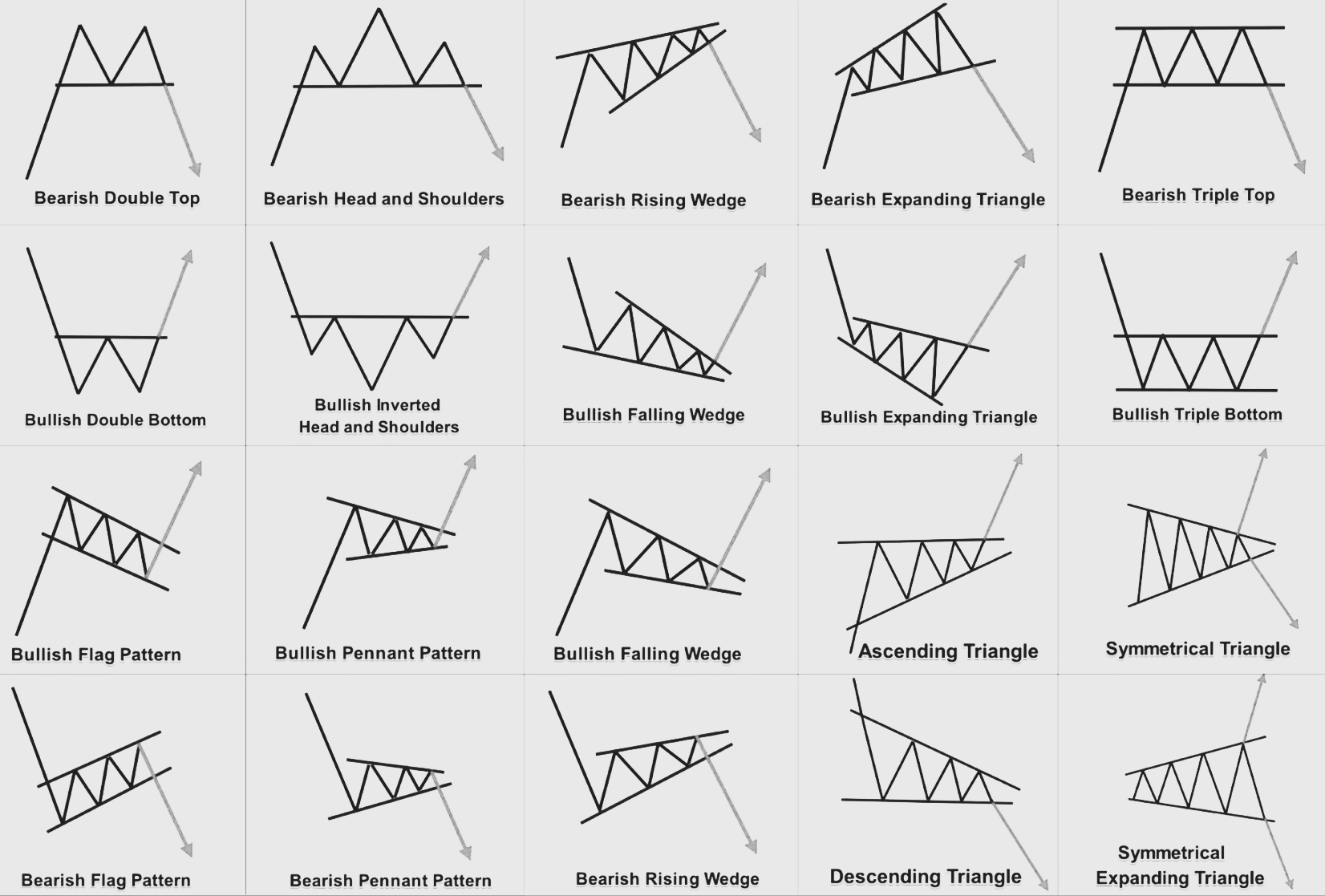
Reversal Patterns
Reversal patterns signal that the current trend may be running out of steam and prepare traders for a potential shift in direction. In crypto, where sentiment turns quickly, these formations can be some of the most valuable signals on the chart.
Head and Shoulders / Inverse Head and Shoulders
The Head and Shoulders (H&S) is one of the most recognized bearish reversal formations. It appears after an uptrend and consists of three peaks: the middle peak (the head) is higher than the two outside peaks (the shoulders), with a neckline connecting the lows. Once the neckline breaks, the pattern suggests the trend is reversing to the downside. Volume often decreases on the right shoulder, showing waning buyer interest. Traders typically short or exit long positions on the neckline break, placing a stop above the right shoulder and targeting a decline equal to the distance from the head to the neckline.
The Inverse Head and Shoulders is its bullish counterpart, forming after a downtrend. Instead of peaks, it features three troughs, with the middle being the lowest. A breakout above the neckline confirms the shift to the upside. Historical tests suggest this pattern has one of the highest success rates in crypto, around 84 percent.
Double Top / Double Bottom
Double Tops signal bearish reversals after extended rallies. The pattern forms when price tests a resistance level twice but fails to break through, creating an “M” shape. Confirmation comes when price breaks below the neckline, triggering a sell signal. Traders often set profit targets based on the vertical distance between the peaks and neckline.
Double Bottoms are bullish, appearing after downtrends in a “W” shape. The price tests support twice before bouncing higher. A breakout above the neckline indicates a reversal, with profit targets measured from the troughs to the neckline. Double Bottoms have tested at around 82 percent reliability, making them favorites among traders.
Triple Tops / Bottoms and Rounded Patterns
Triple Tops and Triple Bottoms are extensions of the double variations. Price tests resistance or support three times before reversing. Though less common, they add weight to the idea that a level has been firmly rejected. Rounded Tops and Rounded Bottoms are slower to form and represent gradual shifts in sentiment. A rounded bottom often signals accumulation and the early stages of a bullish cycle, while a rounded top shows distribution before a decline.
Wedges
Wedges represent compression before a breakout. A Rising Wedge typically forms during an uptrend with converging higher highs and higher lows. Momentum slows, and the pattern often breaks downward, signaling a bearish reversal. A Falling Wedge shows converging lower highs and lower lows during a downtrend, suggesting selling pressure is fading. This setup frequently leads to a bullish breakout. In crypto, Falling Wedges are often spotted near market bottoms, offering traders attractive entry points.
Why Reversal Patterns Matter
Among all reversal setups, the Inverse Head and Shoulders has historically been the most reliable in crypto, with success rates near 84 percent. Double Bottoms and classic Head and Shoulders patterns also score above 80 percent in backtests. While these figures are encouraging, traders must remember that no pattern guarantees an outcome. The strength of a reversal often depends on volume, timeframe, and external market conditions. Used with proper risk management, reversal patterns give traders a structured way to spot shifts that might otherwise be missed in volatile markets.
Continuation Patterns
Continuation patterns occur when the market pauses before resuming its existing trend. They reflect periods where buyers and sellers reach a temporary balance, creating a consolidation zone. Once resolved, the price often continues in the same direction, giving traders an opportunity to join an ongoing trend with defined risk.
Flags and Pennants
Flags and Pennants are among the most reliable continuation setups. Both form after a sharp price movement, known as the flagpole. A Flag resembles a small rectangle that slopes slightly against the main trend. A Pennant looks more like a miniature triangle formed by converging trendlines.
The logic behind both patterns is straightforward: after a strong move, traders take profits and new participants enter, causing a short pause before the trend continues. Breakouts typically occur in the direction of the original move, often with volume spikes confirming renewed momentum. For example, Bitcoin’s rallies in late 2020 repeatedly produced bull flags on the daily chart, each signaling further upside that played out as the bull market unfolded.
Triangles
Triangles are another common continuation structure, formed by converging price action.
- Ascending Triangle: Defined by a flat resistance line and rising support. This is usually bullish, as buyers consistently step in at higher levels until resistance finally breaks. Ethereum displayed ascending triangles throughout 2024, many of which resolved upward after periods of consolidation.
- Descending Triangle: Characterized by a flat support line and falling resistance. It usually signals bearish continuation, with sellers gradually overwhelming buyers until support gives way. Altcoins like XRP have historically formed descending triangles during broader market sell-offs.
- Symmetrical Triangle: Both trendlines converge toward the apex without a clear bias. Although technically bilateral, in strong trends they often act as continuation patterns. Bitcoin has produced symmetrical triangles on the four-hour chart that resolved in the direction of the prevailing move.
Channels
Channels represent steady, trend-aligned trading ranges where price oscillates between two parallel lines.
- Channel Up: Price makes higher highs and higher lows while staying within upward-sloping parallel lines. Traders often buy near the lower boundary and take profits near the upper line. Breakouts above resistance can signal an acceleration of the trend.
- Channel Down: Price forms lower highs and lower lows inside downward-sloping lines. Traders typically short near the upper boundary or wait for breakdowns below support.
Why Continuation Patterns Matter
Continuation patterns give traders structured entry points within existing trends. They are not as dramatic as reversals, but they often provide cleaner setups with manageable risk. In fast-moving crypto markets, spotting a flag or triangle consolidation can be the difference between chasing a move and entering before the next leg higher (or lower). Proper confirmation (especially volume) remains essential, but once validated, continuation patterns are some of the most reliable tools in a trader’s playbook.
Bilateral Patterns
Bilateral patterns are unique because they don’t give a clear directional bias. Instead, they highlight indecision in the market, showing that price is compressing toward a point where pressure must eventually resolve. These setups can lead to strong breakouts in either direction, but only after confirmation.
Symmetrical Triangles
The most common bilateral formation is the Symmetrical Triangle, where price moves between two converging trendlines. Neither buyers nor sellers are in clear control, and momentum gradually shrinks. When the breakout comes, it is often sharp, as traders rush to catch the move. Bitcoin’s four-hour charts often show symmetrical triangles that break upward during bull runs but can just as easily break down in bearish conditions. The key is not to assume direction but to wait for the breakout and confirm with volume.
Diamonds and Rare Structures
Another bilateral setup is the Diamond pattern, formed by expanding then contracting price action that resembles a diamond shape. It’s less common in crypto but does appear at market tops or after extended runs. Breakouts from Diamonds can be powerful, though the direction varies, making confirmation especially critical. Other rare bilateral structures include expanding triangles, which widen over time and signal rising volatility without a directional clue.
The Role of Confirmation
What separates bilateral patterns from reversal and continuation ones is uncertainty. A trader who jumps in before confirmation risks getting caught on the wrong side of the move. Volume surges and candle closes outside the pattern are often used as confirmation triggers. In volatile crypto markets, where false breakouts are frequent, this extra layer of caution can mean the difference between catching a trend early or being trapped in a reversal.
Other Notable Patterns
Not every pattern fits neatly into reversal, continuation, or bilateral categories. Some structures are less common but still play a role in crypto trading, especially when combined with broader market context.
Cup and Handle
The Cup and Handle is a bullish continuation setup. It starts with a rounded “cup” shape formed after a gradual decline and recovery, followed by a short pullback that forms the “handle.” When price breaks above the handle’s resistance, the move often extends higher. The psychology is simple: traders who held through the base regain confidence as the price recovers, while the small pullback shakes out weak hands before the breakout. This pattern was visible in Ethereum’s 2020 recovery phase before its strong move to new highs.
Harmonic Patterns
Another group of structures worth noting are Harmonic Patterns, which use Fibonacci ratios to map out potential reversal zones.
- ABCD Pattern: A basic four-leg structure signaling potential turning points when Fibonacci ratios align.
- Gartley and Butterfly: More advanced versions, with additional legs and ratio rules that attempt to forecast precise reversal levels.
These patterns are not as widely used as flags or triangles, partly because they require more complex measurements and subjective interpretation. However, some crypto traders rely on them to identify high-probability entries, especially on higher timeframes.
Where They Fit in Crypto
Cup and Handle formations are relatively straightforward and align well with crypto’s momentum-driven rallies. Harmonic patterns, while niche, appeal to traders who prefer a rules-based, mathematical approach. They may not appear as often as wedges or channels, but when they do, they can provide unique insights into potential reversals or continuation points. In practice, they tend to be used alongside more traditional technical analysis tools to strengthen conviction.
How to Trade Crypto Chart Patterns
Chart patterns can be approached in two main ways: trading them while they are still forming or waiting for the breakout to be confirmed. Each approach has different levels of risk and reward.
Breakout vs. Emerging Setups
Some traders enter positions before a pattern completes, anticipating where the price will break. This can offer a better entry but carries the risk of false signals. Others wait for a confirmed breakout beyond support or resistance, usually backed by higher volume. The latter method reduces risk but may mean entering slightly later. In crypto, where false breakouts are common, confirmation often saves traders from losses.
Using Indicators for Confirmation
Patterns are stronger when supported by technical indicators.
- Relative Strength Index (RSI) can show whether momentum aligns with the breakout direction. For example, a head and shoulders breakdown becomes more convincing if RSI is also trending lower.
- MACD crossovers help identify shifts in momentum that validate continuation or reversal signals.
- Moving averages can act as dynamic support or resistance, giving further weight to breakout moves when the price closes above or below them.
Entry, Stop-Loss, and Take Profit
Sound trade management is as important as spotting the pattern itself. A typical entry point is just beyond the breakout level, ideally confirmed by volume. Stop-loss orders are usually placed inside the pattern structure, limiting losses if the breakout fails. For example, in a flag breakout, stops are often set just below the flag’s lower boundary. Take profit levels can be estimated using the “measured move” technique, projecting the height of the pattern from the breakout point.
Aligning with the Trend
The strongest setups are those that align with the broader market trend. A bullish continuation pattern during an uptrend has a higher chance of success than the same pattern in a bearish environment. Traders often use higher timeframes to establish trend direction and then apply patterns on lower timeframes for entries. For instance, spotting an ascending triangle on the daily Bitcoin chart while the weekly chart shows clear bullish momentum provides stronger conviction than relying on the smaller pattern alone.
In practice, combining pattern recognition with broader context, confirmation tools, and risk management is what turns chart patterns from visual guides into actionable strategies.
Tools and Platforms
Trading patterns effectively requires reliable charting tools. The most widely used option is TradingView, which offers extensive indicators, drawing tools, and a large community of traders who share setups. Most major exchanges also provide integrated charting. Binance, KuCoin, and Coinbase each have built-in charts, though they are often more limited than TradingView. For quick checks while trading directly on an exchange, they work well, but serious analysis usually benefits from a dedicated platform.
Automated scanners are another useful category of tools. Some platforms allow traders to scan the market for specific setups like triangles, flags, or breakouts in real time. These tools save time by filtering hundreds of assets and highlighting those that match defined criteria. Other scanners focus on momentum, RSI conditions, or volume spikes, which can help confirm emerging patterns.
Most platforms also allow traders to set alerts, so they are notified when price reaches key levels. For instance, an alert can be set at the neckline of a head and shoulders pattern, or at the breakout level of a triangle. This ensures traders don’t need to constantly watch the charts.
Finally, many exchanges and platforms offer demo accounts or paper trading features. These let users practice identifying and trading chart patterns without risking real capital. For those new to technical analysis, it’s a practical way to build confidence and test strategies before committing funds.
Common Mistakes and How to Avoid Them
One of the biggest pitfalls in trading chart patterns is entering positions without proper confirmation. Jumping in before a breakout is validated often leads to losses when price reverses. Waiting for a decisive close beyond support or resistance, ideally with volume backing, reduces this risk.
Ignoring volume is another frequent mistake. A breakout without increased volume is less trustworthy and often turns into a false move. Volume serves as a vote of confidence in the price direction, and neglecting it weakens the reliability of any pattern.
Many traders also fall into the trap of overtrading, especially in crypto’s volatile markets. False breakouts are common, and chasing every setup quickly leads to losses and emotional decision-making. Sticking to a clear strategy, only trading high-quality setups, and managing position size can prevent this.
In addition to this, in today’s markets, “Liquidity Hunts” or “Wicks” are increasingly common. A pattern like a Bull Flag often sees a temporary 2-3% drop below support to trigger stop-losses before the actual breakout. Wait for a 4-hour candle to close above the resistance line before entering, rather than trading the touch.
Finally, some traders overcomplicate their charts by adding too many indicators. While indicators like RSI, MACD, or moving averages are helpful, using too many at once creates conflicting signals and confusion. Simplicity usually works best; focus on a few tools that complement chart patterns rather than cluttering the analysis.
Avoiding these mistakes comes down to patience, discipline, and a willingness to treat chart patterns as probabilities, not certainties. Success in pattern trading is less about spotting every formation and more about filtering for the ones that align with broader context and sound risk management.
Practical Tips for Beginners
Chart patterns can be overwhelming at first, but starting simple helps build confidence and consistency. Patterns such as the Inverse Head and Shoulders or the Falling Wedge appear frequently in crypto markets and are easier to recognize. They also carry relatively high reliability compared to more complex harmonic structures.
Timeframes make a big difference. Shorter charts like the 5-minute or 15-minute windows are often noisy and prone to false signals. Beginners get better results by sticking to the daily (1D) and 4-hour (4H) charts, which filter out most of the volatility and highlight clearer setups. Once you develop more experience, intraday trading becomes less risky.
Risk management cannot be skipped. Setting stop-losses below the neckline or trendline protects your capital from sharp reversals. Keeping position sizes small (only risking a fraction of your portfolio on a single trade) ensures one mistake does not wipe out weeks of progress. Successful pattern trading is less about winning every trade and more about preserving capital until the profitable setups arrive.
Finally, practicing in a safe environment is worth the time. Most platforms and charting tools offer demo accounts or paper trading features. These allow you to test pattern recognition and trade execution without risking money. Once you feel comfortable, gradually transition into live trading with modest amounts. This approach creates the foundation for disciplined, long-term success in crypto pattern trading.
Conclusion
Chart patterns remain one of the most practical tools for navigating crypto’s unpredictable markets. They give traders a structured way to interpret price action and to anticipate where supply and demand might shift. Used correctly, patterns provide a trading edge by helping filter noise and highlight higher-probability setups.
The process is part art and part science. Recognizing patterns relies on careful observation and experience, while confirming them demands measurable signals such as volume, momentum indicators, or moving averages. This blend prevents traders from relying solely on intuition or, on the other hand, becoming paralyzed by overanalysis.
Risk management is what ties everything together. Even the most reliable patterns fail, and traders who survive those failures are the ones who treat capital preservation as a priority. Stop-loss orders, modest position sizing, and patience ensure that the next opportunity can be taken without hesitation.
The final takeaway is simple: chart patterns are about probabilities, not guarantees. They tilt the odds in your favor, but they don’t eliminate uncertainty. Consistent practice, reflection on past trades, and steady refinement of your approach make the difference between treating patterns as gimmicks and turning them into a lasting part of a disciplined trading strategy.
Frequently Asked Questions (FAQ)
Is crypto technical analysis the same as in stocks or forex? +
The core principles are the same, since all markets rely on price, volume, and trader psychology. The difference is that crypto trades 24/7 and often shows sharper volatility, which makes patterns form and resolve faster than in traditional markets.
Which chart patterns work best in crypto? +
Patterns with clear symmetry and volume confirmation tend to be more reliable. Examples include inverse head and shoulders, falling wedges, and ascending triangles. These have historically shown higher success rates on Bitcoin and major altcoins, while exotic harmonic patterns require more experience.
How do I confirm a breakout? +
Confirmation usually comes from a strong candle close outside the pattern’s boundary, supported by higher-than-average volume. Indicators such as RSI and MACD can add confidence, but price and volume remain the primary signals.
Are chart patterns enough to trade profitably? +
Patterns provide probabilities, not guarantees. They should be combined with broader analysis, such as trend direction, support and resistance zones, and risk management. Many traders use them alongside moving averages or momentum indicators.
Do patterns work better on Bitcoin than altcoins? +
Bitcoin and Ethereum often respect patterns more consistently because of higher liquidity and market participation. Altcoins can produce sharper breakouts but also more false signals, making risk management even more important.
What timeframe should beginners focus on? +
The 1-day and 4-hour charts strike a balance between noise and reliability. Shorter timeframes like 5- or 15-minute charts move quickly and can mislead beginners, while weekly charts may be too slow for those learning actively.
How accurate are chart patterns in crypto? +
Historical studies show varied success rates. For example, inverse head and shoulders patterns succeed more than 80% of the time when confirmed. Other patterns, such as symmetrical triangles, may only play out as expected about 50% of the time. The key is discipline in applying stop-losses.
Can AI or scanners identify patterns automatically? +
Yes, many platforms like TradingView and altFINS offer automated pattern recognition. These tools can save time, but traders should still verify signals manually to avoid relying on software that may mislabel complex structures.