


 Buy a Licensed Company
  Explore VASP Data
  Talk to an Expert

 Atis Shala
Atis is a senior analyst and community lead with four years of experience in crypto. He has a bachelor from the Rochester Institute of Technology.
Atis Shala
Atis is a senior analyst and community lead with four years of experience in crypto. He has a bachelor from the Rochester Institute of Technology.
Crypto Insurance: How to Protect Your DeFi Portfolio
- The maturation of decentralized finance demands a shift from pure speculation to active risk management against prevalent threats like smart contract vulnerabilities and exchange failures.
- Crypto insurance utilizes automated smart contracts and transparent liquidity pools to offer faster claim payouts and publicly auditable reserves compared to traditional insurance models.
- Investors can purchase specific coverage types to protect against distinct failure modes ranging from stablecoin de-pegging and validator slashing to centralized custodian insolvency.
- Anyone can act as an underwriter by depositing capital into permissionless liquidity pools to earn a share of policyholder premiums while accepting the associated payout risks.
- Claim approvals rely on either decentralized governance votes for nuanced human review or parametric oracles for instant algorithmic payouts.
- The industry still faces significant challenges with coverage capacity shortages during high demand and correlated systemic risks that could threaten the solvency of the insurance pools themselves.
DeFi’s Billion-Dollar Problem
Decentralized finance promised a financial system without gatekeepers, where smart contracts replaced banks and anyone with a wallet could earn yield. That promise attracted trillions of dollars in capital. It also attracted thieves, opportunists, and unforeseen catastrophes that wiped out fortunes overnight.
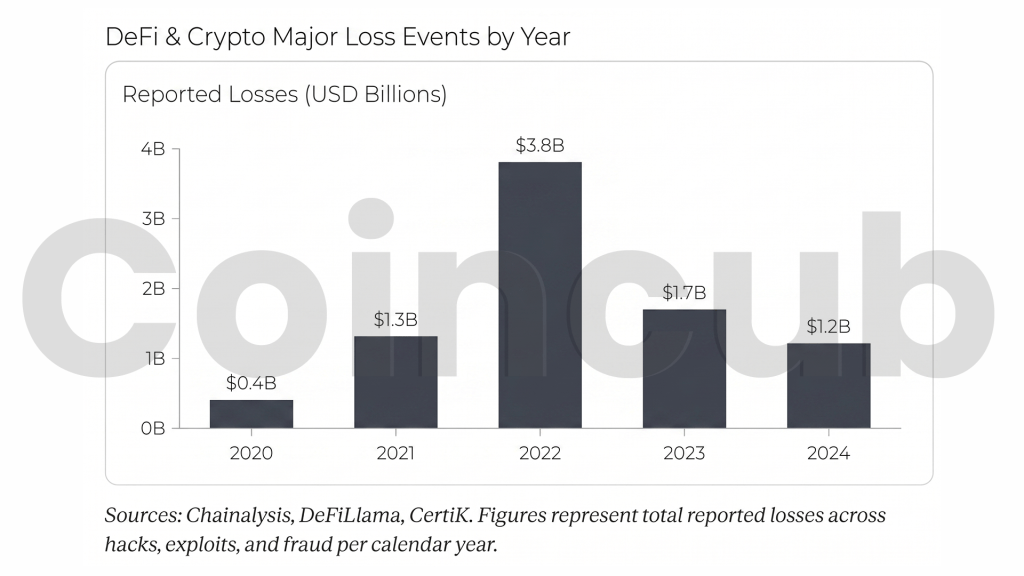
Since 2020, more than $7 billion has been lost to protocol hacks, rug pulls, and contract exploits across major blockchain networks. Some of the most trusted names in the space, from Ronin Network to Euler Finance, have been drained in hours. In traditional markets, a bank robbery is front-page news. In DeFi, nine-figure hacks have become monthly news items.
The culture is shifting. The early “degen” ethos of chasing 10,000% APY with no questions asked is giving way to a more disciplined mindset. Participants who want to build generational wealth onchain are beginning to think like investors rather than speculators. Capital preservation has entered the conversation, and with it, a fundamental question that traditional finance answered decades ago: what happens when something goes wrong?

That question is precisely where crypto insurance enters the picture. Crypto insurance is a financial protection mechanism, typically delivered via decentralized protocols, that compensates policyholders for losses caused by predefined onchain events such as smart contract exploits, exchange insolvencies, or stablecoin de-pegging.
It will not make DeFi risk-free. Nothing will. But it gives serious participants a tool to stay solvent when the unexpected happens, and it is rapidly becoming one of the most important components of a mature onchain portfolio strategy.
The Risk Landscape: Why You Need Protection for Your Crypto
Before choosing a policy, you need to understand exactly what you are protecting yourself against. The threat surface in DeFi is broader and more unpredictable than most participants realize, and each category of risk has its own character, frequency, and financial severity.
Smart Contract Vulnerabilities
Every DeFi protocol runs on code, and code has bugs. Smart contract vulnerabilities represent the most common and financially devastating category of loss in the ecosystem. These are flaws in a protocol’s logic, such as reentrancy attacks, flash loan manipulations, or integer overflow errors, that allow malicious actors to drain funds in a single transaction. The Euler Finance hack in March 2023 exploited a flash loan vulnerability to steal approximately $197 million in minutes. Even audited protocols are not immune; auditors can only verify code against known patterns, not unknown future attack vectors.
Protocol Hacks and Rug Pulls
External attacks and internal fraud represent two distinct but equally dangerous threats. A protocol hack involves an outside party exploiting a weakness in the system. A rug pull is an inside job where founders abandon the project and take user funds with them, having either built fraudulent tokenomics from the start or retained control over a critical admin key. The Frosties NFT rug pull and the Squid Game token collapse in 2021 were two of the more notorious examples, but the pattern repeats itself dozens of times each year with lesser-known projects.
Stablecoin De-Pegging
The collapse of TerraUSD (UST) in May 2022 erased approximately $40 billion in value within 72 hours and demonstrated that so-called “stable” assets carry their own unique existential risks. Algorithmic stablecoins maintain their peg through incentive mechanisms rather than direct collateral, and when confidence breaks down, the spiral can be irreversible. Even fully-collateralized stablecoins are not immune. In March 2023, USDC briefly de-pegged to $0.87 following the collapse of Silicon Valley Bank. While it recovered quickly, holders who needed liquidity during that window experienced real loss.
Exchange Failures
Centralized exchanges hold enormous onchain assets on behalf of their users. The FTX collapse in November 2022, which exposed an $8 billion shortfall in customer funds, became the most significant financial scandal in the history of crypto and affected hundreds of thousands of retail users who had done nothing wrong beyond trusting a centralized custodian. Even well-capitalized, regulated exchanges can freeze withdrawals, become insolvent, or suffer internal fraud.
Crypto vs. Traditional Insurance: What’s the Difference?
Most people’s mental model of insurance comes from health, auto, or property coverage: fill out a form, wait weeks for an adjuster, argue about the payout, and eventually receive a check. Crypto-native insurance protocols are built on fundamentally different architectural assumptions.
Efficiency Through Automation
In traditional insurance, a valid claim can take between 30 and 180 days to process due to manual review, documentation requirements, and legal disputes. DeFi insurance protocols, built on smart contracts, can trigger automatic payouts within hours of a qualifying event being verified. Some protocols use onchain oracle data to confirm an exploit occurred, bypassing human decision-making entirely for clearly defined trigger events.
Transparency by Default
A traditional insurer’s capital reserves and claims history are largely opaque to the average policyholder. Onchain insurance pools are fully auditable by anyone with an internet connection. You can verify, in real time, whether the protocol has sufficient funds to cover outstanding policies before you purchase a single token of coverage.
The Permissionless Factor
Anyone who holds capital can act as a liquidity provider to an insurance pool, earning a share of premiums paid by policyholders. There are no licensing requirements, background checks, or minimum capital thresholds set by a regulator. This creates a more competitive, globally accessible market for both buyers and sellers of risk.
Crypto Insurance vs. Traditional Insurance
| Factor | Crypto Insurance | Traditional Insurance |
| Premium Cost | 1-5% annually, algorithmically priced | Varies; set by actuarial tables and underwriters |
| Payout Speed | Hours to days via smart contract | 30-180 days via manual review |
| Eligibility | Permissionless; wallet address sufficient | Requires identity, underwriting approval |
| Reserve Transparency | Fully onchain, readable in real time | Limited; governed by regulatory disclosure |
| Participation Model | Open two-sided market (buy or provide) | Institutional only; consumers are buyers only |
The Pillars of Coverage: Types of DeFi Insurance
DeFi insurance is not a monolithic product. Because the risk landscape is so varied, the ecosystem has evolved a range of specialized coverage types, each targeting a distinct failure mode.
Smart Contract Cover
The foundational product of the DeFi insurance market. Protects against direct financial losses resulting from exploits of a specific protocol’s smart contract code. Coverage is tied to a named protocol at a named address, so you must purchase separate cover for each protocol you are exposed to. Most major providers offer this as their primary product.
Slashing Cover
Designed for validators and liquid staking participants on proof-of-stake networks like Ethereum. Validators who behave maliciously or go offline at critical moments are “slashed,” meaning a portion of their staked ETH is forcibly removed. Slashing cover compensates stakers for these penalties, making it essential for any participant running a validator or using a liquid staking protocol like Lido or Rocket Pool.
De-Peg Cover
Specifically addresses the risk of a stablecoin losing its intended price anchor. Most de-peg policies activate when a covered stablecoin trades below a defined threshold (commonly $0.95) for a sustained period. The UST collapse and the USDC wobble of March 2023 dramatically increased demand for this product. It is highly relevant for users who hold large stablecoin positions as a “safe haven” within their DeFi strategy.
Custody Cover
Protects funds held with centralized custodians, including major exchanges like Coinbase, Binance, or Kraken, as well as institutional custody providers. The FTX collapse made this category impossible to ignore. Custody cover typically activates in the event of exchange insolvency, withdrawal freezes, or large-scale theft from the custodian’s hot wallets.
Yield Token Cover
The most complex coverage category, designed for “money lego” strategies where yield is generated by stacking multiple protocols. A single position might involve depositing into Curve, receiving an LP token, depositing that into Convex, and staking the resulting token elsewhere. If any layer in this stack fails, the entire position can unwind catastrophically. Yield token cover provides protection across the full stack rather than a single protocol.
The key insight here is that your risk exposure is rarely limited to a single category. A user participating in liquid staking, holding their returns in a stablecoin on a centralized exchange, is simultaneously exposed to slashing risk, de-peg risk, and custody risk. A comprehensive insurance strategy accounts for each layer.
How Do DeFi Insurance Protocols Work?
Unlike a traditional insurance company that holds its own capital, most DeFi insurance protocols pool liquidity from external contributors. Anyone can deposit funds into a coverage pool, effectively becoming an underwriter. In exchange, LPs earn a share of the premiums collected from policyholders on an ongoing basis. The trade-off is clear: if a valid claim is filed and approved, the LP’s deposited capital is used to pay it out. LPs are therefore incentivized to be selective about which pools they fund, favouring protocols with strong audit histories and low historical exploit rates.
Risk Assessment and Premium Pricing
The cost of a policy is determined by a risk scoring algorithm. Inputs typically include the protocol’s audit history, the total value locked relative to the insurance pool’s capacity, the historical exploit record, and the age of the codebase. A newly launched, unaudited protocol might carry a 10-15% annual premium. A long-established, multiply-audited protocol with no exploit history might be insured for under 2%.
Claims Assessment
There are two primary models in use today. The DAO governance model, used by Nexus Mutual, requires token holders to review and vote on whether a claimed event meets the policy’s conditions. This introduces nuance but can cause delays. The parametric oracle model, used by protocols like Risk Harbor, bypasses human voting entirely. If onchain oracle data confirms that a predefined trigger event occurred, the smart contract automatically releases funds to the policyholder, trading judgment for speed.
The Math of Solvency
Protocols manage catastrophic risk through a capital ratio requirement, ensuring that the total coverage issued never exceeds a defined multiple of the capital in the pool. If a protocol requires a 150% capital ratio and there is $100 million in the pool, the maximum coverage that can be issued is $66.7 million. When pool utilization approaches the limit, new policies become unavailable or prohibitively expensive.
The Major Players: Top Crypto Insurance Protocols
Nexus Mutual: Industry Leader
Nexus Mutual pioneered the mutual model for onchain insurance, structuring itself as a member-owned entity where NXM token holders collectively underwrite and govern claims. It offers the broadest coverage catalog in the market and the longest track record in the space.
- Pros: Widest protocol coverage list. Member-owned governance. Strong audit partnerships. Proven claims history.
- Cons: KYC required for membership. DAO vote claims can be slow. NXM token required for governance participation.
InsurAce Protocol: Multi-Chain
InsurAce was designed from the ground up for a multi-chain world, offering coverage across Ethereum, BNB Chain, Polygon, Avalanche, and several other networks. Its portfolio-level cover allows users to protect multiple positions in a single bundled policy.
- Pros: No KYC required. Portfolio-bundled policies. Competitive premiums. Strong multi-chain reach.
- Cons: Smaller liquidity pool than Nexus Mutual. Coverage for niche protocols can be limited.
Unslashed Finance: Institutional Grade
Unslashed Finance positions itself at the institutional end of the market, offering high-capacity coverage including some of the deepest de-peg cover pools available. Its architecture focuses on continuous coverage that auto-renews rather than requiring annual repurchase.
- Pros: High coverage capacity for large positions. Strong de-peg product depth. Suited for institutional deployments.
- Cons: Higher minimum coverage amounts. Less retail-friendly interface. More limited protocol coverage list.
Risk Harbor: Algorithmic
Risk Harbor’s core innovation is the elimination of human judgment from the claims process. Using onchain oracles and pre-defined parametric triggers, it processes claims automatically without any governance vote, making payouts faster and removing the risk of a biased committee.
- Pros: Fully automated, objective claims. Near-instant payouts on valid claims. Transparent onchain trigger logic.
- Cons: Rigid trigger definitions may miss valid edge-case claims. Narrower coverage catalog. Relies on oracle integrity.
The Buyer’s Guide: How to Choose a Policy
Cost vs. Coverage
Annual premiums of 2-5% are worth absorbing when the underlying protocol handles significant capital. For smaller positions below $5,000, the premium cost often outweighs the benefit unless risk is highly concentrated. Prioritize covering your largest and least-liquid positions first.
Reading the Fine Print
Confirm exactly what constitutes a valid claim before purchasing. Smart contract cover often excludes UI-layer attacks (where a front-end website is compromised rather than the underlying contract), oracle manipulation in isolation, and economic design failures that are not technically a “hack.”
3-Step Checklist for Purchasing Cover
- Quantify your exposure. Calculate the USD value of each position and identify which risk category applies: smart contract, de-peg, custody, or slashing.
- Compare at least two protocols. Visit Nexus Mutual and InsurAce as a starting point, enter the target protocol address, and compare quoted premium and available capacity.
- Confirm, purchase, and record. Verify the pool’s capital ratio is healthy. Save your policy certificate or transaction hash. Set a calendar reminder to renew before expiry.
Current Limitations and the Future of Onchain Safety
The most frequently encountered limitation is simple unavailability. When a high-profile protocol becomes particularly popular, demand for coverage can outstrip the pool’s capital, making new policies temporarily unavailable or priced at a punishing premium. This tends to worsen precisely when market uncertainty is highest and coverage is most desired.
Correlated Risk
DeFi insurance protocols carry a structural irony: their own capital is often deployed in DeFi to generate yield for LPs. If a systemic market collapse simultaneously devalues the insurance pool’s assets and triggers mass claims, even a well-capitalized protocol can become insolvent. This correlated risk problem remains the most serious unresolved challenge in the space. Regulatory maturity, deeper liquidity, and reinsurance partnerships will be necessary before this gap is fully addressed.
Insurance is not an expense. It is the price of staying in the game long-term. The participants who will build generational wealth onchain are not the ones who took the most risk; they are the ones who took intelligent risk and had a plan when things went wrong.
The future of onchain safety looks meaningfully brighter than the present. Coverage capacity is growing as institutional capital enters the LP side of the market. Parametric trigger models are becoming more sophisticated, reducing disputes and payout delays. And cross-chain insurance products are beginning to reflect the reality of how modern DeFi portfolios are actually structured, spread across a dozen networks and protocols simultaneously.
DeFi is growing up. The infrastructure around it is growing up with it. Crypto insurance will not eliminate risk from decentralized finance, but it will ensure that a single bad event does not have to end your participation in it.
Frequently Asked Questions (FAQs)
Is there any insurance for cryptocurrency?
Yes, crypto insurance exists. Decentralized protocols and specialized providers offer coverage against smart contract exploits, stablecoin de-pegging, and exchange insolvency. Users pay premiums to protect their digital assets from unforeseen technical failures or malicious on-chain attacks.
Is stolen crypto recoverable?
Recovering stolen cryptocurrency remains highly unlikely. Blockchain transactions are immutable, meaning victims cannot reverse unauthorized transfers. While law enforcement occasionally seizes stolen funds from centralized exchanges, prevention and comprehensive insurance policies provide the most reliable financial protection.
What is the safest way to protect my crypto?
The safest approach combines secure hardware cold storage with robust DeFi insurance. Hardware wallets keep private keys offline, preventing digital theft. Insurance policies cover residual systemic risks, including smart contract vulnerabilities, exchange failures, and stablecoin de-pegging events.
What is DeFi insurance?
DeFi insurance functions as a decentralized financial safety net. Smart contract protocols automatically compensate policyholders for specified on-chain losses. Liquidity providers supply the underwriting capital, while users purchase policies to hedge against hacks, slashing penalties, and custodian insolvency.
Who are the three biggest DeFi insurance platforms?
The three leading decentralized insurance platforms are Nexus Mutual, InsurAce Protocol, and Unslashed Finance. Nexus Mutual dominates with member-owned governance, InsurAce excels at multi-chain coverage, and Unslashed Finance provides high-capacity, institutional-grade protection for massive digital asset portfolios.