Buy a Licensed Company
  Explore VASP Data
  Talk to an Expert

 Atis Shala
Atis is a senior analyst and community lead with four years of experience in crypto. He has a bachelor from the Rochester Institute of Technology.
Atis Shala
Atis is a senior analyst and community lead with four years of experience in crypto. He has a bachelor from the Rochester Institute of Technology.
5 NFT Use Cases That Will Rule the Crypto Market in 2026
Key Takeaways
- Web3 games will formalize digital ownership by integrating NFTs as functional in-game assets rather than relying on pure speculation.
- Ticketing platforms will deploy programmable NFTs to eliminate fraud and transform disposable barcodes into persistent, rewarding relationships between organizers and fans.
- Forward-thinking brands will replace static reward points with dynamic membership tokens that unlock exclusive perks and drive continuous community engagement.
- Manufacturers will anchor trust in physical commerce by utilizing onchain digital twins to verify provenance, prevent counterfeiting, and track product lifecycles.
- Wallet-native identity layers will allow users to securely control and transport their professional histories, educational records, and digital reputations across the internet.
Are NFTs Dead?
NFTs are not dead. The lazy version of NFTs is dead.
The era when a project could slap a cartoon image on a token – on Ethereum, Sui, Solana, or Avalanche -, promise “community,” and expect the market to carry it forever is mostly over, just like the memecoin craze in the last two years. What is replacing it is far more interesting: NFTs that do something. In late 2025, DappRadar described the sector as moving “beyond JPEGs,” with momentum returning through utility, stronger onchain communities, and real-world use cases rather than pure speculation. At the same time, platforms like Ticketmaster, Shopify, and Immutable were all pushing NFT-linked access, commerce, or gaming infrastructure in ways that look much closer to products than hype cycles.

That is the right lens for 2026. The NFT projects that matter most will not win because they are rare. They will win because they verify ownership, unlock access, authenticate products, preserve credentials, or power digital economies that users actually want to participate in. In other words, the next NFT bull case is infrastructure.
So if you are trying to figure out where NFTs are headed next, stop asking which collection will moon and start asking which use cases solve recurring problems at internet scale. That is where the 2026 story gets interesting.
Why NFTs Are Entering a New Phase in 2026
The market has already started separating collectible noise from durable utility. That does not mean speculation disappears; crypto never works that way. It means the strongest NFT categories increasingly look like access layers, ownership rails, and verification tools. DappRadar’s 2025 reporting pointed in exactly that direction, framing NFTs as more accessible, utility-driven, and brand-connected, while Shopify continued expanding token-gated retail tooling and Immutable kept scaling infrastructure for Web3 games.
Another reason 2026 matters is that the user experience is slowly getting less awful. Immutable said its Passport product passed 4 million sign-ups in 2024, which matters because mass NFT adoption depends less on ideology than on whether people can use these systems without feeling like they are filing taxes onchain. When wallets, sign-ins, and rewards get abstracted away, NFTs stop feeling like “crypto products” and start feeling like features.
That is why the next winners are likely to come from areas where ownership and access already matter: games, events, loyalty, authenticity, and credentials. Those are all markets where a persistent, transferable, programmable digital item actually makes more sense than a siloed database entry.
NFT In-Game Assets and Web3 Gaming Economies
If one NFT category has the clearest path to dominating 2026, it is gaming.
The reason is simple. Gaming already has digital scarcity, virtual economies, collectible items, and passionate secondary-market behavior. NFTs do not need to invent demand there; they just formalize ownership. A skin, character, weapon, land parcel, or tournament badge already has value inside a game economy. Turning that item into an NFT gives players clearer ownership, developers programmable rules, and marketplaces a native asset layer. Whether every game needs that is another question. But gaming is the one category where the core logic is immediately intuitive.
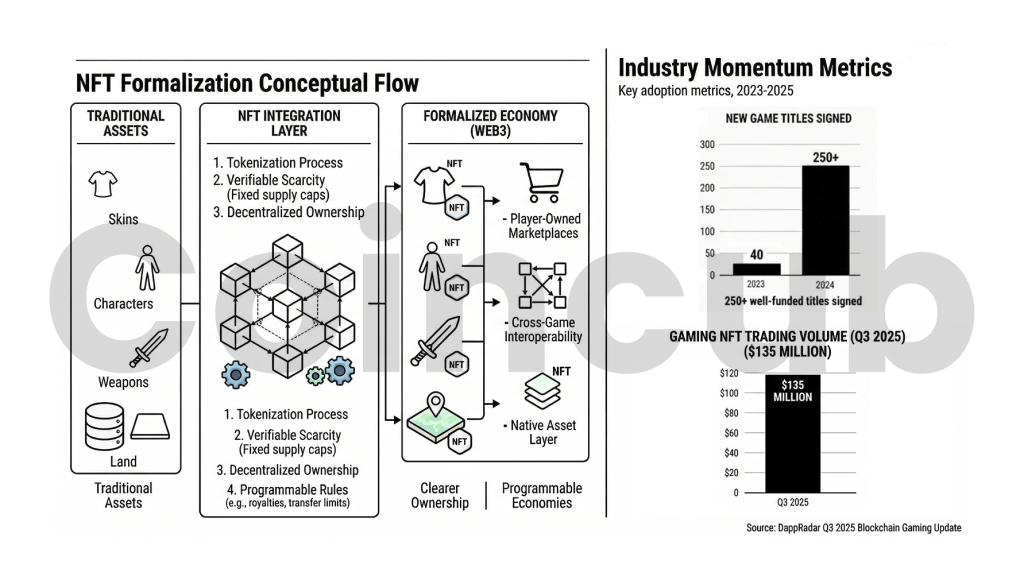
The current momentum supports that view. Immutable said it signed more games in 2024 than in all prior years combined, adding 250+ well-funded titles, and also said Immutable Passport crossed 4 million sign-ups in the same year. DappRadar’s May 2025 games report said gaming remained the most dominant category in the dapp industry, and its Q3 2025 blockchain gaming update reported $135 million in gaming NFT trading volume for the quarter. Those numbers do not prove that every Web3 game will work, but they do show that gaming is still the deepest NFT experimentation zone.
Gaming Through NFTs
The smarter 2026 gaming projects will probably not lean on the old “play-to-earn fixes everything” script. DappRadar’s Q2 2025 report was blunt that many blockchain games shut down amid weak retention, dried-up funding, and broken tokenomics. That is actually useful information, because it tells us what the market is learning: NFT gaming works best when the NFT is part of a fun game loop, not the only reason the game exists.
That means the strongest gaming NFTs in 2026 will likely function in three ways at once. First, they will act as owned assets inside a game economy. Second, they will support a liquid secondary market without forcing every player to become a trader. Third, they will disappear into the background enough that mainstream players can enjoy the game even if they never use the word “NFT.” The infrastructure is moving in that direction already. The products that nail that balance are the ones with the best chance to rule this category.
NFT Ticketing and Live Event Access
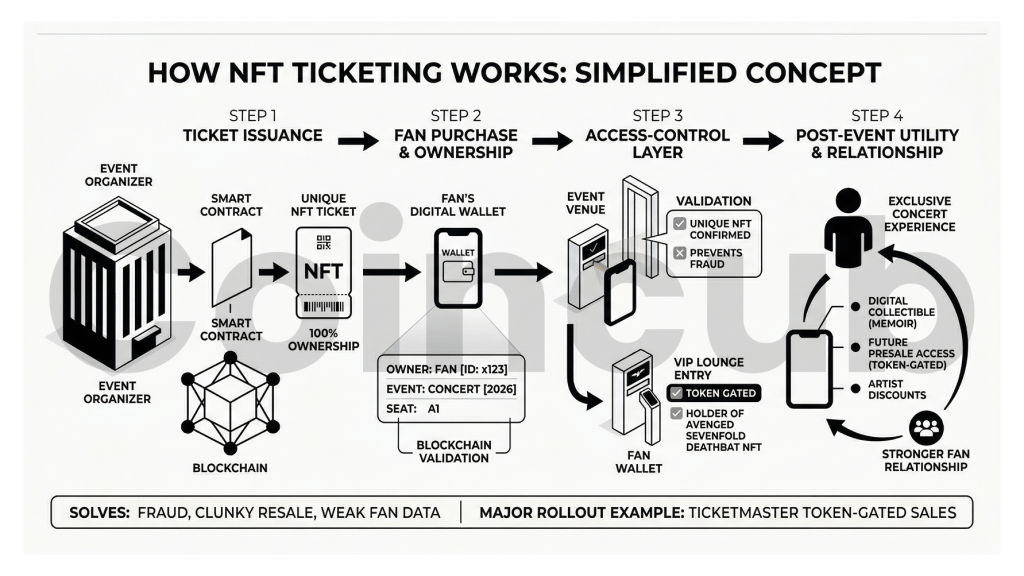
NFT ticketing is one of the cleanest real-world NFT use cases because it solves problems that both fans and organizers already hate: fraud, clunky resale, weak fan data, and one-off ticket relationships that end the moment the event does.
Ticketmaster’s own rollout made the utility clear years ago. It launched token-gated sales that let artists unlock access only for holders of a specific NFT, including special presales, prime seats, exclusive concert experiences, and even custom travel packages. That is not a theoretical pitch deck. That is a major ticketing company using NFTs as an access-control layer.
NFTs as Keys in the Digital Age
The big idea here is that the NFT does not have to be the ticket in the narrowest sense. It can be the pass that unlocks the ticket, the collectible that proves attendance, the resale-controlled asset that reduces fake inventory, or the onchain key that connects a fan’s activity before, during, and after an event. That is where the model gets powerful. A ticket stops being a disposable barcode and starts becoming a persistent relationship object.
POAP helps show why this matters. The Proof of Attendance Protocol turns attendance into collectible digital mementos and says it has passed 1,000,000 POAPs minted with 10,000 issuers. That may sound lightweight compared with financial NFTs, but it hints at a much bigger future: events can issue proof of presence, reward repeat attendance, unlock future perks, and build fan histories that do not disappear inside one platform’s CRM.
In 2026, the projects that win here will probably not market themselves as “NFT ticketing” first. They will market themselves as better ticketing. Fans care about getting in, avoiding scams, and receiving perks. Organizers care about controlling distribution, reducing fraud, and extending engagement. NFTs happen to fit all three.
Memberships, Loyalty Programs, and Token-Gated Communities Through NFTs
This might be the most underrated NFT use case going into 2026.
Traditional loyalty programs are usually boring because they are trapped inside closed systems. Your points live in one app, your perks expire, your status is not portable, and the whole experience feels like a coupon engine with better branding. NFTs offer a different model: membership as a programmable asset that a user can hold, verify, and use across digital touchpoints.
Shopify’s own token-gating documentation is blunt about the value proposition. Merchants can offer token holders exclusive access to products and discounts, and Shopify explicitly frames tokengating as a way to build loyalty and reward mechanisms for communities and customers. Its 2025 blog post on token gating pushes the same logic further, describing NFT holders getting access to exclusive drops, loyalty perks, and member communities.
Reusable NFTs: The Future of Membership
That matters because it turns NFTs from one-time purchases into persistent customer relationship tools. A brand can issue a membership NFT that unlocks early access, gated merch, private chats, discounts, event invitations, digital collectibles, or status tiers that evolve over time. A creator can use the same structure for superfans. A sports brand can use it for product drops. A festival can use it for recurring VIP access rather than starting from zero every year. The NFT becomes less like a collectible and more like a living subscription badge with better composability.
This use case also pairs naturally with ticketing. The ticket gets you into the show; the membership NFT keeps you inside the ecosystem after the show. That is a powerful pattern for 2026 because it creates recurring engagement instead of one-off hype. And unlike many earlier NFT ideas, the commercial incentive here is obvious. Loyalty, retention, and direct-to-community commerce are real business goals, not crypto cosplay.
Real-World Asset Authentication and Digital Product Passports Through NFTs
If gaming is the most crypto-native winner, authentication may be the most important real-world sleeper.
One of the best uses for NFTs is representing a digital twin of a physical product. That can mean luxury goods, sneakers, collectibles, high-end fashion, electronics, art, spare parts, or regulated product categories where provenance and lifecycle data matter. In those cases, the NFT is not valuable because it is scarce art. It is valuable because it anchors trust.
The EUIPO’s AUTHENTIC View project makes this incredibly concrete. Its public materials say the system links physical serialization to the digital twin of the product through an NFT and enables a dynamic check of a brand’s digital identity and product information. The FAQ is even more explicit, noting that when creating digital twins as NFTs, metadata can be updated when relevant circumstances change. That is exactly the sort of functionality that makes NFTs useful for authenticity and traceability rather than speculation.
Non-Fungible Passports?
The wider European digital-identity and product-passport work points the same way. The European Commission’s EBSI-ELSA + EUIPO page says the project uses NFTs to represent digital twins of products, while verifiable credentials are used as part of the trust framework around authenticity and supply-chain events. This is a serious institutional signal that NFTs can fit into product verification systems, especially where IP protection, provenance, and lifecycle transparency matter.
This use case gets even stronger when resale enters the picture. The secondary market for physical goods suffers from counterfeits, incomplete histories, and fragmented trust. An NFT-linked product passport can record origin, ownership transitions, repairs, authenticity checks, and brand-issued updates in a way that is easier to verify than screenshots or paper certificates. That is where NFTs stop looking like crypto toys and start looking like infrastructure for commerce.
NFTs as Identity, Credentials, and Reputation Layers
This is the most forward-looking category on the list, but it has real building blocks already.
The internet has a credential problem. People need ways to prove they completed a course, attended an event, earned access, belong to a group, or hold a specific role without constantly relying on centralized platforms. W3C’s Verifiable Credentials Data Model exists precisely because digital identity needs a standard way to express claims such as a driver’s license, an education certificate, or other attestations.
Where NFTs enter the picture is in portability, persistence, and wallet-native ownership. Crossmint’s 2025 launch of verifiable credentials explicitly described an architecture that blends W3C standards and NFTs, with each credential double-linked to an NFT that serves as an onchain reference for authenticity. That is a useful model because it keeps sensitive data offchain while still giving the credential a durable, user-controlled anchor.
There are already real education-adjacent examples. The University of Nicosia says it has issued university diplomas on the Bitcoin blockchain since 2017 using its own open-source technology. That is not the whole future of credentials, but it shows the basic use case has long been technically viable: issue a tamper-resistant record that can be independently verified.
This category also overlaps with attendance and reputation. POAPs are a simple example of NFT-based proof of participation, and over time that same logic can expand into contributor badges, governance history, onchain résumés, access rights, and event-based reputation systems. In 2026, I would not expect identity NFTs to be the loudest category. I would expect them to quietly become one of the most important.
What Could Slow NFT Adoption in 2026
The bullish case is real, but so are the obstacles.
The first problem is UX. Mainstream users still do not want to think about seed phrases, bridge risk, chain fragmentation, or which wallet standard a project supports. Even in gaming, where NFT logic is strongest, DappRadar’s Q2 2025 report showed that many projects failed because hype could not compensate for poor retention and unsustainable design. That is a reminder that utility only matters if the product experience is good enough to make people stay.
The second problem is overuse. Not every digital item needs to be an NFT. Some teams still force tokens into products where a normal database would work faster, cheaper, and more cleanly. The NFT use cases that win in 2026 will be the ones where transferability, verifiability, or user ownership clearly outperform centralized alternatives.
The third problem is baggage. NFTs still carry the reputation of the 2021 mania cycle, and that creates friction with brands, regulators, and ordinary users who hear “NFT” and think “speculation” first. The fastest-growing projects may end up using NFT rails while barely using the term in marketing at all. Ironically, that could be a sign of maturity rather than weakness.
Final Verdict for the Future of NFTs
The next NFT cycle will not be ruled by digital flexing. It will be ruled by digital function.
If I had to rank the five use cases by likely impact on the crypto market in 2026, I would put in-game assets and gaming economies first, because gaming already has the strongest behavioral fit and the deepest live infrastructure. I would put memberships and token-gated loyalty second, because brands and creators have clear incentives to use NFTs as programmable access passes. Ticketing and live event access comes third because the real-world pain points are obvious and the model already exists at scale. Product authentication and digital passports might be the sleeper with the biggest long-term real-world upside, even if it grows more quietly. Identity, credentials, and reputation may be the slowest to break out, but it could become one of the most durable layers once wallet-based proof systems become easier to use.
The core takeaway is simple: in 2026, NFTs win when they stop asking users to care about NFTs. The projects that dominate will be the ones that make ownership easier, access smarter, trust stronger, and digital experiences more portable. That is the version of the market worth betting on.
Frequently Asked Questions (FAQs)
What does NFTs mean?
NFTs stand for non-fungible tokens. These highly unique digital assets live permanently on a blockchain, proving undisputed ownership of specific virtual items or physical goods and blocking unauthorized duplication forever.
Are any NFTs worth anything anymore?
Yes. While speculative profile pictures lost massive value, utility-driven tokens retain significant worth. Gaming assets, event tickets, and digital product passports hold real financial value because they solve actual problems.
Is there still a future for NFTs?
Absolutely. The future shifts away from pure speculation toward hidden backend infrastructure. Businesses will increasingly use programmable tokens to authenticate luxury goods, streamline global ticketing, and power complex gaming economies.
Will NFTs ever be valuable again?
Future asset valuations will depend entirely on practical utility. Tokens that unlock exclusive memberships, secure intellectual property, or facilitate decentralized digital identity will command premium prices through genuine market demand.