Buy a Licensed Company
  Explore VASP Data
  Talk to an Expert

 Dren Hima
 is Head of Research at Coincub, leading research across digital asset regulation, licensing, market structure, tokenization and institutional adoption.
Dren Hima
Dren Hima is Head of Research at Coincub, leading research across digital asset regulation, licensing, market structure, tokenization and institutional adoption.
Sui Price Prediction 2026-2030: Can Institutional Adoption Break the Ceiling?

- Sui remains one of the strongest technical Layer 1 bets, but the token has reset much harder than the original article reflected.
- The biggest issue for SUI is still token supply, with only around 40% of the fixed 10B supply currently circulating.
- Institutional products help the narrative, but they do not automatically cancel out unlock pressure or weak altcoin liquidity.
- Sui’s ecosystem is active, but TVL has fallen from prior highs and now needs a cleaner recovery trend.
- The 2026 setup is still high-upside, but the realistic forecast range should start from today’s price near $1.10.
Sui sits in a weird spot right now. The tech is elite, the logos backing it are serious, and the chain is actually used. The token now trades around $1.12 after a brutal drawdown from its January 2025 high near $5.35.
This piece walks through what Sui actually built, why institutions suddenly care, how the tokenomics cut both ways, and where the price could realistically land by 2026-2030 if the “Move L1” bet works out.
Disclaimer: This article is for informational purposes only and does not constitute financial, investment, or trading advice. Cryptocurrency markets are highly volatile and speculative. Always do your own research and never invest more than you can afford to lose.

Quick Sui Price Prediction Overview
Sui heads into the last quarter of 2026 still in a reset phase, even after a roughly 45% rally from mid-September. The market cap is around $4.6B with roughly 4.12B SUI in circulation out of a fixed 10B supply. That leaves a fully diluted valuation around $11.2B sitting over the chart, and that overhang is what most traders feel every time an unlock hits.
At the same time, the chain runs at sub-second finality, handles parallel workloads cleanly, and now has spot ETFs from Canary, Grayscale, and 21Shares trading in the US, plus CME SUI futures since May 2026.
Right now Sui trades around $1.12, roughly 79% below its ATH of $5.35. On fundamentals, it looks like a high-beta infrastructure play. On tokenomics, it is still a grind.
So Sui is technically superior and now institutionally validated, but long-term vesting and FDV remain the main ceiling. High-risk, high-reward, and very sensitive to execution between now and 2030.
What is Sui – The Object-Centric L1
Most chains still think in terms of accounts and global state. Sui takes a different route. It is an object-centric Layer-1 built around the Move language, which came out of the original Facebook Diem effort. Instead of treating everything as balances in an account, Sui tracks individual objects, such as NFTs, game items, or positions, and reasons about how they move.
That design allows a big optimization. Independent objects do not need to wait for global consensus. The network can process a huge number of “owned object” transactions in parallel while only sending shared-state operations through full consensus. In practice that means horizontal scalability, better hardware utilization, and much lower congestion compared with typical account-based chains.
Move sits at the center of this. It is a resource-oriented language that encodes assets directly into the type system, which reduces whole classes of exploits that plague Solidity, such as re-entrancy and unchecked state flows. For institutional developers, that combination of safety and performance matters more than meme potential.
The Mysticeti consensus upgrade is the other big pillar. It takes the Narwhal/Bullshark lineage and pushes latency into the few-hundred-millisecond range. In controlled tests, Mysticeti variants have demonstrated hundreds of thousands of TPS while staying below one second of latency. On live Sui, you see sub-second finality for typical loads, which is what high-frequency DeFi, perps, and real-time gaming actually need.
Sui’s current focus lines up with gaming and on-chain assets, high-frequency DeFi and perps, payments and AI-driven transactional workloads (agents, micro-payments, machine-to-machine flows)
The UX layer follows the same logic with zkLogin, sponsored transactions, and programmable transaction blocks are there to hide Web3 friction from users and enterprise partners.
Sui Price History and Tokenomics
Sui went live into a market that already knew the Diem story. Expectations were high from day one. The token chopped through its first year, found a base, then ripped into early 2025 as narratives around AI chains, Move, and “Solana alternatives” kicked in.
By 6 January 2025, SUI hit an all-time high around $5.35. That move coincided with peak speculation on high-performance L1s and heavy coverage of Sui’s performance numbers. At that moment, the fully diluted valuation already made some analysts nervous.
The rest of 2025 unwound the hype. Continuous token unlocks, macro volatility, and capital rotating back into Bitcoin and the largest L1s pushed SUI down into the $1.50-$2.00 range. On-chain activity kept rising, but the chart looked like a classic “sell the news” pattern: ATH into unlocks, then a grinding bleed as early investors and ecosystem recipients took liquidity.
Right now, around $1.12, SUI has bounced well off the $0.65 floor it set after the ATH, with most of the move coming in a rally from about $0.81 in mid-September. The issue is not that the market has given up. The issue is that new demand has to fight a constant stream of new supply.
The Tokenomics Trap
Sui has a fixed supply of 10 billion SUI. That is a positive in the abstract. The structure behind those 10 billion tokens is where the headwind appears.
Roughly 4.12B SUI are in circulation, or about 41% of the total. The rest sits across community reserves, allocations for the storage fund and stake subsidies, team and contributor vesting, investor tranches, and the Mysten Labs treasury. Monthly unlocks have thinned a long way from the early schedule and now add about 20 million to 24 million SUI a month, well under 1% of circulating supply. These emissions extend into 2030.
Instead of one giant cliff that blows up the chart, Sui runs a long, steady program of unlocks. That avoids a single “event risk” moment in 2026 or 2027, but it also means a mostly continuous stream of sellable supply into every rally. The fully diluted valuation near $11.2B still shows up as a red flag, even while the circulating market cap sits closer to $4.6B.
There are offsets. Staking participation has stayed high, often in the 65-75% range of circulating supply, which pulls a large chunk of tokens out of active markets and aligns holders with network fees and rewards. The storage fund mechanism is another lever. Network fees allocate part of the value into a pool that can, over time, counteract some emissions and even tilt the system toward deflation if data growth slows relative to fee burn.
Sui’s tokenomics reward patient stakers and long-term believers, but they punish anyone looking for a quick supply squeeze. Until unlocks slow after 2030, price will keep reflecting both fundamentals and a constant “hidden tax” from vesting.
Major Catalysts for SUI in 2026 and Beyond
Institutional Validation
The turn came between December 2025 and February 2026. 21Shares US listed the first SUI-linked ETF in the country, a 2x leveraged product, in December 2025. Canary and Grayscale then launched the first US spot SUI ETFs on 18 February 2026, SUIS on Nasdaq and GSUI on NYSE Arca, both staking the SUI they hold and passing net staking rewards of roughly 7% through NAV. 21Shares listed the non-leveraged spot fund TSUI on Nasdaq on 24 February 2026. Bitwise, Franklin Templeton, and VanEck all have products or filings in the same lane.
In Europe, VanEck already runs an exchange-traded Sui product, which quietly built liquidity over 2024-2025. On the infrastructure side, major custodians like Crypto.com have added regulated SUI custody, and native WBTC and compliant USDsui stablecoins have gone live through BitGo, LayerZero, and payments partners.
CIOs and treasurers can now touch SUI without opening an offshore exchange account. They can size positions through ETFs, trusts, or custodied spot, and they can lean on familiar compliance stacks. Price does not automatically spike just because these products exist, but the ceiling on potential flows is now much higher.
The payments push is the newest leg of the thesis and the one Mysten Labs pushes hardest. The team turned on gasless stablecoin transfers in June 2026, and CEO Evan Cheng says the network moved more than $65 billion through them in the first two months, on top of the $1 trillion of cumulative stablecoin volume co-founder Adeniyi Abiodun cited at Consensus in May 2026. Protocol-level private transactions are queued behind that, with privacy enabled by default rather than as an opt-in. If Sui turns into settlement plumbing for stablecoin flow, fee revenue and blockspace demand start to look very different from the 2025 picture, and the thesis stops depending on a speculative alt-L1 cycle.
Hashi, the Bitcoin finance network Mysten Labs built on Sui, began a phased mainnet rollout in October 2026 with more than $500 million in capital commitments. Its launch coalition of more than 20 firms includes BitGo, Bullish, Cumberland, FalconX, and Ledger, with Anchorage Digital offering institutions settlement and self-custody.
Mysticeti and AI Integration
On the network side, the Mysticeti upgrade is not just a marketing term. It delivers sub-second finality and very high throughput under real workloads, which is exactly what on-chain order books, perps, and AI-driven agents need.
AI agents that rebalance portfolios, settle invoices, or trade in response to real-time signals cannot sit on chains where finality takes half a minute or fees spike randomly. Sui’s design around parallel execution and object ownership gives those agents a predictable environment:
- independent positions can update without waiting on global state
- fee markets stay flatter because congestion is removed earlier
- state transitions feel closer to Web2 speed, which helps UX and retention
Sui’s 2026 roadmap leans into that with more AI and gaming integrations, deeper tooling for Move developers, and better pipelines for high-frequency DeFi. If these workloads land, they feed back into demand for blockspace, which is the real long-term driver for any L1 token.
Mysticeti v2 shipped in November 2025 and moved transaction validation inside the consensus process, cutting out a redundant post-consensus step. Mysten Labs measured latency dropping roughly 35% on Asian nodes and 25% on European ones, and from node version 1.60 it became the default for new network participants.
Ecosystem Maturation
On-chain numbers back up the idea that Sui is not just a testnet science project. Total DeFi TVL sits around $530M, and Sui still has a live, trading-heavy ecosystem across protocols like Bluefin, Suilend, NAVI, Haedal, Cetus, and DeepBook.
TVL did fall sharply from its October 2025 peak near $2.6B, but that mirrored a broader risk-off phase across alt L1s. The more important point is trajectory since launch: TVL grew roughly tenfold from early 2024, account numbers passed 200M, and lifetime transactions moved into the tens of billions.
Against Aptos, the comparison is tight. Both chains use Move, both market themselves as safer, more scalable L1s, and both court similar categories of apps. Sui’s edge sits in its object-centric model and the performance numbers after Mysticeti. Aptos counters with a more conservative decentralization posture and different fee and gas economics. The “Move winner” question is still open, but on pure performance Sui has arguably pulled ahead.
Native Bridge to Ethereum
The other quiet catalyst is connectivity. A native, trust-minimized bridge to Ethereum, live since 30 September 2024, plus WBTC and USDsui support, gives Sui credible two-way liquidity flows with the largest DeFi base on the planet. Assets can move in size from Ethereum into Sui’s high-speed environment and back without relying on opaque multisig bridges.
As more Ethereum blue-chip users and protocols get comfortable routing value through Sui, that bridge becomes a structural source of inflow. If the AI and gaming narratives take off on Sui side-chains or rollups, the bridge also acts as an escape valve, not just an entry point.
Sui Price Prediction 2026
2026 is where the market either accepts Sui as a serious L1 alongside Solana and the larger Ethereum L2s, or keeps it in the “narrative alt” bucket.
- Bear case 2026 – $0.55
- ETF and trust flows disappoint, unlocks keep pressuring the market, and risk appetite across alt L1s stays muted. On-chain metrics grow, but not fast enough to absorb emissions. SUI trades below current levels and struggles to reclaim the $1 zone.
- Base case 2026 – $1.50
- TVL and stablecoin activity recover, daily trading activity remains healthy, and institutional products bring in some steady demand. SUI re-rates from the reset zone, but still trades far below its prior ATH because unlocks keep capping rallies.
- Bull case 2026 – $3.50
- AI, gaming, and high-frequency DeFi narratives hit at the same time as broader risk-on conditions. Unlocks get absorbed by demand, and SUI pushes back toward the $3–$4.50 range. This path needs macro tailwinds and clean execution across the stack.
In all three paths, unlocks remain the key drag. Even in the bull case, rallies will likely come with sharp pullbacks as early holders take profits.
| Scenario | 2026 SUI price range | What would need to happen |
|---|---|---|
| Bear case | $0.55 to $0.75 | Unlock pressure stays heavy, ETF and trust demand disappoint, and alt L1 liquidity remains weak |
| Base case | $1.40 to $2.20 | TVL and stablecoin activity recover, Sui keeps developer momentum, and institutional access brings some steady demand |
| Bull case | $3.00 to $4.50 | Risk appetite returns, AI and gaming narratives strengthen, and Sui absorbs unlocks through real ecosystem demand |
Sui Price Prediction 2027-2028
If Sui survives 2026 as a top-tier L1, the next two years look more like a consolidation and build phase than an immediate moonshot.
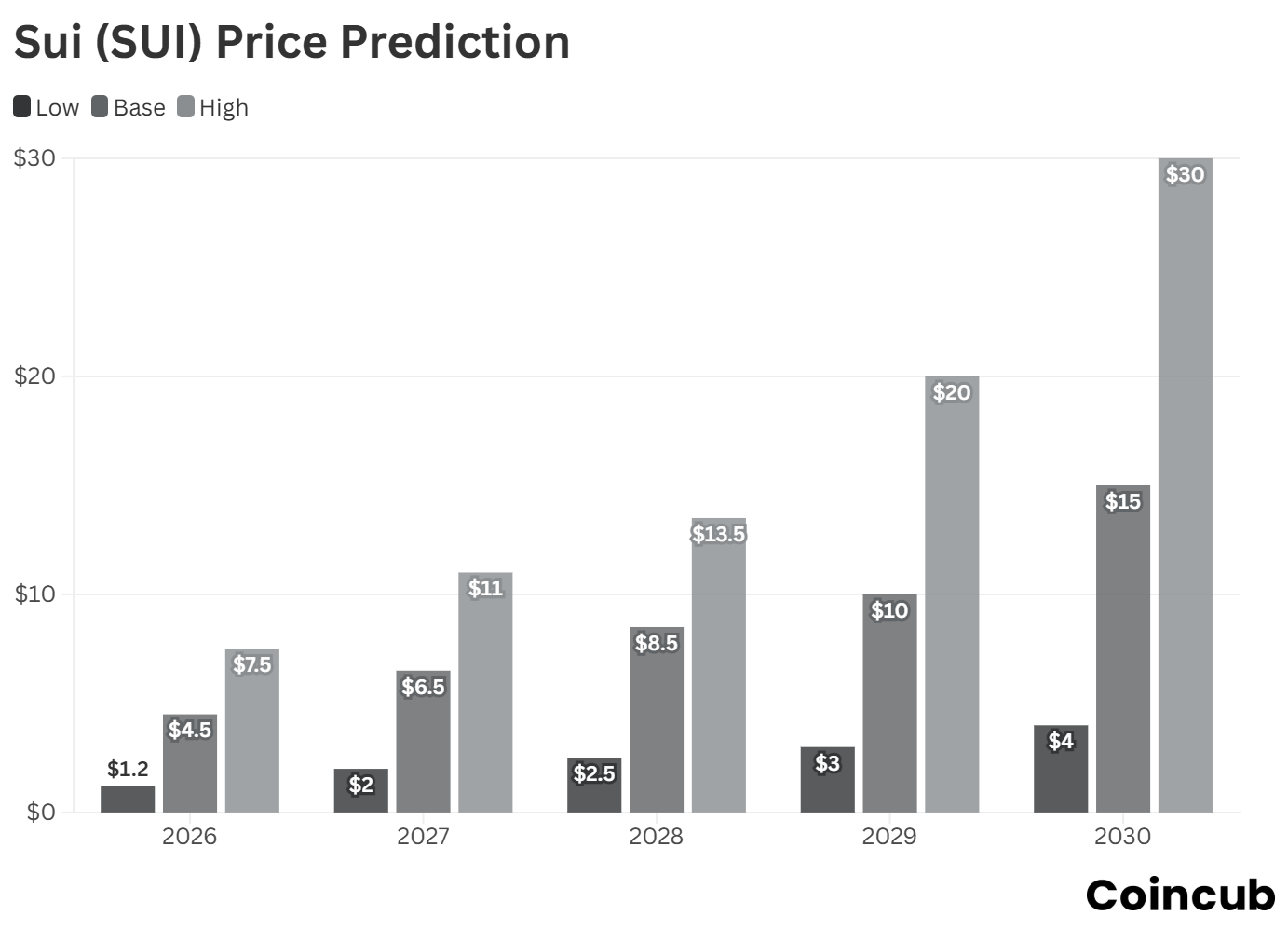
2027 ranges:
- Bear: $2.00
- Base: $6.50
- Bull: $11.00
In the bear path, Sui ends up as “just another fast L1,” overshadowed by Solana, Ethereum rollups, and maybe one more breakout chain. The base path sees Sui hold its share of mind, deepen its ecosystem, and trade around mid-single-digit dollars, with spikes into low double digits during speculative phases.
The bull case for 2027 assumes Sui wins a clear share of gaming, perps, and AI transactional flows. That puts it into serious competition with Solana on throughput and fees, and the market prices SUI accordingly.
2028 ranges:
- Bear: $2.50
- Base: $8.50
- Bull: $13.50
By 2028, the market either views Sui as a structural part of crypto’s base layer, or starts migrating elsewhere. The base case has long-only funds and large traders comfortable holding SUI through a full macro cycle, with ETF and trust products now widely held. The bull case has Sui stepping into early top-10 territory by market cap, with growing fee revenue offsetting more of the inflation.
Sui Price Prediction 2029-2030
The late-decade picture depends on how much of the “Move L1” thesis turns into measurable revenues and sustained usage.
2029 ranges:
- Bear: $3.00
- Base: $10.00
- Bull: $20.00
In the bear scenario, the market recognizes Sui’s technology but decides value accrues elsewhere. Unlocks slow, but growth also slows, and price drifts in a wide $3–$8 band depending on the broader crypto cycle.
The base path has Sui positioned as a top-15 L1 with entrenched DeFi, perps, gaming, and AI infrastructure. SUI trades mostly between high single digits and low teens, with spikes higher on liquidity waves.
2030 ranges:
- Bear: $4.00
- Base: $15.00
- Bull: $30.00
The bear case assumes technical superiority never fully translates into economic dominance. Sui remains important, but not central, and investors prefer Solana, Ethereum L2s, and a handful of other winners.
The base case assumes Sui secures a material share of L1 market revenues, sits comfortably in the top-15 by market cap, and benefits from a more forgiving emission profile as vesting slows past 2030.
The bull case assumes Sui wins a large part of the “Move war,” becomes the default home for high-frequency apps and AI agents, and manages to capture value through fees, storage economics, and sustained demand for SUI in staking and governance. A $30 handle in that world is aggressive but not impossible.
These numbers are directional. The point is to show how much of the upside depends on Sui turning technical dominance into durable demand for blockspace while the unlocks slowly fade into the background.
Sui vs. Aptos: Who Wins the Move War?
Sui and Aptos share DNA. Both came out of the Diem ecosystem, both use Move, and both sell a story of safer, more predictable smart contracts.
The differences sit in architecture and market positioning.
Sui leans into its object-centric model and aggressive parallel execution. It optimizes for maximum throughput and sub-second UX, even if that means higher hardware expectations and a slower path to maximal decentralization. Mysticeti and the DAG-driven design underline that focus on speed and determinism.
Aptos emphasizes a more traditional account-centric layout with strong performance but a slightly different trade-off on validator requirements and decentralization. Fees, gas schedules, and on-chain economics also differ, which can matter a lot for certain categories of apps.
From an investor point of view, Sui currently looks like the more aggressive bet on throughput, AI, and gaming, while Aptos looks like the marginally more conservative Move chain with its own ecosystem and backers. Both sit under Solana and Ethereum in mindshare, but both have room to surprise if the Move tooling and developer base keep expanding.
If Sui keeps outpacing Aptos in TVL, active addresses, and institutional product launches, the market will likely assign it the “winner” label in this niche. That is the scenario where the upper bands of the 2030 forecast start to make sense.
Is Sui a Good Investment?
You get a chain with proven sub-second finality, a modern language designed for asset safety, and an architecture that solves real scaling problems. You see an ecosystem with around $530M in TVL, about $39M a day in DEX volume and $6M a day in perps volume over the past week, and clear traction in gaming and AI-adjacent use cases. Also, you now have live ETFs, a Grayscale trust, and reputable custody platforms, which together make it easier for serious money to allocate.
The bear case is equally clear. The vesting schedule runs to 2030. Monthly emissions are heavy enough to weigh on every rally. FDV is high, even after an 79% drawdown from the ATH. Competition from Solana, Ethereum L2s, and other L1s is intense, and attention is finite. Sui also faces ongoing criticism around validator concentration and the cost of running full nodes, which may matter more as regulators and institutions scrutinize decentralization claims.
Reliability belongs on that list. Sui mainnet stalled for hours in January 2026 after validator consensus processing diverged, following a roughly three-hour outage in November 2024 caused by a bug in transaction scheduling logic. Downtime carries more weight now that Sui pitches itself as settlement infrastructure, because a payments partner routing real volume tolerates far less of it than a fund holder does.
So the honest answer is that Sui looks like a high-conviction, high-volatility bet on “next-gen L1s” and the Move ecosystem. It fits better in a long-term allocation with a 2027+ horizon than in a short-term trade that cannot stomach 50-70% drawdowns along the way.
Position sizing, entry timing, and your broader portfolio matter more here than the exact number in any 2030 model.
Frequently Asked Questions (FAQ)
What is the Sui price prediction for 2030? +
Our 2030 forecast puts SUI at $4.00 in the bear case, $15.00 in the base case, and $30.00 in the bull case. The base case assumes Sui secures a material share of L1 revenue and holds a top-15 spot by market cap. The bull case needs Sui to become the default home for high-frequency apps and AI agents and to capture that activity through fees and staking demand.
Can SUI reach $10? +
Our base case gets SUI to $10.00 in 2029, and the bull case reaches $11.00 as early as 2027. With a fixed supply of 10 billion tokens, a $10 SUI implies a fully diluted valuation of $100B. From about $1.12 in October 2026, the token would need to climb nearly ninefold.
Can SUI return to its all-time high? +
SUI set its all-time high near $5.35 in January 2025 and now trades about 79% below it. Our base case clears that level in 2027 with a $6.50 target. In the bear case, SUI stays below its old high through the end of the decade and finishes 2030 at $4.00.
What is holding the SUI price back? +
Token supply is the main drag on SUI. Only about 41% of the fixed 10 billion supply circulates, and the rest vests on a schedule that runs to 2030. Monthly unlocks add roughly 20 million to 24 million SUI, and every rally has to absorb that new supply. High staking participation, around 65% to 75% of circulating supply, keeps a large share of tokens off the market.
Is there a spot SUI ETF? +
Canary and Grayscale launched the first US spot SUI ETFs on 18 February 2026, SUIS on Nasdaq and GSUI on NYSE Arca, and both funds stake the SUI they hold. 21Shares followed with TSUI on Nasdaq on 24 February 2026. CME Group added regulated SUI futures in May 2026.