Buy a Licensed Company
  Explore VASP Data
  Talk to an Expert

 Atis Shala
Atis is a senior analyst and community lead with four years of experience in crypto. He has a bachelor from the Rochester Institute of Technology.
Atis Shala
Atis is a senior analyst and community lead with four years of experience in crypto. He has a bachelor from the Rochester Institute of Technology.
Tokenizing the Real World: Why RWA Is the Next Big Trend in Crypto
- RWA tokenization isn’t crypto replacing traditional finance; it’s Wall Street adopting public blockchains as a superior, 24/7 settlement and custody plumbing system.
- The onchain RWA market exploded 380% to reach $24 billion by mid-2025, with major financial analysts projecting the sector could scale to $30 trillion by 2034.
- BlackRock’s launch of the BUIDL fund on Ethereum permanently validated public blockchains for institutional capital, shifting the industry consensus from if tokenization will happen to how fast.
- Tokenized private credit ($17 billion) and U.S. Treasuries ($7.3 billion) currently dominate the market, providing the reliable, risk-free yield that decentralized ecosystems have historically lacked.
- The launch of tokenized U.S. equities to European retail users in 2025 signaled a critical inflection point, moving RWAs from institutional-only backends to consumer-grade interfaces.
- Before reaching its trillion-dollar projections, the sector must still solve liquidity fragmentation across closed networks, cross-chain interoperability, and global regulatory harmonization.
The financial system has always run on paper- paper deeds, paper contracts, paper certificates. Blockchain is about to make most of that paper obsolete.
The Biggest Market You Have Never Traded
Right now, somewhere in the world, a pension fund is sitting on a $50 million stake in a private credit facility that it cannot easily sell. A real estate developer in São Paulo holds equity in a building worth $200 million but cannot find a buyer for a slice of it. An art collector in Singapore owns a Picasso that has appreciated magnificently for twenty years but remains entirely illiquid unless she wants to sell the whole thing.
These are not edge cases. They are the normal condition of global wealth. The vast majority of the world’s assets, an estimated $500 trillion worth of real estate, private debt, commodities, equities, infrastructure, and collectibles, are difficult to trade, expensive to transfer, and fundamentally inaccessible to anyone outside a small circle of accredited or institutional investors.

Blockchain is now challenging that reality directly, through a category that has captured the attention of Wall Street, Silicon Valley, and every major central bank in the world: Real World Asset tokenization, or RWA.
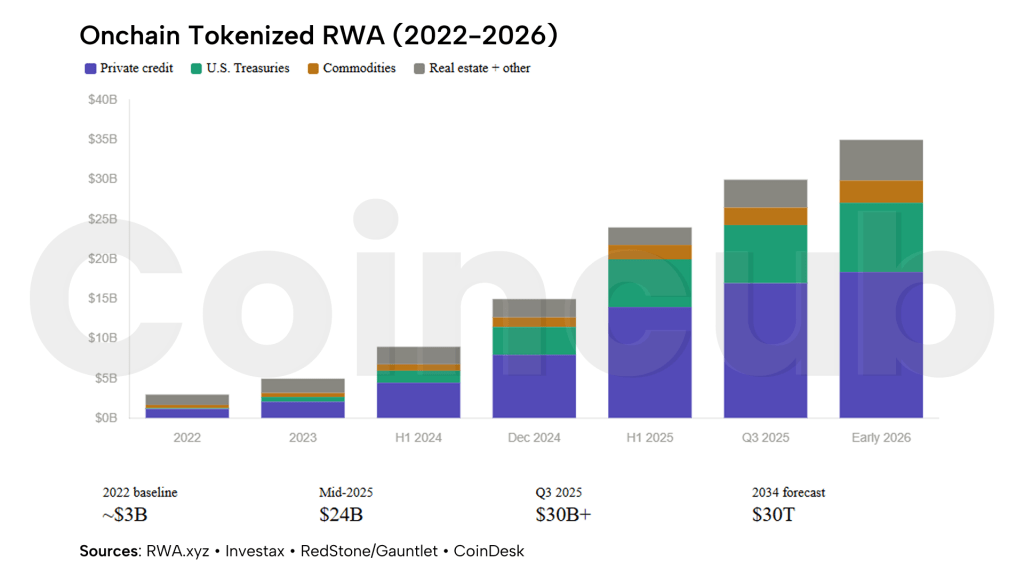
The RWA tokenization market grew 380% in just three years, reaching $24 billion by mid-2025. What was described as an experimental pilot in 2022 is now, in the words of the RedStone research team, a sector that has “decisively transitioned from experimental pilots to scaled institutional adoption.” By Q3 2025, tokenized RWAs had crossed $30 billion, a roughly 10x increase from 2022 levels. And analysts at Standard Chartered project the market could reach $30 trillion by 2034.
This is a story about the future architecture of finance itself.
What Is a Real World Asset?
Before diving into the numbers and the platforms, it is worth being precise about what we are actually talking about.
A real world asset is any asset that exists outside the blockchain- a building, a bond, a barrel of oil, an invoice, a share of stock, a music royalty, a bar of gold. These assets have traditionally been represented by legal documents: title deeds, certificates, contracts. Ownership is recorded in centralized databases maintained by banks, law firms, and government registries. Transferring ownership is slow, expensive, and heavily intermediated.
What Does Tokenizing an Asset Mean?
Tokenization is the process of creating a digital representation of that asset on a blockchain. A token is minted, typically as a smart contract on a public or permissioned blockchain, that corresponds to a specific ownership stake in the underlying asset. That token inherits all the properties of blockchain-native assets: it can be transferred near-instantly, held in a self-custody wallet, used as collateral in DeFi protocols, divided into fractional units, and traded on secondary markets without the involvement of a broker, clearinghouse, or correspondent bank.
The key insight is that tokenization does not change the underlying asset. The building is still a building. The bond still pays interest. The gold is still locked in a vault. What changes is the infrastructure of ownership, the mechanism through which that ownership is recorded, transferred, and leveraged. And as anyone who has tried to buy real estate, access private credit, or invest in a hedge fund knows, that infrastructure has historically been the primary barrier separating most of the world’s wealth from most of the world’s people.
RWA tokenization promises to dissolve that barrier.
How It All Started: The Origins of RWA in Crypto
The idea of putting real-world assets on a blockchain is almost as old as Ethereum itself. As soon as Vitalik Buterin’s 2013 whitepaper introduced the concept of programmable smart contracts, a subset of developers immediately asked: could you use this to represent ownership of things that exist in the physical world?
The first serious attempts were rough. Early experiments with tokenized real estate appeared on Ethereum between 2016 and 2018, mostly as small-scale proofs of concept. RealT, one of the earliest platforms, began offering fractional ownership of Detroit rental properties onchain in 2019. Polymath launched the ST-20 standard for security tokens around the same time, attempting to build compliance into the token itself.
The first meaningful wave of institutional interest arrived around 2019 to 2021, when a handful of asset managers began treating blockchain not as a speculative curiosity but as a potential operational layer for traditional securities. In 2019, Société Générale issued a €100 million covered bond as a security token on the Ethereum public mainnet – a milestone that demonstrated, at least in principle, that regulated financial instruments could live on a public blockchain.
BlackRock’s Venture in Tokenization
But the breakthrough that changed the conversation permanently came in early 2024, when BlackRock, the world’s largest asset manager, with over $10 trillion in assets under management, launched its BUIDL fund on Ethereum. BUIDL is a tokenized money market fund invested in U.S. Treasury bills, repos, and cash. It is fully regulated under SEC frameworks, managed by Securitize as the transfer agent, and accessible only to qualified investors through a KYC/AML-compliant onboarding process. Within a year, BUIDL grew to manage over $2 billion in assets under management, becoming the single largest tokenized money market fund in existence and sending an unambiguous signal to the rest of Wall Street: the tokenization era had arrived.
Franklin Templeton had been slightly earlier, bringing its OnChain U.S. Government Money Fund to public blockchain rails in 2022. But it was BlackRock’s entry that functioned as the permission structure for the entire institutional world. If the firm that manages retirement savings for hundreds of millions of Americans had decided that tokenized assets were legitimate infrastructure, the question was no longer whether tokenization would happen, only how fast.
The Architecture of the RWA Market Today
Before examining the major platforms, it helps to understand the structure of the market as it actually exists in 2026.
The RWA tokenization space divides naturally into asset classes, each with its own dynamics, risk profile, and institutional appetite. The dominant categories today are: Private Credit, U.S. Treasuries, Real Estate, Commodities, and Equities.
Tokenized Private Credit
Tokenized private credit is currently the largest segment by value. As of September 2025, private credit accounts for roughly $17 billion of the $30 billion onchain tokenized RWA market. This reflects institutional appetite for yield-bearing assets with enhanced distribution efficiency. Tokenized private credit includes onchain corporate loans, structured credit products, and short-duration financing structures.
Tokenized U.S. Treasuries
Tokenized U.S. Treasuries represent the second largest category, offering the safety of sovereign debt with the 24/7 tradability of crypto markets. Tokenized Treasuries reached approximately $7.3 billion by September 2025. The key players here are BlackRock (BUIDL), Franklin Templeton (BENJI), and Ondo Finance (OUSG).
Tokenized Real Estate
Tokenized real estate remains the most recognized category but, paradoxically, not yet the largest by onchain value. The tokenized real estate market has reached approximately $20 billion in estimated value, with platforms like RealT offering fractional ownership of residential rental properties. Deloitte projects $1 trillion in tokenized private real estate funds by 2035.
Tokenized Commodities
Tokenized commodities, primarily gold, represent a fast-growing niche. For example, tokenized gold rose 227% in key periods, with Pax Gold (PAXG) and Tether Gold (XAUT) leading the category. Gold tokenization offers a practical bridge between crypto-native users and traditional safe-haven assets.
Tokenized Equities
Tokenized equities are the newest and most controversial frontier. In September 2025, Robinhood launched tokenized versions of U.S. stocks and ETFs for European users, bringing the RWA concept to retail investors for the first time in a truly mainstream way. The regulatory picture for tokenized equities remains the most complex of any category, but the direction of travel is clear.
The Biggest Platforms in the RWA Ecosystem
The RWA ecosystem is not monolithic. It comprises a layered stack of infrastructure providers, issuance platforms, and distribution networks, each occupying a specific part of the value chain. Here are the most consequential players as of 2026.
BlackRock BUIDL / Securitize: The Institutional Benchmark
BlackRock’s BUIDL fund, managed with Securitize as the transfer agent and tokenization infrastructure provider, became the market’s defining product and its proof-of-concept for institutional-grade tokenized funds. BlackRock has set the industry benchmark with BUIDL, which tokenized $7.4 billion in money market assets directly on Ethereum. Securitize itself manages over $1 billion in tokenized assets and provides the compliance plumbing, investor allowlisting, KYC/AML, cap table management, and regulatory reporting, that makes institutional-grade tokenization possible.
Ondo Finance: The Yield Infrastructure Layer
Founded by a former Goldman Sachs banker, Ondo Finance is the primary bridge between crypto-native users and institutional-grade, yield-bearing assets. Its flagship OUSG product provides onchain exposure to short-term U.S. Treasury securities, with the underlying assets held in BlackRock’s BUIDL fund. By March 2026, Ondo’s TVL crossed $2.75 billion, and in September 2025 it expanded into tokenized equities through its Global Markets platform, reaching approximately 60% market share in tokenized equities. Ondo’s institutional partnerships include JPMorgan and Mastercard, and its products are available on Ethereum, Aptos, Solana, the XRP Ledger, and Stellar.
Chainlink: The Data Oracle Backbone
Chainlink does not issue tokenized assets; it makes them function. Smart contracts on blockchains cannot access real-world data on their own, they need external data feeds to verify that the assets backing a token are real, that prices are accurate, and that cross-chain transfers are valid. Chainlink holds a 67% market share in the oracle space and had secured more than $100 billion across DeFi by year-end 2025. Its Cross-Chain Interoperability Protocol (CCIP) is the primary mechanism through which tokenized assets move between blockchains, and its Proof of Reserve solution provides real-time verification that off-chain assets actually exist. Without Chainlink, most of the RWA ecosystem would simply not function.
Centrifuge: The Private Credit Pioneer
Centrifuge was tokenizing invoices, mortgages, and structured credit before RWA became a buzzword. Built specifically for private credit, it allows businesses to use real-world assets as collateral to access onchain lending, while offering investors exposure to asset-backed yield that has historically been available only to large institutions. By March 2026, Centrifuge’s TVL surpassed $1 billion, and it was selected as one of three winners in Spark’s $1 billion Tokenization Grand Prix, receiving a $200 million allocation for its JTRSY Treasury fund. Its V3 architecture spans six EVM chains.
Maple Finance: Institutional Lending at Scale
Maple operates as an onchain lending marketplace connecting verified institutional borrowers with capital from both crypto-native and institutional lenders. After a painful restructuring following the 2022 market collapse, Maple rebuilt with a more rigorous underwriting model. From under $100 million in early 2024, Maple scaled to over $4 billion in TVL by late 2025, with its institutional borrower base growing from 4 to 28 counterparties during 2024.
Franklin Templeton OnChain: The Traditional-Finance Pioneer
Franklin Templeton’s BENJI fund was, arguably, the first serious institutional-grade tokenized product on a public blockchain, launched in 2022. Their tokenized money market fund represents $420 million in assets, making it the third-largest tokenized treasury product. Franklin Templeton’s willingness to lead before the institutional herd made it the quiet pioneer that others followed.
| Platform | Primary Focus | TVL / AUM (2025/26) | Blockchain(s) | Key Feature |
| BlackRock BUIDL | Tokenized money market fund | $7.4B+ | Ethereum, Aptos | Institutional benchmark, SEC-compliant, 24/7 redemptions |
| Ondo Finance | Tokenized Treasuries + equities | $2.75B+ TVL | Ethereum, Solana, XRP Ledger, Aptos, Stellar | ~60% market share in tokenized equities (Global Markets) |
| Chainlink | Oracle + crosschain infrastructure | $100B+ secured | All major chains | CCIP, Proof of Reserve, 67% oracle market share |
| Centrifuge | Private credit tokenization | $1B+ TVL | Ethereum, Base, Arbitrum, Avalanche, BNB Chain, Plume | $1B Spark Grand Prix winner, Janus Henderson CLO onchain |
| Maple Finance | Institutional credit markets | $4B+ TVL | Ethereum, Solana | 28 institutional borrowers, secured + overcollateralized lending |
| Franklin Templeton | Tokenized government fund (BENJI) | $420M+ AUM | Stellar, Polygon, Ethereum | First institutional tokenized fund on public blockchain (2022) |
| Securitize | Tokenization infrastructure + transfer agent | $1B+ tokenized | Ethereum | BlackRock BUIDL partner, full SEC compliance stack |
2025 as the Inflection Point of RWA
Several forces converged in 2025 to accelerate RWA adoption from steady growth to genuine institutional momentum.
The first was regulatory clarity, specifically in the United States. The Trump administration’s pro-crypto posture translated directly into policy: the GENIUS Act passed by Congress in July 2025 provided a framework for tokenized asset adoption, allowing major firms including Bank of America, Citi, BlackRock, and Coinbase to move from pilots to production. For institutions that had been sitting on the sidelines pending regulatory certainty, this was the signal they needed.
The second was the disappearance of the “going concern” risk at the infrastructure level. In 2022, the collapse of TerraUSD and the subsequent FTX implosion destroyed confidence in crypto infrastructure broadly. But by 2025, the chains underpinning RWA, Ethereum, primarily, with growing roles for Solana, Avalanche, and purpose-built RWA networks like Plume, had demonstrated years of reliable uptime with no major exploits of the custody or settlement infrastructure. The track record existed. As the RedStone & Gauntlet report concluded, “asset tokenization has decisively transitioned from experimental pilots to scaled institutional adoption in 2024-2025.”
The third was interest rates. The sustained high-rate environment of 2023 through 2025 made tokenized Treasuries and yield-bearing instruments genuinely attractive, particularly for DeFi users who had previously been stuck earning yield on volatile crypto assets or using stablecoins that paid nothing. Tokenized Treasuries offered what the DeFi ecosystem had long lacked: real, risk-free yield from the most credible issuer in the world, available 24/7 onchain.
Robinhood’s Launch of Tokenized U.S. Stocks in 2025
The fourth was a summer 2025 moment that changed the retail story: Robinhood’s launch of tokenized U.S. stocks and ETFs for European users on the Arbitrum network. This was the first time RWA tokenization reached ordinary retail investors in a consumer-grade interface. In early 2025, onchain tokenized RWAs totaled around $5.5 billion, but quickly tripled to roughly $18.6 billion over the course of the year. The Robinhood product was not the only driver, but it was the most visible signal that the technology had crossed from institutional infrastructure into consumer experience.
The Institutional Tidal Wave: Who Is Building What in 2026
The list of institutions that are now active in RWA tokenization reads like a summary of global finance.
Goldman Sachs and BNY Mellon, two of the oldest names in financial services, teamed up to launch tokenized money market funds. Binance adopted tokenized Treasuries in its off-exchange settlement infrastructure. The Nasdaq filed with the SEC to list tokenized stocks. DBS Bank in Singapore integrated tokenized money market funds as collateral for lending. MUFG began piloting tokenized bonds in Japan. The Dubai DFSA approved the region’s first tokenized money market fund, issued by QNB and DMZ Finance.
The regulatory environment globally is also shifting. The UK launched a Digital Securities Sandbox allowing institutions to test tokenized securities infrastructure. Singapore continued its Project Guardian pilots, now one of the most expansive multi-bank tokenization initiatives in the world. Australia’s Project Acacia invited industry participants to experiment with 24 innovative use cases focused on RWA tokenization. Japan’s FSA planned to introduce a comprehensive crypto bill covering tokenized assets. Hong Kong launched a new RWA platform under its Web3 Standardization Association.
The pattern here is not speculative interest but operational deployment. Institutions are not studying RWA tokenization; they are running it.
By early 2025, 86% of institutional investors had exposure to or planned to invest in digital assets. High-net-worth individuals and institutional investors plan to allocate 8.6% and 5.6% of their portfolios, respectively, to tokenized assets by 2026. Over 200 active institutional RWA projects are underway globally, supported by more than 40 major financial institutions.
The Challenges for RWA Adoption
It would be dishonest to present this picture without acknowledging what still stands between the current moment and the $30 trillion future that analysts project.
Liquidity fragmentation is the most immediate problem. Most tokenized RWA tokens today exist inside permissioned, closed ecosystems. They are issued on one chain, held by allowlisted investors, and cannot easily be transferred across blockchain ecosystems or listed on open secondary markets. The $18.6 billion in distributed onchain RWAs is dwarfed by an estimated $402 billion in platform-locked or “represented” assets that exist in walled gardens rather than open, interoperable markets.
Synthetic vs. real ownership is a philosophical challenge that has practical consequences. Many tokenized equities today, including those launched by Robinhood in Europe, do not confer actual shareholder rights. They are price-linked digital contracts, not true ownership claims. For retail investors especially, the gap between “holding a token that tracks Apple stock” and “owning shares in Apple” matters both legally and in terms of corporate governance rights.
Cross-chain interoperability remains technically incomplete. Chainlink’s CCIP and other bridging solutions have made enormous progress, but the seamless movement of tokenized assets across chains, with the compliance, identity, and audit trail information traveling with the token, is still a work in progress.
Smart Contract Exploits are a Risk to Traditional Finance
Smart contract risk has not disappeared. A $25 million exploit of a mid-sized DeFi platform in 2024 was a reminder that the code infrastructure underlying tokenized assets carries its own security risks, distinct from the asset risks of the underlying investments.
Regulatory harmonization is still absent. Different jurisdictions have radically different frameworks for what a tokenized asset represents, who can hold one, and how it is taxed. This creates compliance complexity that limits the truly global, borderless trading that RWA tokenization theoretically enables.
None of these challenges are insurmountable. Each has a plausible technical or regulatory solution, and each is actively being worked on by the institutions, protocols, and policymakers described in this article. But they are real, and they will determine the pace of the next phase of growth.
What Comes Next: The Path to a $30 Trillion RWA Market
Analysts project tokenization could reach $16 trillion by 2030 in BCG’s conservative scenario, with more aggressive forecasts from Standard Chartered projecting $30 trillion by 2034. Ripple and BCG forecast tokenized RWAs expanding from approximately $0.6 trillion in 2025 to $18.9 trillion by 2033, a compound annual growth rate of roughly 53%.
The trajectory to those numbers runs through several phases. First comes the continued domination of fixed income: tokenized Treasuries, government bonds, and private credit will continue to lead adoption because they are the simplest use case with the clearest regulatory framework and the most obvious value proposition for yield-seeking DeFi users and institutions alike.
Second comes the scaling of private markets. The trillion-dollar opportunity in private equity, private debt, and infrastructure is largely untapped. Tokenization could dramatically expand access to these asset classes by lowering minimum investment thresholds, enabling secondary market liquidity that does not currently exist, and reducing the operational friction of fund administration. KKR, Hamilton Lane, and similar firms have already begun moving in this direction through partnerships with tokenization platforms.
Third comes the consumer inflection point. The Robinhood moment of 2025, tokenized equities available to retail investors through a consumer interface, will be replicated across multiple platforms and jurisdictions. When a user in Lagos can invest $50 in a fractional share of a Nairobi office building, or a freelancer in Manila can hold U.S. Treasury bills directly in the same wallet where she receives her salary in USDC, the addressable market for RWA tokenization expands from institutions to individuals.
2026: The Year of Tokenizing Real Assets
The deeper shift, though, is architectural. In the context of a $147 trillion equities market, the $18.6 billion in onchain tokenized RWAs represents just 0.01-0.02% of market cap. The technology is not constrained. The infrastructure is not constrained. What has been constrained is institutional permission, regulatory clarity, and consumer awareness. In 2025, all three unlocked simultaneously.
Traditional Finance is Adopting Crypto Through RWA
It is tempting to frame RWA tokenization as a crypto story, another chapter in the ongoing saga of blockchain disrupting finance. But that framing misses what is actually happening.
The revolution in RWA is not that crypto is eating traditional finance. It is that traditional finance is adopting blockchain as its settlement and custody infrastructure, the same way it once adopted electronic trading, SWIFT messaging, and T+2 settlement. The assets are the same. The ownership rights are the same. The regulations are largely the same. What is changing is the plumbing, the underlying mechanism through which ownership is recorded, transferred, verified, and monetized.
When Goldman Sachs and BNY Mellon launch tokenized money market funds, they are not becoming crypto companies. They are updating their operational infrastructure. When BlackRock puts Treasury bills on Ethereum, it is not a philosophical endorsement of decentralization. It is a recognition that a 24/7 programmable settlement layer is more efficient than one that closes on weekends.
That is a much bigger story than any bull market narrative. Infrastructure transitions are permanent. The telegraph did not become obsolete when investors stopped finding it exciting. The SWIFT network does not depend on people being enthusiastic about international wire transfers to function as the backbone of global commerce.
RWA tokenization is building that kind of infrastructure, quietly, persistently, and at enormous scale. The next time someone tells you that crypto has no real-world use case, show them the numbers. A $24 billion market growing 380% in three years, backed by BlackRock, Goldman Sachs, JPMorgan, and every major central bank in the world, is not a use case. It is a transition.
Frequently Asked Questions (FAQs)
What does RWA stand for?
RWA stands for Real World Assets. In the context of cryptocurrency and blockchain technology, it refers to traditional, physical, or off-chain financial assets that have been digitized and represented as tradable tokens on a distributed ledger.
What is an RWA in crypto?
A Real World Asset (RWA) in crypto is a digital token that represents ownership of a traditional asset, such as real estate, government bonds, or commodities, allowing it to be traded, fractionalized, and settled efficiently on a blockchain.
How do I tokenize my property?
To tokenize property, you must establish a legal entity to hold the asset, choose a blockchain like Ethereum, and use a specialized tokenization platform to mint smart contracts that represent fractional ownership while enforcing KYC and AML compliance.
Is XRP tokenizing real-world assets?
Yes, the XRP Ledger is actively used for tokenizing real-world assets. The network has grown significantly in this sector, hosting over $2 billion in tokenized value, making it a competitive blockchain for institutional-grade asset issuance and high-speed settlement.
Who is leading tokenization?
Traditional financial giants like BlackRock and Franklin Templeton lead institutional tokenization through massive digital funds. Within the crypto ecosystem, platforms such as Ondo Finance, Securitize, and Centrifuge lead issuance, relying heavily on Chainlink for essential data oracle infrastructure.
What blockchain will be used for tokenization?
Ethereum and Ondo are currently the dominant blockchain for RWA tokenization, holding the vast majority of total value locked. However, alternative networks like Solana, Polygon, Base, and the XRP Ledger are increasingly used for their lower fees and faster transaction speeds.