Buy a Licensed Company
  Explore VASP Data
  Talk to an Expert

 Dren Hima
 is Head of Research at Coincub, leading research across digital asset regulation, licensing, market structure, tokenization and institutional adoption.
Dren Hima
Dren Hima is Head of Research at Coincub, leading research across digital asset regulation, licensing, market structure, tokenization and institutional adoption.
XRP Price Prediction 2026: Can XRP Break $10?
Summary
- XRP trades near $2.4 in 2026, with a market cap of around $178 billion and strong global liquidity.
- The XRP Ledger is designed for fast, low-cost payments and remains one of the most scalable blockchain platforms.
- Regulatory clarity after the SEC case has reopened U.S. exchange access and boosted institutional confidence.
- Most forecasts place XRP in the $3 to $6 range, with upside above $10 if adoption and institutional products expand.
- Risks include macro downturns, Bitcoin dominance, and competition from Solana and Ethereum.
XRP is trading at around $2.4 in August 2025, giving it a market value of approximately $178 billion. The asset has regained momentum after years of uncertainty tied to the SEC case. With legal clarity now in place, XRP is back in focus as one of the most liquid altcoins on global exchanges.
The XRP Ledger has been live since 2012 and is built for fast, low-cost settlement. Its design targets payments and cross-border transfers rather than general smart contract use. This clear purpose, together with Ripple’s network of banking and institutional partners, keeps XRP in a different category compared to other top coins.
Price predictions for 2026 depend less on short-term trading charts and more on fundamentals. Settlement speed, transaction costs, adoption of Ripple’s On-Demand Liquidity, and potential products like ETFs or an IPO are central drivers. This article examines the fundamentals to establish realistic scenarios for where XRP could be headed by the end of 2026.

What is XRP and the XRP Ledger
XRP is the native asset of the XRP Ledger, a blockchain launched in 2012 to solve inefficiencies in payments. The ledger was designed from the start for speed, scale, and low cost, making it different from networks that later tried to retrofit payments on top of other use cases.
Transactions on the XRPL settle in three to five seconds, with fees as low as $0.0002. The network can handle about 1,500 transactions per second, making it one of the few blockchains that can manage high payment volumes. Unlike Bitcoin or Ethereum, the ledger does not depend on mining. It instead uses a federated consensus model where independent validators agree on the sequence of transactions. There are over 150 validators today, operated by universities, businesses, and exchanges. This setup eliminates a single point of failure and secures the network without using a lot of energy.
Beyond payments, the ledger also includes a built-in decentralized exchange and supports tokenization of assets. Developers use it to issue stablecoins, experiment with DeFi applications, and test central bank digital currency pilots. The design is energy-efficient and carbon-neutral, which has become a crucial factor as regulators and institutions consider blockchain adoption.
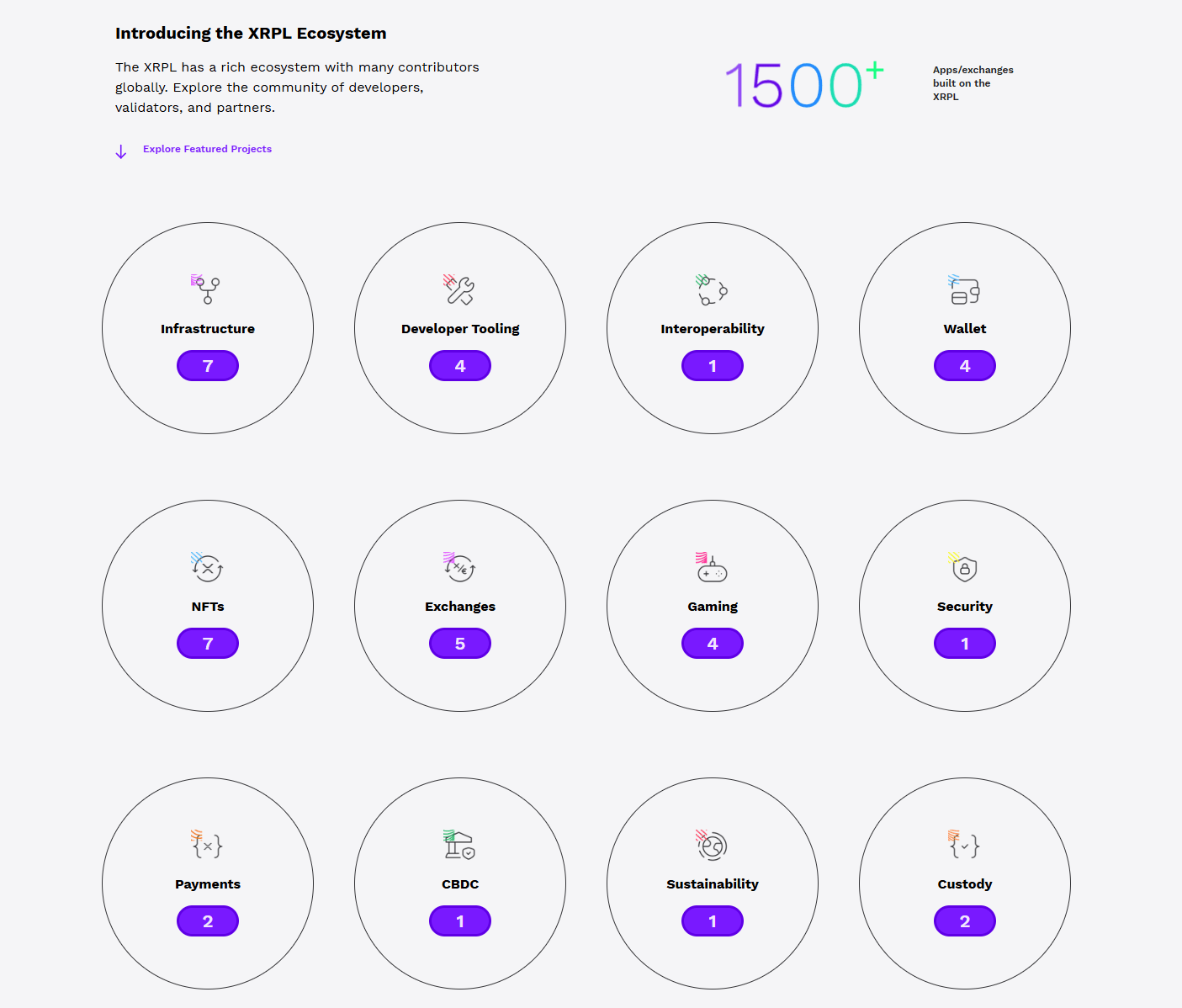
These fundamentals matter for long-term valuation. Utility is central to sustaining demand, and the XRP Ledger’s focus on payments and tokenization gives XRP a use case beyond speculation. The ability to bridge currencies at a low cost, combined with reliable settlement and growing adoption, sets the floor and potential ceiling for XRP’s price trajectory.
Ripple vs. XRP
Ripple is a company that develops payment solutions for banks and businesses. XRP is the digital asset that operates on the XRP Ledger. They are connected but distinct. Ripple uses XRP in some of its products, such as On-Demand Liquidity, but XRP also exists independently and trades freely on cryptocurrency exchanges.
XRP has a fixed maximum supply of 100 billion coins. About 59 billion are currently in circulation. A large portion of the supply was given to Ripple early on, and much of it is held in escrow. These escrows release coins on a set schedule, which provides predictability for supply. If the released coins aren’t used, Ripple returns them to the escrow account. This system helps limit inflation and makes the asset more transparent for investors watching its future availability.
Regulating the supply is an essential part of XRP’s tokenomics. Unlike coins that can be issued endlessly, XRP’s capped supply and planned release help prevent dilution. When combined with demand from payments and trading, this creates the balance that supports sustainable prices. If adoption increases while supply enters the market in a controlled manner, scarcity works to XRP’s advantage. This makes tokenomics a key factor in predicting how far XRP can go in 2026 and beyond.
Historical Context & SEC Case
XRP reached an all-time high of $3.84 in early 2018 during the last major crypto bull run. However, that momentum faded. In December 2020, the U.S. Securities and Exchange Commission filed a lawsuit against Ripple, claiming that the company raised over $1 billion through an unregistered offering of XRP. The case dragged on for years, heavily impacting the token’s price. Many U.S. exchanges removed XRP, and institutional investors avoided it while the outcome was uncertain.
The lawsuit became one of the most significant legal disputes in the cryptocurrency industry. Ripple chose to fight rather than settle, challenging the SEC’s view of securities law. This back-and-forth shaped XRP’s market narrative for almost five years.
In 2025, the case was finally resolved. Ripple agreed to pay a fine, but the court decided that secondary market sales of XRP are not classified as securities. This clarity opened the door for listings in the U.S., improved liquidity, and boosted institutions’ confidence in using XRP. The ruling also set a precedent that other projects can reference when facing regulatory challenges.
For price, the resolution was a turning point. Legal uncertainty had limited demand. With that cloud lifted, the conversation shifted to new products like ETFs and the possibility of a Ripple IPO, both of which could speed up institutional adoption.
Current Market Standing
The daily trading volume is nearly $6.6 billion, indicating consistent activity across major markets. The circulating supply stands at roughly 59 billion XRP, out of a fixed maximum of 100 billion.
Liquidity is deep across leading exchanges. Binance, Coinbase, OKX, Bitstamp, and Huobi all list XRP with active pairs against both crypto and fiat currencies. This broad coverage keeps XRP among the top-traded assets globally and ensures tight spreads for both retail and institutional participants.
The market has been relatively stable in the $2.3 to $3 range over recent weeks. Despite pullbacks from July’s $3.66 high, XRP has maintained substantial turnover compared to most altcoins. The return of U.S. exchange access after the SEC case has added further support.
These figures give XRP a firm position in the top tier of crypto assets by size and liquidity. A strong base of circulating supply and reliable market depth are crucial for sustaining investor interest, particularly as new financial products tied to XRP are introduced.
XRP Price Prediction 2026
Forecasting XRP’s price for 2026 comes down to how fundamentals play out over the next year. The ledger has proven it can scale, Ripple now has regulatory clarity, and liquidity on exchanges is back. The question is how much adoption and institutional participation will actually translate into demand for the asset. Based on current data and published forecasts, three main scenarios emerge.
Conservative Case: $2.20-$3.50
This range represents the lower end of analyst expectations. CoinCodex projects XRP between $2.79 and $3.23. InvestingHaven places a similar floor near $1.81 with a potential rise to $4.44 if momentum improves. Flitpay puts the low case at $2.20. Factors behind this scenario include weak macro conditions, lower interest in altcoins, or a lack of progress on Ripple’s adoption goals. Liquidity could stall if trading volumes drop or if Bitcoin dominance continues to rise, which often limits upside for other assets. In this situation, XRP would stay within its current range but fail to break out significantly.
Base Case: $3.00-$5.00
Most forecasts cluster in this range. Binance’s community consensus estimates XRP at around $3.03 for 2026. CoinDCX expects a breakout above $3.50, aiming for about $5.00. 99Bitcoins suggests a realistic mid-range around $6, while noting $2.50 as the lower limit. In this scenario, XRP benefits from steady growth in Ripple’s On-Demand Liquidity (ODL) service, stable regulatory conditions, and ongoing exchange support. Gradual adoption by banks and businesses would expand, and trading demand would remain steady. This outcome does not rely on dramatic new developments but instead on XRP continuing to meet its payment use case.
Bullish Case: $5.00-$10.00
The high case depends on stronger institutional adoption and new financial products tied to XRP. Standard Chartered predicts that XRP will reach $5.50 by the end of 2026, rising to $12.50 by 2028. Flitpay’s wide forecast includes an upside as high as $15. Finance Magnates analysts have suggested a move into the $4–$13 zone if momentum continues to accelerate. More aggressive calls, like The Tradable’s $18–$27 model or social media predictions of $100 or more, require extraordinary conditions and should be seen as speculative.
For XRP to sustain a move above $5, several catalysts would likely need to align. An exchange-traded fund (ETF) based on XRP could attract new capital flows, similar to what Bitcoin experienced with the approval of ETFs. Ripple has also floated the idea of a future IPO, which would increase attention and tie institutional value directly to XRP. Stablecoin projects like RLUSD, launched in Japan, may also increase settlement volumes on the ledger, directly boosting demand.
The weight of published forecasts supports the base case. Consensus points to a range between $3 and $5, with bullish targets beyond that tied to speculation on institutional products. Conservative forecasts show XRP holding near its current price with only limited upside. The key to which path plays out will be utility. If Ripple can prove that ODL and stablecoin settlement bring measurable volume onto the ledger, XRP can justify a move into the higher end of forecasts. If not, the asset may remain range-bound as traders focus on faster-growing competitors.
By late 2026, realistic expectations place XRP between $3 and $6, with a chance of pushing past $10 if multiple adoption catalysts align. Extreme targets in the hundreds should be treated as noise rather than serious outlooks.
Catalysts for Growth
Several fundamental factors could lift XRP beyond its base range in 2026. The first is Ripple’s On-Demand Liquidity service. ODL has already been rolled out with financial partners in Asia and Europe, and continued adoption would translate into real settlement volume on the XRP Ledger. Every increase in institutional usage builds a stronger case for demand.
A second catalyst is Ripple’s stablecoin initiative. The company launched RLUSD in Japan, aiming to provide a fiat-anchored payment option on the ledger. If this product scales, it could drive more utility by pairing stable settlements with XRP liquidity as a bridge asset.
Another driver could come from traditional markets. An exchange-traded fund tied to XRP would make the asset more accessible to institutions that cannot trade directly on crypto exchanges. Bitcoin and Ethereum both saw significant inflows after ETF approvals, and XRP could benefit from the same effect.
Ripple has also expressed interest in a future IPO. Listing shares on a public market would attract wider attention to the company and, by extension, to the XRP ecosystem. It could also enhance credibility with banks and regulators.
Risks and Bearish Scenarios
The most direct threat comes from competition. Solana has established itself as a fast settlement layer with strong developer interest, and Ethereum continues to grow through rollups. If these networks capture payment and tokenization use cases more quickly, XRP’s market share could decline.
Macro conditions are another risk. If global markets shift into a risk-off environment, liquidity across crypto could shrink. Bitcoin usually holds up better in such cycles, leaving altcoins like XRP under pressure. A stronger dollar or higher interest rates would also reduce appetite for speculative assets.
Bitcoin dominance plays into this dynamic. Historically, when Bitcoin takes a larger share of the market, capital drains from altcoins. XRP could remain stuck in a tight range if investors rotate back into Bitcoin during uncertain periods.
Overhyping is an additional concern. Social media frequently promotes unrealistic targets, such as $100 or even $1,000 per XRP. If expectations exceed fundamentals too much, the risk of disappointment and sharp sell-offs increases.
Market Sentiment
Sentiment around XRP in 2026 shows a clear divide between institutional research and retail communities. Standard Chartered projects XRP at $5.50 by the end of the year, framing it as a payment-focused asset that could gain share over time. Other banks and research firms cluster in the $3 to $6 range, with upside tied to measurable adoption.
Retail investors on social platforms often set far higher targets. Calls for $50, $100, or even more circulate daily on Twitter and Reddit. These numbers reflect optimism about Ripple’s partnerships and frustration that XRP has lagged other altcoins in past cycles.
In the short term, sentiment influences momentum. Retail enthusiasm can boost trading volume, especially when paired with news of partnerships or product launches. But fundamentals determine the underlying value. The adoption of ODL, the introduction of a stablecoin, and the chance of institutional products will dictate whether new inflows can be sustained. Without real utility, hype has rarely supported price over the long term.
Conclusion
XRP sits near $2.4 as of 2026, with consensus forecasts in the $3 to $6 range. Upside scenarios push above $10 if institutional catalysts align, while downside risk remains if macro conditions tighten or adoption slows.
The fundamentals stand out. The XRP Ledger is fast, cheap, and energy efficient. Ripple’s settlement products and new ventures, like stablecoins, keep the asset tied to real payment use cases. Regulatory clarity has also removed a major obstacle that held back growth for years.
Price forecasts remain speculative, but XRP has re-established itself as one of the most important payment-focused assets in crypto. The balance between adoption and market conditions will decide how far it can climb in 2026.
Frequently Asked Questions (FAQ)
Can XRP hit $10 in 2026?
It’s possible but depends on strong catalysts. Institutional products like an ETF or a Ripple IPO, combined with growing ODL usage, would be needed. Most forecasts place XRP lower, in the $3 to $6 range.
Will XRP beat its 2018 ATH?
XRP’s record high is $3.84. Many analysts see a break above that as achievable, especially if adoption continues. Whether it holds above $4 depends on market conditions and liquidity inflows.
What drives XRP’s price most?
Utility is the main driver. If banks and businesses use the XRP Ledger for payments and tokenization, that creates sustained demand. Regulatory clarity and exchange access also matter for liquidity.
Is XRP better than Bitcoin for payments?
For settlement speed and cost, yes. XRP transactions take seconds and cost fractions of a cent, while Bitcoin is slower and more expensive. But Bitcoin remains stronger as a store of value.
How risky is XRP in 2026?
XRP carries the same risks as other altcoins. Competition, macro downturns, or failed adoption could limit upside. Clarity from the SEC reduces legal risk, but market risk remains high.