

 Buy a Licensed Company
  Explore VASP Data
  Talk to an Expert

 Dren Hima
 is Head of Research at Coincub, leading research across digital asset regulation, licensing, market structure, tokenization and institutional adoption.
Dren Hima
Dren Hima is Head of Research at Coincub, leading research across digital asset regulation, licensing, market structure, tokenization and institutional adoption.
Ondo Finance and the Future of RWA
- RWA tokenization is now real infrastructure. The sector has moved past pilots and is now being used for actual treasury products, tokenized equities, and on-chain settlement.
- Ondo’s edge lies in its compliance-first design. Ondo uses offshore SPVs, regulated broker-dealers, and legal wrappers to bring traditional assets on-chain without ignoring securities law.
- USDY and OUSG serve two different markets. USDY targets non-U.S. offshore users looking for yield-bearing dollar exposure, while OUSG is built for accredited, permissioned institutional capital.
- Ondo is expanding beyond treasuries. The platform is pushing into tokenized stocks, day-one IPO access, and derivatives, which makes it more than just a tokenized Treasury issuer.
- The ONDO token still has a value-capture problem. ONDO governs the ecosystem, but it does not currently receive direct cash flow from protocol revenue, and that remains the biggest long-term question.
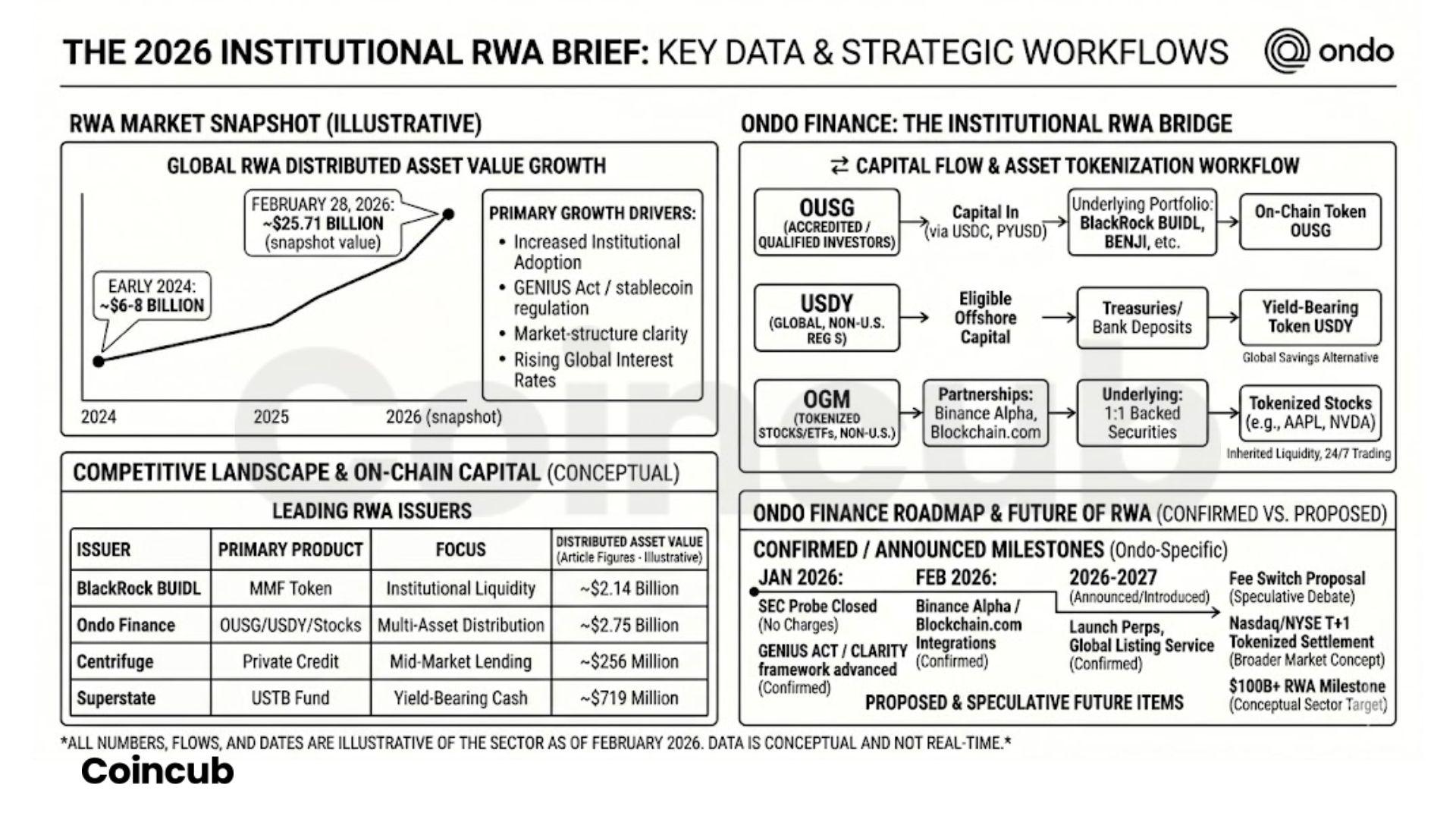
The tokenization of Real-World Assets (RWAs) has transitioned from proof-of-concept pilot programs into a functional component of global market infrastructure. As of late February 2026, the distributed value of tokenized assets across public blockchains reached approximately $25.71 billion. This growth is characterized by a shift in institutional focus: market participants are moving beyond the initial mechanics of asset digitization to increasingly prioritize secondary market liquidity, automated compliance, and programmable settlement.
A prominent entity in this sector is Ondo Finance. Operating across multiple blockchains, Ondo focuses on engineering regulatory-compliant digital wrappers for U.S. sovereign debt and publicly traded equities. By utilizing offshore special purpose vehicles (SPVs) and traditional custodial broker-dealers, the protocol aims to provide the borderless efficiency of decentralized finance (DeFi) while maintaining strict adherence to international securities laws.
This piece provides an objective analysis of Ondo Finance and the RWA landscape in early 2026. It examines the macroeconomic and legislative drivers of tokenization, the operational mechanics of Ondo’s core treasury and equity products, and the technical scope of newly proposed primitives such as Ondo Perps and the Ondo Chain. Furthermore, it analyzes the ongoing debate over tokenized settlement infrastructure (as highlighted by Nasdaq’s recent regulatory filings) and evaluates the structural tokenomics of the native ONDO asset.

Macroeconomic Context
The maturation of the RWA sector in 2026 is driven by the implementation of “Programmable Trust,” the embedding of compliance, identity verification, and counterparty risk controls directly into smart contracts. This allows for on-chain Delivery-versus-Payment (DvP), a cryptographic mechanism that synchronizes asset delivery and capital payment within a single atomic transaction. By mitigating the standard T+2 settlement delay of legacy markets, tokenized assets become highly mobile collateral that can be utilized across global trading venues around the clock.
A stabilizing regulatory baseline in the United States heavily supports this technological shift. Two key legislative developments have shaped the current environment:
- The GENIUS Act (2025): Enacted in July 2025, this legislation established the first comprehensive federal framework for payment stablecoins in the U.S.. By mandating 100% reserves and strict monthly disclosures for dollar-pegged tokens, the Act neutralized much of the systemic volatility associated with early crypto markets.
- The CLARITY Act: Following House passage of the CLARITY Act in 2025, the Senate Agriculture Committee advanced related market-structure legislation in January 2026, building on the CLARITY framework. The bill aims to resolve jurisdictional friction between the Securities and Exchange Commission (SEC) and the Commodity Futures Trading Commission (CFTC) by establishing clear market-structure rules for digital commodities and tokenized securities.
These legislative frameworks provide traditional asset managers with the legal certainty they need to interact with compliance-gated RWAs, tokenized treasuries, and new settlement rails, thereby directly validating the offshore and permissioned architectures built by protocols like Ondo. Additionally, in early 2026, the SEC formally closed a multi-year, confidential investigation into Ondo Finance without filing any charges. The closure of this probe reduced a key overhang for the protocol, demonstrating that its preemptive legal structuring and geographical fencing strategies could withstand federal scrutiny.
The Yield-Bearing Core: Tokenized U.S. Treasuries
At the foundation of its product suite, Ondo Finance tokenizes short-term U.S. Treasuries and government-sponsored enterprise (GSE) securities to create programmable cash equivalents. This segment is divided into two primary assets, each engineered for distinct regulatory profiles and target demographics: USDY and OUSG.
USDY: Permissionless Offshore Yield
The US Dollar Yield (USDY) token is designed to capture offshore liquidity. While it functions structurally like a stablecoin, it is backed by a portfolio of short-term U.S. Treasuries and institutional bank demand deposits. Unlike traditional stablecoin issuers that retain the yield generated by their reserves, USDY distributes a programmatic return directly to token holders.
To maintain regulatory compliance, USDY is offered exclusively under Regulation S exemptions of the U.S. Securities Act of 1933. The asset is strictly geo-blocked and unavailable to U.S. persons. Because it represents a bankruptcy-remote, yield-bearing claim, USDY is increasingly utilized as base-layer collateral within DeFi protocols, serving as an alternative to non-yielding stablecoins for offshore investors.
OUSG: Permissioned Institutional Access
Conversely, the Ondo Short-Term US Government Treasuries (OUSG) fund is a heavily permissioned asset built for high-net-worth individuals, corporate treasuries, and decentralized autonomous organizations (DAOs). OUSG relies on Rule 506(c) of Regulation D and Section 3(c)(7) of the Investment Company Act of 1940, allowing it to serve accredited U.S. entities legally.
The OUSG portfolio does not directly hold raw government bonds; it is invested in highly liquid traditional funds managed by institutions like BlackRock, Fidelity, and Franklin Templeton. OUSG supports instant subscriptions and redemptions via USDC or PYUSD, while the portfolio itself includes fund holdings, bank deposits, and USDC for liquidity. The product provides institutional capital with constant access to Treasury yields while remaining within a compliant, KYC-gated environment.
Tokenized Equities: Ondo Global Markets
Beyond sovereign debt, the tokenization of global corporate equities represents a significant growth vertical. Ondo Finance is one of the leading issuers in the tokenized public equities sector through its Ondo Global Markets (OGM) platform, offering on-chain exposure to major U.S. stocks and ETFs.
Legal Architecture and Structured Notes
Tokenizing publicly traded securities requires precise legal engineering to avoid violating domestic securities laws. Ondo’s tokenized stocks are not direct bearer shares; legally, they are classified as structured notes.
These notes are debt instruments issued by Ondo Global Markets (BVI) Limited, a bankruptcy-remote special purpose vehicle (SPV) organized in the British Virgin Islands, with token holder rights governed by Swiss law. The tokens are backed on a strict 1:1 basis by the actual physical securities, which are held by regulated custodial broker-dealers.
A designated Security Agent maintains a first-priority perfected security interest in these underlying assets for the benefit of the token holders. While economic exposure is mirrored on-chain (dynamically incorporating corporate actions like dividend distributions and stock splits), token holders do not possess direct shareholder voting rights or traditional corporate information rights from the underlying issuer. Similar to USDY, these products rely on Regulation S exemptions and are not available to U.S. investors.
Expansion and Exchange Integration
The utility of tokenized equities relies heavily on distribution. In February 2026, Ondo expanded its distribution network through strategic integrations. Binance incorporated Ondo tokenized stocks into its Binance Alpha platform, allowing eligible non-U.S. users to trade fully collateralized U.S. equities using funds from centralized exchanges. Concurrently, Blockchain.com expanded its partnership with Ondo to offer these regulated tokenized stocks directly to users across the European Economic Area (EEA) via its self-custodial DeFi wallet, aiming to reduce the friction of accessing traditional cross-border brokerage services.
Advanced Primitives: Day-One IPOs and Ondo Perps
Building on the OGM infrastructure, Ondo Finance introduced two new financial primitives in February 2026 designed to alter how global capital interacts with U.S. markets: Ondo Global Listing and Ondo Perps.
Ondo Global Listing
Historically, access to Initial Public Offerings (IPOs) in the United States has been concentrated among institutional clients and specific geographic demographics. The Ondo Global Listing service facilitates the tokenization of U.S. stock IPO shares on their first day of trading. By routing IPO allocations through the established OGM legal structure, near-real-time onboarding is achieved on public blockchains. This mechanism allows non-U.S. on-chain wallets to gain immediate exposure to the initial price action of newly public entities, bypassing traditional localized brokerages.
Ondo Perps and Collateral Efficiency
Perpetual futures contracts are a standard trading instrument in digital asset markets. However, traditional crypto derivative platforms often require users to post non-yielding stablecoins or volatile crypto assets as margin.
Ondo Finance introduced Ondo Perps, a derivatives platform for eligible non-U.S. users, allowing them to trade perpetual futures on U.S. stocks, ETFs, and commodities. The primary operational shift is its capital efficiency model: traders can post tokenized, yield-bearing securities (such as OUSG or tokenized blue-chip stocks) as margin collateral. This architecture mirrors the traditional prime brokerage model, allowing investors to continue earning baseline Treasury yields or stock dividends on their collateral while simultaneously maintaining leveraged derivative positions. To support accurate cross-margining and liquidation engines, Ondo integrated decentralized oracle networks to deliver live, institutional-grade price updates directly on-chain.
Infrastructure Strategy: The Proposed Ondo Chain
While currently deploying liquidity across multiple general-purpose networks like Ethereum, Solana, and BNB Chain, Ondo Finance has outlined plans for its own bespoke infrastructure: the Ondo Chain.
The proposed Ondo Chain is a Layer-1 Application-Specific Blockchain (AppChain) intended to synthesize public blockchain interoperability with the strict compliance requirements of institutional finance. Built leveraging the Cosmos SDK and designed to be EVM-compatible, the architecture is intended to support high throughput and fast finality via the CometBFT consensus mechanism while retaining access to established Ethereum developer tooling.
According to protocol documentation, the defining characteristic of the planned Ondo Chain is its native integration of compliance and oracle infrastructure. Key proposed features include:
- Enshrined Oracles & Proof of Reserves: Through base-layer consensus, validators will automatically verify off-chain data such as asset prices and proof of reserves held at custodial broker-dealers.
- Asset-Backed Security: Validators are intended to include institutional asset managers who can stake high-quality liquid assets (such as tokenized RWAs) to secure the network, rather than relying solely on volatile native cryptocurrencies.
- Permissioned Validators with Open Access: While the validator set will be permissioned to prevent front-running and ensure best execution, the network will remain open to global users and developers to build applications.
The Regulatory Friction: The Battle for Settlement
As the tokenization sector scales, a systemic debate is unfolding regarding the control of the underlying settlement layer. In late 2025 and early 2026, the Nasdaq Stock Market submitted a proposed rule change to the SEC seeking approval to trade tokenized versions of eligible securities on its exchange.
Nasdaq’s proposal relies heavily on clearing and settling these tokens through the legacy Depository Trust Company (DTC) pilot program. Under this model, blockchain technology is utilized primarily as a supplementary digital representation managed by the centralized depository, rather than serving as an independent, peer-to-peer transfer mechanism.
Ondo Finance engaged directly in this regulatory discourse by submitting a formal comment letter to the SEC. The protocol urged regulators to support a multi-pathway approach to tokenization. Ondo argued that while intermediated ownership (via the DTC) is valid, SEC policy must equally support the direct registration and transfer of tokenized securities on public, permissionless blockchains. This regulatory friction highlights a broader industry divide: legacy institutions generally prefer to integrate blockchain within existing intermediated structures, whereas crypto-native firms advocate for open-architecture models that preserve decentralized composability and direct ownership.
Tokenomics: Valuation and the Value Capture Debate
Despite Ondo’s significant footprint in the RWA sector, the economic design of the native ONDO token remains a focal point of industry analysis. As of late February 2026, ONDO trades with a market capitalization of approximately $1.18 billion and a Fully Diluted Valuation (FDV) of roughly $2.42 billion.
Supply Dynamics and Unlocks
The ONDO token launched with a fixed genesis supply of 10 billion tokens. The distribution model is weighted heavily toward ecosystem growth (52.1%) and core protocol development (33%). In January 2026, the protocol executed a scheduled token unlock, substantially expanding the circulating supply. A portion of these unlocked tokens was distributed to early private sale investors, while the majority was earmarked for treasury ecosystem growth. While large supply unlocks historically introduce downward pricing volatility, market data in late February indicated that exchange inflows had moderated. The asset was consolidating, suggesting that the market absorbed the new supply alongside the announcements of new product integrations.
The Structural Ambiguity of Value Capture
The primary analytical debate surrounding the ONDO token concerns the disconnect between protocol revenue generation and tokenholder value accrual. Ondo Finance secures billions in assets under management, generating revenue through management and platform fees charged on the underlying traditional assets. However, under the current legal and technical framework, the ONDO token captures zero direct cash flow from these operations. The revenue accrues entirely to the corporate entities managing the protocol.
Currently, ONDO functions strictly as a governance instrument, granting holders the right to vote on DAO proposals, system parameters, and treasury management. Market participants are split on the token’s long-term trajectory.
Some analysts anticipate that, as regulatory clarity improves in the U.S., the Ondo DAO may eventually propose a “fee switch” to route a percentage of protocol revenue to token holders or institute programmatic buybacks. Furthermore, the eventual launch of the Ondo Chain could require ONDO for network gas fees and validator staking, providing direct organic utility. Conversely, skeptics argue that stringent compliance with U.S. securities laws may permanently prevent the DAO from implementing direct value capture mechanisms without triggering regulatory interventions. The resolution of this structural ambiguity will be the determining factor in ONDO’s long-term economic viability.
Competitive Landscape
The institutional tokenization ecosystem in 2026 is highly competitive, defined by a mix of crypto-native protocols and legacy asset managers.
- BlackRock (BUIDL): BlackRock’s USD Institutional Digital Liquidity Fund (BUIDL) serves as the primary institutional reference asset in the tokenized money-market space. By late February 2026, BUIDL maintained approximately $2.14 billion in assets. BUIDL caters strictly to the highest tier of institutional capital through rigorous onboarding processes. While a direct competitor in the Treasury sector, it validates the asset class, and Ondo itself uses BUIDL as a reserve asset for its OUSG fund.
- Centrifuge: While Ondo focuses on highly liquid public securities and treasuries, Centrifuge has established a strong presence in the institutional private credit market. Managing roughly $256 million in tokenized value, Centrifuge focuses on illiquid assets such as real estate debt and supply chain invoice factoring, complementing rather than directly competing with Ondo’s liquid equity models.
- Securitize & Superstate: Firms like Securitize (which partners with BlackRock) and Superstate are actively deploying compliant infrastructure for traditional funds. Superstate manages over $719 million in tokenized assets, contributing to a diversified and highly competitive primary issuance market.
Frequently Asked Questions (FAQ)
What is Ondo Finance?
Ondo Finance is a protocol focused on bringing regulated real-world assets, such as U.S. Treasuries and public equities, on-chain.
What does RWA mean?
RWA stands for Real-World Assets, meaning traditional assets like bonds, funds, or stocks represented on blockchain rails.
What is USDY?
USDY is a yield-bearing token for non-U.S. users backed by short-term U.S. Treasuries and bank deposits.
What is OUSG?
OUSG is a permissioned tokenized Treasury product built for accredited investors and qualified purchasers.
Can U.S. users access all Ondo products?
No, products like USDY and tokenized equities rely on Regulation S and are restricted from U.S. persons.
How are Ondo tokenized stocks structured?
They are structured notes issued by a BVI SPV and backed 1:1 by underlying securities held with regulated custodians.
Do Ondo tokenized stockholders get voting rights?
No, holders get economic exposure, not direct shareholder voting rights.
What is Ondo Perps?
Ondo Perps is a derivatives product that lets eligible non-U.S. users trade perpetual futures on stocks, ETFs, and commodities using tokenized assets as collateral.
What is Ondo Chain?
Ondo Chain is a proposed Layer-1 network designed to support compliance-heavy institutional tokenization with built-in oracle and transfer controls.
Does the ONDO token earn protocol revenue?
No, ONDO is currently a governance token and does not receive direct revenue from Ondo’s underlying products.