


 Buy a Licensed Company
  Explore VASP Data
  Talk to an Expert

 Atis Shala
Atis is a senior analyst and community lead with four years of experience in crypto. He has a bachelor from the Rochester Institute of Technology.
Atis Shala
Atis is a senior analyst and community lead with four years of experience in crypto. He has a bachelor from the Rochester Institute of Technology.
DEX vs. CEX in 2026
Key Takeaways:
- The industry has entered a Great Convergence where the binary choice between CEX and DEX has dissolved into a seamless, multi-venue trading experience.
- Centralized exchanges maintain an 80% dominance over spot trading and fiat on-ramps, while decentralized perpetual volume has exploded to record highs of $6.7 trillion.
- Regulatory clarity from the GENIUS and CLARITY Acts has enabled an institutional mullet strategy that pairs regulated centralized custody with high-velocity decentralized execution.
- Breakthroughs in account abstraction and intent-based trading have essentially made the underlying blockchain tech invisible to the average user.
- The market has shifted toward the Hybrid Exchange (HEX) model, where traders prioritize best execution and liquidity over philosophical loyalty to a specific platform type.
For the better part of a decade, the cryptocurrency industry was locked in a philosophical and practical civil war. On one side stood the Centralized Exchanges (CEXs), the titans of custody, the gateways to fiat, the polished, user-friendly giants like Binance and Coinbase that mimicked the architecture of Wall Street. On the other side were the Decentralized Exchanges (DEXs), the scrappy, idealistic, code-is-law protocols like Uniswap and dYdX that promised self-sovereignty but often demanded a steep learning curve and higher transaction friction.
Traders were forced to choose sides. You were either a normie who left your coins on an exchange, or you were a DeFi native navigating nonces, gas fees, and bridge hacks.

The Great Convergence of Exchanges
Welcome to 2026. That war is over. Neither side won. Instead, the binary choice has died.
The industry has arrived at a moment of synthesis, a Great Convergence, between CEXs and DEXs. The catalyst was not a single event, but a relentless accumulation of technological breakthroughs and regulatory clarity that redefined market structure. The past twelve months, specifically the explosive Perp Boom of 2025, have fundamentally altered where and how capital moves.
The data tells the story of a bifurcated yet symbiotic ecosystem. While centralized entities have solidified their grip on spot trading and fiat on-ramps, fortified by the regulatory moats of the U.S. CLARITY and GENIUS Acts, the derivatives market has undergone a decentralized revolution. In 2025, decentralized perpetual exchange volume surged 346% year-over-year, hitting a record $6.7 trillion. This was a migration of sophisticated flow.
The Current State of DEX vs CEX
Today, the average sophisticated trader operates in a state of hybridity. They hold their fiat and parking capital on CEXs for the safety of insured custody and regulatory compliance, yet they route their high-velocity, complex strategies through onchain venues like Hyperliquid, Lighter, and EdgeX. They do this out of necessity. The user-experience gap has closed. The latency gap has vanished. The fee gap has inverted. In 2026, the question is no longer DEX or CEX? It is simply: “Where is the best execution?”
The Macro Data Landscape: CEX vs DEX
To understand the nuance of 2026, one must look beyond the top-line numbers and analyze the divergent paths of spot and derivatives markets. The crypto economy has effectively split into two distinct layers of activity: the layer of Access (Spot) and the layer of Action (Derivatives).
The Spot Plateau: The 80/20 Rule
In the spot market, the revolution has been quiet. Decentralized spot trading has stabilized, hovering stubbornly near 20% of total global volume. This figure has become something of a constant in market modeling.
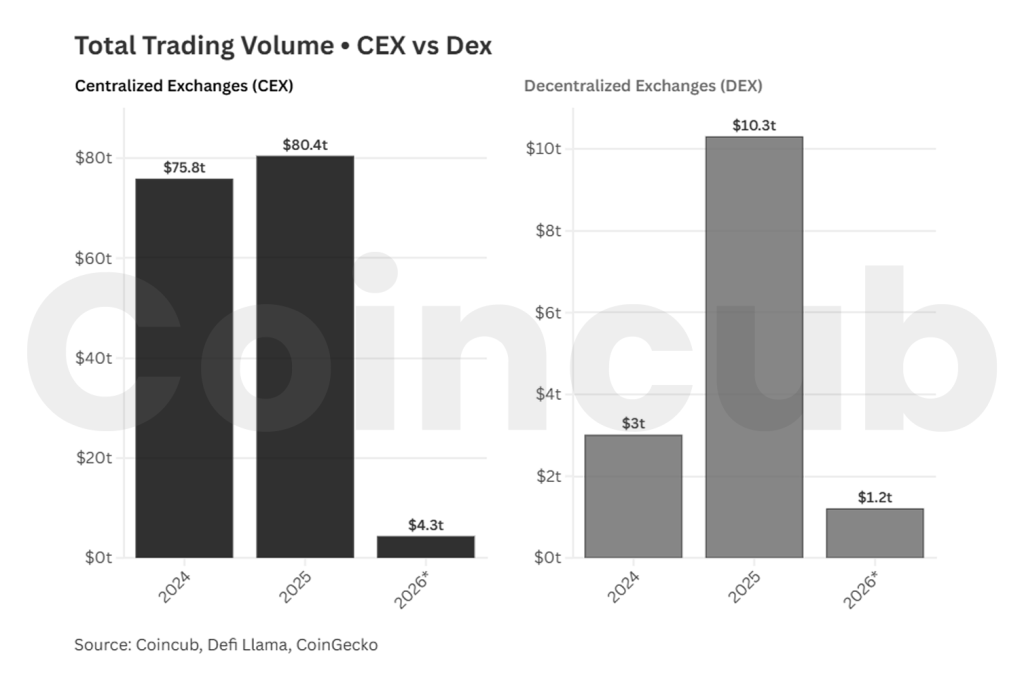
We saw a brief deviation from this norm during the Memecoin Mania of June 2025, a frenetic period driven by Solana and BNB Chain token speculation that saw DEX market share spike to nearly 37%. However, as the frenzy cooled, gravity took hold. By early 2026, the split returned to the historical mean: CEXs control roughly four-fifths of all spot volume.
The resilience of the CEX spot market is underpinned by the fiat moat. Despite the proliferation of stablecoins, the primary entry point for new capital remains the banking system. Whether it is a retail user depositing a paycheck or a hedge fund wiring millions, the path of least resistance leads to a regulated entity with a banking license. Global liquidity for major pairs – BTC/USD, ETH/EUR – remains deepest on centralized order books, which continue to serve as the price discovery engines for the broader market.
The Derivatives Explosion
Contrast this with the derivatives sector, where the tectonic plates have shifted violently. The ratio of DEX-to-CEX derivatives volume has climbed to approximately 19.9%. While CEXs still dominate in raw nominal terms, processing $86.2 trillion in 2025 compared to the DEX sector’s $6.7 trillion, the growth velocity is entirely onchain.
| Year | CEX Derivatives (Trillion) | DEX Derivatives (Trillion) | DEX/CEX Ratio |
| 2024 | $52.45 | $1.50 | 2.86% |
| 2025 | $61.80 | $6.70 | 10.84% |
| 2026 (YTD) | $3.50 | $0.70 | 19.97% |
The momentum signals a changing of the guard. In October 2025 alone, monthly DEX perpetual volume hit a record $903.6 billion, representing a more than tenfold year-over-year increase. In comparison, CEX futures grew at a modest 47% year-over-year.
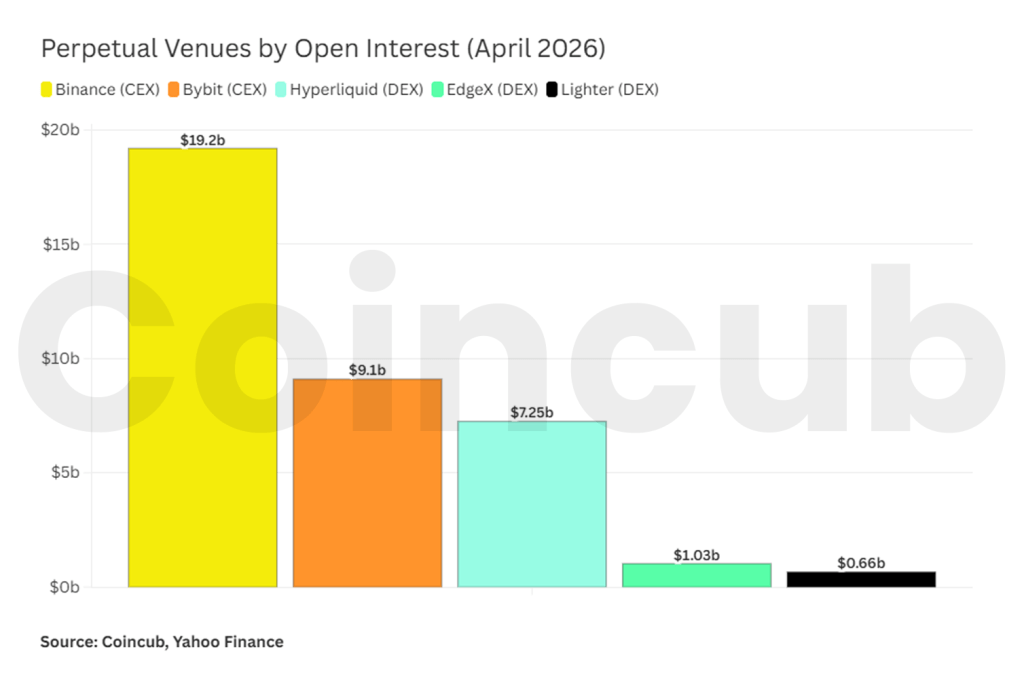
The most telling metric, however, is Open Interest (OI), the amount of capital actively committed to trades. CEX open interest actually declined by 20.8% in 2025, while DEX open interest skyrocketed by 229.6%. This divergence indicates that while high-frequency algorithms might still churn volume on CEXs, longer-term position traders and whales are increasingly comfortable holding their leverage onchain. They are voting with their collateral, moving it away from centralized exchange wallets and into smart contract vaults.
The Hidden OTC Economy
There is a third dimension to this data that public charts often miss: the Institutional Over-The-Counter (OTC) market.
Institutional flows have largely bypassed public retail spot markets. According to Finery Markets, crypto spot OTC trading surged 109% year-over-year in 2025. This dwarfs the growth of on-exchange spot volumes and data point resolves a key paradox of 2026: Why do onchain volumes look so robust while CEX spot volumes appear to have plateaued?
The answer lies in the workflow. Large traders are executing block trades via CEX prime desks or OTC brokers to minimize slippage, then immediately withdrawing those assets to settle into DeFi venues for yield farming or derivatives trading. The capital is sourced centrally but employed decentrally. This behavior explains the hollow middle, headline spot volumes are flat, but OTC and onchain perp volumes are booming.
The Derivatives Battlefield for CEX vs DEX
If the spot market is a utility, the derivatives market is a gladiator arena. It is here that the most intense innovation of the last two years has occurred, driven by a new generation of protocols that have finally solved the blockchain trilemma for trading: Speed, Decentralization, and Liquidity.
By late 2025, the narrative that “DEXs are too slow for serious trading” was dead. It was killed by a cohort of platforms that industry analysts now call the DEX Champions: Hyperliquid, Lighter, EdgeX, and Jupiter.
Hyperliquid: The Speed of Light
Leading the pack is Hyperliquid. By eschewing general-purpose blockchains in favor of a customized Layer-1 built specifically for trading, Hyperliquid transformed the landscape. It operates as an onchain Central Limit Order Book (CLOB), not an Automated Market Maker (AMM).
The stats are staggering. In 2025, Hyperliquid processed roughly $37.9 billion in weekly perpetual volume, maintaining an open interest of around $5.5 billion. These are not DeFi numbers… these are Coinbase numbers. The platform’s specialized consensus mechanism allows for sub-second finality, meaning a trader can click buy and receive confirmation instantly, with no fear of a failed transaction or a front-running bot sandwiching their order.
More aggressively, Hyperliquid attacked CEXs on the one front where they felt safe: fees. By offering taker rebates of up to 90%, the protocol effectively pays market makers to provide liquidity. This created a virtuous cycle. As liquidity deepened, slippage vanished, attracting more volume, which generated more fees to fund rebates.
The Supporting Cast: Lighter, EdgeX, Jupiter
While Hyperliquid focused on a sovereign chain approach, others leveraged the scaling power of Ethereum and Solana.
- Lighter: Built as a zk-rollup on Ethereum, Lighter capitalized on the privacy and compression benefits of zero-knowledge proofs. By the fall of 2025, its daily volumes exceeded $10 billion, with open interest hovering near $2 billion. On volatile days, Lighter frequently flipped Hyperliquid in volume, proving that Ethereum-aligned traders were hungry for a native high-performance venue.
- EdgeX: Utilizing StarkEx technology, EdgeX carved out a niche for professional algorithmic traders, processing $4.6 billion daily. Its API-first design made it the darling of quant funds migrating from traditional finance.
- Jupiter: On Solana, Jupiter expanded from a spot aggregator into a derivatives powerhouse. Anchoring over $4 billion in Total Value Locked (TVL), it leveraged Solana’s high throughput to offer a retail-friendly perpetuals experience that felt as snappy as a mobile game.
The CEX Counter-Punch
The centralized incumbents did not watch this migration passively. In 2025 and 2026, we witnessed a strategic pivot from the giants. Realizing they could not beat the transparency of onchain trading, they decided to co-opt it.
The result was the Exchange Chain phenomenon.
- Kraken Ink: Launched ahead of schedule in late 2024 on the Optimism OP Stack, Kraken Ink represents a walled garden DeFi ecosystem. It allows Kraken users to move funds seamlessly from their centralized account to a Kraken-branded L2, where they can interact with dApps in a semi-regulated environment.
- Binance & BNB Chain: Binance doubled down on its ecosystem, funneling activity to the BNB Chain. Their 2025 Year-in-Review highlighted $2.3 billion in onchain TVL, driven by the integration of the Binance Web3 Wallet, a tool that lives inside the main Binance app, blurring the line between the exchange and the chain.
- Coinbase & Base: Coinbase’s Base L2 deepened its integration, allowing DEX trading directly from the Coinbase app.
This counter-strategy is driven by economics. By keeping the transaction lifecycle within their proprietary or affiliated chains, CEXs can capture value at every step: the deposit fee, the trading fee, and the sequencer fee (gas) of the L2. They are essentially internalizing the revenue that used to leak out to Ethereum miners or independent validators.
Spot Markets & The Liquidity Moat
While derivatives have flown the coop, the spot market remains the fortress of centralization. The primary reason is the enduring complexity of the global banking system.
In 2026, despite numerous pilot programs for Central Bank Digital Currencies (CBDCs) and the expansion of stablecoins like USDC and PYUSD, there is still no truly decentralized way to turn a bank wire into crypto without a regulated intermediary. The fiat on-ramp is the choke point of the entire industry.
Exchanges like Binance and Coinbase have leveraged this choke point to evolve into Super-Apps.
Consider the user journey of a retail trader in 2026. They open their Coinbase app. They deposit USD instantly via the FedNow payment rail. If they want to buy Bitcoin, they do it on the centralized spot market. But if they want to buy a new, trending token that is only available onchain? Two years ago, they would have had to withdraw funds to MetaMask, bridge to a network, and swap on Uniswap.
Today, that friction is gone. The Super-App integrates the DEX experience. The user stays in the Coinbase interface, clicks “Trade on DEX,” and the app handles the routing in the background using an embedded wallet. The user effectively trades on a DEX, but through a CEX window.
This integration has solidified the CEX’s role as the operating system of crypto. They provide the safety, the recovery tools, and the tax reporting, while outsourcing the long-tail asset listings to the decentralized protocols.
The Long Tail: Where DEXs Shine
This brings us to the one area where DEX spot markets remain unrivaled: Discovery.
DEXs own the day zero market. In 2026, 80-90% of all new tokens, whether they are governance tokens for serious protocols or the latest memecoins, launch exclusively on DEXs. The economics dictate this. Listing on a Tier-1 CEX takes months of due diligence and often involves six-figure listing fees or market-making requirements. Creating a liquidity pool on Uniswap or Raydium takes five minutes and costs a few dollars in gas.
| Platform Type | Primary Venue(s) | Avg. New Listings (Monthly) | 13-Month Cumulative (2025-26) |
| DEX (Exclusive) | Uniswap, Pump.fun, Raydium | ~2,000,000 | 24.04 Million |
| DEX + CEX (Aggressive) | MEXC, Gate.io, Bitget | ~100 | 1,281 |
| DEX + CEX (Strict) | Binance, Coinbase, OKX | ~5-8 | 100 |
We saw this dynamic play out vividly in late 2025, when Raydium’s volume on Solana briefly rivaled Uniswap’s on Ethereum, driven entirely by a resurgence in speculative memecoins. For the risk-seeking trader hunting the next 100x gem, the DEX is the only game in town. The CEX is where assets go to retire; the DEX is where they are born.
Consequently, the revenue models have bifurcated. CEXs generate billions from listing fees, withdrawal fees, and volume on blue chip assets like Bitcoin or Solana. DEXs generate revenue (for their LPs) from the high-velocity churn of the long tail.
Regulation & The Institutional Mullet on Crypto Exchanges
Perhaps the most significant development of 2025-2026 has been the clarification of the rules of engagement. The wild west era is officially closed, replaced by the era of the Regulatory Moat.
In the United States, the passage of the GENIUS Act and the CLARITY Act fundamentally altered the institutional calculus. These bills established a comprehensive framework for stablecoin issuance and digital asset exchanges. They provided the legal enforceability that Wall Street compliance departments had been waiting for. Across the Atlantic, the full implementation of Europe’s MiCA created a unified compliance standard for the EU.
“Clarity is the best compliance tool,” a New York regulator famously stated in late 2025. And she was right.
The Failure of Permissioned DeFi
Interestingly, the industry’s initial attempt to woo institutions, Permissioned DeFi, largely failed. Initiatives like Aave Arc, which created separate, allowlisted pools for institutions, struggled to gain traction. As of mid-2025, Aave Arc held a paltry $50k in TVL.
Why? Because institutions didn’t want a kiddie pool. They wanted the deep liquidity of the main markets. They wanted to be safe rather than segregated.
The Hybrid Solution for Crypto Exchanges
The market solved this via the Mullet structure. Institutions now utilize regulated custodians and prime brokers (the Front) to handle KYC, AML, and fiat logistics. These brokers then act as the bridge, executing trades in the broader DeFi ecosystem (the Back) on behalf of the client, often using anonymized or aggregated omnibus accounts.
This allows a hedge fund to technically remain within the regulatory perimeter of their prime broker while accessing the yield and liquidity of Hyperliquid or Uniswap.
Custody 2.0: MPC and the Death of “Not Your Keys”
The technological enabler of this hybrid model is Multi-Party Computation (MPC). The old maxim “Not your keys, not your coins” has been rendered nuanced by MPC.
MPC wallets split a private key into multiple shards distributed across different parties. An institution can hold one shard, their custodian can hold another, and a third-party auditor can hold a third. A transaction requires a quorum to sign.
This setup offers the best of both worlds: the security and recoverability of institutional custody with the agility of onchain interaction. By 2026, MPC has become the industry standard. It allows institutions to feel safe holding billions in crypto assets because there is no single point of failure, no single employee who can run off with a private key, and no single hack that can drain the vault.
The Future of Crypto Exchange Technology & UX
If you ask a retail user in 2026 how they use a DEX, they might look at you confused. “I don’t use a DEX,” they might say, “I just trade on my wallet.”
This is the triumph of abstraction. The friction points that defined the 2020-2024 era, gas management, chain switching, failed transactions, MEV attacks, have been abstracted away by two massive technological shifts: Intent Networks and Account Abstraction.
The Era of Intents
The dominant trading paradigm of 2026 is Intent-Based Trading. In the old model, a user submitted a specific transaction: “Swap 1 ETH for 2000 USDC on Uniswap v3 pool X.” If the price moved while the transaction was pending, the trade failed or was sandwiched by a bot.
In the Intent model, utilized by protocols like Uniswap X, CowSwap, and 1inch Fusion, the user simply signs a message: “I want to trade 1 ETH and receive at least 2000 USDC.”
This intent is broadcast to a network of offchain solvers (sophisticated market makers). These solvers compete to fill the order at the best possible price. The winner bundles the trade and executes it. The user pays no gas (the solver pays it) and is protected from MEV (because the price is guaranteed by the solver).
Uniswap reports that in 2025, its X protocol facilitated over $7 billion in volume in just six months using this model. It turns the DEX into a passive infrastructure layer, while the solvers act as the active engines of liquidity.
Account Abstraction: One-Click Magic
Parallel to intents is the widespread adoption of ERC-4337 (Account Abstraction). This standard transformed the crypto wallet from a random key-pair into a smart contract.
In 2026, users log in to trading terminals using WebAuthn (FaceID or TouchID). There are no seed phrases to scribble on paper. Recovery is handled via Social Recovery (guardians) or email-based MPC backups.
Trust Wallet’s SWIFT smart wallet exemplifies this shift. It abstracts away gas entirely; the user pays fees in the token they are trading (or the fees are sponsored by the app). A user can trade USDC for ETH on an Arbitrum DEX without holding any Arbitrum ETH for gas. The wallet handles the conversion in the background.
Infrastructure: The Speed Demons
Underpinning all of this is the raw performance of the blockchains themselves.
- Ethereum: The Glamsterdam upgrade in late 2025 optimized data blobs and parallel processing, significantly lowering L2 costs and congestion.
- Solana: The production launch of Firedancer in 2025 was a watershed moment. This new validator client, written in C++, rebuilt Solana from the ground up, delivering theoretical throughputs of over 1 million transactions per second.
For the end user, these upgrades mean that the blockchain part of the experience is invisible. Apps open instantly. Trades settle in under a second. The spinning wheel of death is a relic of the past.
Conclusion: The Era of the Hybrid Exchange (HEX)
As we look toward 2027, the trajectory is undeniable. The Death of the Binary is permanent. The future belongs to the Hybrid Exchange (HEX).
The pure-play models are dying. Tier-2 CEXs that failed to integrate onchain features have largely merged or shuttered, their liquidity cannibalized by the giants or the DEXs. Conversely, pure DEXs that refused to cater to compliance or fiat connectivity have been relegated to niche status, serving only the most hardcore privacy advocates.
The winners of the next cycle will be the platforms that most effectively blur the lines. They will offer the regulatory safety of a bank, the user experience of a FinTech app, and the boundless execution capability of the blockchain.
We are moving toward a world where liquidity fabrics connect all chains and venues. Smart Order Routers (SORs) will become the most valuable pieces of code in finance, dynamically routing every trade to the venue, centralized or decentralized, that offers the best net outcome.
The war is over. The walls have come down. In 2026, we stopped caring about who hosts the server. We stopped caring about the ideology of the database. We just wanted the trade to settle fast, cheap, and safe. And finally, we got it.
Frequently Asked Questions (FAQs)
Is Binance a CEX or Dex?
Binance is primarily a Centralized Exchange (CEX). While the company launched the Binance DEX on the BNB Chain, the main global platform (Binance.com) operates as a centralized entity. It manages user funds, provides high-speed order matching, and requires identity verification (KYC) to maintain regulatory compliance across its vast liquidity pools.
Is CEX.IO centralized or decentralized?
CEX.IO is a centralized exchange, as its name explicitly suggests. It functions as a regulated custodial platform where the company manages the ledger and secures user assets. Unlike a DEX, it requires users to pass identity checks and serves as a trusted intermediary for fiat-to-crypto and spot trading.
What is a centralized exchange (CEX)?
A Centralized Exchange (CEX) is a platform managed by a central organization that facilitates cryptocurrency trading. Acting as a middleman, the CEX maintains an order book, provides liquidity, and holds user funds in custody. Most CEXs offer advanced features like fiat on-ramps, 24/7 customer support, and institutional-grade security.
Which is better, Dex or CEX?
Neither is objectively better. It fully depends on your goals. CEXs are superior for high liquidity, fast execution, and easy fiat deposits. DEXs win on privacy, permissionless access to new tokens, and true self-custody. Use a CEX for convenience and a DEX for full control over your keys.
What is an example of dex?
Uniswap is the most widely recognized example of a Decentralized Exchange (DEX). It operates on the Ethereum blockchain using automated smart contracts and liquidity pools rather than a central authority. Other major examples include Jupiter (on Solana) and PancakeSwap (on BNB Chain), which allow direct peer-to-peer trading.