


 Buy a Licensed Company
  Explore VASP Data
  Talk to an Expert

 Dren Hima
 is Head of Research at Coincub, leading research across digital asset regulation, licensing, market structure, tokenization and institutional adoption.
Dren Hima
Dren Hima is Head of Research at Coincub, leading research across digital asset regulation, licensing, market structure, tokenization and institutional adoption.
Automated Crypto Tax-Loss Harvesting: AI, DeFi, and IRS Rules

- AI can automate crypto tax-loss harvesting across DeFi. Modern execution tools such as intent-based routing, gRPC streaming, and lower-cost Layer 2 settlement make continuous harvesting more feasible than before.
- Spot crypto still sits outside the classic wash sale rule in many cases. Bitcoin and Ethereum are generally not treated as stock or securities under IRC Section 1091, but tokenized securities are a different story.
- Compliance risk does not disappear just because the wash sale rule may not apply. Practitioners still warn that the IRS could challenge instant sell-and-rebuy strategies under the Economic Substance Doctrine.
- DeFi broker reporting was rolled back, but taxpayer reporting still applies. DeFi platforms and non-custodial wallets do not issue 1099-DAs under the nullified broker rule, but users still have to track and report gains and losses themselves.
- The infrastructure is ahead of the legal certainty. The tools to build autonomous harvesting agents are already here, but the tax treatment around aggressive automation remains gray in important areas.
AI agents can help automate crypto tax-loss harvesting across fragmented DeFi venues. Some of the execution stack already exists, including intent-based routing, ultra-low-latency streaming, and cheaper Layer 2 settlement. But the compliance layer is less settled than many crypto tax pieces suggest. Spot crypto still sits outside the classic wash-sale rule in many cases, while tokenized securities do not. Economic substance risk is also more nuanced than a simple automated rule can capture.
This piece separates the confirmed regulatory framework from the practitioner interpretations and plausible technical architectures being developed to execute continuous, high-frequency tax-loss harvesting in decentralized environments.
The Confirmed State of Digital Asset Taxation
Automated portfolio management systems must be built upon the verified boundaries of U.S. tax law. The Internal Revenue Service (IRS) strictly treats digital assets as property, not fiat currency, meaning that any sale, exchange, or disposal of a digital asset triggers a taxable capital gain or loss.

Broker Reporting and the 1099-DA Rollout
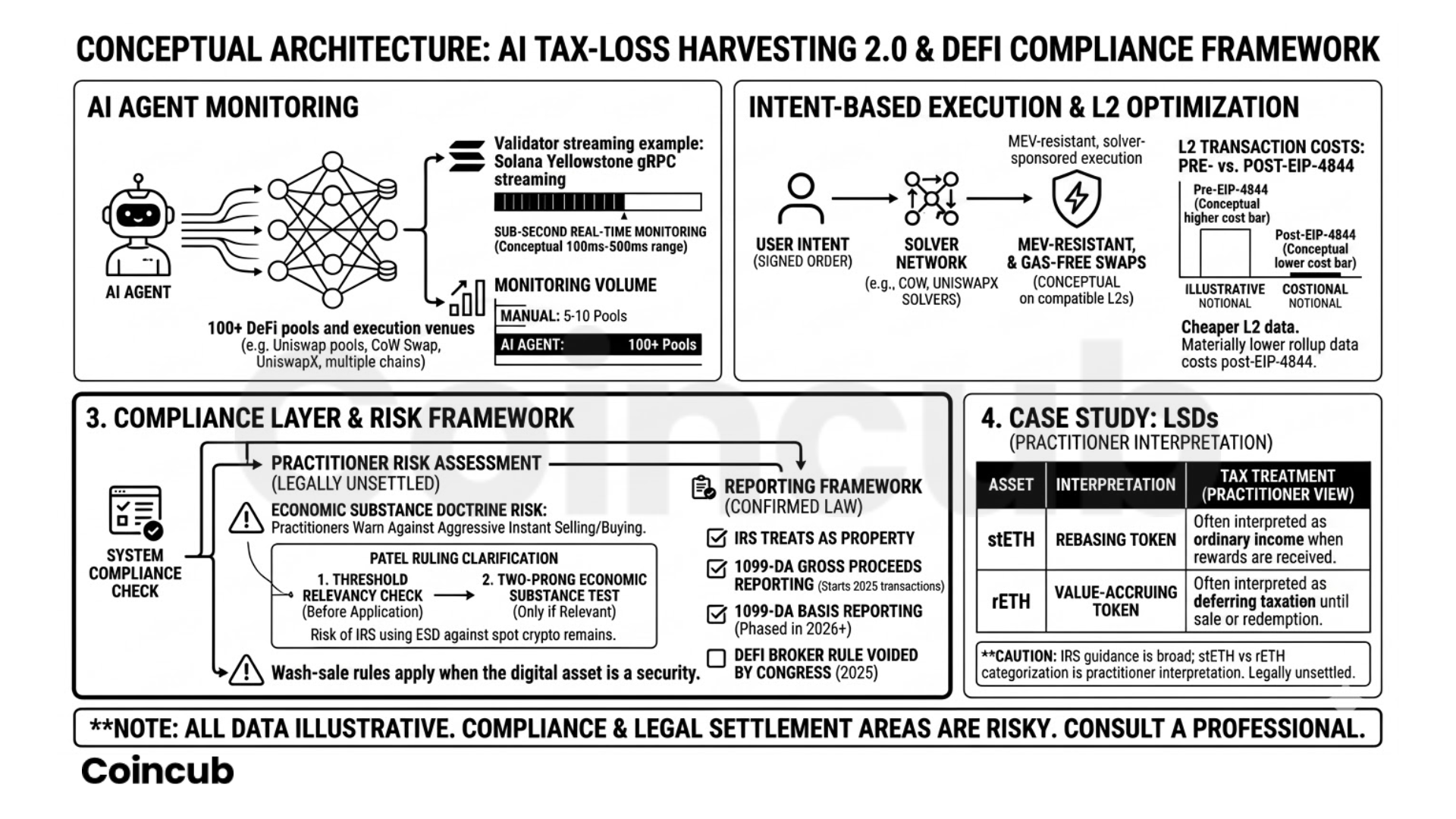
The reporting requirements for cryptocurrency transactions are currently undergoing phased implementation that fundamentally alters the amount of data the IRS receives. Under final regulations, traditional custodial brokers, such as centralized cryptocurrency exchanges, are required to issue the new Form 1099-DA to report gross proceeds for digital asset transactions occurring on or after January 1, 2025.
The surveillance architecture will deepen the following year. Mandatory cost basis reporting for these centralized brokers will begin for specific “covered securities” (digital assets acquired on or after January 1, 2026) for transactions occurring on or after that date. This phased approach gives the IRS unprecedented visibility into individual taxpayer profitability on centralized platforms.
The Nullification of the DeFi Broker Rule
The regulatory landscape for decentralized finance (DeFi), however, took a significantly different path. The Infrastructure Investment and Jobs Act originally included broad language that would have forced DeFi platforms and non-custodial wallet providers to act as reporting brokers. In December 2024, the Treasury Department finalized these regulations, scheduling them to take effect for transactions beginning in 2027.
However, in April 2025, President Trump signed legislation passed under the Congressional Review Act (CRA) that explicitly and formally nullified these DeFi broker reporting regulations. This bipartisan action revoked the regulations entirely, meaning they have no legal force or effect, and the text of Section 6045 reverted to its prior state. Therefore, while individual taxpayers remain legally obligated to track and report their own crypto gains and losses, autonomous AI systems operating through non-custodial wallets on decentralized exchanges currently execute trades outside the scope of the Form 1099-DA broker reporting mandate.
The Wash Sale Exemption Boundaries
Under Internal Revenue Code (IRC) Section 1091, the “wash sale” rule prohibits taxpayers from claiming a capital loss if they sell a security and repurchase the same or a “substantially identical” security within 30 days. Because Section 1091 applies only to “stock or securities,” spot digital assets such as Bitcoin (BTC) or Ethereum (ETH) are currently exempt from the rule.
This exemption is not universal across the digital asset class. Final Treasury regulations make it clear that if a digital asset represents a tokenized version of a traditional security, such as a tokenized equity share or a cryptocurrency exchange-traded fund (ETF), the wash sale rule applies, and the 30-day window must be observed by the taxpayer.
Theoretical Compliance
Because spot crypto is exempt from the statutory wash sale rule, some investors assume an automated AI system can safely sell a depreciated asset and buy it back milliseconds later to harvest a loss. While mechanically possible, this aggressive strategy introduces significant theoretical compliance risks that tax practitioners heavily warn against.
The Economic Substance Doctrine
Practitioners frequently caution that the IRS could attempt to apply the Economic Substance Doctrine, codified at IRC Sec. 7701(o), to disallow losses arising from instantaneous crypto wash trading. This common-law doctrine requires that a transaction meaningfully change a taxpayer’s economic position apart from tax effects and that the taxpayer have a substantial non-tax purpose for the transaction.
The legal threshold for applying this doctrine is currently a major focal point in federal tax courts. In the highly anticipated November 2025 Patel v. Commissioner (165 T.C. No. 10) decision, the U.S. Tax Court unanimously clarified how the IRS may utilize the statute. The court firmly held that Section 7701(o) requires a “threshold relevancy determination” before the doctrine’s two-prong economic substance test can even be applied. The court noted that the legislative history is clear that the doctrine does not apply to every transaction.
However, if a court determines the doctrine is relevant to a specific transaction, the two-prong test is rigorously enforced. In Patel, the court ultimately disallowed the taxpayer’s transaction, noting that it resulted in a “circular flow of funds” that failed to subject the capital to genuine market risk. While there is currently no clear, crypto-specific authority stating that an instant sell-and-rebuy of spot BTC is automatically disallowed under this doctrine, practitioners warn that an instantaneous crypto repurchase perfectly mirrors this “circular flow of funds.” Because an instant repurchase effectively eliminates all market risk, it is viewed as an aggressive, high-risk tax position.
Correlation Matrices and Proxy Assets
To mitigate this theoretical risk, AI harvesting models are rarely programmed to buy back the same asset. Instead, practitioners suggest replacing a sold asset with a highly correlated, but legally distinct, proxy asset to maintain market exposure while arguably altering the taxpayer’s economic position.
In automated systems, this is often achieved through advanced network analysis and price forecasting. For instance, developers might use algorithms such as the Louvain method for community detection alongside consensus clustering on historical daily closing prices. This allows the AI to dynamically group the cryptocurrency market into temporally stable clusters of highly correlated assets. If an AI incurs a loss on a specific Layer 1 token, the algorithm directs the repurchase of an equally weighted basket of competing tokens from the same cluster, in an attempt to demonstrate genuine market risk to satisfy the objective economic effect prong of the doctrine.
Liquid Staking Derivatives (LSDs)
Another area of interpretive compliance involves using Liquid Staking Derivatives (LSDs) as replacement assets. IRS guidance broadly states that staking rewards are taxable as ordinary income when the taxpayer gains “dominion and control” over the assets.
Based on this principle, some tax practitioners interpret that the underlying mechanical structure of different LSD protocols could yield entirely different tax treatments. For instance, rebasing tokens (like Lido’s stETH), which deposit new, fractional tokens directly into a user’s wallet daily to reflect staking yields, might be interpreted as creating continuous, taxable ordinary income events. Conversely, value-accruing tokens (like Rocket Pool’s rETH) maintain a fixed token supply while their exchange rate against ETH steadily increases. Practitioners often interpret this mechanism as deferring the taxable event entirely until the rETH token is ultimately sold or swapped, potentially allowing for highly favorable long-term capital gains treatment. While this distinction is not settled IRS doctrine, a sophisticated AI portfolio manager would theoretically need to be programmed to recognize these structural differences when selecting replacement assets.
| Topic | Current status | What it means for automated harvesting |
| IRS treatment of digital assets | Digital assets are treated as property | Sales, swaps, and disposals can trigger capital gains or losses |
| Form 1099-DA reporting | Centralized brokers must report gross proceeds starting in 2025, with basis reporting expanding after that | Activity on custodial platforms is becoming easier for the IRS to track |
| DeFi broker reporting | The DeFi broker reporting rule was nullified in 2025 | Non-custodial DeFi platforms do not issue 1099-DAs under that revoked rule |
| Wash sale rule for spot crypto | Spot assets like BTC and ETH are generally outside IRC Section 1091 | A same-asset repurchase may still be possible from a wash sale perspective |
| Wash sale rule for tokenized securities | Tokenized stocks and similar digital securities can fall under wash-sale treatment | Automated systems must identify when a digital asset is actually a security for tax purposes |
| Economic Substance Doctrine | Application to crypto tax-loss harvesting is not clearly settled | Instant sell-and-rebuy strategies may still face IRS challenge |
| Proxy asset replacement | Common practitioner approach, not a guaranteed safe harbor | AI systems may use correlated assets to keep exposure while reducing legal risk |
| Layer 2 execution costs | Costs have fallen materially after EIP-4844 | Smaller and more frequent harvesting trades are more viable than before |
| Intent-based execution | Already used in modern DeFi routing systems | AI agents can outsource routing, gas, and part of the execution risk to solver networks |
Plausible Technical Implementations
The infrastructure required to build a continuous, multi-pool harvesting agent relies on several existing, proven technologies. Modern DeFi execution stacks make it highly plausible to engineer systems that monitor fragmented venues and execute trades autonomously in ways that were impossible just a few years ago.
Real-Time Data Pipelines (gRPC)
Monitoring over 100 decentralized liquidity pools simultaneously is practically impossible using standard HTTP RPC polling due to the inherent latency of the request-response architecture. To achieve the responsiveness required to identify transient pricing dislocations before they resolve, modern systems utilize Remote Procedure Call (gRPC) streaming protocols.
For example, utilizing the Yellowstone gRPC plugin on the Solana network allows an agent to establish a persistent, bi-directional stream directly with blockchain validators. By filtering the stream for specific automated market maker (AMM) program IDs (such as Raydium or Jupiter), the agent can ingest parsed transaction metadata and liquidity depth with sub-second latency or ultra-low-latency validator streaming. This allows the data layer of an AI agent to continuously update its internal pricing models across hundreds of pools without overwhelming network nodes.
Layer 2 Economics and Blobspace
Historically, the gas fees on Layer 1 networks like Ethereum made high-frequency tax-loss harvesting economically unviable for smaller retail portfolios. Even a minor $20 gas fee would obliterate the tax benefit of harvesting a $100 unrealized loss.
Because EIP-4844 lowered rollup data costs, the transaction-cost threshold for automated harvesting has dropped materially on many Layer 2 networks. EIP-4844 introduced “blobspace,” a highly subsidized, temporary data storage mechanism on the Ethereum mainnet. Before this, Layer 2 networks (like Arbitrum or Base) had to post their batched transaction data to the L1 via expensive calldata. By shifting to blobspace, the L1 data posting costs associated with L2 transactions dropped precipitously. With total execution fees drastically reduced, the “tax benefit materiality threshold” (the point at which the tax savings from harvesting outweigh the network transaction costs) has shifted, making automated micro-harvesting a plausible strategy.
Intent-Based Execution Solvers
The most significant architectural shift enabling these autonomous agents is the move from imperative AMM routing to intent-based execution. Previously, an automated trading bot had to specify the exact liquidity pool, the exact routing path, and the maximum slippage tolerance to execute a trade. This imperative model left the transaction highly vulnerable to execution failures and Maximal Extractable Value (MEV) attacks (such as front-running or sandwiching) while it sat in the public mempool.
In an intent-based model, utilized by advanced protocols, the AI agent simply cryptographically signs an off-chain message stating its desired outcome (e.g., “Swap 1 ETH for a minimum of 2,500 USDC”). This completely abstracts the routing complexity away from the agent.
Protocols process these intents using sophisticated solver networks. For instance, UniswapX utilizes an Exclusive Dutch Order mechanism. The auction starts at a price slightly better than the current market rate, and the required output price gradually decays over time until a participating third-party “filler” (solver) accepts the order and executes it. Alternatively, CoW Swap relies on batch auctions to find “Coincidences of Wants,” matching buyers and sellers peer-to-peer off-chain, bypassing AMM liquidity pools entirely. In both models, a decentralized network of solvers competes to find the best routing path, absorbing the execution, gas, and MEV risks, ensuring the AI agent’s minimum parameters are strictly met before the smart contract releases the funds.
Multi-Agent Architectures in DeFi Trading
In theoretical designs for advanced autonomous trading, developers are moving away from monolithic, single-script bots toward complex Multi-Agent Systems (MAS). By dividing responsibilities among specialized, interconnected entities, the system can operate more resiliently and process vastly more data in chaotic market environments.
Hierarchical vs. Swarm Architectures
The orchestration of these agents typically falls into two primary design patterns. The first is a Hierarchical (or Manager-Worker) structure, where a central supervisor agent evaluates the overall portfolio state and delegates specific, discrete tasks (such as finding a route or executing a swap) to subordinate worker agents. While efficient at distributing tasks, the manager can become a computational bottleneck.
The second pattern is a Decentralized Swarm or “Blackboard” architecture. In this model, agents operate in parallel without a central manager, asynchronously reading from and writing to a shared memory space. This is highly favored in DeFi monitoring because it allows dozens of independent agents to publish liquidity anomalies on the blackboard continuously. In contrast, strategy agents independently subscribe to that data to trigger harvesting logic.
Specialized Agent Roles and Systemic Risk
A fully realized architecture relies on distinct agent roles:
- Data and Compliance Agent: Ingests gRPC streams to maintain a real-time state of monitored liquidity pools and to track 30-day holding periods for assets classified as tokenized securities, ensuring statutory wash-sale compliance.
- Strategy Agent: Calculates the individual cost basis of the user’s holdings, evaluates the continuous tax benefit materiality threshold, and selects the highly correlated proxy asset from the consensus clusters to replace the liquidated position.
- Execution Agent: Formulates the declarative trade intent, signs it securely (often utilizing ERC-4337 Account Abstraction wallet mechanics), and broadcasts the intent to the off-chain solver networks.
- Risk Agent: Operates as a systemic health supervisor. Smart contracts and AI algorithms cannot natively verify real-world asset prices; they rely entirely on decentralized oracles. If an oracle is manipulated or suffers a latency failure, it can broadcast a wildly distorted price, tricking the Strategy Agent into harvesting a fake loss and liquidating assets at a severe discount. The Risk Agent prevents this by cross-referencing primary oracle feeds with secondary time-weighted average price (TWAP) data and retains the authority to halt the execution pipeline during anomalous market conditions instantly.
Frequently Asked Questions (FAQ)
What is automated crypto tax-loss harvesting?
It is the use of software or AI agents to identify unrealized losses in a crypto portfolio, sell those assets, and potentially replace them with similar exposure to reduce taxable gains.
Are cryptocurrencies subject to the wash sale rule?
Spot cryptocurrencies like BTC and ETH are generally not covered by the traditional wash sale rule because they are not currently treated as stock or securities under IRC Section 1091.
Are all digital assets exempt from wash sale rules?
No. Tokenized versions of traditional securities, such as tokenized stocks or certain tokenized ETFs, may be subject to wash sale treatment.
Why is instant sell-and-buy-back still risky?
Even if spot crypto is outside the classic wash sale rule, the IRS could still challenge an aggressive strategy under the Economic Substance Doctrine if the trade creates no meaningful market risk.
Why would an AI agent buy a proxy asset instead of the same token again?
A correlated proxy can help preserve market exposure while making the taxpayer’s position look economically different from the original holding.
What role do Layer 2 networks play in this strategy?
Lower transaction costs on Layer 2s make smaller harvests more practical, especially when frequent trading would be too expensive on the Ethereum mainnet.
What are intent-based solvers?
They are systems that take a signed desired outcome, such as swapping one asset for another at a minimum price, and compete to execute it efficiently while reducing routing complexity and MEV exposure.
Do DeFi platforms report these trades directly to the IRS?
Currently, DeFi broker reporting rules were nullified, so non-custodial DeFi platforms do not issue 1099-DAs in the same way centralized brokers do.
Do users still need to report DeFi gains and losses?
Yes. Even without platform-level broker reporting, taxpayers remain responsible for tracking and reporting their own crypto transactions.
Is AI-driven tax-loss harvesting fully compliant today?
No clear answer exists yet. The infrastructure is real, but some of the most aggressive strategies still sit in a legal gray area.