Buy a Licensed Company
  Explore VASP Data
  Talk to an Expert

 Atis Shala
Atis is a senior analyst and community lead with four years of experience in crypto. He has a bachelor from the Rochester Institute of Technology.
Atis Shala
Atis is a senior analyst and community lead with four years of experience in crypto. He has a bachelor from the Rochester Institute of Technology.
5 Penny Cryptos With 1000x Potential in 2026

- A penny crypto is a low-priced token with a small to mid market cap, not just any cheap coin; market cap, not unit price, decides how much room it has to grow.
- A realistic 1000x usually needs a tiny starting valuation plus a real catalyst: working technology, a strong community, and a narrative the market is already chasing.
- Nosana (NOS) targets decentralized GPU compute for AI, riding the demand for cheaper, censorship-resistant AI inference on Solana.
- Celer Network (CELR) is undervalued crosschain infrastructure; its value is “behind the scenes,” which keeps the token cheap despite wide integration.
- Zora (ZORA) is a creator-economy Layer 2, while Pengu (PENGU) turns the Pudgy Penguins brand into an onchain currency driven by culture more than utility.
- Zano (ZANO) is the privacy pick, and the 2026 privacy rally led by Zcash gives the category fresh momentum.
- Penny cryptos carry outsized risk: token unlocks, thin liquidity, and sentiment swings can erase gains as fast as they appear, so position sizing matters.
Penny Cryptos Are Modern Penny Stocks
The crypto sector continues to evolve at a remarkable pace, drawing both traditional investors and degens toward its unmatched volatility. Each market cycle introduces fresh narratives, from institutional adoption to regulatory shifts and new, much needed technological breakthroughs. These developments influence how capital flows across the ecosystem and shape investor expectations about long-term growth. While blue-chip coins such as Bitcoin and Ethereum command the spotlight, a significant portion of market experimentation happens in the lower-cap segment. This is where ambitious teams, early-stage protocols, and emerging use cases attempt to prove themselves before the broader market takes notice.
Within that segment sits a category many traders refer to as penny cryptos. These tokens typically trade at a low price per unit and hold mid-size market capitalizations compared to major projects. Their low entry cost often attracts investors who want parabolic upside, and their early positioning allows them to grow rapidly if their technology, token design, or community traction proves sustainable. Price alone does not define a strong penny crypto. The real value appears when a low-cost coin or token combines credible technology, a clear use case, and a roadmap that addresses real market needs.
The idea of a 1000x return captures attention, but it deserves careful framing. Such growth rarely stems from speculation alone. It usually occurs when a project starts from a very small base and solves an urgent problem better than competitors… or a memecoin that goes super viral. That kind of trajectory demands strong fundamentals, execution, and market timing. Investors and traders who study early-stage coins often look for these signals rather than chasing hype.

How Do 1000x Multipliers Form in Early Stage Crypto Projects?
Extreme multipliers in early stage crypto projects emerge when several factors align and reinforce one another. Early positioning gives small market cap tokens room to grow beyond a certain point, but that alone does not create any massive expansion. Real acceleration begins when a project introduces utility that solves a clear problem more efficiently than existing alternatives, driving real usage and revenue.
However, one anomaly for such 1000x multipliers this cycle were memecoins. This type of token does not solve anything but rather rides waves of speculation to generate a massive market cap. Investors respond to this clarity, and early demand pushes liquidity into the market at a faster pace than the circulating supply can absorb.
Strong community formation often accelerates the process of growth in utility projects. When users actively participate in governance, test features, and provide feedback, the project adapts quickly. This cycle of contribution and iteration strengthens the protocol’s value and encourages further adoption. Teams that communicate clearly, deliver updates on schedule, and validate their roadmap through real product releases create credibility that fuels organic growth.
Network effects also play a central role. As more users interact with a protocol, the value of participation rises for everyone involved. DeFi platforms experience this when liquidity pools deepen and borrowing activity grows. Web3 gaming projects see it when player economies expand and in-game assets gain real utility. In these environments, one improvement triggers another, which compounds the project’s attractiveness and increases the likelihood of outsized returns.
Market timing influences outcomes as well. When a narrative aligns with a broader trend such as scalable infrastructure, zero knowledge technology, or real world asset tokenization, early projects can gain momentum quickly. Investors who track these narratives often identify strong contenders before the crowd enters.
How to Find Penny Cryptos?
To find penny cryptos with realistic 1000x potential, you should use a method that blends technical fundamentals with market awareness. The process starts by scanning low to mid market cap tokens that show active development, consistent updates, and transparent roadmaps. This initial filter helps separate serious early stage projects from those that rely only on hype.
From there, evaluate each project’s core value proposition. Strong contenders aim at real market pain points such as scalability, privacy, interoperability, data quality, or improved models for digital ownership. Projects that introduce unique solutions or significantly more efficient alternatives stand out. Those that merely copy existing trends without adding meaningful innovation usually fall short, unless marketing fills in that gap.
Token design offers another crucial checkpoint. Well structured tokenomics attract participation, supports stable liquidity, and aligns incentives across users, developers, and investors. Tokens with uncontrolled emissions or little to no utility often struggle to maintain momentum. By contrast, cryptocurrencies linked directly to protocol activity tend to grow more sustainably as adoption increases.
Community strength deserves close attention as well. A vibrant user base that engages with the product, shares feedback, and participates in governance can push early growth faster than any marketing campaign. Look for projects that deliver consistent communication and show measurable engagement across their ecosystem.
Market relevance should also guide your selection. Tokens that align with expanding narratives such as AI enhanced infrastructure, modular networks, RWA, DeFi, or Web3 gaming have a stronger chance of drawing long term interest.
Ultimately, consider memecoins as a separate category of penny crypto. These tokens operate on social momentum rather than strict utility, yet some achieve explosive growth when strong branding meets an active community.
5 Penny Cryptos with a Realistic 1000x Potential
Nosana (NOS): Decentralized GPU Network for AI Workloads
Nosana (NOS) is positioning itself as a critical infrastructure layer for the rapidly expanding AI economy. Instead of traditional centralized cloud providers, Nosana offers a decentralized GPU compute marketplace where users can access affordable, distributed GPU power for AI inference and model training. Built on Solana, Nosana leverages Solana’s high throughput and low cost to coordinate job scheduling, verification, and payments with exceptional efficiency. Its design allows developers, enterprises, and AI startups to tap into unused or underutilized GPUs contributed by node operators globally. The NOS token fuels this system through payments, staking, network incentives, and governance.
By decentralizing AI compute, Nosana aims to lower costs, expand accessibility, and provide censorship-resistant infrastructure. As demand for AI inference accelerates across consumer applications, enterprise automation, and onchain AI agents, Nosana’s network provides an execution layer tailored for high-volume, high-performance compute workloads.
Why NOS Trades at a Low Price
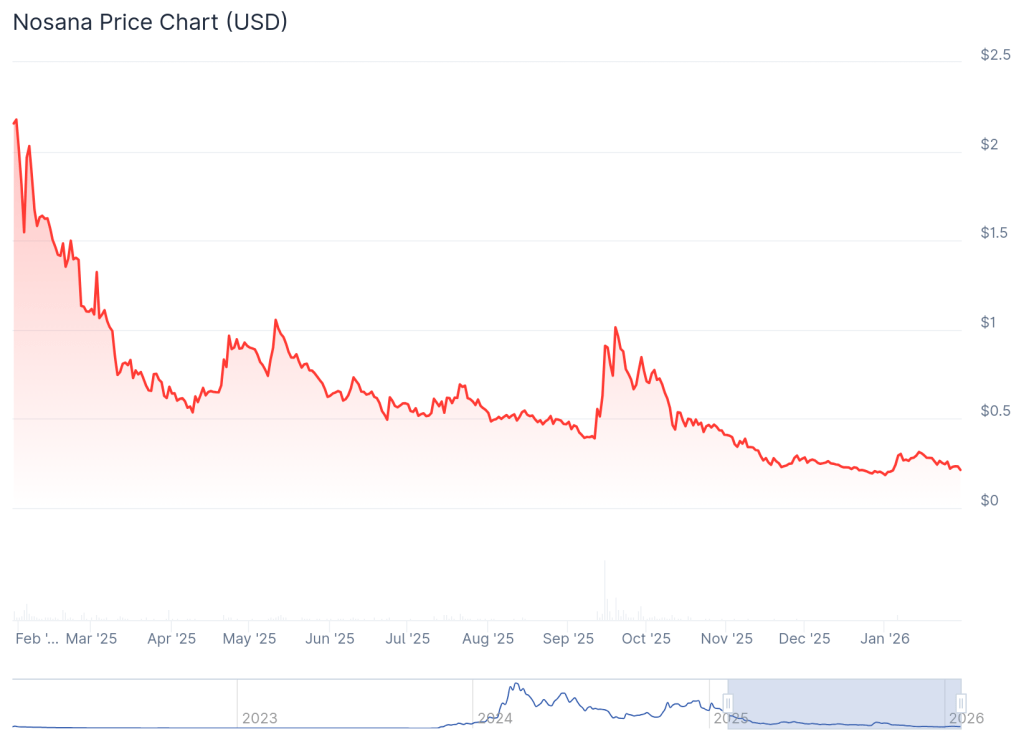
Even with increasing attention around decentralized AI infrastructure, NOS trades at a modest valuation due to a combination of structural and market-driven factors. A large share of tokens remains locked in ecosystem, team, and early-stakeholder allocations, leading to uncertainty about future unlock cycles and potential supply pressure. Investors are also waiting for Nosana’s throughput and pricing advantages to be tested at scale. Many AI compute networks face skepticism until they demonstrate real-world reliability, latency stability, and consistent job settlement.
Additionally, the decentralized AI sector is becoming increasingly competitive, with multiple projects racing to attract developers and GPU providers. Early trading volatility and profit-taking around announcements have kept price performance muted. More broadly, macro market fluctuations continue to influence appetite for infrastructure tokens, especially those still in the early adoption stage.
Key Catalysts for NOS
Nosana’s biggest catalyst is the accelerating demand for AI inference and compute infrastructure. As more developers deploy and run AI models onchain, Nosana’s decentralized GPU marketplace becomes increasingly relevant. Upcoming expansions of supported model types, deeper integrations with Solana’s AI tooling, and onboarding of institutional-grade GPU providers could dramatically enrich network capacity.
The launch of enterprise APIs, incentive programs for node operators, and partnerships with AI tooling platforms are expected to spark ecosystem growth. If Nosana successfully demonstrates that it can deliver high-quality inference at a fraction of centralized cloud costs, market sentiment could shift rapidly. Additional catalysts include exchange liquidity expansions, new customer pipelines, and improvements in job routing, verification, and performance measurement.
NOS Tokenomics Snapshot and Risks
NOS has a fixed supply of 100 million tokens, with structured vesting for team and investors and dedicated allocations for ecosystem development. Token utility spans payments for compute, staking for node operators, and governance participation. While the supply is relatively small, unlock schedules remain a key risk for near-term price pressure.
Nosana must prove sustained demand, reliable GPU supply, and consistent execution performance. Competition from centralized providers and rival decentralized AI networks also poses challenges. Ultimately, adoption, network reliability, and real economic activity, not speculation, will determine whether NOS grows into a leading decentralized AI infrastructure token.
Celer Network (CELR): Crosschain Infra Layer
Celer Network (CELR) is a leading interoperability and Layer-2 scaling platform built to enable seamless, trust-minimized communication across multiple blockchains. Its core innovation, the Celer Inter-Chain Messaging Framework (Celer IM), allows smart contracts on different chains to interact as if they were operating on the same network.
This architecture powers crosschain dApps, unified liquidity systems, and asset bridges, all without compromising security or user experience. Beyond interoperability, Celer offers Layer-2 solutions such as rollups and state channels that help developers build high-performance applications capable of handling large transaction volumes at low cost. Already integrated with major chains, including Ethereum, BNB Chain, Arbitrum, Polygon, Avalanche, and more, Celer has positioned itself as foundational infrastructure for a multi-chain future. The CELR token underpins the network through staking, security guarantees, and fee mechanisms.
Why CELR Trades at a Low Price
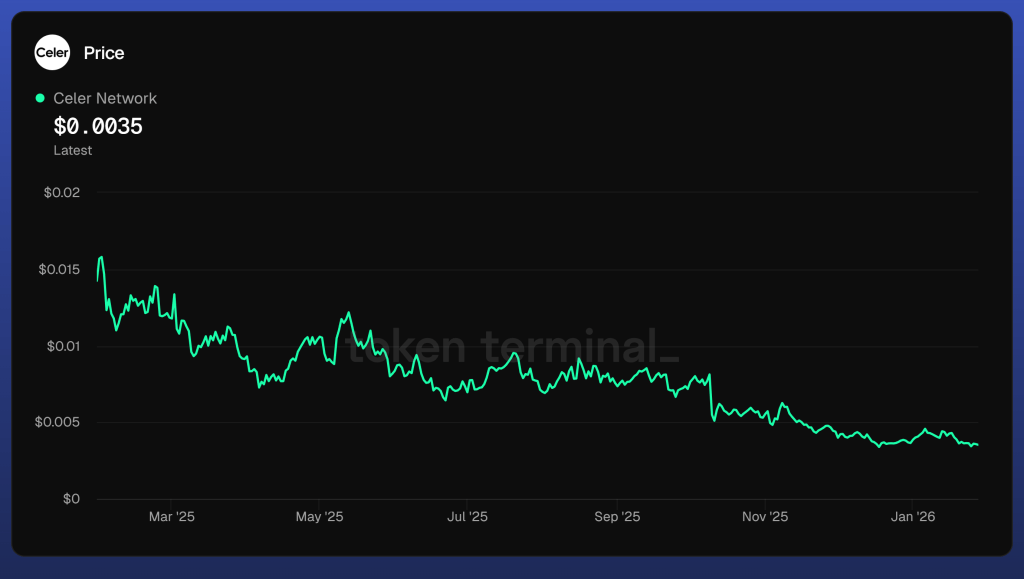
Despite serving a crucial role in Web3’s crosschain ecosystem, CELR’s valuation remains modest relative to its technological relevance. Market sentiment across interoperability projects has been subdued due to past concerns around bridge exploits and liquidity fragmentation, placing pressure on token performance even for secure, battle-tested solutions like Celer. Additionally, CELR’s circulating supply and broad token distribution have created uncertainty for some investors, contributing to slow momentum during periods of market consolidation.
Celer’s technology is widely used, but much of its infrastructure operates “behind the scenes,” making its value less visible compared to high-profile DeFi or AI tokens. Interoperability narratives also tend to lag speculative trends unless tied to major new catalysts. With a market cap near $50M and a price around $0.0048, CELR remains significantly below its all-time high of $0.1987, reflecting both broader market cycles and underappreciation of the interoperability sector.
Key Catalysts for CELR
The most powerful catalyst for Celer is the accelerating demand for crosschain applications. As DeFi, gaming, and modular blockchain ecosystems become increasingly chain-agnostic, seamless communication across networks becomes essential. Celer IM is already integrated into dozens of dApps, and continued expansion into new L1s and L2s strengthens its network effects. Upcoming improvements to message routing, unified liquidity systems, and crosschain intent execution may further enhance adoption.
Partnerships with major rollup providers, institutional-grade bridge infrastructure, and developer incentive programs can also draw attention back to CELR. If market narratives shift toward interoperability as a core pillar of Web3, Celer’s early-mover advantage could translate into significant upside.
CELR Tokenomics Snapshot and Risks
CELR’s token utility spans staking, transaction fee payments, and network security. While its relatively low market cap offers strong upside potential, risks remain: competition from other interoperability frameworks, regulatory uncertainty around crosschain messaging, and the need for continuous security audits. Ultimately, widespread developer adoption and reliable crosschain activity will determine whether CELR reclaims its previous valuation or remains undervalued in a growing sector.
Zora (ZORA): The Social Layer of Crypto
Zora focuses on enabling creators to mint, distribute, and monetize content through its network, offering a frictionless experience for publishing and collecting digital media. Built as an Ethereum Layer-2 using the OP Stack, Zora delivers low-cost transactions optimized for high-volume minting and social interactions. The chain functions as a cultural infrastructure layer, aiming to merge social engagement, creator monetization mechanics, and onchain identity. The ZORA token sits at the center of this ecosystem, powering incentives, governance, and alignment between creators, collectors, and the network.
Why ZORA Trades at a Low Price
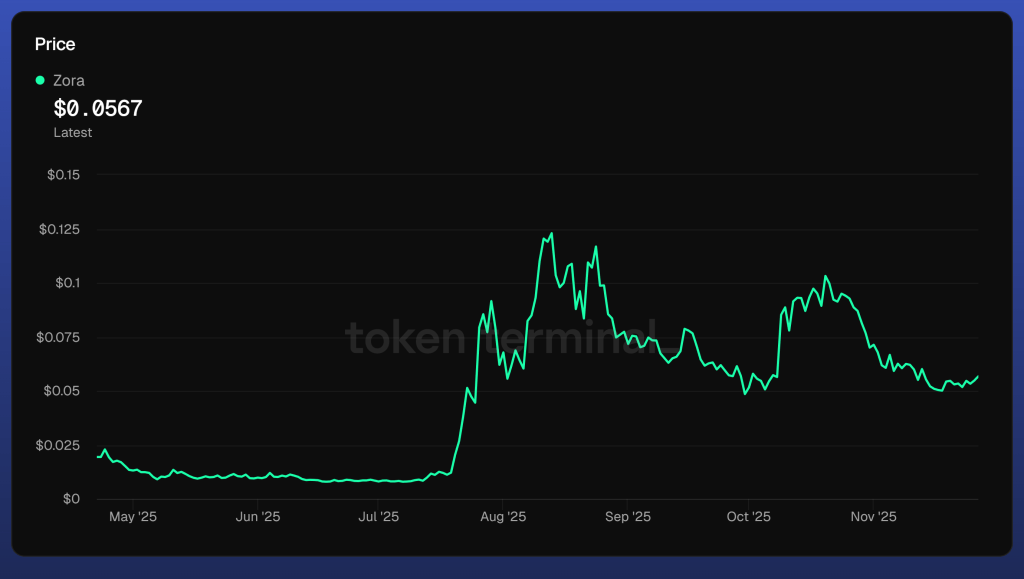
Despite strong brand visibility within the creator economy, the ZORA token trades at a relatively low valuation due to several structural factors. Much of the supply is still locked across team, investor, and treasury allocations, leaving markets cautious about future unlock-driven sell pressure. The project is also in the early stages of proving sustainable demand for creator-driven coins beyond NFT boom cycles. While Zora’s cultural relevance is high, crypto markets often value measurable onchain activity, transaction volume, retention, fee generation, and these metrics are still developing. The L2 landscape adds another layer of competition: Zora must differentiate itself against established general-purpose chains while convincing markets that a creator-focused L2 can achieve durable, high-value usage. As a result, early volatility and modest liquidity have kept price action suppressed despite strong narrative potential.
Key Catalysts for ZORA
Zora’s clearest catalyst is continued creator onboarding, every new collection, drop, or creator community amplifies the network’s cultural flywheel. Low-cost minting via the OP Stack enables mass-scale content deployment, which could significantly boost activity as social-onchain primitives become more widely adopted. Incentive programs, grants, and strategic partnerships are positioned to attract developers building social, media, and creator-economy dApps. As Zora evolves its governance framework, the ZORA token may gain more explicit value accrual, increasing investor interest. Broader exchange listings, liquidity expansion, and integrations with wallets, social apps, and aggregation layers could further accelerate adoption. If Zora successfully establishes itself as the default chain for onchain creativity and content publishing, sentiment could shift quickly in its favor.
ZORA Tokenomics Snapshot and Risks
- Total Supply: 10 billion ZORA
- Initial Public Allocation: Limited circulating supply at launch
- Team Allocation: Multi-year unlock schedule
- Investor Allocation: Vesting aligned with long-term network growth
- Ecosystem & Grants: Significant allocation toward creators, developers, and community incentives
- Economic Model: Utility centered on governance, incentives, and creator-aligned mechanisms rather than gas payments
This structure aims to align contributors, reward early ecosystem growth, and strengthen long-term creator incentives, though the sizable locked allocations introduce uncertainty around future supply dynamics.
Zora must ultimately prove that a creator-centric L2 can generate durable economic activity, not just periodic hype cycles. Competition within the L2 and social-onchain space is intense, and cultural momentum must translate into consistent network usage. Token unlocks may create sell pressure over time, and regulatory shifts around digital media and tokenized content could impact adoption. Market sentiment, creator engagement, and the emergence of successful onchain social applications will determine whether ZORA matures into a leading cultural blockchain or struggles to scale beyond its niche.
Zano (ZANO): The Default Privacy Coin
Built on a custom implementation of the CryptoNote protocol, Zano emphasizes privacy, decentralization, and resistance to blockchain analysis. Its architecture integrates ring signatures, stealth addresses, and confidential transactions to ensure that sender, receiver, and transaction amounts remain shielded. Zano also incorporates a hybrid PoW/PoS consensus mechanism designed to balance security with energy efficiency while reducing susceptibility to 51% attacks. Beyond payments, the project aims to support privacy-preserving e-commerce and decentralized marketplaces, positioning Zano as a robust infrastructure layer for censorship-resistant digital trade. The native token, ZANO, powers transactions, staking, and network incentives. With the privacy meta taking off, especially after the boom of Zcash, Zano could be next.
Why ZANO Trades at a Low Price
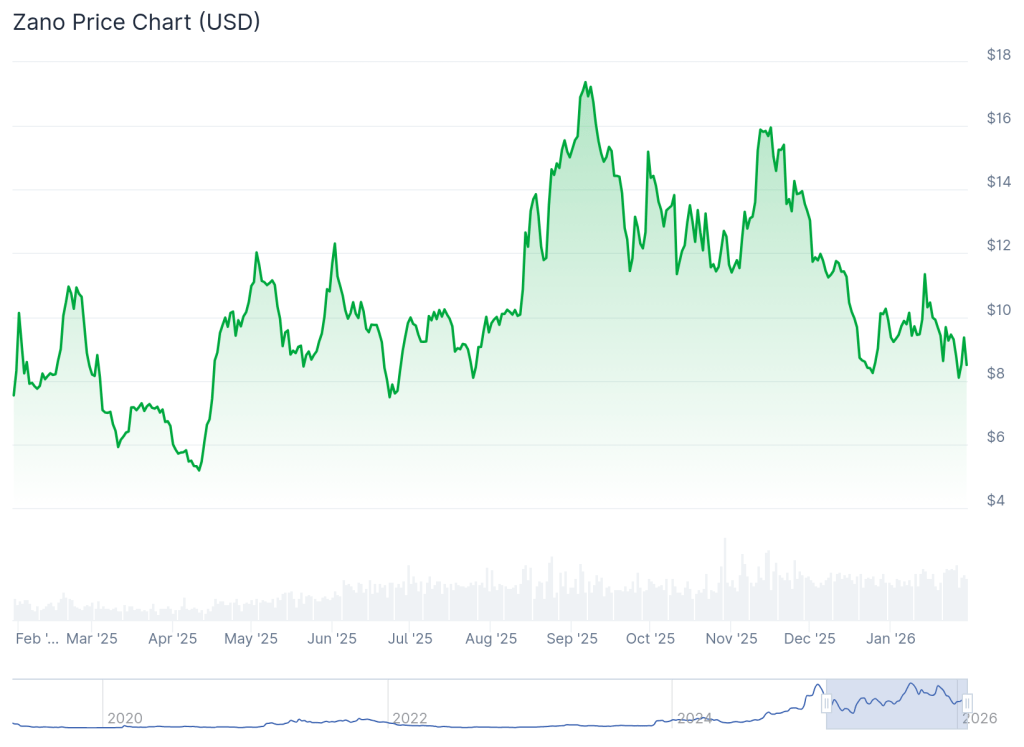
Despite its strong technological foundations, ZANO trades at a relatively low market value due to several factors. Privacy coins as a category face persistent regulatory pressure, which tends to suppress investor confidence and exchange accessibility. Zano’s specialized focus, private payments and marketplace infrastructure, appeals to a more niche segment compared to broader smart-contract platforms, limiting speculative inflows. Liquidity is thinner than mainstream coins, and the project lacks the marketing scale or high-profile partnerships commonly associated with larger altcoins. Additionally, privacy tech is harder for retail users to evaluate, meaning strong fundamentals do not always translate to market enthusiasm. As a result, ZANO remains underpriced relative to its technical maturity and longevity in the ecosystem.
Key Catalysts for ZANO
Zano’s most important catalyst is growing demand for censorship-resistant financial tools as global regulatory environments tighten. Its hybrid consensus system and privacy stack could position it as a preferred asset for secure onchain payments, especially if larger privacy-focused networks face increased scrutiny or centralization. Development efforts around decentralized marketplaces, escrow systems, and trust-minimized trading could also unlock new utility for ZANO beyond simple transfers. Upgrades to wallet infrastructure, mobile clients, and user onboarding may broaden accessibility and help the project appeal to mainstream users. Any expansion in exchange listings, liquidity pools, or integrations with privacy-enhancing technologies would further strengthen its market presence.
ZANO Tokenomics Snapshot and Risks
- Total Supply: Capped emission schedule with declining block rewards
- Circulating Supply: Gradually increases through mining and staking
- Consensus Model: Hybrid PoW + PoS to reduce attack risk and improve decentralization
- Utility: Transaction fees, staking rewards, and incentives for network participation
- Economic Design: Emphasis on long-term sustainability rather than aggressive inflation or dilution
This structure creates a predictable emission curve and aligns network incentives but also limits hype-driven token distribution that many newer projects rely on for rapid user growth.
Zano’s primary risks stem from its category: privacy coins face regulatory headwinds, potential delistings, and shrinking access to centralized exchanges. Growth is also dependent on adoption of privacy-preserving commerce, a sector still developing. Liquidity constraints may amplify volatility, and competition from better-known privacy coins could overshadow Zano’s technical strengths. Ultimately, market acceptance, regulatory climate, and sustained developer commitment will determine whether ZANO can expand beyond its niche or remain undervalued despite its solid foundation.
Pengu (PENGU): The Face of Crypto
Pudgy Penguins began as a collection of 8,888 unique NFTs and has grown into a broader media-brand, consumer products line, and tokenized ecosystem. PENGU is designed as the onchain currency of that world: enabling access, gating experiences, rewarding community participation, and linking digital collectibles with real physical goods and virtual world features. The brand’s aim is to turn NFT ownership into culture, merchandise, gaming, and social identity, with PENGU acting as the currency that binds those threads.
Why PENGU Trades at a Low Price
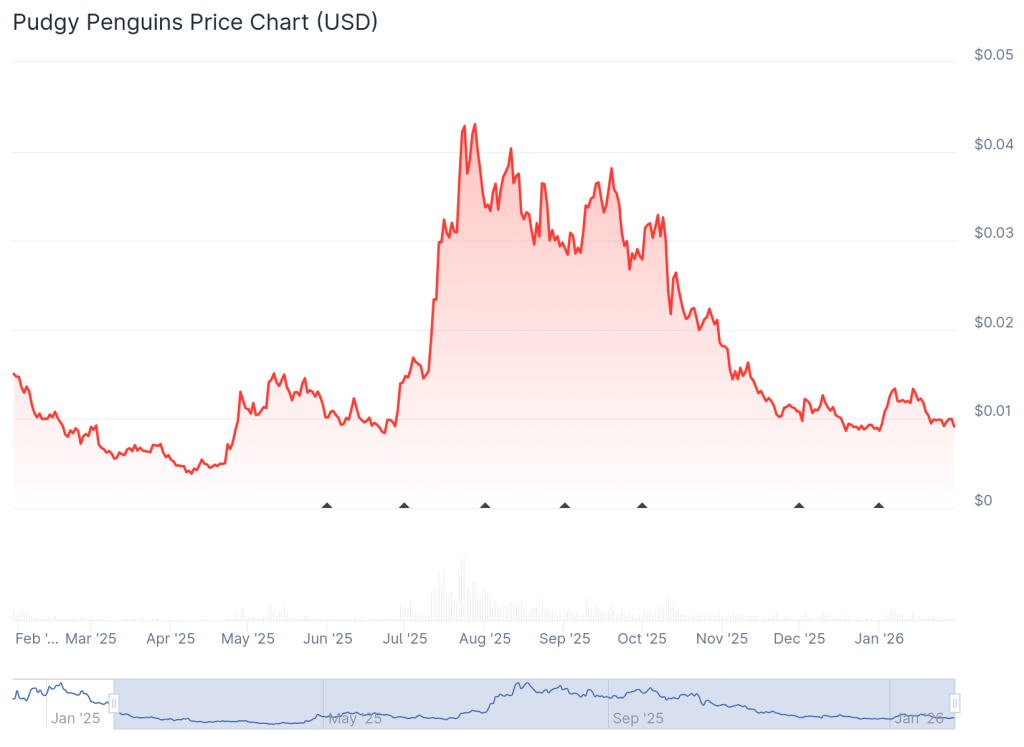
Despite its strong brand and cultural resonance, PENGU remains modestly priced today for a number of reasons. First, the token’s utility is still evolving: while many holders believe in the brand, the full roadmap of token-driven usage (gaming, metaverse, real-world commerce) remains under development, causing many investors to wait for proof. Second, the project sits in a niche intersection (NFT culture + consumer brand) rather than broad DeFi or infrastructure utility, limiting speculative upside in the eyes of many. Third, large token allocations, vesting schedules, and a very large total supply (tens of billions of PENGU) mean markets are wary of future supply pressure. Finally, because much of the value is derived from brand perception rather than clear transactional demand, the price is vulnerable to sentiment shifts, causing a discount relative to more purely utility-driven tokens.
Key Catalysts for PENGU
A number of developments could provide meaningful upside for PENGU. Activation of the brand’s virtual world (Pudgy World) and other gaming/metaverse features would create token demand when PENGU is required for access, purchases or interaction. Expansion of consumer-goods licensing, physical product drops tied to NFTs, or tie-ins with mainstream retail increase brand reach beyond crypto‐native audiences, which could broaden token usage and demand. Listings on major exchanges, staking programs, liquidity pools for token holders or gamified mechanics (token rewards for participation) can also drive interest. If the brand leverages its cultural identity into sustained onchain activity and “everyday” token use, PENGU may shift from speculative holding toward functional currency, changing the valuation dynamic.
PENGU Tokenomics Snapshot and Risks
- Total Supply: ~88.8 billion PENGU (circulating supply ~62 billion)
- Initial Public/Airdrop Allocation: Significant portion distributed to community and NFT holders.
- Team / Treasury / Vesting: Large allocations subject to multi-year vesting schedules.
- Utility: Token functions include gating digital experiences, future game and metaverse transactions, and being a symbol of community ownership.
- Economic Design: The model leans more brand & community oriented than protocol-driven.
Scarcity is limited by high supply, and while some burn mechanisms like unclaimed airdrops burned may exist, the token is not currently tied to major transaction-fee burns.
PENGU’s success depends heavily on brand momentum and implementation of utility. If the token remains used mainly as a collectible or speculative asset rather than functional currency, demand may stagnate. Large unlocked allocations, concentrated ownership, and limited current utility present supply- and sentiment-risk. Competition from other brands and the broader volatility of NFT/media-adjacent tokens add further uncertainty.
When 1000x Multipliers Become Possible in Crypto
A 1000x multiplier in crypto is rare, but it becomes possible when several forces converge at the exact right moment. The first requirement is starting small. Projects with small to mid market caps have far more room to grow, but that alone isn’t enough, the catalyst must come from a product, narrative, or cultural force powerful enough to pull liquidity into the asset faster than new supply enters the market. In traditional fundamentals-driven projects, this usually means solving a real problem better than existing competitors, offering a clear advantage in speed, cost, design, privacy, or user experience. When early traction appears, network effects begin to compound, and growth can accelerate rapidly.
The second path, aka the anomaly, comes from memecoin virality, where social momentum replaces utility. In these cases, branding, storytelling, and community cohesion matter more than technology. When a meme becomes culturally dominant, demand can flood into the token long before fundamentals exist, creating extreme multiples if the starting valuation is low enough.
Community is the accelerant in both cases. Strong early communities test features, evangelize the project, and create a feedback loop that strengthens development and visibility. Clear communication from the team, consistent iteration, and visible progress all build trust, a key ingredient for compounding growth.
Narrative alignment is the final multiplier. When a project sits at the center of a rising meta, AI infrastructure, DePIN, privacy, L2 scaling, or Web3 social, capital flows faster, attention compounds, and upside becomes exponential. When all these factors collide, 1000x outcomes emerge not from luck, but from timing, execution, and strategic positioning.
Final Thoughts: 5 Penny Cryptos with Realistic 1000x Potential
Penny cryptos offer some of the most dramatic upside in the entire digital asset market, but that potential comes with equally significant risk. The projects that achieve extraordinary growth aren’t simply lucky, they combine strong execution, committed communities, and narratives that resonate at the right moment in the cycle.
The privacy narrative that the Zano case rests on strengthened through 2026. Zcash rallied above 640 dollars in May 2026 and overtook Monero as the largest privacy coin, pulling fresh attention and liquidity into smaller privacy projects like Zano. On the meme side, PENGU traded near 0.0068 dollars in June 2026 with a circulating supply above 60 billion tokens, a reminder that a low unit price still implies a large market cap that any 1000x case has to clear. Always re-check live prices and market caps on CoinGecko before publishing, since low-cap tokens move fast.
Understanding fundamentals, token design, and real market demand helps separate long-term contenders from short-lived hype. As the next wave of new generation projects unfolds across infrastructure, DePIN, creator economies, privacy, and culture-driven tokens, early-stage tokens will continue to play a defining role in shaping new market leaders. For investors, the key is disciplined research, measured conviction, and a willingness to look beyond surface-level price action to identify projects capable of truly exponential growth.
Frequently Asked Questions (FAQ)
What is a penny crypto? +
A penny crypto is a token that trades at a very low price per unit, usually under one dollar, with a small or mid-size market cap. The low entry price attracts traders seeking large percentage gains, but these coins carry high risk and volatility.
Which penny crypto has the most realistic 1000x potential? +
No outcome is guaranteed, but coins tied to strong 2026 narratives have the clearest path. Examples include Nosana (decentralized AI compute), Celer Network (crosschain infrastructure), and Zano (privacy), each starting from a small market cap with a real use case.
Which penny cryptos could boom in 2026? +
Penny cryptos aligned with leading 2026 trends are the most likely to surge: Nosana for decentralized AI, Celer Network for crosschain messaging, Zora for the creator economy, Zano for privacy, and Pengu for brand-driven memecoins.
Why do penny cryptos trade so cheaply? +
Penny cryptos trade cheaply because of large or locked token supplies, low liquidity, limited brand awareness, and unproven real-world demand. A low price often reflects early-stage risk rather than a bargain, so fundamentals matter more than the sticker price.
How do I find penny cryptos with real potential? +
Screen low to mid market cap tokens for active development, transparent tokenomics, a clear use case, and a growing community. Favor projects solving real problems in trending sectors like AI, crosschain infrastructure, privacy, or Web3 social, and avoid pure hype with no utility.
Are penny cryptos a good investment? +
Penny cryptos can deliver large gains but are high risk and highly volatile. They suit only money you can afford to lose, and they require research into token unlocks, liquidity, and team credibility before buying.
Can a penny crypto realistically do a 1000x? +
A 1000x is rare and happens only when a token starts from a very small market cap and gains a powerful catalyst, such as breakthrough utility or viral community momentum, that pulls in liquidity faster than supply grows. Most penny cryptos never reach it.