Buy a Licensed Company
  Explore VASP Data
  Talk to an Expert

 Atis Shala
Atis is a senior analyst and community lead with four years of experience in crypto. He has a bachelor from the Rochester Institute of Technology.
Atis Shala
Atis is a senior analyst and community lead with four years of experience in crypto. He has a bachelor from the Rochester Institute of Technology.
Polygon Price Prediction: Can POL Reach $1?

- Polygon is an Ethereum Layer-2 ecosystem, not a single chain: it spans the PoS chain, zkEVM, the CDK for custom rollups, and the AggLayer that unifies liquidity and security.
- POL replaced MATIC as the native token; the migration was over 99% complete by September 2025, and POL now powers gas, staking, and governance across every Polygon chain.
- Real demand comes from consumer apps and brands, with Polymarket, Starbucks Odyssey, and Reddit Avatars driving steady onchain activity.
- POL has fallen well below earlier forecasts, trading near 0.08 to 0.10 dollars in mid-2026, far under the 1 dollar level the headline asks about.
- Validator staking and the EIP-1559-style base-fee burn tie network growth directly to token demand, which supports a longer-term recovery case.
- The Layer-2 field is crowded: Arbitrum, Optimism, and fast Layer-1s like Solana compete for the same DeFi, gaming, and consumer users.
- Reaching 1 dollar would require a major adoption and market-cycle tailwind; current data makes it a multi-cycle target rather than a near-term one.
Polygon as a Leading Blockchain
The crypto industry continues to grow, and with it, adoption grows as well. This industry has matured a lot in the past couple of years. With it, the number of consumer apps has grown as well. Well-established networks are competing for users, liquidity, and real-world adoption like never before. Among these networks, Polygon stands out as one of the most widely used L2 scaling solutions on Ethereum. Its low fees, high throughput, and thriving ecosystem have attracted developers building everything from DeFi protocols to consumer apps.
This growth has also brought a new phase for its native coin. POL, previously known as MATIC, underpins Polygon’s transition to a unified ecosystem of zero-knowledge and proof-of-stake chains. It powers staking, governance, and security for multiple Polygon networks, positioning itself as more than just a transactional token.
From being used to transfer value because of its high speed and low fees, to consumer apps such as Polymarket, Polygon is growing fast. However, there’s still a lot of challenges ahead and competitors to worry about.

What is Polygon?
Polygon is a layer-2 built on top of Ethereum and has been operating since 2020 when it launched its mainnet. Its core thesis is simple yet ambitious: scale Ethereum without sacrificing its security or developer network effects. The project approaches this through modularity and liquidity aggregation. Instead of relying on a single chain, Polygon builds a framework where multiple chains interoperate under one umbrella. This model lowers costs, accelerates transactions, and concentrates liquidity, making it easier for users and developers to move assets and applications across networks without friction.
Main Components of Polygon
The Polygon PoS chain remains the entry point for millions of users. It offers a low-fee environment compatible with Ethereum tools, making it home to many retail-facing dApps and DeFi protocols.
Polygon zkEVM takes the next step by bringing zero-knowledge rollup technology into production. It executes smart contracts natively and submits proofs to Ethereum for verification, combining high throughput with strong security guarantees.
Polygon CDK (Chain Development Kit) allows projects to launch their own custom Layer 2 networks. Teams can design specialized chains with built-in access to Polygon’s shared infrastructure, reducing time to market and cost.
Above these sits Polygon’s aggregation layer, a vision for unifying liquidity and security across every connected chain. By standardizing cross-chain communication and staking, it creates a shared security model that strengthens the entire ecosystem.
Each component ties back to POL. Validators stake POL to secure chains, while governance decisions direct upgrades and resource allocation. As more applications and assets flow through Polygon’s architecture, demand for staking and participation grows. This design channels network growth into token utility, giving POL holders exposure to a broad range of Layer 2 activity rather than a single chain’s success. In effect, Polygon turns scale and modularity into a direct driver of token value.
Migrating From MATIC to POL
Polygon has completed its migration from MATIC to POL, making POL the native asset across the network. The onchain swap began in 2024 and by September 2025 more than 99% of MATIC had been converted. POL now powers gas, staking, and governance across Polygon’s PoS chain and the new ecosystem of Layer 2s built with the Chain Development Kit. Most major exchanges have already migrated balances, with only a few finishing their conversions in late 2025.
POL is designed to secure multiple Polygon chains simultaneously. Validators stake it to participate in consensus and earn rewards, while holders can delegate their tokens and vote on protocol upgrades or treasury decisions. This consolidation turns POL into a unified token for security and governance rather than splitting these roles between separate assets.
Supply mirrors MATIC’s original 10 billion tokens, with an emissions schedule funding staking rewards and ecosystem incentives. The network continues to implement an EIP-1559 style burn on base fees from the PoS chain, reducing net issuance during high activity. Staking yields fluctuate based on validator participation and transaction volume. As more tokens are staked, individual returns decrease even as network security strengthens.
Although the migration is functionally complete onchain, temporary risks remain. Some exchanges may still be processing conversions or limiting withdrawals, causing brief liquidity fragmentation. Projects and users should confirm that contracts and validators they interact with are fully migrated to POL to avoid disruptions.
Polygon Ecosystem: Usage That Can Drive Price
Polygon’s ecosystem has become a multi-sector engine where DeFi, gaming, consumer apps, enterprise activations and infrastructure improvements converge. This matters because it creates both direct token utility and indirect demand for blockspace, security and developer resources.
On the financial side, Polygon hosts some of the largest DeFi deployments outside Ethereum mainnet. Uniswap, QuickSwap and Balancer process billions in monthly trades, while lending markets like Aave and Compound attract users seeking yield. Liquid staking and collateralized debt protocols experiment with new models for Layer 2 assets, producing several billion dollars in total value locked. Low fees keep these interactions affordable, while composability lets developers chain protocols together without bottlenecks.
How Real Demand Forms Across Polygon
Gaming and consumer applications add a second pillar of demand. Enterprise and brand activations strengthen this funnel. Starbucks Odyssey and Reddit Avatars have onboarded people on Polygon for loyalty, ticketing and identity functions. Each program normalizes onchain interactions for mainstream users and generates steady transaction flow for the network.
Supporting all of this is a growing infrastructure and developer layer. The Chain Development Kit allows teams to launch custom rollups with native interoperability. Improvements in rollup standards, zero-knowledge prover performance and analytics tools like Covalent give builders visibility and speed. This lowers time-to-market, aggregates liquidity and security, and signals developer momentum across sectors.
Polymarket: Prediction Markets as a Demand Engine
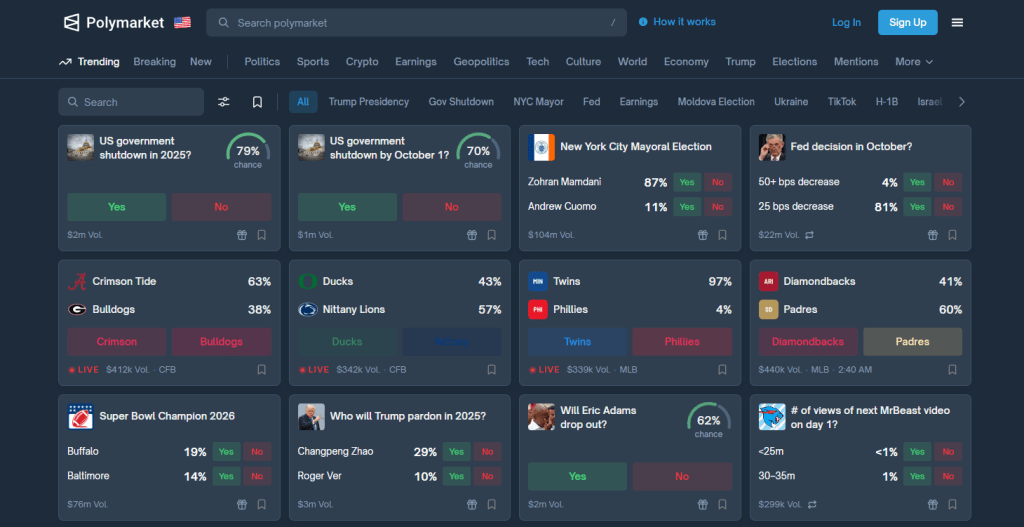
Polymarket is a prediction market where users buy and sell shares on future outcomes such as political events, cultural moments and sports. It operates on Polygon because the network offers low fees, fast settlement and composability. These traits allow prediction markets to scale and turn event-driven speculation into consistent blockspace demand.
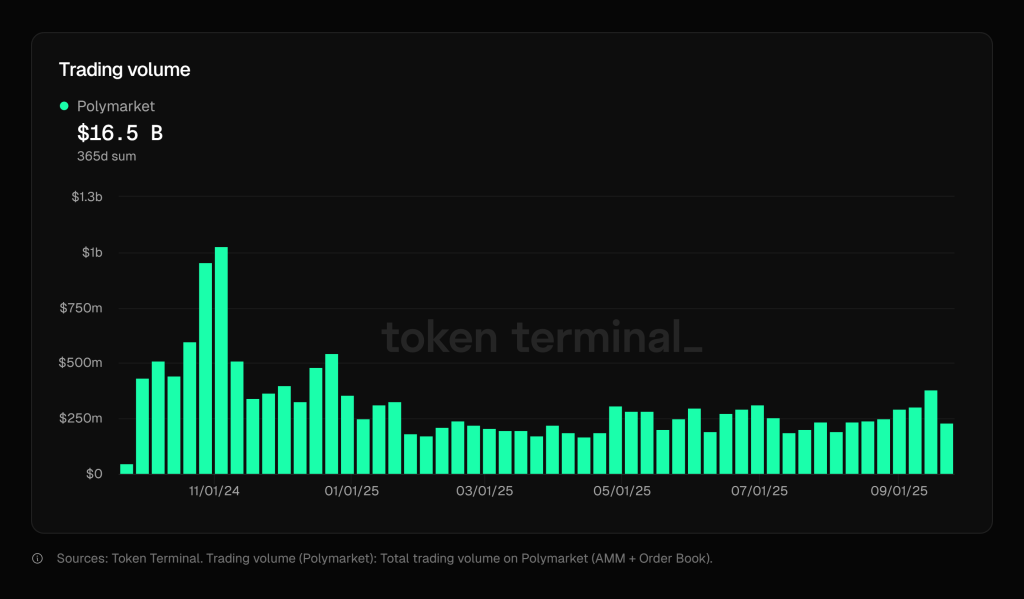
Volume and activity show the impact. In June 2025, Polymarket recorded about $1.16 billion in monthly trading volume. Over its lifetime it has handled more than $18 billion in cumulative trading across prediction markets. TokenTerminal reports roughly 208,600 monthly active users and a TVL of 165 million dollars. These figures reflect mainstream interest during big events along with steady background demand in niche markets.
Election cycles, major sports seasons and cultural milestones drive spikes in bets. During the 2024 U.S. presidential race alone, markets saw billions in volume as traders speculated on outcomes. Polymarket’s integration with X amplifies reach and exposes its prediction interface to hundreds of millions of users.
Onchain user experience matters as well and is often overlooked by builders. Polymarket onboarding is smooth when users already hold USDC. However, custody paths such as wallet setup, approvals and KYC/geofencing rules based on region can block or limit access. Scaling requires handling millions of casual participants rather than only serious bettors. If liquidity fragments across alternative Layer 2 networks or app-specific chains, Polymarket could lose volume to faster or cheaper rivals.
As Polymarket continues to grow, it becomes more than just an app. It drives persistent blockspace usage tied to real value transfer. That flow makes POL more than a validator utility token because it channels one of Web3’s most dynamic use cases. As prediction markets expand they can pull the entire ecosystem’s demand upward and strengthen POL.
Competitive Landscape and Narrative Positioning
Ethereum’s L2 ecosystem is crowded, though. Optimism and Arbitrum both compete directly by offering low-cost, high-throughput rollups that inherit Ethereum’s security model. They attract DeFi protocols that demand composability and trust. At the same time, alternative Layer-1 chains like Solana and Avalanche court the same categories of gaming, consumer apps, and retail finance that Polygon targets.
Polygon’s differentiators are clear. Its CDK delivers modularity, enabling teams to launch custom Layer-2 chains with flexible choices in data availability, gas tokens, and security. Builders using CDK can opt into Polygon’s aggregation layer, tapping into shared liquidity across chains. This gives them access to both Ethereum and Polygon ecosystem depth without needing to bootstrap from zero.
Enterprise go-to-market is another strength. Brands and platforms adopt Polygon to roll out loyalty systems, NFT drops, and identity schemes. That keeps Polygon visible in consumer-facing use cases. Finally, liquidity aggregation (unifying capital across chains rather than fragmenting it) remains a core narrative, and one many competing chains struggle to replicate.
Despite all of this, Polygon has gaps to close. Some competitors boast simpler developer tooling and deeper integration with Ethereum’s latest upgrades. Others offer ultra-low latency or niche architectures tailored for gaming or high-volume microtransactions. Governance, decentralization, and cross-chain security under the aggregation model still need proof at scale. If CDK chains splinter liquidity or duplication emerges across app-chains, Polygon risks losing network effects. Additionally, a chain that tries to do everything right without focusing on a specific niche could lose it all.
Valuation and Metrics Dashboard
| Metrics | Value | Notes |
| Active addresses (24h) | 619,796 | Closest public metric to 30-day MAU. |
| Tx count (24h) | 3.68 million | Observed throughput; supports a stable base of onchain activity. |
| Observed TPS | 42-47 TPS | Based on 24h txs and explorer stats. |
| Avg fee per txn | ~$0.003 | Chain fees $10,301/3.68m tx ≈ $0.0028 per txn. Explorer gas trackers also show sub-cent fees. |
| Chain revenue | $10,022 | Chain revenue is the portion retained by the chain after burns. |
| % revenue to stakers/treasury | Base fee burned; tips to validators | Polygon PoS uses EIP-1559 style burn. Priority fees go to validators; burn reduces supply pressure. |
| TVL | $1.131b | High-quality mix anchored by stables; stablecoin cap on Polygon $2.97b with ~48% USDT share. |
| Fees paid (total, 24h) | $365,606 | Includes app + chain fees; do not use this to compute network fee per txn |
| POL market cap | ~$2.34b | Current market capitalization of POL. |
Sources: DeFi Llama, Token Terminal, Polygon Scan
Polygon (POL) Price Prediction
Polygon (POL) Price Prediction for 2026
As of late June 2026, POL trades near $0.07, with a market cap of roughly $760 million, down about 58% over the past year. That sits well below the $0.20 figure cited earlier in this guide and far under the $1.30 April 2026 target that appeared in earlier drafts. The Layer-2 sector has stayed under pressure as liquidity rotated toward majors and AI tokens, and POL has not reclaimed its prior range despite steady network usage and growing stablecoin activity, including leading stablecoin transfer volume in Latin America.
This resets the base for every forecast that follows. A move back to $1 now implies roughly a 13x to 14x from current levels, which realistically requires a full market cycle plus a clear catalyst. The most credible candidates are AggLayer traction, the Polygon 2.0 payments push (the network now claims around 5,000 payments per second), and a breakout consumer or payments app that drives real fee generation rather than speculation.
Near-term, most technical models lean bearish to neutral, with support around $0.065 to $0.072 and resistance near $0.10. A decisive break below $0.065 would open the door to new lows, while reclaiming $0.10 would be the first real sign that momentum is turning. A realistic 2026 range is roughly $0.07 on the low end to $0.20 to $0.28 if broader risk appetite returns. Higher targets of $1 or beyond belong to multi-year scenarios contingent on execution, sustained TVL growth, and a friendlier macro backdrop.
Polygon (POL) Price Prediction for 2027
2027 could be a quieter year for crypto. Trading volumes may slow, headlines may shrink and more focus could shift to building rather than speculation. For POL this environment would likely mean lower volatility compared with previous years. Price swings could narrow as traders wait for the next big catalyst.
A calm market does not rule out gains. Slow but steady growth is still possible if user adoption keeps improving. Bringing new users onchain remains one of the hardest problems for every network. Polygon’s developers have already started addressing it through consumer apps, partnerships and better onboarding tools. By 2027 these initiatives could scale further and attract a larger non-crypto audience.
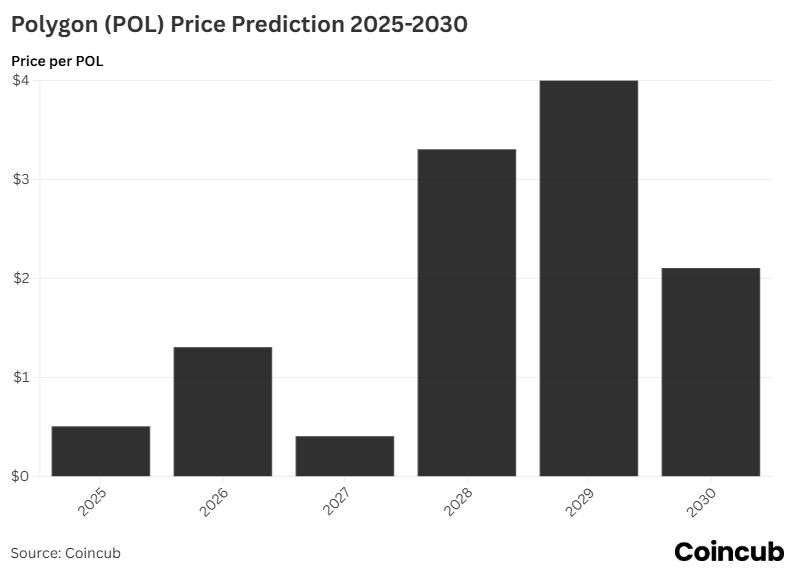
If that happens, POL could benefit from a base of consistent demand. Staking across multiple Polygon chains would continue to lock up supply while new applications generate more transactions. Together these factors could support gradual upward movement even in a low-hype environment. Despite this, POL is likely going to dip in 2027, potentially sitting around $0.40-$0.50 throughout the year.
This scenario assumes steady execution by builders and continued interest from mainstream partners. A setback in adoption or a major macro shock could delay progress, but a slow, positive trend remains the most likely outcome for 2027.
Polygon (POL) Price Prediction for 2028
2028 is likely going to be a strong year for crypto. Several key events could align to push momentum upward. First, the next Bitcoin halving is expected to reduce miners’ rewards, tightening supply and often driving price pressure upward. Miners need BTC to maintain profitability, and a lower issuance rate tends to draw capital into the market.
Second, 2028 is a U.S. election year. Shifts in administration often energize financial markets with fresh policy direction. If a crypto-friendly candidate supports crypto, that can accelerate integration and legitimacy in the system. Former President Trump has already supported cryptocurrencies in previous campaigns. If he remains engaged through the last year of his term, 2028 could be a time when crypto gains further access into traditional financial infrastructure.
For POL, these macro catalysts might turn into upward momentum. The coin has been gaining adoption through DeFi, Web3 apps, and brand integrations. By 2028, those trends could scale by a lot.
Under a bullish scenario, POL might break previous all-time highs and push beyond $2.80. In an aggressive case, heights above $3.30 could be possible assuming adoption, liquidity, and market confidence all rally together. Price isn’t assured, but the alignment of network growth and macro tailwinds could make 2028 one of POL’s breakout years.
Of course, nothing is guaranteed. Regulatory changes, macro shocks, or network missteps could interfere. But given the upcoming halving, elections, and increasing adoption, the odds are on hodlers and traders favor.
Polygon (POL) Price Prediction for 2029
2029 will be the post-halving year, a period that historically produces new all-time highs for Bitcoin and altcoins. The 2021 cycle delivered record prices and the 2025 cycle showed similar behavior, although with some changes in patterns. In 2024 and 2025 an unprecedented wave of memecoins captured liquidity and attention, making the market less predictable. By 2029 the environment is expected to look more traditional. Capital should flow toward projects with strong fundamentals rather than purely speculative tokens.
This shift could benefit Polygon and its token POL. By that time, the network’s infrastructure will be far more mature. Developers will have built consumer applications, DeFi platforms, and enterprise integrations at scale. If user adoption and transaction volumes continue to grow, POL will see stronger staking demand and tighter supply from validators and delegators.
Under these conditions POL could push to a new all-time high near $4.00. Smart money would view it as exposure to a whole ecosystem rather than just a single token. While market risks and competition will always exist, 2029 has the potential to be a classic post-halving year where fundamentals and market cycles push the market to ATHs.
Polygon (POL) Price Prediction for 2030
2030 could mark a calmer stage for crypto. By then the industry is expected to be far more mature, with deeper liquidity, clearer regulation, and better infrastructure. Since 2017 each cycle has brought new products and larger players, but also a gradual shift toward smarter capital allocation. Speculative runs like the memecoin mania of 2021 and 2024 may still appear, but they will likely be shorter and less disruptive.
This environment would not remove risk entirely. Markets tend to cool after periods of strong growth, and even solid ecosystems can experience sharp dips. Polygon, despite its scale, would be no exception. After years of expansion across DeFi, consumer apps, and enterprise integrations, the network could face profit taking or a pause in new capital inflows.
A significant dip for POL is possible under these conditions. A price near $2.10 per token would represent a correction from prior highs but still reflect a much larger ecosystem and market capitalization than today. Such a move would mirror the pattern of past cycles where strong projects held most of their gains even during market resets. For long-term holders, 2030 could be less about quick rallies and more about steady building and consolidation before the next uptrend.
Final Thoughts on Polygon (POL) Price Prediction
Polygon has evolved from a single proof-of-stake chain into a full suite of scaling and infrastructure tools. It now supports the PoS chain, zkEVM, CDK-based rollups, and an aggregation layer designed to unify liquidity and security. This depth gives POL holders exposure to far more than one network. It represents a stake in an expanding ecosystem that combines low fees, high throughput, and a growing roster of consumer and enterprise apps.
The price forecasts for 2025 through 2030 show both the sides of the future. POL could rise in years when macro conditions, Bitcoin cycles, and user adoption align, then retrace during quieter phases. What goes up, has to come down at the end of the day. This mirrors the pattern seen in previous crypto cycles. Yet unlike earlier periods, Polygon now has a clear strategy to capture value. Validators stake POL across multiple chains, fees are burned on the PoS chain, and developers can launch their own rollups while tapping into shared liquidity.
These mechanics matter because they tie network growth directly to token demand. More dApps and users mean more transactions, more staking, and a stronger governance base. That is the foundation for long-term value even when price action is volatile.
Looking ahead, success will depend on Polygon proving that it can outperform rival Ethereum Layer-2s and fast Layer-1s. On top of that, it is up to Polygon or the products being built on it to make it as easy as possible for newcomers to join the ecosystem. Polymarket is a great example of how to onboard web2 people to web3. Currently, it is all about consumer apps and onboarding new people, and with the momentum Polygon has, this is likely going to benefit its ecosystem in the long run.
Frequently Asked Questions (FAQ)
What is POL (Polygon) worth in 2026? +
As of mid-2026, POL trades in roughly the 0.08 to 0.10 dollar range, well below its 2025 levels. The price reflects weak demand for Layer-2 tokens despite steady network usage, so always check a live source before relying on a figure.
Can POL reach 1 dollar? +
POL reaching 1 dollar is possible but not likely in the near term. From a mid-2026 base near 0.10 dollars it would need roughly a 10x move, which realistically requires a full market cycle plus strong adoption catalysts like AggLayer growth or a breakout consumer app.
Why did POL drop so much? +
POL fell because demand for Layer-2 tokens weakened, liquidity rotated into Bitcoin and AI tokens, and competition from Arbitrum, Optimism, and fast Layer-1s intensified. Network usage stayed healthy, but token price decoupled from activity during the decline.
What is the difference between MATIC and POL? +
POL is the upgraded native token that replaced MATIC across Polygon. The migration was over 99% complete by September 2025, and POL now handles gas, staking, and governance across the PoS chain and all CDK-based Layer-2s, with the same 10 billion base supply.
Is POL a good investment in 2026? +
POL may suit investors who believe in Ethereum scaling and Polygon's consumer-app strategy, but it carries real risk from competition and execution. Its low price offers higher upside if adoption grows, though there is no guarantee it recovers previous highs.
What drives Polygon's real demand? +
Polygon's demand comes from DeFi protocols like Aave and Uniswap, prediction markets like Polymarket, and brand programs from Starbucks and Reddit. These generate steady transactions and staking demand that tie network growth to POL utility.
Who founded Polygon? +
Polygon has no single owner. It was founded by Jaynti Kanani, Sandeep Nailwal, Anurag Arjun, and Mihailo Bjelic, and is now governed through POL staking and community governance rather than a single controlling entity.