


 Buy a Licensed Company
  Explore VASP Data
  Talk to an Expert

 Atis Shala
Atis is a senior analyst and community lead with four years of experience in crypto. He has a bachelor from the Rochester Institute of Technology.
Atis Shala
Atis is a senior analyst and community lead with four years of experience in crypto. He has a bachelor from the Rochester Institute of Technology.
Dogwifhat (WIF) Forecast: Can WIF Make a Comeback?
Price predictions in crypto are already considered a speculative investment. When the token in question is a memecoin like Dogwifhat, the usual playbook breaks down even further. Applying frameworks designed for utility tokens, cash flow proxies, or network adoption curves leads to false confidence and poor conclusions.
Memecoins do not trade on discounted future value. They trade on attention – liquidity and utility are not primary. Attention determines whether new buyers even see the meme. Liquidity determines how easily capital can move in and out. Reflexivity ties the two together. Rising prices attract attention, attention attracts liquidity, and liquidity reinforces price momentum. The process can reverse just as quickly.
This dynamic highlights the core difference between valuation and price discovery. Valuation asks what a token should be worth based on fundamentals. Price discovery asks where buyers and sellers agree to transact right now. For Dogwifhat, price discovery dominates. There is no revenue stream to model and no protocol usage to forecast. The market sets the price based on belief, positioning, and timing within the broader cycle.

Narratives therefore matter more than fundamentals. WIF lives or dies by its ability to remain culturally relevant, liquid, and visible in a crowded memecoin landscape. Social momentum, exchange access, and ecosystem sentiment matter more than roadmaps or technical upgrades. Ignoring this reality leads to misleading predictions that look precise but explain nothing.
This article treats Dogwifhat price prediction as scenario analysis, not prophecy. It focuses on market conditions, liquidity regimes, and narrative strength, while clearly defining what would invalidate each outlook. Nothing here constitutes financial advice. The goal is education, not hype, and clarity over comfort.
Dogwifhat (WIF) Flash Prediction
| Horizon | Base case | Bull case | Bear case |
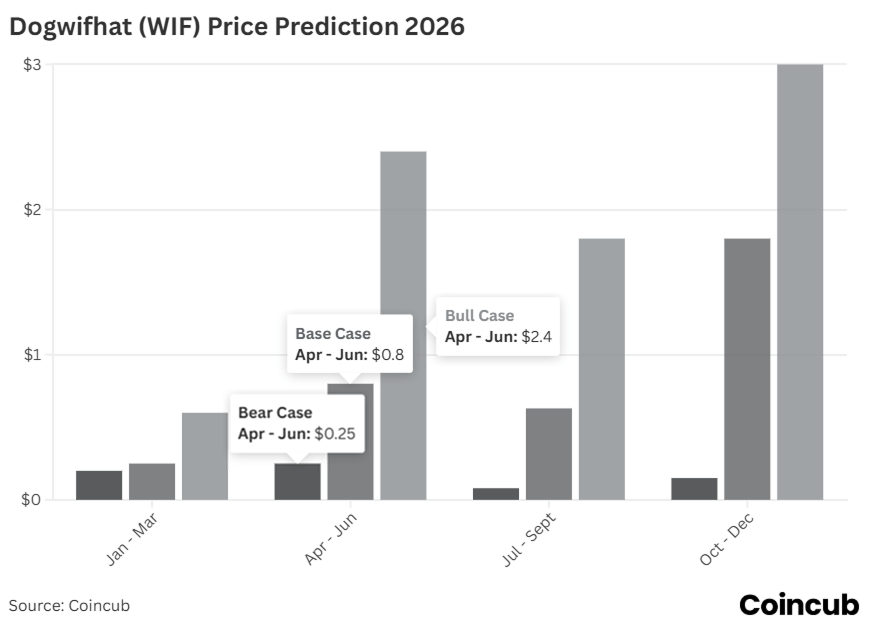
| 2026 | $0.25 – $0.80 Bitcoin stays constructive; Solana remains relevant; selective risk-taking returns. Periodic meme rotations lift WIF, but no full meme season. Liquidity improves gradually, resistance breaks slowly. |
$0.60 – $3.00 Clear risk-on phase across crypto; Solana leads; memes regain cultural mindshare. WIF trades as a “blue-chip meme” with sustained spot volume and broad participation. |
$0.08 – $0.25 Bitcoin chops or trends lower; Solana activity cools; retail disengages. Thin liquidity dominates, rallies fade quickly, engagement metrics decline. |
| 2027-2028 | $0.30 – $1.80 At least one broad crypto upcycle completes. WIF retains legacy meme status and benefits from familiarity and liquidity during risk-on phases, despite deep drawdowns between cycles. |
$2.50 – $6.00 Full meme supercycle returns. WIF remains top-of-mind, supported by deep liquidity on major venues and repeated narrative relevance. |
$0.06 – $0.20 Rotation risk dominates. New memes capture attention, liquidity fragments, and WIF loses default meme status. Holder growth stagnates and exchange depth weakens. |
| 2030+ | $0.40 – $3.00 WIF survives via recognition and liquidity concentration. It remains tradable across cycles as a known meme asset without dominating the sector. |
$5.00 – $15.00 Speculative tail scenario. Another major bull run and meme season emerge post-2028 halving. Retail adoption returns and WIF stays culturally relevant across venues. |
$0.03 – $0.10 Relevance fades. Liquidity migrates permanently to newer memes, spreads widen, and organic social presence declines toward irrelevance. |
What is Dogwifhat (WIF)?
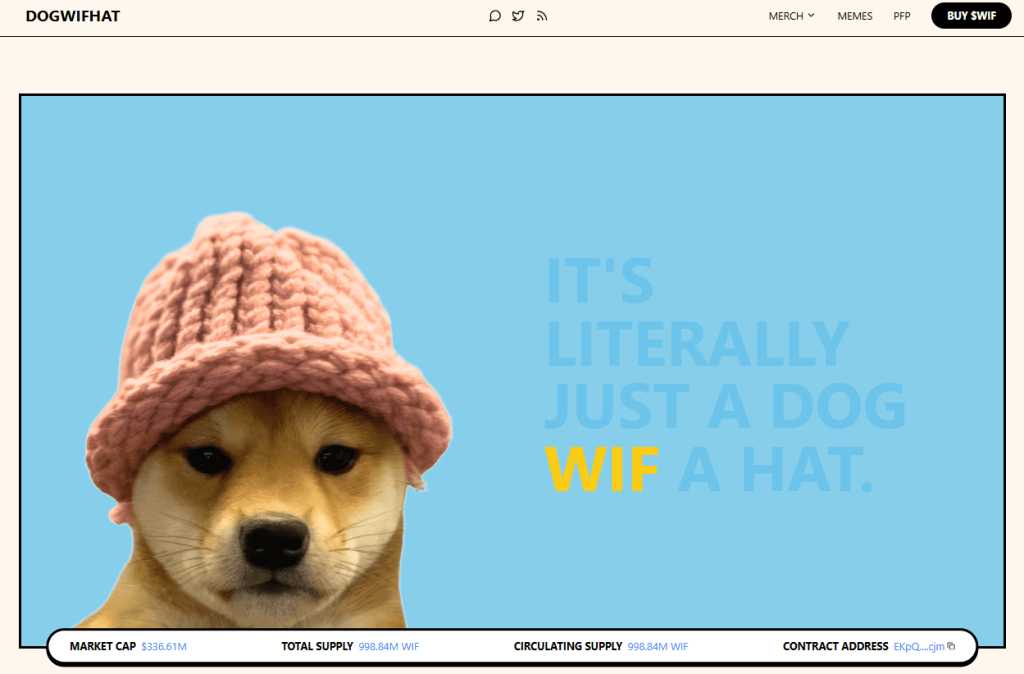
Dogwifhat is literally just a dog wif a hat. But if you want it to make sense, Dogwifhat starts with stripping away assumptions that usually accompany crypto. WIF did not emerge to solve a technical problem, optimize a protocol, or unlock a new form of decentralized coordination. It emerged as a memecoin, natively launched on Solana, built around a simple visual joke and a shared sense of online humor. That origin is not a weakness as it defines how the token behaves.
Dogwifhat belongs to a category of tokens that are intentionally minimal. There is no protocol utility by design. WIF does not secure a network, pay for computation, or govern an ecosystem. It does not promise yield, roadmaps, or long-term development milestones. This absence matters because it removes a common source of narrative drift. Holders do not debate future upgrades or adoption curves. The market trades WIF for what it is today, not for what it might become.
Socially, WIF represents coordination, identity, speculation, and even manipulation sometimes. Holding the token signals participation in a shared meme and a specific moment in crypto culture. That coordination effect allows thousands of independent market participants to act in parallel without formal organization. Identity reinforces stickiness, while speculation provides the incentive structure. Together, they create a feedback loop where belief translates into liquidity, and liquidity reinforces belief.
This is how memecoins derive value. Not from cash flows or protocol usage, but from shared conviction and market depth. When enough participants agree that a token matters, capital flows follow. Liquidity enables price discovery, attracts traders, and lowers friction for new entrants. As long as that loop holds, price can sustain levels that traditional valuation models would dismiss outright.
Simplicity plays a crucial role here. In meme markets, complexity often dilutes attention. A token with no emissions schedule to decode, no governance debates, and no technical dependencies remains easy to understand and easy to trade. That clarity reduces cognitive load for retail participants, which matters during fast-moving market phases.
Why Did WIF Blow Up?
Once you accept what Dogwifhat is, so, an extremely volatile speculative memecoin, the next step is understanding the environment it trades in. Memecoins do not move in isolation. They amplify broader market conditions, especially liquidity cycles driven by Bitcoin and macro risk appetite. When liquidity expands and investors shift into risk-on mode, speculative tokens benefit first and fastest. When liquidity contracts, memecoins tend to suffer sharper drawdowns than most other crypto sectors.
Bitcoin plays a central role in this cycle. Rising Bitcoin prices often signal improving market confidence and attract new capital into crypto. As that capital rotates outward, traders look for higher beta opportunities. Memecoins sit at the extreme end of that spectrum. They attract capital not because they offer yield or utility, but because they offer volatility and narrative leverage. This rotation usually happens late in bullish phases, but it can be violent while it lasts.
The Solana ecosystem adds another layer. Low transaction costs, fast settlement, and a retail-friendly culture have turned Solana into a natural home for memecoin activity. When Solana volume increases and retail participation rises, memecoins like WIF benefit from tighter spreads, deeper liquidity, and faster narrative transmission. Conversely, when Solana activity cools, memecoin liquidity often dries up quickly.
Memecoins Are Liquidity Bottom-Feeders
Meme rotation dynamics further complicate price behavior. Attention does not distribute evenly across tokens. It concentrates, peaks, and then decays. New memes emerge, capital rotates, and older narratives lose mindshare even if nothing breaks structurally. This makes timing critical. A memecoin can remain fundamentally unchanged while its price collapses simply because attention moves elsewhere.
This is why fundamentals lag price for memecoins. There are few fundamentals to react to in real time. Price leads sentiment, not the other way around. Traders respond to momentum, liquidity, and visibility long before any onchain metric stabilizes. Waiting for confirmation often means missing the move entirely.
That said, social velocity alone is not enough. Sustained price action requires onchain confirmation. Rising transaction counts, growing holder bases, and consistent volume signal that attention has translated into capital. When social hype spikes without onchain follow-through, moves tend to fade quickly.
Dogwifhat (WIF) Maximum Supply
After setting the market context, the next layer is structural. Dogwifhat’s supply mechanics are simple on paper, yet price behavior remains anything but. Understanding this distinction helps explain why WIF can experience sharp moves without any change in token design.
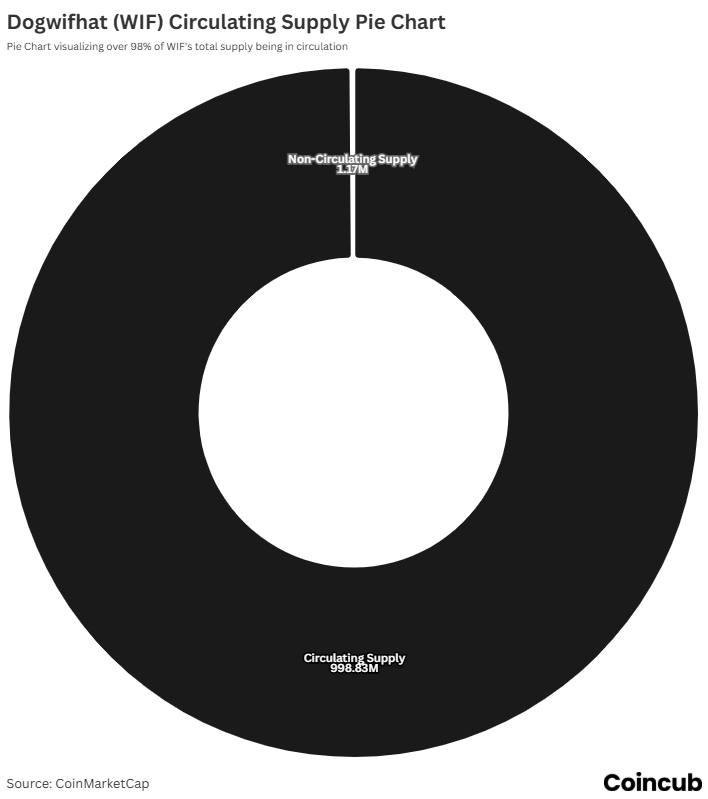
Circulating supply refers to the number of WIF tokens currently available to trade on the market. Max supply represents the total number of tokens that will ever exist. In WIF’s case, these figures are effectively aligned, which removes a major source of uncertainty common in other crypto tokens. There are no future unlock schedules to model and no gradual emissions that dilute holders over time. This absence of inflation matters. Price pressure does not come from new tokens entering circulation. It comes entirely from shifts in demand and liquidity.
Market Capitalization as an Indicator
Market cap often creates a false sense of scale. It simply multiplies price by circulating supply. Fully diluted valuation applies the
same logic to max supply. Neither metric reflects how much capital actually entered or exited the market. In memecoins, price can move aggressively on relatively small net flows because liquidity sits in thin order books rather than deep institutional markets. A modest increase in buy pressure can push price far higher than intuition suggests.
This explains why price frequently moves faster than market cap logic implies. Market cap measures the value of the last traded token, not the cost of repricing the entire supply. When liquidity concentrates at certain levels, price jumps occur as offers disappear, not because billions of dollars suddenly entered the system.
Liquidity concentration introduces its own risks. Large holders can influence short-term price action. Exchange depth varies widely across venues. During high-volume periods, this concentration amplifies upside momentum. During risk-off phases, it accelerates downside moves just as quickly.
How Did WIF Attain Relevance?
Dogwifhat attained relevance through a textbook example of memecoin reflexivity. Everything began with attention from the right people on the crypto bubble within X known as CT (short for crypto twitter).
In its early phase, WIF circulated quietly within Solana-native trading circles. The meme itself was simple and highly adaptable, which made it easy to reproduce without explanation. That simplicity lowered friction. Anyone could repost the image, modify it slightly, or attach it to a one-line caption without needing context. This allowed the meme to spread faster than more complex narratives.
The tipping moment came when high-visibility accounts on X, such as Ansem, began sharing Dogwifhat posts in rapid succession. Several widely followed traders and crypto-native influencers posted the dog-in-a-hat image with minimal or no text. Those posts generated unusually high engagement relative to effort, signaling to the broader market that something was forming. The key was coordination without coordination. No single post caused the breakout, but the clustering of viral tweets within a short window created social proof.
get accused of this a fair amount so I will clarify this here, longer post on memes incoming
firstly i do not pnd any coins, i am wrong on trades sometimes yes, but i have never intently shared a trade on here & then immediately thereafter sold while bullishly tweeting about it… https://t.co/TwXB2Rnmyk
— Ansem (@blknoiz06) May 15, 2024
Once that threshold was crossed, reflexivity took over. Engagement drove curiosity. Curiosity drove spot buying. Spot buying pushed price higher. Rising price validated the meme and pulled in the next wave of participants. Liquidity expanded quickly, especially on Solana-based venues, allowing the narrative to scale without immediately collapsing under slippage.
This moment also marked a broader shift in the memecoin market. WIF demonstrated that memes did not need elaborate lore or promised utility to dominate attention. Speed, recognizability, and social repeatability mattered more. After Dogwifhat’s breakout, traders increasingly watched X timelines as closely as onchain data, recognizing that memecoin relevance now forms socially first and financially second.
Will WIF Ever Make a Comeback?
After understanding how Dogwifhat attained relevance and why that moment mattered, the harder question follows naturally: can that relevance return? For memecoins, revival is far more difficult than initial ascent. Attention decays faster than it accumulates, and once a meme exits the active rotation, the market rarely offers second chances without a meaningful regime shift. In the current environment, where memecoin activity has cooled significantly, any discussion of catalysts must stay grounded.
The first and most important catalyst would be a renewed Solana ecosystem bull phase. This does not mean incremental improvement or isolated protocol success. It requires a broad increase in onchain activity, retail participation, and speculative appetite across Solana tokens. If transaction volumes rise, new wallets enter the ecosystem, and capital rotates back into high-beta trades, WIF could benefit indirectly. The mechanism here is liquidity spillover. More capital in the ecosystem increases tolerance for speculative bets. Durability would show up through sustained volume growth across multiple Solana-based venues, not a single spike.
A second potential catalyst is a retail-driven meme supercycle. These cycles tend to emerge late in broader crypto bull markets, when risk appetite peaks and traders actively seek asymmetric upside. In such phases, older memes with strong name recognition can resurface alongside new entrants. For WIF, this would require not just renewed interest, but renewed creativity. Evidence of durability would include consistent meme production across many accounts and rising holder counts rather than short-lived price pumps.
Exchange listings or meaningful liquidity expansions represent another possible catalyst, though their impact has diminished over time. Listings can still improve access and reduce friction, but they no longer guarantee sustained demand. For WIF, a listing would only matter if it coincides with rising market-wide interest. Confirmation would come from improved order book depth and stable volumes weeks after the listing, not on day one.
Viral moments remain the most unpredictable catalyst. A single image or phrase can still travel fast, but virality alone no longer suffices. To revive WIF, a viral moment must translate into sustained trading activity and new holders. Without follow-through, these spikes fade quickly.
Dogwifhat (WIF) Forecast for 2026 and Beyond
For your information, WIF’s circulating supply sits near max supply, so future dilution does not drive the model the way it does for many utility tokens.
Dogwifhat (WIF) Forecast 2026
Memecoins tend to get liquidity last. That sequencing matters. If traders do not make money on Bitcoin first, and then on majors and higher-quality alts, memecoins usually do not get a real season. In that environment, WIF can still bounce on local catalysts, but it struggles to sustain the trend.
Bear Case: WIF Trading Between $0.08 to $0.25
Assumptions: Bitcoin chops or grinds down, Solana cools, and retail stays disengaged. Liquidity remains thin, and each rally sells into overhead supply from trapped holders.
What you would see: Brief pumps on social spikes, quick mean reversion, and declining engagement metrics.
Base Case: WIF Trading Between $0.25 to $0.80
Assumptions: Bitcoin stays constructive, Solana holds relevance, and the market allows selective risk. WIF benefits from periodic rotations, but the meme complex does not fully re-ignite.
What you would see: Higher lows in spot volume, improving order book depth, and repeated tests of resistance that eventually stick.
Bull Case: WIF Trading Between $0.60 to $3.00
Assumptions: A clear risk-on phase returns, Solana leads, and memes regain cultural mindshare. WIF acts as a “blue-chip meme” within the Solana set.
What must be true: Broad meme participation, not a single-token squeeze. Consistent spot-led volume (not just perp leverage). If people do not make money first in Bitcoin and then in alts, this case usually fails.
Dogwifhat (WIF) Forecast 2027-2028
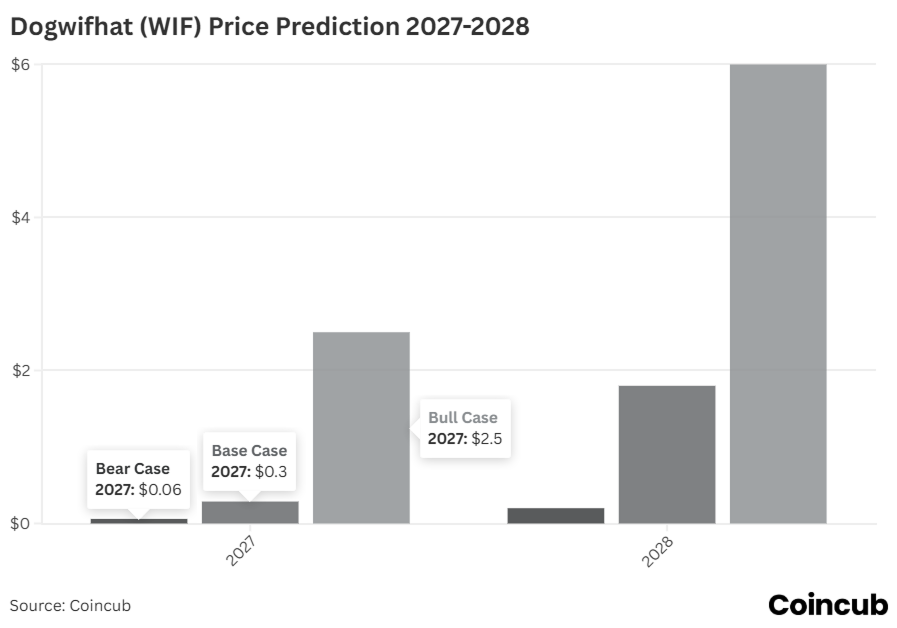
Over this window, the core question becomes longevity. Meme markets punish stagnation. They also reward survival because most competitors disappear. That creates a weird dynamic: WIF can underperform for long periods, then reprice violently if the market decides it still belongs in the “main cast.”
Again, memecoins get liquidity last. If traders do not make money on Bitcoin and then alts, a memecoin resurgence becomes unlikely.
Bear Case: WIF Trading Between $0.06 to $0.20
Assumptions: Rotation risk dominates. New memes replace WIF as the default attention sink. Liquidity fragments, and market makers prioritize newer venues.
What you would see: Fewer organic social spikes, shrinking holder growth, and lower exchange depth.
Base Case: WIF Trading Between $0.30 to $1.80
Assumptions: Crypto completes at least one more broad upcycle, Solana remains a top retail chain, and WIF retains “legacy meme” status.
Mechanism: Not fundamentals. Familiarity plus liquidity. Traders prefer liquid memes when they want high beta without microcap slippage.
What you would see: Periodic strong rallies during risk-on phases, followed by deep drawdowns, but with higher cycle-to-cycle floors.
Bull Case: WIF Trading Between $2.50 to $6.00
Assumptions: A full meme supercycle returns and WIF stays top-of-mind. Major venues support deep liquidity, and the market treats WIF like an index component of the meme sector. This would come after the Bitcoin halving scheduled for mid-2028.
What must be true: Sustained cultural persistence, not nostalgia. Also, broad profit conditions upstream in Bitcoin and alts.
Dogwifhat (WIF) Forecast 2030
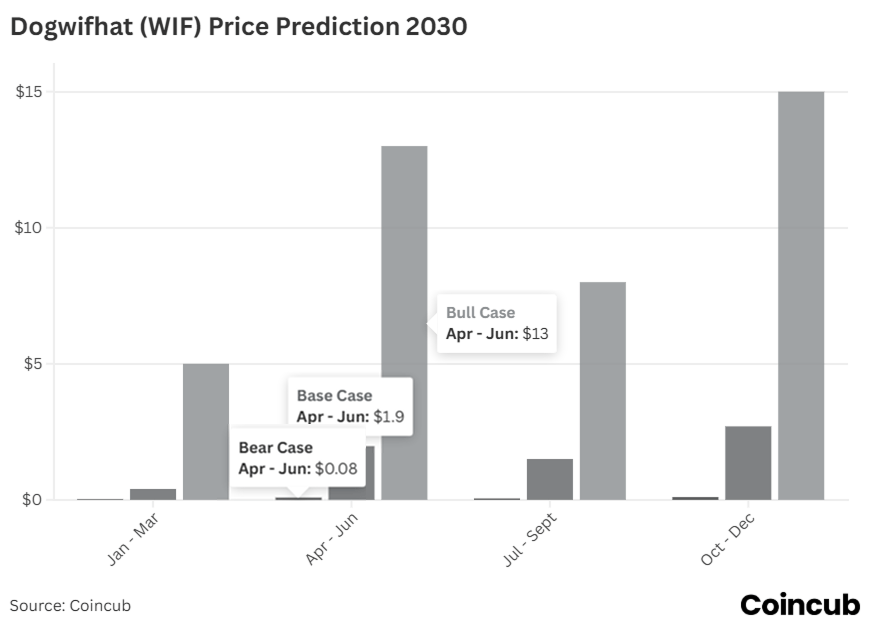
Five-plus years forces humility. Survival bias dominates memecoins as most go to near-zero or become illiquid relics. A small set survives because they remain culturally legible and liquid enough for traders to keep using them as “attention chips.”
This is a speculative tail scenario, not a forecast. Still, long horizons often include multiple Bitcoin halving-driven cycles, including the 2028 halving, which can contribute to another broad risk-on wave if macro conditions cooperate.
Memecoins still get liquidity last. If people do not make money on Bitcoin, then alts, then other risky tokens, memecoins usually do not lead. However, by 2030, another bull run could plausibly produce another meme season reminiscent of 2023-2024.
Bear Case: WIF Trading Between $0.03 to $0.10
Assumptions: WIF fails the relevance test. Liquidity migrates permanently to new memes and new social primitives.
What you would see: Exchange support thins, spreads widen, and organic social presence fades.
Base Case: WIF Trading Between $0.40 to $3.00
Assumptions: WIF survives as a recognizable, liquid meme across cycles. It does not dominate, but it stays tradable and culturally understood.
Mechanism: Durability plus liquidity concentration. Traders return to the “known liquid names” when they want meme exposure quickly.
Bull Case: WIF Trading Between $5.00 to $15.00
Assumptions: A major retail adoption wave hits, meme trading returns as a mainstream behavior, and WIF remains a top-tier symbol in that wave.
What must be true: Multi-venue liquidity, persistent social velocity, and repeated cycle relevance. Treat this as a long-shot outcome, not an expectation.
Could WIF Become the Next Dogecoin?
Although WIF is one of the biggest memecoins of this cycle, we must address how these predictions can fail. For Dogwifhat, downside risks do not come from protocol bugs or broken token mechanics. They come from market behavior, attention dynamics, and capital allocation decisions. These risks are structural, not temporary.
The most obvious risk is narrative fatigue. Memecoins live and die by attention, and attention is finite. Once a meme exhausts its cultural novelty, reviving it becomes exponentially harder. Reposts feel recycled, engagement thins, and new participants gravitate toward fresher narratives. Even if the community remains active, the broader market may simply stop caring. For WIF, declining meme originality and reduced organic sharing would signal that fatigue has set in.
Liquidity evaporation is closely related but more dangerous. Memecoins often appear liquid until they are not. In risk-off conditions, market makers pull depth, spreads widen, and price gaps emerge. What looks like a healthy chart during calm periods can unravel quickly once selling pressure increases. Without consistent spot demand, WIF becomes vulnerable to sharp downside moves driven by relatively small flows.
Whale concentration risk adds another layer. Large holders can dominate short-term price action, especially when liquidity thins. If a small number of wallets control a meaningful share of circulating supply, exits can cascade. This does not require malicious intent. Even rational profit-taking can overwhelm bids and trigger prolonged drawdowns that discourage new entrants.
Opportunity cost often goes overlooked. Capital locked in a stagnant memecoin is capital not deployed elsewhere. If Bitcoin, major altcoins, or emerging narratives offer better risk-adjusted returns, traders rotate out. Over time, this rotation can hollow out liquidity even if the community remains vocal. Markets reward momentum, not loyalty.
The Infamous DOGE Case
Finally, there is the “DOGE case.” Dogecoin remains one of the most recognized memecoins in existence, yet it has never sustainably returned to its prior peak despite massive brand awareness, celebrity endorsements, and a persistent community.
This scenario matters because it shows that cultural relevance does not guarantee price recovery. A memecoin can survive socially while failing financially. For WIF, this is a real risk. Even with continued recognition, prior all-time highs may remain structurally out of reach.
If a memecoin that once had a market capitalization above $70 billion fails and never recovers, why should WIF, a new-gen memecoin that never even reached a market cap above $10 billion recover and set new all-time highs?
Frequently Asked Questions (FAQs)
Is WIF crypto a good investment?
WIF is a speculative memecoin with no fundamental utility. Its price depends on community sentiment, liquidity, and narrative cycles. That makes it high-risk and not a traditional “investment” by fundamentals. Not financial advice.
How much is WIF today?
The price of Dogwifhat (WIF) is around $0.33 USD at the time of writing, fluctuating with market activity. Values vary slightly across exchanges.
What is the WIF?
WIF is the ticker for Dogwifhat, a Solana-based memecoin created for community engagement and speculative trading. It does not offer protocol utility or governance rights.
What does dogwifhat mean?
Dogwifhat combines “dog” imagery with a playful “with hat” meme motif. It represents internet humor, community identity, and the cultural appeal behind meme token markets.
What is the future of WIF?
The future of WIF depends on market cycles, social attention, and liquidity. It could recover in the future, although it is highly unlikely.