Buy a Licensed Company
  Explore VASP Data
  Talk to an Expert

 Dren Hima
 is Head of Research at Coincub, leading research across digital asset regulation, licensing, market structure, tokenization and institutional adoption.
Dren Hima
Dren Hima is Head of Research at Coincub, leading research across digital asset regulation, licensing, market structure, tokenization and institutional adoption.
Aave Price Prediction 2026-2030: Can V4 and GHO Deliver a New ATH?
Aave has survived every DeFi cycle and sits on top of the lending stack again in late 2025. TVL is in the $34-44 billion range, borrowed value is above $21 billion, and Ethereum still carries the bulk of the liquidity.
The token does not reflect that strength yet. AAVE trades around $190, with a market cap just under $3 billion, and a fully diluted value close to $3.1 billion. Almost all of the fixed 16 million supply already circulates.
At the same time, protocol revenue runs around $100-120 million annualized depending on the data source and timeframe, with close to a billion dollars in gross fees flowing through the system. Governance just locked in a permanent $50 million yearly buyback budget funded from those revenues, on top of the existing pilot program that already retired more than 94,000 AAVE.

This is the setup for the next phase. V4 restructures the protocol into a modular hub and spoke system, GHO is scaling as a native stablecoin, and the DAO is killing off unprofitable side deployments. The question for investors is simple: does this combination pull AAVE back toward its $661 all-time high, and does it justify four-figure valuations by 2030?
Quick Aave Price Prediction Overview
Aave is the dominant DeFi lending protocol by a wide margin. It controls an estimated 40-45% of total lending TVL, with Ethereum alone holding close to $28 billion in deposits and the rest spread across L2s like Arbitrum, Base, and Avalanche.
The token sits around $190 at the time of writing, after a strong but not explosive year. Price is still more than 70% below the $661 peak from the 2021 cycle, even as TVL and revenue are at or near new highs.
Supply is almost fully out. Circulating AAVE is roughly 15.2 million, versus a hard cap of 16 million. That means more than 94% of all possible tokens are already in the market or staked, with no ongoing inflation schedule in the background.
From a valuation angle, the picture is blunt. Aave controls tens of billions in collateral, generates nine-figure annual revenue, and still trades at a low market-cap-to-TVL multiple. The market prices AAVE as a risky altcoin. The fundamentals look like a mature, fee-spitting blue chip.
- 2026: Re-rating year. If V4 launches cleanly on mainnet and liquidity migrates from V3, AAVE has a clear path back toward the $350-$450 range, with a plausible squeeze toward the high hundreds in a strong DeFi market.
- 2030: Fixed-supply governance asset on top of a global “lending OS” for DeFi and RWAs. If the roadmap executes, four-figure prices stop being a meme and start looking like the natural result of scarcity and fees converging.
None of this is guaranteed, and this is not investment advice. It is a structured thesis for a scarce token, a modular V4 architecture, a native stablecoin, and a permanent buyback machine.
Aave Protocol 2030 Roadmap: The V4 Catalyst
The Hub-and-Spoke Architecture
V3 made Aave multi-chain, but it also fragmented liquidity into separate pools on every network and market instance. V4 flips this model.
The new design introduces a Liquidity Hub on each network. The Hub holds and manages the underlying reserves, rates, and accounting. Spokes sit on top as separate execution environments where users interact, open positions, and define custom risk rules.
Assets list at the Hub, not per market. Governance then decides which assets are enabled on which Spokes. The Hub tracks balances and interest accrual in one place, while each Spoke handles things like:
- Collateral eligibility
- Health factor logic
- Liquidation rules
- Exotic features like intent-based flash loans, RWA-specific rules, or permissioned institutional flows
This structure matters for price because it attacks the core constraint of DeFi lending: every new market historically split liquidity and made the long tail of assets shallow and fragile. V4 keeps the liquidity unified while still allowing specialized risk buckets.
If it works as described, Aave can add new spokes for RWAs, institutional desks, “pro” markets, or high-volatility collateral without draining the main pool. That should raise average utilization and tighten spreads across the system. A reasonable expectation is that TVL grows at least 20-30% simply from better capital efficiency and more attractive yields, even before broader market growth.
GHO Stablecoin Expansion
GHO is Aave’s own decentralized, overcollateralized dollar stablecoin. Users mint GHO by locking collateral in Aave markets and paying a protocol-defined borrow rate.
Through 2024-2025, GHO moved from an experimental side product into a serious revenue lever. Supply increased by roughly a couple of hundred million over the past year, with average collateralization around 245%. The stablecoin now appears in the top tier of decentralized dollars by protocol integration and is rolling out across more chains.
The cross-chain story is important. GHO is now live beyond Ethereum, with expansions through Chainlink CCIP to L2s like Arbitrum and Avalanche, where users can mint or bridge GHO against local collateral with governed caps. As V4 rolls out, each Hub will treat GHO as a core settlement asset, and Spokes can build specialized flows around it, like RWA credit lines or savings products.
For AAVE holders, every GHO minted generates a fee spread for the DAO. Part of that pays facilitators and incentives. The rest flows into the treasury and, under the new Aavenomics setup, helps fund buybacks and Safety Module rewards. That closes a loop: more GHO in circulation means more protocol revenue, which means more AAVE removed from circulation over time.
Financial Consolidation and New Standards
Aave spent the last cycle deploying everywhere. Some of those pools never reached meaningful traction. The DAO is now pivoting from “deploy everywhere” to “focus where economics justify it.”
Governance discussions in 2025 already push to sunset low-revenue deployments and concentrate resources on the networks that generate real fees, led by Ethereum where more than 80% of revenue originates.
V4 fits neatly into that shift. The Hub design lets Aave run fewer, deeper instances with better UX, rather than a zoo of half-used pools. This also simplifies risk monitoring and auditing.
At the same time, Aave is adopting shared DeFi standards like ERC-4626 for aToken accounting. That change seems small but removes a lot of friction for integrators and users dealing with reporting, tax, and portfolio tools. Tokens that follow ERC-4626 plug more easily into vaults, structured products, and on-chain asset managers.
AAVE Tokenomcis and Revenue Drivers
The Scarcity Model
AAVE has simple supply mechanics. Genesis created 13 million AAVE through a migration from the old LEND token, with a 3 million ecosystem reserve on top for a hard cap of 16 million tokens.
There is no open-ended inflation schedule. Most of the vesting and reserve allocations are done. Circulating supply today sits around 15.2 million, depending on how you treat staked balances, which leaves less than 1 million AAVE that can ever hit the market in the future.
This is different from many other DeFi tokens that still bleed new issuance into the market each year through incentives. Aave already paid that bill. Incentive programs relied on treasury holdings and are now shifting toward pure cash-flow rewards using protocol revenue.
In practice, AAVE now behaves like a capped governance equity token for a protocol with real fees.
Buybacks and the Fee Switch
Aavenomics in 2025 turned Aave from a growth-at-all-costs design into a cash-flow machine.
The DAO approved a permanent, $50 million per year buyback program. The execution team repurchases AAVE on the market using protocol revenue, with weekly budgets between $250,000 and $1.75 million based on conditions.
A pilot between May and November 2025 already bought more than 94,000 AAVE, spending over $22 million. That is a non-trivial slice of supply removed in a short window. The new program extends this behavior indefinitely as long as Aave keeps generating fees.
DefiLlama shows annualized “earnings” for the protocol around $95-100 million, with gross fees pushing close to $1 billion across all markets. Only a part of that ends up as net income for AAVE holders, but the direction of change is obvious. Incentives are shrinking, revenues are rising, and more of the surplus gets recycled into buybacks and Safety Module rewards instead of emissions.
This is effectively a fee switch that routes economic value from the protocol to tokenholders. It does not make AAVE a security overnight, but it makes the token much easier to value using traditional cash-flow multiples.
The Safety Module and Staking Utility
The Safety Module is the insurance layer that backstops the protocol. AAVE holders stake their tokens (stkAAVE), accept slashing risk if a shortfall event hits, and earn yield in exchange.
Roughly half a billion dollars in AAVE is currently staked in the Safety Module, which represents around 17% of market cap. Those tokens are functionally removed from active trading, except for the risk that a serious exploit forces a partial slash.
Rewards for staking come from protocol revenue and GHO incentives. A lot of that now flows through the buyback program, so stkAAVE holders receive value both from direct rewards and from the reduced free float that supports long-term price.
The Safety Module matters for valuation because it makes AAVE more than a governance meme. The token plays three roles at once:
- Control over parameters and upgrades
- Skin in the game as economic insurance
- Claim on part of protocol cash flow through buybacks and staking rewards
That is what you want to see from a DeFi “blue chip” token that wants investors to hold it for years rather than farm and dump it.
Aave Price Prediction 2026
By 2026, the market will have an answer to one core question, which is whether Aave can ship V4 on mainnet without breaking anything important.
The base case assumes:
- V4 mainnet is live across Ethereum and at least one major L2, with the majority of V3 liquidity migrated.
- TVL grows into the high $40 billions or more as capital gets better yields from unified liquidity and new spokes.
- The $50 million annual buyback runs at full speed for most of the year.
- GHO supply continues to trend upward on multiple chains with healthy collateralization
In that environment, AAVE does not trade like a random governance token anymore. It starts to trade closer to a high-growth financial infrastructure equity with scarce float.
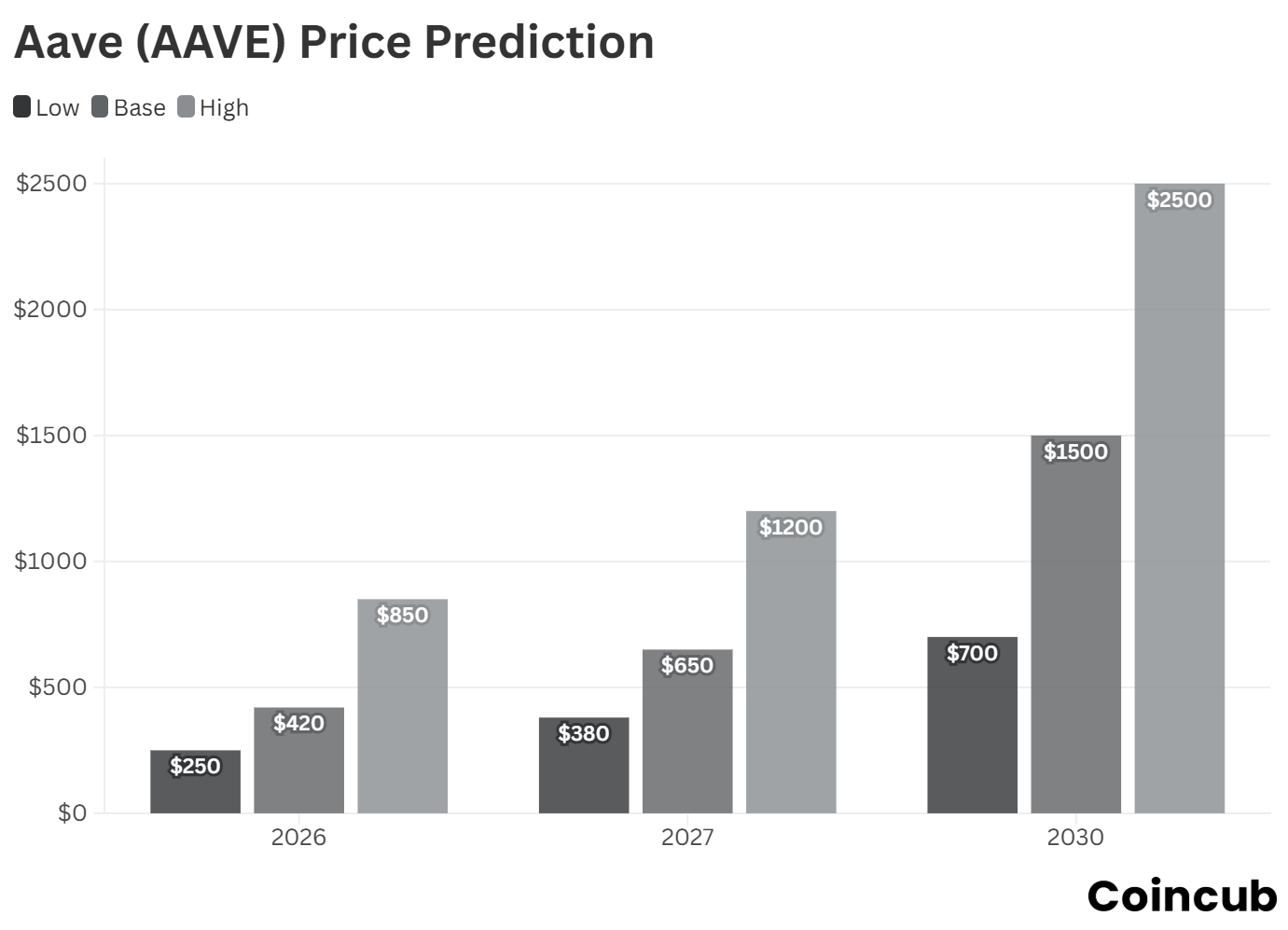
- Low: $250, in a choppy macro environment where crypto sentiment stays muted and DeFi underperforms, but Aave keeps growing slowly.
- Base: $420, in a scenario where DeFi rotations return, TVL climbs, and revenue multiples revert toward mid-cycle norms.
- Bull: $850, in a strong crypto bull market where DeFi lending becomes a major narrative, and the combination of buybacks and scarcity triggers a squeeze similar to prior cycles.
If V4 and the buyback engine both work as designed, a sub-$300 AAVE price would look cheap on any reasonable cash-flow or market-share metric.
Aave Price Prediction 2027-2028
The 2027-2028 window is the period where GHO and V4 either become embedded in the broader DeFi stack or fade into the background as yet another cycle experiment.
The bullish path looks like this:
- GHO becomes a multi-billion dollar stablecoin, integrated across chains and DeFi protocols as a default borrow asset.
- The Hub-and-Spoke design attracts external builders who ship new spokes for RWAs, institutional desks, and structured products. Medium+1
- Aave’s share of the lending market holds or grows, even with competition from Morpho, Spark, and newcomers.
Under those conditions, the buyback machine keeps grinding. A $50 million annual budget that targets 2-3% of float per year starts to matter when combined with the natural reduction in effective free float from staking and long-term holders.
A bear-leaning scenario in this window would include regulatory pressure on DeFi lending, a major exploit on a core instance, or a loss of market share to more capital-efficient competitors. That would cap upside even if GHO and V4 are technically sound.
Assuming no catastrophic event, a reasonable 2027-2028 band looks like:
- Low: mid-to-high $300s, in a world where crypto as an asset class stagnates and Aave mostly holds its ground.
- Average: around $650, with market-cap-to-TVL and price-to-revenue ratios sitting in healthy but not frothy territory.
- High: up to $1,200 in a scenario where DeFi becomes a core leg of the next bull market and Aave is treated as the default blue chip.
At those levels, AAVE would reclaim and then surpass the last cycle’s high, which fits with the idea that the protocol is larger, more profitable, and less risky than it was in 2021.
Aave Price Prediction 2029-2030
The 2029-2030 horizon is where the question “Will Aave reach $1,000?” really belongs.
By that point, either Aave is the central bank and back office of DeFi lending, or it has been displaced, cloned, or regulated into a niche.
The upside scenario assumes:
- TVL covers a broad mix of traditional and on-chain assets, including tokenized treasuries, credit, and RWAs via specialized spokes.
- GHO persists as a core settlement layer, with highly diversified collateral and limited peg drama.
- Institutions treat Aave V4 Hubs as standard rails, supported by compliance tooling like Chainlink ACE and other risk-control layers.
- The buyback program survives governance churn and keeps pulling float off the market every year.
In that world, AAVE’s fixed 16 million cap starts to bite. There is only so much supply for a token that controls parameters for a multi-billion dollar balance sheet and a treasury that earns nine-figure revenue.
A conservative 2030 forecast band:
- Low: around $700, in a world where DeFi adoption is steady but not explosive, and Aave is “just” a dominant protocol priced on moderate multiples.
- Average: around $1,500, which implies a market cap in the $24 billion range. That level would be consistent with Aave serving as a core finance primitive and trading at reasonable multiples on protocol earnings.
- High: up to $2,500, reserved for a scenario where DeFi lending scales into the trillions, Aave holds a big slice of it, and governance tokens capture more of the value chain.
Put simply, four-figure AAVE is not a wild moonshot if V4 and GHO deliver. It is a logical result of a scarce, capped supply linked to a large and sticky revenue base.
Investment Conclusion
Aave is not a Layer-1 trying to sell a narrative. It is an application that already earns real money, sits on top of billions in collateral, and runs one of the oldest and cleanest track records in DeFi lending.
V4 unifies liquidity and turns Aave into a modular lending operating system. GHO scales as a protocol-native stablecoin that feeds revenue back into the DAO. Buybacks and Safety Module rewards link that revenue to tokenholders with a fixed supply that is already almost fully unlocked.
BUT, V4 is a big architectural change and carries technical and migration risk. A major exploit, a long GHO depeg, or a serious governance attack could hit confidence hard and drain TVL. Regulatory pressure on decentralized lending, especially around KYC and securities rules, could also limit growth or push activity into gray zones.
On balance, AAVE in the $180-$200 range looks cheap relative to TVL, revenue, and market dominance. The token behaves more like an underpriced equity in a profitable infrastructure provider than a fading governance coin.
For long-term DeFi investors willing to live with smart contract and regulatory risk, Aave is one of the clearest blue-chip holds in the sector. The next five years will show if the V4 and GHO flywheel is enough to carry it into that four-figure club.
Frequently Asked Questions (FAQ)
What is Aave V4?
Aave V4 is the next major version of the protocol. It restructures Aave around a Hub-and-Spoke model where a central Liquidity Hub on each network holds reserves and manages accounting, while multiple Spokes sit on top as specialized markets.
This design stops liquidity from fragmenting across separate pools, allows new markets to launch without diluting depth, and lets governance manage risk at the Hub level. V4 also introduces things like dynamic risk premiums, health-targeted liquidations, and better integration with standards such as ERC-4626.
What is GHO and how does it affect AAVE?
GHO is Aave’s native, overcollateralized stablecoin pegged to the US dollar. Users mint GHO by locking assets in Aave and paying a borrow rate. The protocol collects that interest spread as revenue.
A portion of GHO-related revenue ends up in the Aave DAO treasury and helps fund the permanent $50 million yearly buyback program and Safety Module rewards. The more GHO circulates across chains and DeFi protocols, the more stable and predictable that revenue base becomes, which is positive for AAVE holders over time.
Why is the price low if TVL is high?
There are a few reasons.
Legacy token overhang and bear-market trauma still weigh on many DeFi names. Investors remember 2022-2023 and are slower to re-rate governance tokens, even when fundamentals recover. Many funds also prefer L1 narratives during early bull phases, which delays flows into DeFi infrastructure.
The market might also be waiting to see V4 in full production before assigning higher multiples. A big architectural upgrade always carries risk. Until migrations finish and GHO proves itself across multiple chains and stress events, a discount persists.
That gap between fundamentals and price is exactly where long-term investors look for entries. It will not close unless Aave keeps executing, but the building blocks for that re-rating are already visible.