Buy a Licensed Company
  Explore VASP Data
  Talk to an Expert


Arbitrum Price Prediction 2026-2030: What Changed After the June Bottom
- ARB is trading at roughly $0.23 on September 2026, with a market capitalisation near $1.44 billion and about 6.78 billion of the 10 billion total supply in circulation. The token set an all-time low of $0.0707 on 26 June 2026 and has since roughly tripled, rising about 128 percent over the trailing 30 days.
- The question this article asked in its previous version has an answer. The bottom the earlier version speculated about formed on 26 June 2026, and the recovery since then has been driven by revenue rather than by narrative.
- Arbitrum now earns money that the DAO can see and report. The DAO booked $6.19 million of income in the first half of 2026 at a gross margin above 97 percent, and the Arbitrum Expansion Program began returning licence fees from chains that settle outside Arbitrum One.
- Robinhood Chain went live on mainnet on 1 July 2026 and became the single largest driver of that revenue line. Under the Expansion Program licence it returns 10 percent of net protocol revenue to the ecosystem, split 8 percent to the DAO treasury and 2 percent to the Arbitrum Developer Guild.
- Standard Chartered initiated coverage of ARB on 15 September 2026 with a $10 end-2030 target, the first time a global bank has published a formal price path for the token.
- Supply pressure has eased but has yet to end. About 19.5 percent of total supply remains non-circulating, a 139 million ARB release was scheduled for 23 September 2026, and a further cliff falls on 15 October 2026.
- Token holders still receive no protocol fee stream. The ARB Staking AIP that the DAO finalised in August 2024 built the staking infrastructure and the stARB liquid staking token through Tally, and it deliberately left fee distribution switched off.
Arbitrum: One of the Biggest Ethereum L2s
Arbitrum looks like two different assets at the same time.
On one side you have the chain. TVL around $16.5 billion, constant bridge inflows, millions of wallets, and one of the strongest DeFi stacks in the market. On the other side you have the token, trading around $0.23, more than 90% down from the ~$2.4 peak in January 2024, with a constant stream of unlocks coming into the market every month.
Disclaimer: This article is for informational purposes only. It is not financial or investment advice. Cryptocurrency markets are volatile and high risk. Always do your own research, consider your personal financial situation and risk tolerance, and never invest more than you can afford to lose.

Where Arb Stands on 20 September 2026
Any forecast has to start from verified numbers. As of 20 September 2026, ARB changed hands at about $0.2125 on CoinMarketCap and $0.2135 on CoinGecko, giving a market capitalisation of roughly $1.44 billion and a fully diluted valuation near $2.13 billion. Circulating supply of tokens stood at approximately 6.78 billion ARB against a 10 billion total, so a little under 68 percent of the supply was liquid.
The trading pattern behind that price tells the more interesting story. ARB bottomed at $0.0707 on 26 June 2026, a new all-time low. From that floor the token has gained roughly 201 percent, including about 128 percent in the last 30 days and close to 50 percent in the last week. Twenty-four hour volume ran between $358 million and $568 million depending on the aggregator, which is heavy relative to a $1.44 billion capitalisation and points to genuine repositioning rather than thin drift.
That recovery still leaves ARB about 91 percent below its all-time high of $2.39 to $2.40, set on 12 January 2024. Anyone reading a 2030 target should hold both facts at once, because the token has tripled off a floor and remains a long way from its own record.
What Changed for Arbitrum in 2026
For most of its history, Arbitrum combined excellent technology with a token that had no clear way to capture value from it. Three developments in 2026 have altered that picture, and the order in which they arrived matters.
The Arbitrum Expansion Program
The first was the Arbitrum Expansion Program starting to produce cash. The AEP licence requires any Arbitrum-technology chain that settles somewhere other than Arbitrum One or Nova to return 10 percent of net protocol revenue to the ecosystem, of which 8 percent goes to the DAO treasury and 2 percent to the Arbitrum Developer Guild. This was a legal arrangement on paper for most of its life. It became a revenue line in July 2026.
Robinhood Chain
The second was Robinhood Chain reaching mainnet on 1 July 2026 after a testnet period that processed more than 200 million transactions. Because Robinhood Chain settles to Ethereum rather than to Arbitrum One, it falls squarely inside the AEP licence. In July alone the licensing fees it generated came to $360,000, which was 35 percent of the DAO’s income for that month. By 1 September 2026 the chain recorded daily fees of $3.75 million, a figure that placed it above Ethereum mainnet and Base on that day.
DAO Volume and Fees
The third was the DAO publishing numbers that a financial analyst can work with. Its first-half 2026 report showed $6.19 million of accrued income drawn from Arbitrum One transaction fees, Timeboost sequencer access auctions, Expansion Program licensing, and treasury management returns. Gross margin on protocol revenue exceeded 97 percent, up from above 90 percent in 2025, and the DAO closed June holding $125 million in non-ARB assets. Foundation leadership indicated that the third quarter was tracking more than 40 percent ahead of the second.
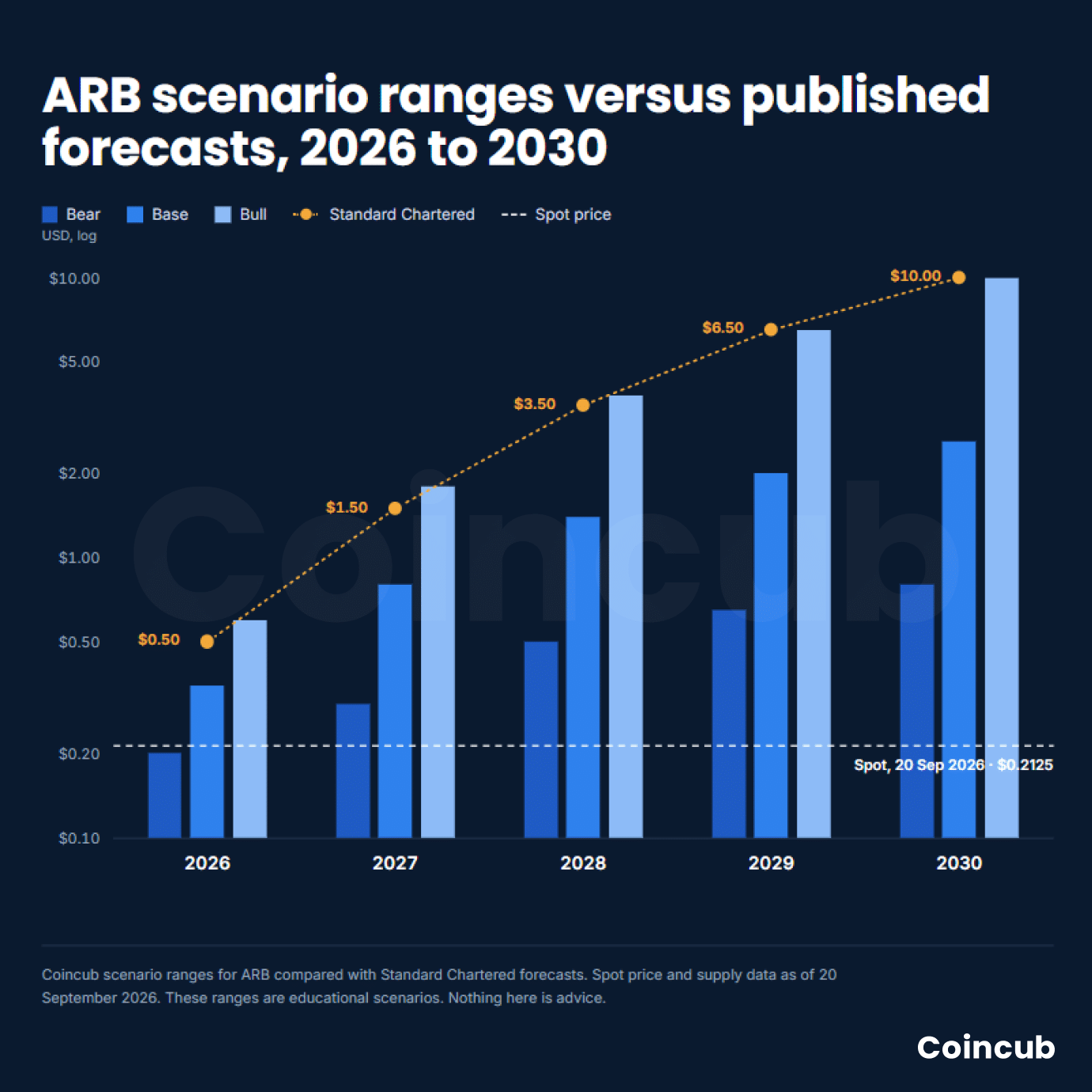
Those three items together explain why a bank was willing to put a number on ARB. On 15 September 2026 Geoff Kendrick, Standard Chartered’s global head of digital assets research, initiated coverage with a path of $0.50 at end-2026, $1.50 at end-2027, $3.50 at end-2028, $6.50 at end-2029 and $10 at end-2030. The reasoning rests on tokenised assets, probably a minimal portion of NFTs as well, growing from roughly $340 billion to $4 trillion by end-2028, with tokenised equities reaching around $750 billion, and on more traditional finance firms following Robinhood onto Arbitrum infrastructure under the same licence terms.
Does ARB Capture Any of Arbitrum’s Value?
Revenue arriving at the DAO is a different thing from revenue arriving at token holders, and the distinction decides what ARB is worth. The ARB Staking AIP that the DAO finalised in August 2024 is often described as having solved this. Reading the proposal itself shows what it did and where it stopped.
The AIP deployed staking through the Tally protocol and created stARB, an immutable receipt token that auto-compounds, redeems one for one against ARB, and remains usable in DeFi while the underlying tokens stay delegated to an active governance participant. Those are real improvements to governance security, since they give the DAO a larger and stickier base of delegated voting power to defend a treasury that has at times been worth billions. The proposal states plainly that it implements staking without turning on fee distribution to token holders, and it left the eventual reward source to parallel workstreams that might draw on sequencer fees, MEV fees, validator fees, inflation, or treasury diversification.
So the position on 20 September 2026 is that Arbitrum earns fees, the DAO books them, and a fee switch to holders remains an open governance question rather than a live mechanism. ARB captures value today through the treasury it controls and through whatever the DAO chooses to do with $125 million of non-ARB assets and a growing income statement. A holder who expects a yield stream is expecting a vote that has yet to happen.
Supply: Lighter Than Before, Still Present
Dilution has been the central bearish argument against ARB since launch, and it has weakened without disappearing. Roughly 19.5 percent of ARB’s total supply sat outside circulation in September 2026, held across team, contributor, advisor and investor allocations. A release of 139 million ARB was scheduled for 23 September 2026, and a cliff event on 15 October 2026 was sized at about 1.37 percent of float.
Two things have changed about how that supply lands. Monthly releases now meet a market with deeper liquidity and an identifiable revenue story, so the same nominal unlock represents a smaller share of daily turnover than it did when ARB traded at $0.10 on lighter volume. The offsetting risk is that a token trading 200 percent above its June low gives long-vested holders their first profitable exit in a year, which tends to bring forward selling that a lower price had deferred.
Technology and Ecosystem Developments
Network upgrades since April 2026 have pushed in two directions at once, and both feed the revenue thesis above. ArbOS 61, known as Elara, shipped on 20 August 2026. It raised the size limit for WASM contracts on Arbitrum One from 24 KB to 96 KB, which materially widens what Stylus developers can deploy, and it introduced optional protocol-level compliance filtering that lets chain operators screen transactions. That second feature reads as unglamorous engineering and is precisely what a regulated broker needs before it will settle customer activity on your stack.
Governance hardening arrived alongside it. In July 2026 the DAO extended Security Council member terms from one year to two, lowered the nomination threshold from 0.2 percent to 0.1 percent of votable ARB, and tightened key management procedures.
Stylus, Orbit and BoLD remain Arbitrum’s core technical pillars. Stylus lets developers write contracts in Rust, C++ and other WASM-targeting languages. Orbit allows custom chains that settle to Arbitrum or, as with Robinhood Chain, elsewhere under licence. BoLD introduced permissionless validation. Decentralised sequencing is still on the roadmap rather than in production, and it is the upgrade most directly tied to any future fee switch, because a decentralised sequencer is the natural place to route sequencer revenue to stakers.
Competition in Late 2026
Arbitrum’s competitive position has to be read against the revenue model rather than against total value locked alone. Base continues to benefit from Coinbase’s retail distribution, and Optimism continues to push the Superchain framing with its own revenue-sharing arrangement. Newer ZK rollups compete on proving costs and finality.
What separates Arbitrum in September 2026 is that its licensing model converted a distribution partner into a reported income line within a single quarter. Standard Chartered’s thesis rests on that pattern repeating. If two or three more regulated financial firms launch chains under AEP terms, Arbitrum’s income grows without Arbitrum One itself needing to win more retail activity. If Robinhood turns out to be a one-off, the bank’s $10 target loses its engine, considering than some competitors like Polygon are already losing their edge.
Arbitrum (Arb) Price Prediction 2026-2030
These ranges were built on 20 September 2026 from a spot price of about $0.21, a circulating supply near 6.78 billion, the DAO’s published first-half financials, and the scheduled unlock calendar. Crypto prices are volatile and forecasts of this kind are frequently wrong, so treat every figure below as a scenario with a stated assumption rather than as a target.
| Year | Bear case | Base case | Bull case | Governing assumption |
|---|---|---|---|---|
| 2026 | $0.14 to $0.20 | $0.22 to $0.35 | $0.40 to $0.60 | October unlock absorbed, Q3 revenue confirms the growth rate |
| 2027 | $0.15 to $0.30 | $0.40 to $0.80 | $1.20 to $1.80 | One or two more AEP chains launch, vesting substantially completes |
| 2028 | $0.25 to $0.50 | $0.70 to $1.40 | $2.50 to $3.80 | Tokenised asset growth arrives, fee switch debate reaches a vote |
| 2029 | $0.30 to $0.65 | $1.00 to $2.00 | $4.00 to $6.50 | Decentralised sequencing live, revenue share to stakers begins |
| 2030 | $0.35 to $0.80 | $1.30 to $2.60 | $6.00 to $10.00 | Arbitrum is default settlement for regulated onchain finance |
ARB in 2026
The remainder of 2026 turns on two dated events and one number. The 23 September and 15 October unlocks arrive into a market that has already run 200 percent off the low, which is the condition under which vested holders most often sell. Against that, the DAO’s third-quarter revenue report should confirm or break the claim that income is tracking more than 40 percent above the second quarter.
Our base case of $0.22 to $0.35 assumes the unlocks are absorbed within a few weeks and the revenue trend holds, leaving ARB to drift upward with Ethereum rather than to re-rate sharply. The bull case of $0.40 to $0.60 requires a broad market upturn and brackets Standard Chartered’s $0.50 end-2026 figure. The bear case of $0.14 to $0.20 assumes the unlocks trigger a retracement of roughly half the summer rally, which would still leave ARB double its June low.
ARB in 2027 and 2028
The middle years decide whether AEP is a business or an anecdote. By 2027 most insider vesting completes, which removes the structural supply argument that has dominated ARB’s price history since launch. A base case of $0.40 to $0.80 assumes steady licence revenue growth and continued Orbit adoption without a fee switch, valuing ARB as governance over a growing treasury. The bull case of $1.20 to $1.80 assumes several regulated chains launch under AEP terms and that the DAO signals a credible path to distributing revenue.
Carrying that into 2028, Standard Chartered’s $3.50 sits inside our bull band of $2.50 to $3.80, which is where the bank’s tokenisation forecast would put ARB if it proves correct. Our base case of $0.70 to $1.40 is considerably more conservative, because it assumes tokenised assets grow substantially while Arbitrum captures a smaller share of that growth than the bank models.
ARB in 2029 and 2030
By the end of the decade the bear and bull outcomes separate on a single question, which is whether ARB holders receive protocol revenue. A base case of $1.30 to $2.60 for 2030 implies a market capitalisation between roughly $13 billion and $26 billion on a fully vested supply, which is defensible for a leading execution layer with a modest revenue share. The bull case of $6.00 to $10.00 implies $60 billion to $100 billion and matches the Standard Chartered path, and it requires both the tokenisation thesis and an active fee distribution mechanism. The bear case of $0.35 to $0.80 assumes AEP revenue plateaus, competitors capture the regulated-chain business, and ARB stays a governance token over a shrinking treasury.
How Third-Party Forecasts Compare
Published forecasts for ARB sit unusually far apart, which is itself informative. Standard Chartered’s Geoff Kendrick published $0.50 for end-2026 and $10 for end-2030 on 15 September 2026. Changelly’s model, updated 20 September 2026, gives a 2026 range of $0.0991 to $0.211 with an average of $0.155, and a 2030 range of $0.270 to $0.450. The gap between a bank at $10 and a retail forecasting model at $0.45 for the same year is roughly twenty-two times.
That spread exists because the two approaches measure different things. Standard Chartered models a business with licence revenue and assumes token holders eventually share in it while Changelly extrapolates price history. Readers who want a single number will find neither satisfying, and the honest conclusion is that ARB’s 2030 valuation depends on a governance decision that nobody can currently model.
How to Buy and Store ARB
ARB trades with deep liquidity on major centralised exchanges, and twenty-four hour volume of $358 million to $568 million means large orders clear without unusual slippage. Self-custody options include MetaMask, Rabby and Trust Wallet for software storage, and Ledger hardware wallets connected to the Arbitrum network. Withdrawing directly to Arbitrum rather than to Ethereum mainnet remains materially cheaper, and most major exchanges now support it natively.
Holders who want governance exposure can delegate to an active participant and hold stARB through Tally, which keeps the tokens liquid and delegated at the same time. Anyone doing so should understand that stARB currently entitles the holder to governance weight rather than to a protocol fee stream.
On the self-custody side, ARB is an ERC-20 token native to Arbitrum One, a Layer 2 network that settles to Ethereum, and an official bridged version also exists on Ethereum mainnet. You can hold it in wallets like MetaMask, Rabby, Trust Wallet, Ledger, or other hardware wallets that connect to Arbitrum.
Frequently Asked Questions (FAQ)
Is the bottom in for ARB? +
ARB set an all-time low of $0.0707 on 26 June 2026 and traded near $0.21 on 20 September 2026, roughly 201 percent above that floor. That confirms a bottom in hindsight, and it guarantees nothing about the future. Two unlock events in late September and October 2026 are the near-term test of whether the level holds.
Does ARB pay holders any share of Arbitrum's revenue? +
No. The DAO booked $6.19 million of income in the first half of 2026, and none of it flows to token holders automatically. The ARB Staking AIP finalised in August 2024 created staking and the stARB token through Tally while explicitly leaving fee distribution switched off. Turning it on would require a further governance vote.
What is the Arbitrum Expansion Program and why does it matter for ARB? +
The AEP is a licence that lets other projects build chains with Arbitrum technology. Chains that settle somewhere other than Arbitrum One or Nova must return 10 percent of net protocol revenue to the ecosystem, split 8 percent to the DAO treasury and 2 percent to the Arbitrum Developer Guild. Robinhood Chain, live since 1 July 2026, is the largest example and generated $360,000 in licence fees in July alone.
Will ARB reach $10? +
Standard Chartered published $10 as its end-2030 target on 15 September 2026, which implies a market capitalisation near $100 billion on the full 10 billion supply. Reaching it would require the bank's tokenised-asset forecast to prove correct and ARB holders to receive a share of protocol revenue. Both are plausible and neither is decided.
When does ARB vesting finish? +
About 19.5 percent of total supply remained non-circulating in September 2026, with a 139 million ARB release on 23 September 2026 and a cliff of roughly 1.37 percent of float on 15 October 2026. Most insider vesting completes during 2027, after which the structural dilution argument largely falls away.
Does Arbitrum burn ARB? +
No. ETH is the gas token on Arbitrum, and the burn mechanism that applies is Ethereum's own EIP-1559 on the settlement layer. ARB functions as a governance and treasury-control token.