Buy a Licensed Company
  Explore VASP Data
  Talk to an Expert

 Atis Shala
Atis is a senior analyst and community lead with four years of experience in crypto. He has a bachelor from the Rochester Institute of Technology.
Atis Shala
Atis is a senior analyst and community lead with four years of experience in crypto. He has a bachelor from the Rochester Institute of Technology.
What are Ethereum ETFs? A Detailed Explanation

- Ethereum ETFs are regulated financial instruments that allow investors to track the price of Ethereum through traditional brokerage accounts without the need to manage digital wallets or private keys.
- The approval of spot Ethereum ETFs signaled a major regulatory shift, officially classifying Ethereum as a commodity and enabling its inclusion in conservative institutional portfolios.
- A new generation of staked Ethereum ETFs now allows investors to capture both the price appreciation of the asset and the native yield generated by the network’s proof of stake mechanism.
- Major asset managers like BlackRock and Fidelity dominate the market, providing institutional-grade custody and liquidity that has bridged the gap between decentralized finance and Wall Street.
- The success of Ethereum ETFs has paved the way for a broader crypto ecosystem, including the launch of Solana ETFs and multi-asset index funds that treat digital assets as a standard investment class.
Ethereum has gone from an experimental blockchain project to one of the most important technologies in modern finance. In its early years, many investors saw crypto as little more than a speculative corner of the market. Bitcoin was easier for traditional investors to understand because it could be framed as digital gold. Ethereum was more complicated. It was not just a currency. It was a programmable network that could run applications, settle value, support decentralized finance, and serve as the backbone for tokenized assets.
That difference mattered. For years, institutions hesitated because Ethereum required a new mental model. To understand its value, they had to understand smart contracts, staking, tokenization, and the idea that blockchains could become infrastructure for a digital financial system. Once that shift in thinking began, the conversation changed dramatically.
Ethereum ETFs sit at the center of that change. They are the bridge between the blockchain world and the traditional investment system. They allow investors to gain exposure to ETH through ordinary brokerage accounts, retirement plans, and advisory platforms without having to manage wallets, private keys, or crypto exchange accounts.

What is an ETF?
An ETF, or exchange traded fund, is a fund that trades on stock exchanges. Investors buy shares of the fund, and those shares represent exposure to the assets inside it. In a stock ETF, the fund may hold a basket of equities. Similarly, a gold ETF, the fund may hold physical gold. In an Ethereum ETF, the fund holds ETH or gains exposure to it through an approved structure.
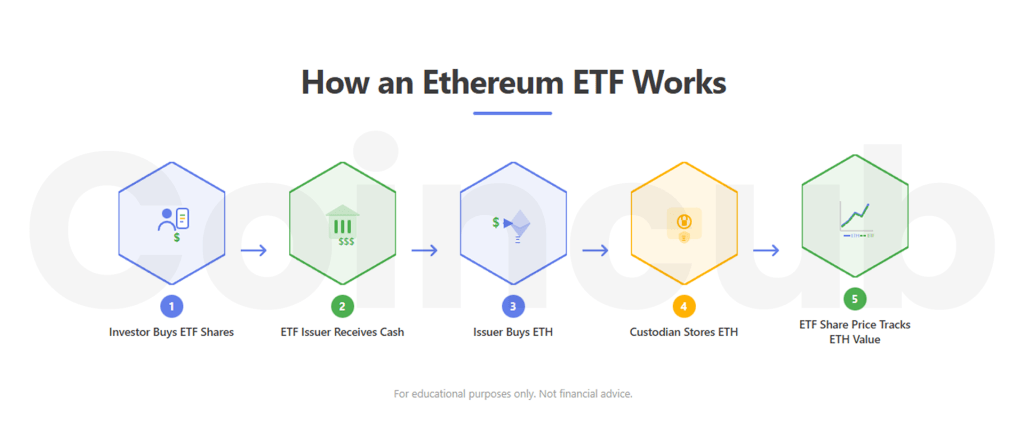
For most investors, this means they do not need to directly buy ETH on a crypto platform. Instead, they can purchase shares of an Ethereum ETF through the same brokerage account they use for stocks and other funds. This makes access much simpler.
That simplicity is a major reason these products matter. Direct crypto ownership can be intimidating. Investors must choose a trading platform, secure their assets, learn about custody, and understand the risks of losing access to their holdings. Ethereum ETFs remove much of that operational burden. They package crypto exposure in a form that traditional markets already understand.
Why Ethereum Needed an ETF?
Bitcoin entered mainstream discussion with a relatively clear narrative. It was scarce, digital, and often compared to gold. Ethereum never fit neatly into that framework. Its value comes from utility as much as scarcity. The network supports smart contracts, decentralized exchanges, lending systems, token issuance, nonfungible assets, and a growing set of tokenized real world assets.
That made it harder for institutions to classify. Was ETH a commodity, a technology platform, a yield producing asset, or something else entirely? The regulatory uncertainty only added to the confusion. For years, one of the biggest questions in the market was whether ETH would be treated like a security or a commodity.
The approval of spot Ethereum ETFs helped answer that question in practice. It signaled that ETH had achieved enough regulatory clarity for traditional investment wrappers to be approved. That mattered enormously for pension consultants, fiduciaries, advisors, and institutions that cannot simply buy an asset if its legal treatment is unclear.
In other words, the ETF was not just a new product. It was a statement that Ethereum had matured enough to enter the mainstream financial system.
What exactly is a Spot Ethereum ETF?
A spot Ethereum ETF is a fund backed by actual Ether. When investors buy shares of the fund, the issuer uses the proceeds to acquire ETH, which is then held in custody. The share price is designed to track the value of the ETH owned by the fund, minus fees and small operational frictions.
This is what separates spot ETFs from futures based products. A futures ETF tracks the price of contracts tied to Ethereum rather than owning the asset itself. A spot ETF holds the real thing. For long term investors, that distinction matters because it usually leads to cleaner exposure and avoids some of the costs associated with futures rollovers.
The basic process works like this. Large market participants called authorized participants create and redeem ETF shares. When demand for the fund rises, these firms deliver cash to the issuer, the issuer buys Ether, and new ETF shares are created. When demand falls, the process works in reverse, and shares can be redeemed.
This creation and redemption mechanism helps keep the ETF price close to the value of the underlying ETH it holds. That value is measured through the fund’s net asset value, often called NAV.
Ethereum ETF Custody Behind the Scenes
One of the least visible but most important parts of an Ethereum ETF is custody. The ETF issuer needs a secure way to store large amounts of Ether. This usually involves institutional grade custody arrangements, often with cold storage systems where private keys are kept offline.
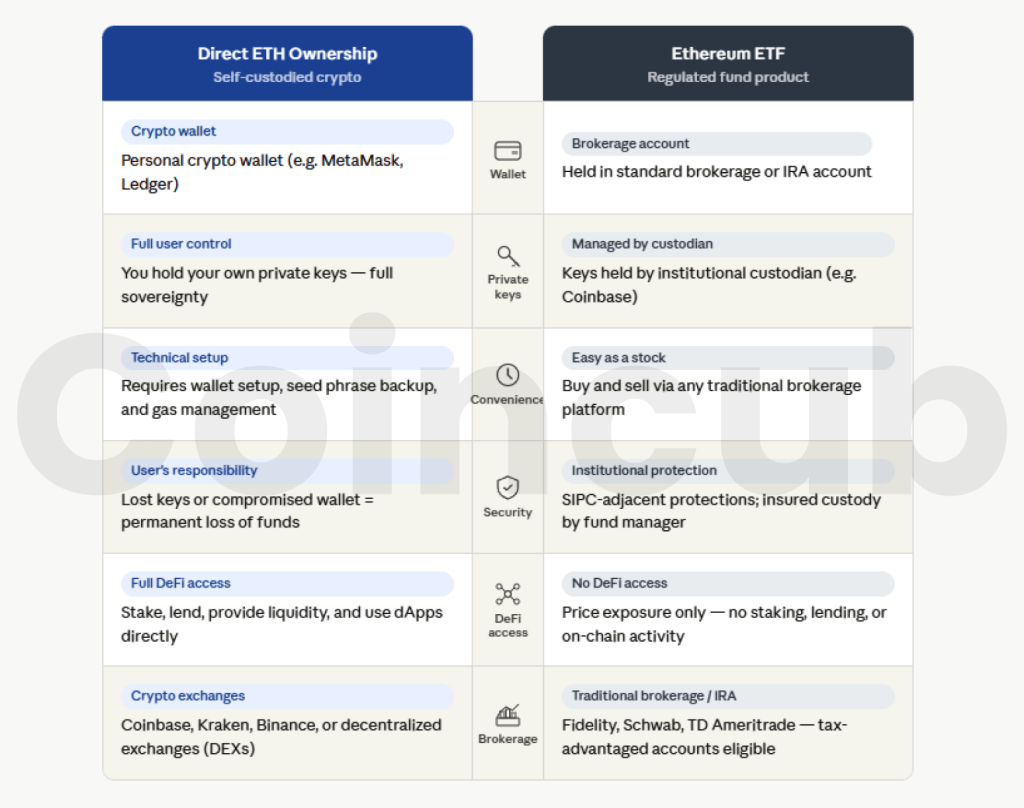
For everyday investors, this is one of the strongest arguments for the ETF structure. Self custody offers control, but it also comes with responsibility. If someone loses their seed phrase or makes a transfer mistake, the loss may be permanent. Institutional custody shifts that burden to professional operators whose entire business is built around secure storage, operational controls, and compliance.
Of course, that convenience comes with tradeoffs. The investor gains ease of use, but loses direct control over the asset. They own shares in a fund, not ETH in a wallet they personally manage. For some crypto purists, that defeats part of the purpose of decentralization. For many traditional investors, however, the tradeoff is worth it.
Why Does NAV Matter?
An Ethereum ETF needs a reliable method for valuing its holdings. That is where benchmark pricing comes in. Funds typically rely on established reference rates to determine the daily value of the ETH they hold. This creates a standard way to calculate NAV and helps reassure investors that the share price is grounded in transparent market data.
Still, ETF prices can drift slightly above or below NAV during the trading day. That is normal. The creation and redemption system exists to reduce those gaps. If the ETF trades too far away from the underlying asset value, market participants can step in and arbitrage the difference. Over time, this tends to keep the fund aligned with the value of its ETH holdings.
For retail investors, this structure may feel invisible. They simply see a ticker symbol and a price. But under the surface, the ETF is a carefully engineered wrapper designed to translate a twenty four hour crypto market into a format that stock exchanges and brokerage systems can handle.
Ethereum’s Proof of Stake Mechanism as an ETF
Ethereum is different from Bitcoin in another important way. It is a proof of stake network. That means ETH holders can stake their coins to help secure the network and potentially earn yield. For native Ethereum users, staking is a central part of the asset’s value proposition. It turns ETH into something closer to a productive digital asset.
This raised an immediate question for ETFs. If the fund holds ETH, should that ETH be staked? On one hand, staking could generate additional return for shareholders. On the other hand, it introduces extra complexity, operational risk, and regulatory concerns.
Early Ethereum ETFs generally did not include staking. Regulators were cautious, and issuers had to keep the structure simple enough to gain approval. Over time, however, the market began moving toward new products that incorporate staking features. These funds aim to combine price exposure with network yield.
That evolution is significant. It suggests that Ethereum is not only being accepted as an investable asset, but also increasingly understood on its own terms. Institutions are learning that ETH is not just something to hold. It is also part of an economic system that can generate income.
Competition Among ETF Issuers
Once Ethereum ETFs entered the market, competition quickly became fierce. The battle was not just about crypto expertise. It was about trust, distribution, fees, liquidity, and operational design.
Large firms such as BlackRock and Fidelity benefited from brand power and existing relationships with advisors, institutions, and platforms. For many investors, a familiar issuer makes a major difference. An Ethereum product offered by a household financial brand feels less risky than one offered by a niche specialist, even if both hold the same underlying asset.
Other issuers tried to differentiate themselves in different ways. Some emphasized lower fees. Others leaned into education, sustainability narratives, or more specialized crypto positioning. In practice, this competition pushed the market toward tighter fees and stronger product design.
As of April 2026, there’s a competitive field that includes BlackRock’s ETHA, Fidelity’s FETH, Bitwise’s ETHW, Grayscale’s lower cost ETH product, and 21Shares’ CETH. Management fees range from 0.15 percent to 0.25 percent, showing how quickly pricing pressure emerged once multiple issuers were active in the same category.
For investors, fees matter. Even small differences can affect long term returns, especially in a category where many products offer similar exposure. That said, cost is not the only consideration. Liquidity, tracking quality, custody structure, and issuer credibility also deserve attention.
Ethereum ETF: Slow Adoption
The market did not adopt Ethereum ETFs all at once. Instead, the rollout appears to have happened in stages.
The first stage was an initial burst of demand. Early investors who already believed in Ethereum but preferred traditional brokerage access rushed in. Net inflows exceeded $2 billion in the first 30 days of trading. That reflected pent up demand from investors who had been waiting for a simpler and more compliant way to gain exposure.
The second stage involved an adjustment period created by legacy products. Grayscale’s older trust structure had carried high fees, and once conversion pathways opened, many holders sold or moved into cheaper alternatives. That created selling pressure and temporarily weighed on sentiment.
The third stage was slower but arguably more important. Financial advisors and wealth platforms began evaluating Ethereum for client portfolios. This process takes time. Large advisory networks do not approve new asset classes overnight. They conduct due diligence, examine volatility, assess legal and operational risks, and decide where the product fits within portfolio construction.
By 2025 and 2026, Ethereum had made progress onto the approved lists of major advisory platforms. That is a crucial milestone because advisors control access to enormous pools of household wealth. When an ETF becomes available through those channels, the investor base broadens significantly.
Did the ETF Have a Price Impact on ETH?
Ethereum ETFs do more than create a convenient investment wrapper. They also affect the underlying market.
When money flows into a spot ETF, the issuer must buy actual ETH. That creates direct demand for the asset. If inflows are sustained, a meaningful amount of Ethereum can be pulled out of the liquid market and placed into long term custodial storage. In simple terms, fewer coins remain readily available on exchanges.
This matters because price is shaped by supply and demand. If institutional demand rises while liquid supply tightens, the result can be upward pressure on price. This is seen as a supply shock dynamic during the 2025 and 2026 cycle.
There is also a signaling effect. ETF inflows can be interpreted by the market as evidence of institutional conviction. That can influence sentiment beyond the raw buying itself. Retail investors may see ETF adoption as validation. Institutions may view it as proof that Ethereum has crossed an important legitimacy threshold.
By April 2026 Ethereum ETFs have reached total net inflows of $18.4 billion, total assets under management of $32.2 billion, and average daily trading volume of $620 million. Whether those figures rise or fall over time, the broader lesson is clear: ETF flows have become an important force in Ethereum’s market structure.
Why Do Many Investors Prefer the ETF Model?
Crypto culture often celebrates self custody and direct ownership. In principle, that offers maximum control. In practice, many investors prefer convenience, oversight, and integration with the rest of their financial life. An ETF solves several real problems.
First, it reduces operational complexity. Investors can buy exposure through their existing brokerage accounts. They do not need to learn how to use a wallet, interact with exchanges, or manage private keys.
Second, it simplifies taxes and reporting. Direct crypto activity can become messy, especially for active traders or users of decentralized applications. An ETF turns that complexity into ordinary brokerage statements and familiar tax documents.
Third, it fits existing portfolio workflows. Advisors, retirement platforms, and institutional allocators can more easily own an ETF than raw crypto. Risk systems, compliance processes, and reporting frameworks are already built around securities.
This is why the ETF model won such rapid traction. It does not require traditional investors to change their habits. It brings Ethereum into the systems they already use.
Ethereum ETF Risks You Shouldn’t Ignore
Despite the appeal, Ethereum ETFs are not risk free. In some ways, they introduce new forms of risk even as they solve others.
One major concern is centralization. If a small number of custodians end up holding a large share of all circulating Ethereum, they become powerful chokepoints. That concentration may create security concerns, political vulnerability, and tension with Ethereum’s decentralized ethos.
Another concern is governance during extraordinary events. If Ethereum were ever to split through a major hard fork, ETF sponsors would have to decide how the fund treats the resulting assets. That gives centralized institutions real influence in moments when the network itself may be divided.
There is also market structure risk. Because ETFs are embedded in traditional trading systems, they can become tools for high speed speculation. Some critics worry that this could amplify volatility, especially during periods of stress.
Investors should also remember that ETF shares are not the same as native ETH. ETF holders usually cannot use their exposure in decentralized finance, stake it directly, or move it onchain. They gain convenience, but lose flexibility.
The Ethereum ETF story is not limited to the United States. Other regions have also developed exchange traded crypto products, and competition across markets is shaping the next phase of adoption.
Hong Kong is an important gateway because its market structure allows in kind redemptions, meaning investors can move between fund shares and actual ETH more directly. That offers a level of flexibility not always present in the United States model.
Europe also has a longer history with crypto ETPs, though many earlier products lacked the scale and liquidity of the new generation of funds. As larger markets embraced Ethereum investment vehicles, fee pressure and competition pushed providers to improve.

Ethereum ETFs in the Bigger Crypto Picture
Ethereum ETFs are part of a broader transformation in crypto investing. Bitcoin ETFs opened the door. Ethereum ETFs expanded the menu. New products tied to other networks and index baskets suggest that crypto is beginning to look more like a full asset category within portfolio management.
That does not mean all crypto assets are equal. Bitcoin, Ethereum, and newer networks each serve different narratives and use cases. Bitcoin often occupies the store of value role. Ethereum is increasingly seen as a utility layer for programmable finance. Other chains may compete on speed, cost, or specialized applications.
For investors, the rise of ETFs means these distinctions can now be expressed through familiar vehicles. Instead of opening multiple wallets or navigating several exchanges, they can choose among listed products that package different slices of the ecosystem.
Conclusion: Do Ethereum ETFs Matter?
Ethereum ETFs matter because they make a complicated technology investable in a familiar form. They reduce friction, expand access, and signal that Ethereum has become important enough for mainstream finance to accommodate. At the same time, they also reshape the nature of ownership. What began as a decentralized network built for direct participation is increasingly being held through centralized wrappers designed for traditional portfolios.
That tension will define the next chapter. For some investors, the ETF is the ideal solution because it offers regulated access with less hassle. For others, it is only a partial expression of what Ethereum can be because it strips away direct participation in the network itself.
Still, there is no denying the scale of the shift. Ethereum ETFs have helped move crypto from the margins of finance toward the center of portfolio discussion. The core question is no longer whether Ethereum can be packaged for mainstream investors. That question has already been answered. The real question now is how deeply these products will reshape both traditional markets and the Ethereum ecosystem itself.
In that sense, Ethereum ETFs are more than investment products. They are evidence that finance is being rebuilt, one wrapper at a time.
Frequently Asked Questions (FAQs)
Which Ethereum ETF is best?
There’s no single best Ethereum ETF. Grayscale’s ETH has a lower 0.15% fee than BlackRock’s ETHA at 0.25%, but the best option depends on whether you prioritize lower costs, a specific issuer, trading access, or other features for your goals.
Has Ethereum ETF been approved?
Yes. In the United States, the SEC approved spot Ethereum ETF rule changes in May 2024, and the first spot Ethereum ETFs began trading on July 23, 2024. Since then, Ethereum ETFs have remained available through major issuers and brokers.
Is there a 3x Ethereum ETF?
Yes, but usually as a leveraged ETP rather than a plain spot ETF. Products such as Leverage Shares 3x Long Ethereum aim to deliver triple Ethereum’s daily move, making them short-term trading tools with higher risk and daily reset effects.
Is there a BlackRock Ethereum ETF?
Yes. BlackRock offers the iShares Ethereum Trust ETF, ticker ETHA, which seeks to track the price of Ether. It is a spot Ethereum ETF available through standard brokerage accounts today, giving investors crypto exposure without directly holding ETH themselves outright.