Buy a Licensed Company
  Explore VASP Data
  Talk to an Expert

 Dren Hima
 is Head of Research at Coincub, leading research across digital asset regulation, licensing, market structure, tokenization and institutional adoption.
Dren Hima
Dren Hima is Head of Research at Coincub, leading research across digital asset regulation, licensing, market structure, tokenization and institutional adoption.
Stress Builds on Wall Street, Support Breaks in Bitcoin

- Wall Street’s switch to risk-off in stocks and tech lined up almost perfectly with Bitcoin’s drop to a 6-month low.
- Spot Bitcoin ETFs turned into the main channel for selling, with billions in redemptions hitting price much harder than normal retail flows.
- Financialization shifted Bitcoin from self-custody and on-chain activity into brokerage accounts, making price more sensitive to institutional flows and rebalancing.
- Thin order books, profit-taking by older holders and heavy leverage inside crypto turned a normal correction into a nearly 30% drawdown.
- Bitcoin traded like a high-beta macro asset tied to Wall Street sentiment, not like independent “digital gold” immune to equity stress.
In early October, Bitcoin was trading above $126,000. Six weeks later it was under $90,000. That is a drop of almost 30%, one of the sharpest four to six-week corrections since the classic bear phases of earlier cycles. The move erased the entire gain for the year and wiped more than a trillion from total crypto market value.
Long-term holders watched an almost straight line up turn into an almost straight line down. Short-term traders saw support levels fail one after another. Social feeds went from victory laps to “what just happened” in days. Talk of a healthy reset did not match what the chart was showing. A healthy reset does not usually take out eleven months of gains in a month and a half.
Retail flows alone do not do that. Something bigger changed posture and did it fast.

Wall Street Flipped to Risk-Off
The week Bitcoin broke below $90,000 was the same week U.S. stocks went into a slide. The Dow dropped nearly 500 points in a day. The S&P 500 logged its longest losing streak since August. The Nasdaq gave up more than 6% from its record, wiping out around $2.6 trillion in value.
Nvidia sold off, Amazon and Microsoft sold off, the fear index jumped double digits, and sentiment gauges sat in “extreme fear.”
Investors did what they always do when nerves hit, which is cutting risk. They moved out of high-beta stocks and speculative assets first. Crypto sits in that bucket in their models, whatever people in the space like to say about digital gold and store of value.
You could see the linkage. Stocks sold off during U.S. hours, and Bitcoin slid in the same sessions. The sequence did not look like some isolated crypto panic. It looked like Bitcoin being treated as another line item on the same risk sheet as tech and AI.
Surveys of investors back this up. When people are asked why crypto and stocks move together, they rarely talk about hash rate or halvings. They point to sentiment and macro headlines. To them, crypto is another way to express optimism or fear about the economy, not a separate system.
The ETF Era – Who Really Holds the Steering Wheel
The launch of spot Bitcoin ETFs was sold as a milestone. Easy access for traditional investors, new capital inflows, a more “mature” market, and some people genuinely believed that would mean a more stable price.
Throughout November, spot ETFs saw billions in outflows. BlackRock’s fund had record redemption days. Other issuers bled for almost a full week. The bulk of this activity happened in U.S. trading hours. That pattern is not retail dumping on offshore exchanges, but more on the lines of institutional rebalancing.
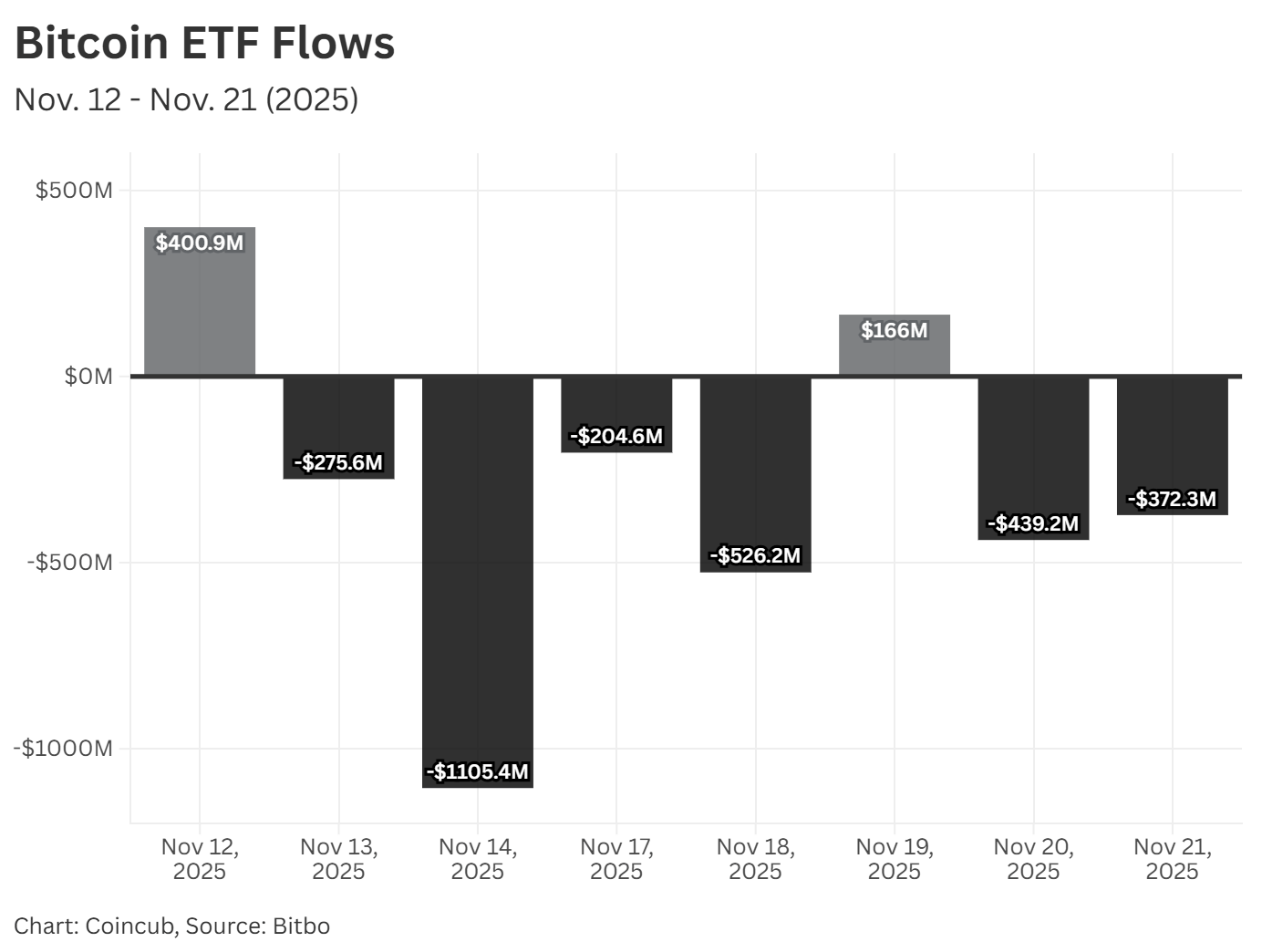
Research on ETF flows and on-chain activity shows something important here. After spot ETFs arrived, on-chain wallet growth weakened. New and active addresses slowed, even as ETF volumes surged. A chunk of demand moved off-chain into brokerage accounts and retirement platforms. People who once would have bought and held in their own wallets outsourced it to Wall Street products.
Order books became more sensitive to large flows. Spreads widened on average. In some periods, cumulative ETF flows showed a counterintuitive effect. Flows did not always lift the price; under certain conditions, they lined up with downward pressure.
That sounds like heresy to the simple “ETF = number go up” story, but it makes sense in practice. ETFs do not just bring one-way demand. They bring a new class of seller. A fund can clip profits, run stop-loss rules, or de-risk across the board in a way that a cold-storage pleb never will.
Once enough supply is held through these vehicles, the price starts to move with those rules. Bitcoin stops being only a crypto-native asset and starts to behave like a financial instrument wired into rebalancing cycles, quarterly reviews, and macro factor models.
The Macro Backdrop
This all played out against a macro picture that encourages exactly this kind of fast exit.
Tariff threats returned, and trade tensions picked up. Markets had to reassess whether the Federal Reserve would actually cut rates. The U.S. government had just been through a record shutdown. AI and tech stocks, which had carried indices for months, started to look overextended. The easy narrative of endless growth ran into basic worries about inflation, spending, and earnings.
You can layer one more thing on top: the structure of the financial system itself.
Over the last few decades, safeguards that once segmented boring banking from risk-taking have been dismantled piece by piece. The repeal of old separation rules, the growth of derivatives with weak oversight, the post-crisis mergers that turned dozens of institutions into a few megabanks, and then a fresh wave of deregulation in the last years have all pushed the system in the same direction.
Large institutions now sit on more market power, more interconnected exposure, and, frankly, more confidence that the fallout of aggressive positioning will not sit on them alone. Enforcement budgets have been cut. Experienced regulators have walked. Policy has leaned away from investor protection and toward “capital formation” and short-term growth.
Put that together and you get an environment where big players ride trends hard, use leverage freely, and then yank capital fast when the wind shifts. Bitcoin has been plugged into that system through ETFs and institutional desks. That is the context of this six-month low. The crash sits inside a risk culture that rewards speed.
Inside the Violent Drop
The external flows started the move. The internal market made it worse.
Liquidity in spot markets was already weakened after the October flash crash, when Trump’s renewed tariff push sparked a sudden liquidation wave. Several market makers took hits and reduced exposure. Order books became thinner. There were fewer resting bids at each level.
When ETF redemptions and macro-driven selling hit that structure, every move pushed further than it would have in a deep market. Slippage increased, and that is how you get sharp intraday wicks and failed bounces.
On top of that, some long-term holders used the new highs as an opportunity to take profit. Data from on-chain analytics firms shows elevated profit-taking by older coins in the weeks before and during the drop. That is rational behavior from early entrants, but it adds more supply hitting exchanges at exactly the wrong time.
Futures markets carried a lot of long exposure at the top. Once price started to break key levels, forced liquidations kicked in. Each liquidation sale drove price lower, which in turn triggered more liquidations. That chain reaction is familiar to anyone who has traded crypto for a few cycles, but it hits much harder when the spot side is already thin and ETF flows are pointed in the same direction.
Nothing in that mix looks like a mysterious whale attack. It looks like a fragile structure being hit by a large and coordinated change in positioning from outside.
The “This Cycle” Myths
Many people walked into this cycle thinking Bitcoin had finally graduated. The narrative was that spot ETFs prove institutional blessing, regulatory clarity improves, a crypto-friendly White House signs new laws, and Bitcoin turns into something like digital gold with deep liquidity and a steady climb.
The actual behavior has been closer to a high beta macro asset. The price marched higher alongside tech and AI names. It cracked when those names cracked. It pumped on positive policy headlines and slumped when tariff and rate uncertainty came back. And it moved harder than stocks, but in the same direction.
That is not how an independent hedge behaves. That is how a leveraged expression of the same risk trade behaves.
It is also not a market primarily driven by self-custodied retail anymore. With ETFs absorbing huge flows and on-chain activity softening around the edges, the marginal buyer and seller are more often institutions than anonymous plebs. Once that shift happens, the cycle depends less on halvings, memes and exchange listings, and more on portfolio construction meetings and macro calls. People who still talk about decoupling are looking at an old version of the asset.
So Do We Finger-Point and Blame Wall Street?
If you follow the chain, the answer is yes in the way that actually matters.
Wall Street did not single-handedly press a button and nuke the chart. There was no secret meeting where a group of bankers decided to send Bitcoin back to eighty-something. The reality is more mundane and more powerful.
Institutional investors came in through ETFs and large custodial channels. That gave them a huge share of circulating supply. When the macro backdrop turned, when tech corrected, when tariff and rate fears picked up, those same investors reduced risk. They pulled billions from Bitcoin ETFs and related products. They did it inside a market with thinner order books and elevated leverage.
You can blame “the market” for that or you can be precise. The market is a set of players with different tools and priorities. Right now, the players with the most firepower sit on Wall Street and they use Bitcoin as part of a larger risk engine. Their exit is what took Bitcoin from $126,000 to the high eighty-thousands in weeks.
I would like Bitcoin to separate money from the state.
I’d also like Bitcoin to separate money from Wall Street.
— Flying Raven ⚡️🇺🇸 (@OffshoreHODL) November 20, 2025
Frequently Asked Questions (FAQ)
Why did Bitcoin fall to a 6-month low?
Bitcoin fell because Wall Street rotated out of risk assets, ETF outflows spiked and that selling hit a thin, leveraged crypto market.
Did Wall Street cause the Bitcoin crash?
Yes, institutional risk-off and ETF redemptions were the main driver, with crypto-native factors mostly amplifying the move.
What role did Bitcoin ETFs play in the sell-off?
Spot ETFs acted like a firehose in reverse, sending billions out of Bitcoin exposure in a short window and forcing the market lower.
Why is Bitcoin moving with tech and AI stocks?
Big investors now treat Bitcoin as a high-risk growth asset, so it tends to rise with tech in easy conditions and fall with it when fear kicks in.
How did long-term holders affect the price drop?
Long-term holders used the highs to lock in profits, adding extra selling pressure just as ETF outflows and weak liquidity hit.
Are Bitcoin ETFs good or bad for price stability?
ETFs improve access and depth in good times but also let large players pull capital quickly, which can make crashes sharper.
What does this drop mean for Bitcoin’s future?
The low says Bitcoin now lives inside Wall Street’s risk machine, and long-term outcomes depend on who controls more supply, ETFs or true holders.