



 Buy a Licensed Company
  Explore VASP Data
  Talk to an Expert

 Atis Shala
Atis is a senior analyst and community lead with four years of experience in crypto. He has a bachelor from the Rochester Institute of Technology.
Atis Shala
Atis is a senior analyst and community lead with four years of experience in crypto. He has a bachelor from the Rochester Institute of Technology.
Capital Requirements Explained: Funding Your Offshore Crypto Entity
- Incorporation cost is not the same as regulatory funding. Offshore crypto founders must plan beyond setup fees and prove they can operate a compliant, resilient business.
- Capital requirements depend on the business model. Advisory firms, transfer services, exchanges, custodians, and trading platforms all face different levels of regulatory risk and funding expectations.
- Regulators care about capital because crypto risk moves fast. Volatility, instant transfers, cybersecurity threats, and customer-asset exposure make financial resilience a core licensing concern.
- The statutory minimum is only the starting point. A credible capital plan should also include licensing costs, compliance infrastructure, staffing, operating runway, and contingency reserves.
- Jurisdiction choice can materially change the required funding. Offshore regimes vary widely, so founders should map their activity to the correct license category before estimating capital needs.
- Compliance costs are ongoing, not one-time. AML, KYC, blockchain analytics, audits, cybersecurity, MLRO support, and reporting obligations must be funded long after approval.
- Strong capital planning improves credibility with regulators, banks, and partners. A well-funded entity is better positioned to obtain licensing, secure banking relationships, and survive delays or market stress.
The Capital Question Most Crypto Founders Ask Too Late
A founder incorporates an offshore company, retains legal counsel, polishes a whitepaper, and assumes the hardest decisions are behind them. Then a regulator, banking partner, or compliance officer asks a single question that reshapes the entire budget: how will this entity remain solvent, compliant, and operational under stress?
This question catches many crypto founders off guard because they confuse incorporation cost with regulatory funding. Setting up an offshore crypto entity often costs a few thousand dollars. Running one as a credible, licensed virtual asset service provider (VASP) costs far more, and regulators want evidence of that financial depth before granting approval.
Crypto businesses face higher scrutiny than ordinary offshore companies for clear reasons. The assets are volatile, transfers are instant, and customer funds can disappear in minutes if controls fail. Regulators, banks, and counterparties want assurance that a crypto entity has the capital to handle volatility, compliance obligations, cybersecurity incidents, and orderly wind-down scenarios.

What Is an Offshore Crypto Entity Actually Funding?
When founders ask about capital requirements, they often picture a single number sitting in a corporate bank account. The reality is broader. An offshore crypto entity funds a layered operating model, and each layer carries its own cost.
Capital supports legal entity formation and registered office services, licensing or registration with the relevant regulator, and the compliance infrastructure that powers AML, KYC, and transaction monitoring. It also funds the technology stack behind custody, exchange, brokerage, or payment activity, alongside the local substance expectations that come with most reputable jurisdictions, including resident directors, officers, office space, and a money laundering reporting officer (MLRO).
On top of that sit the ongoing operational expenses across staff, audits, banking, and renewals. You are funding a regulated operating model, and that model has obligations long after incorporation.
Offshore does not mean unregulated
The Financial Action Task Force (FATF) expects every jurisdiction to license or register VASPs and supervise them for AML and counter-terrorism financing compliance. Reputable offshore jurisdictions follow this standard. Bermuda, for example, operates a Digital Asset Business framework with distinct licence classes covering testing environments, modified operations, and full digital asset business activities.
A crypto advisory firm and a fiat-pegged stablecoin issuer have entirely different funding needs. The license category flows from the business model, and the capital figure flows from the license category. Define the activity first, then map the regulatory expectations.
Activities that involve holding customer assets, processing fiat, or matching trades attract heavier regulatory expectations because the potential for customer harm is greater. Capital requirements rise accordingly.
Capital Requirements vs. Startup Budget vs. Runway
Founders often use terms like “capital,” “budget,” and “runway” interchangeably, which leads to underfunding. Each concept plays a different role in the licensing and operational picture.
Core Funding Concepts Every Founder Should Understand
| Term | What It Means | Why It Matters |
| Paid-up share capital | Money formally contributed to the company as equity | Often reviewed during incorporation or licensing |
| Regulatory capital / own funds | Minimum financial resources required by law or regulator | Shows the business can absorb risk |
| Net assets | Assets minus liabilities | Used to assess financial strength |
| Liquid capital | Cash or near-cash resources | Proves the company can meet obligations quickly |
| Operating runway | Months of expenses covered by available funds | Shows the entity can survive pre-revenue periods |
| Compliance budget | AML, KYC, audits, monitoring tools, legal support | Essential for licensing and ongoing supervision |
| Client asset safeguards | Segregation, custody controls, insurance, reconciliation | Protects customers and reduces operational risk |
A minimum capital requirement is the floor. A credible funding plan is the house built above it. Regulators evaluate both. Paid-up share capital tells them you have committed equity, regulatory capital tells them you can absorb losses, and operating runway tells them you can survive a slow launch. Together, these figures paint a picture of resilience.
A founder who arrives at a licensing interview with only the statutory minimum often leaves with follow-up questions about staffing, technology, and contingency funding. A founder who arrives with the minimum plus a documented compliance budget and a 12-month runway plan often leaves with momentum.
Why Regulators Care About Capital in Crypto
Capital requirements exist because crypto markets test financial resilience in ways traditional finance rarely does. Prices swing sharply, customer assets move instantly, and a single security incident can wipe out poorly capitalized firms overnight.
Regulators want assurance that a licensed entity can pay staff, maintain AML systems, respond to cyber incidents, handle customer complaints, and wind down in an orderly manner if needed. Capital is the buffer that makes all of this possible.
Capital as a consumer protection tool
When a crypto firm collapses, customers are the first to suffer. Adequate capital ensures that customer assets remain segregated and recoverable, and that the firm has the resources to honor withdrawals and complete reconciliations during stressed periods.
Capital as an operational resilience tool
Compliance is expensive. AML monitoring, blockchain analytics, audits, cybersecurity, and qualified staff cost money every month. A firm that runs out of capital cuts these functions first, which is exactly when compliance failures occur.
Capital as a credibility signal
Banking partners, payment processors, institutional clients, and listing partners all assess financial strength before engaging with a crypto firm. A well-capitalized entity opens doors that a thinly funded one cannot. FATF guidance reinforces this by expecting jurisdictions to assess virtual asset risks and apply AML and CFT obligations to VASPs, which means undercapitalized firms struggle to meet the supervisory bar.
How Jurisdiction and License Type Shape the Number
Capital requirements vary dramatically depending on where you incorporate and what license you pursue. The final figure depends on jurisdiction and its regulatory philosophy, the license type and category, the specific activity such as custody, exchange, or token issuance, and whether the entity holds client assets or touches fiat currency. Customer focus matters as well, because retail-facing entities generally attract heavier expectations than institutional ones, and projected transaction volume shapes the risk profile regulators want to see covered.
The European Union’s Markets in Crypto-Assets Regulation (MiCA) provides a useful benchmark even for offshore planning. Under MiCA, crypto-asset service providers face minimum capital classes of €50,000, €125,000, and €150,000 depending on the services offered, with additional prudential requirements tied to fixed overheads where these exceed the base amount. Many offshore jurisdictions calibrate their own frameworks against similar logic.
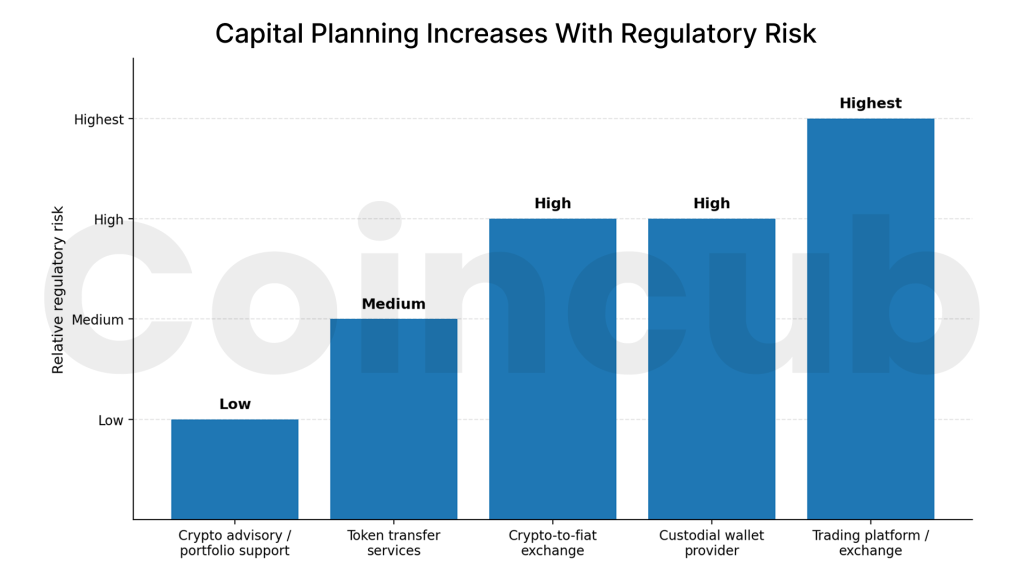
Risk Level and Capital Planning by Business Model
Offshore jurisdictions take varied approaches. The Cayman Islands rolled out its Virtual Asset Service Providers framework in phases, beginning with registration requirements and later extending licensing obligations to custodians and virtual asset trading platforms. The British Virgin Islands, Bermuda, Gibraltar, and Mauritius each apply their own license categories, capital thresholds, and substance expectations. A custodial exchange in one jurisdiction may face a six-figure capital floor, while a transfer-only service in another may face a much lighter threshold.
The lesson is straightforward: research the license category that fits your business model before assuming a capital number. Two seemingly similar jurisdictions can demand very different commitments once you map the activity to the appropriate license class.
| Business Model | Typical Regulatory Risk Level | Capital Planning Implication |
| Crypto advisory / portfolio support | Lower | Lighter minimum capital, but still needs compliance budget |
| Token transfer services | Medium | Requires AML, Travel Rule, transaction monitoring budget |
| Crypto-to-fiat exchange | Higher | More liquidity, banking, reconciliation, and compliance costs |
| Custodial wallet provider | Higher | Needs custody controls, insurance, security, segregation processes |
| Trading platform / exchange | Highest | Larger regulatory capital, tech resilience, market surveillance, incident response |
The Four Funding Buckets Every Offshore Crypto Entity Should Plan For
Once the business model and jurisdiction are clear, founders can plan capital across four buckets. Each bucket addresses a different category of cost and risk.
Bucket 1: Statutory or regulatory capital
This bucket covers the financial thresholds set by law or regulator, including minimum paid-up capital required for incorporation or licensing, own funds requirements set by the regulator, net asset thresholds maintained at all times, and regulatory buffers tied to overheads or risk weightings. This is the floor. Falling below it can trigger supervisory action or license suspension.
Bucket 2: Licensing and professional fees
These are the one-off and recurring fees required to obtain and maintain the license. Legal counsel handles application drafting and regulatory liaison, while the regulator charges its own application and assessment fees. Most jurisdictions also require local director and officer appointments, corporate secretary services, and audit and accounting setup. On top of that, founders pay for drafting policies, procedures, and risk frameworks before the application can be submitted. These costs accumulate quickly and often exceed founder expectations, especially when revisions or follow-up submissions are required.
Bucket 3: Compliance and operating infrastructure
A licensed crypto entity must run real compliance systems from day one. That means AML and KYC platforms with ongoing screening, blockchain analytics and wallet monitoring tools, transaction monitoring with alert handling, and Travel Rule solutions for VASP-to-VASP transfers. Cybersecurity tooling and penetration testing sit alongside data protection and privacy compliance, and qualified compliance staff or an outsourced MLRO function pull it all together. Skimping here is a common reason applications stall.
Bucket 4: Runway and contingency buffer
Even with everything else in place, the entity must survive long enough to generate revenue. A planning benchmark of twelve to eighteen months of operating expenses gives the business room to handle delays and unexpected costs. Within that runway, founders should set aside incident response reserves for cyber or operational events, a buffer for banking onboarding delays that routinely take longer than expected, and additional cushion for licensing timelines that slip beyond initial estimates. A treasury reserve sized to weather market downturns rounds out this bucket.
Return to our earlier founder. Initially they budgeted only for incorporation and licensing. After mapping the four buckets, the picture changed entirely. The real question shifted from “what is the minimum?” to “what funding level makes this business credible to regulators, banks, and customers?” That shift is the difference between a stalled application and a licensed, operating entity.
How to Estimate Your Practical Capital Requirement
A useful planning formula brings the four buckets together:
Practical capital need = regulatory minimum + licensing costs + 12-month operating runway + compliance setup + risk buffer
Work through the formula in sequence. Start with the license category and confirm the regulatory minimum. Add fixed professional costs across legal, audit, and corporate services. Layer in compliance technology subscriptions and integration costs, then staffing and local substance expenses that include MLRO and compliance officer roles. Add a treasury reserve sized to your business model, and close with a contingency buffer that is typically larger for exchanges, custodians, and fiat gateways.
Mini Planning Table
| Cost Layer | Conservative Planning Question |
| Regulatory minimum | What must be maintained at all times? |
| Legal and application costs | What must be paid before approval? |
| Compliance tools | What systems must exist before launch? |
| Staffing | Who performs MLRO, compliance, finance, and operations roles? |
| Runway | Can the company survive a delayed launch? |
| Risk buffer | What happens if markets fall or banking is delayed? |
The discipline of answering each question forces clarity. Founders who treat capital planning as a budget exercise often miss the resilience question entirely. The strongest plans assume something will go wrong, whether that means a banking partner pausing onboarding, a regulator requesting additional documentation, or a market downturn arriving mid-launch.
Conservative planning treats the regulatory minimum as a starting point and builds outward. Aggressive planning treats it as the target and runs into trouble within months.
Funding Sources and Proof-of-Funds Expectations
Once founders know how much capital they need, the next question is where it comes from. Common sources include founder equity, investor equity through priced rounds, SAFE notes or convertible instruments, parent company funding for subsidiaries, strategic partner contributions, revenue when the business is already operating, and loans used cautiously and with regulatory awareness.
Regulators and banks scrutinize funding sources closely. Expect detailed requests covering source of funds documentation, source of wealth verification for principals and major investors, and bank statements showing balances and movements. Applications usually also require a clean cap table with ultimate beneficial ownership disclosed, background checks on investors and directors, audited financial statements where available, a board-approved budget and forecast, and a documented treasury policy that explains how reserves will be managed.
One point deserves emphasis: crypto held on the balance sheet may receive different treatment than fiat liquidity. Regulators often want to see how the crypto is custodied, valued, and could be liquidated under stress before counting it toward regulatory capital. Some jurisdictions accept stablecoin holdings under defined conditions, while others require fiat reserves for the statutory portion of capital. Confirm the policy before assuming crypto reserves qualify.
Common Capital Planning Mistakes That Delay Licensing
Predictable mistakes derail otherwise strong applications. The most common is treating incorporation cost as the full budget, which sets the project up for shortfalls before the license application is even drafted. Closely related is choosing a jurisdiction before defining the business model, which often results in a poor fit between the license class and the planned activities. Founders also routinely ignore local substance costs, including director fees and office space, and lean too heavily on volatile crypto holdings as the only capital source.
Underbudgeting compliance staff and AML tooling is another frequent stumbling block, as is failing to separate client assets from company funds, which raises immediate red flags during supervisory review. Some founders present a one-month cash position rather than a runway plan, forget audit, regulatory reporting, and annual renewal costs, or assume banking onboarding will be quick when in practice it often stretches across many months. Skipping documentation of source of funds and source of wealth rounds out the list of avoidable mistakes that show up in licensing refusals across multiple jurisdictions.
Final Checklist: Is Your Crypto Entity Properly Funded?
Use this checklist before submitting any license application or pitching investors on the funding round:
- Is the business model clearly mapped to the license type?
- Have you identified minimum capital or net asset expectations?
- Do you have enough runway for licensing delays and banking onboarding?
- Can you prove source of funds and source of wealth for all contributors?
- Have you budgeted for AML, KYC, audit, cybersecurity, and legal support?
- Are client assets segregated through documented custody arrangements?
- Is your treasury policy written, approved, and operational?
- Have you stress-tested the budget under lower revenue or delayed banking?
- Have you allocated funds for ongoing renewals, audits, and regulatory reporting?
- Have you documented contingency plans for incident response and wind-down?
The strongest offshore crypto entities are the ones that can prove they are funded, supervised, operationally resilient, and ready to survive well beyond launch. Capital planning, done properly, becomes the foundation of regulatory credibility and long-term operational strength.
Frequently Asked Questions (FAQs)
What are capital requirements for an offshore crypto company?
Capital requirements vary by jurisdiction and license type. They typically include statutory minimum capital, regulatory own funds, licensing fees, compliance infrastructure costs, and operating runway. Plan for the full stack rather than the statutory floor alone.
Do all offshore crypto entities need a license?
Most reputable offshore jurisdictions require VASPs to register or obtain a license, in line with FATF standards. The specific obligations depend on the activities performed, with custody, exchange, and fiat services typically attracting full licensing.
Is paid-up capital the same as operating runway?
They serve different purposes. Paid-up capital is equity formally contributed to the company. Operating runway measures how many months the company can fund expenses with available cash. Regulators usually want to see both.
Can crypto assets count toward regulatory capital?
Some jurisdictions accept defined crypto holdings under specific custody and valuation conditions. Many still require fiat reserves for the statutory minimum. Confirm the policy with your regulator before relying on crypto reserves.
Which crypto business models usually need more capital?
Custodial wallet providers, exchanges, trading platforms, and fiat gateways generally face the highest capital expectations because they hold client assets, process fiat, and carry greater operational and consumer protection risk.
How much runway should a crypto entity have before applying for a license?
A twelve to eighteen month runway is a common planning benchmark. This covers licensing timelines, banking onboarding, and the pre-revenue period after launch.









