


 Buy a Licensed Company
  Explore VASP Data
  Talk to an Expert

 Atis Shala
Atis is a senior analyst and community lead with four years of experience in crypto. He has a bachelor from the Rochester Institute of Technology.
Atis Shala
Atis is a senior analyst and community lead with four years of experience in crypto. He has a bachelor from the Rochester Institute of Technology.
Litecoin (LTC) Price Prediction 2026: The Silver to Bitcoin’s Gold
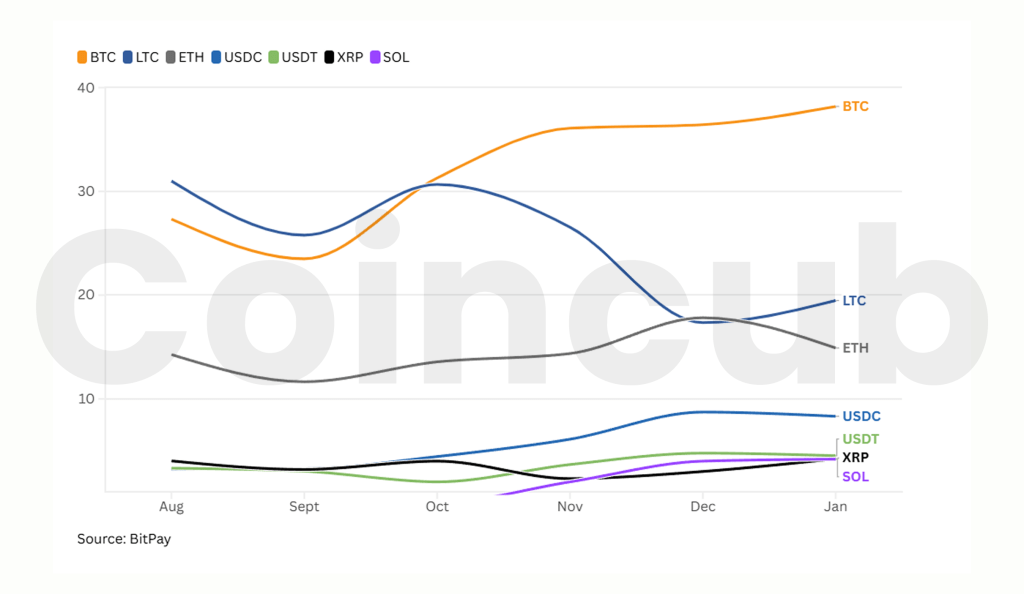
Investors demand precision, and the 2026 outlook for Litecoin (LTC) hinges on a single, critical question: Can the digital silver narrative survive in a market dominated by high-throughput blockchains and memecoins? Well, yes. Litecoin remains the silent giant of cryptocurrency adoption, processing more real-world transactions than nearly any other asset on BitPay. As the market matures from speculation to utilization in 2026, Litecoin transitions from a “boring” legacy coin to a fundamental infrastructure play.
The 2026 landscape presents a unique duality for Litecoin. While we anticipate the broader market may face a post-cycle correction following the expected 2025 peak, Litecoin historically behaves differently. It often acts as a safe haven during high volatility and a reliable exit ramp for traders moving profits from riskier altcoins. Our analysis suggests that while 2026 may not bring the explosive 100x gains, it will likely solidify LTC as a triple-digit asset with a risk profile significantly lower than its competitors.
The 2026 Price Snapshot
| Metric | Bearish Floor | Consensus Target | Bullish Ceiling |
| Price Target | $85.00 | $185.00 | $350.00+ |
| Market Cap | $6.3 Billion | $13.8 Billion | $26.1 Billion |
| LTC/BTC Ratio | 0.0012 | 0.0025 | 0.0045 |
Primary 2026 Drivers:

- The Commodity Classification: The CFTC and other global regulators consistently classify Litecoin as a commodity, distinct from securities. This regulatory clarity positions LTC as a prime candidate for a Spot ETF in 2026, following the precedents set by Bitcoin and Ethereum.
- Payment Dominance: Transaction data confirms Litecoin is on par with Bitcoin in merchant usage due to negligible fees and faster block times. In a high-fee environment, users default to LTC.
- The Hashrate Highs: Network security continues to break records. The mining industry signals long-term confidence by investing heavily in Scrypt hardware, securing the network against 51% attacks and cementing its status as the second most secure proof-of-work chain.
What is Litecoin?
For those new to the ecosystem, understanding the origin of Litecoin clarifies its 2026 value proposition.
History & Origin
Charlie Lee, a former Google engineer, launched Litecoin in October 2011. He did not aim to kill Bitcoin; he aimed to complement it. He famously stated that if Bitcoin is gold, Litecoin is silver. This defined the technical roadmap. Litecoin served as the testnet for major Bitcoin upgrades, including SegWit and the Lightning Network, proving its value as a stable technological partner.
LTC Tokenomics
The economic policy of Litecoin mirrors Bitcoin but with a 4x multiple.
- Hard Cap: There will only ever be 84 million LTC (4x Bitcoin’s 21 million).
- Block Time: Blocks are solved every 2.5 minutes (4x faster than Bitcoin’s 10 minutes).
- Halving: Block rewards cut in half every 840,000 blocks (roughly every 4 years).
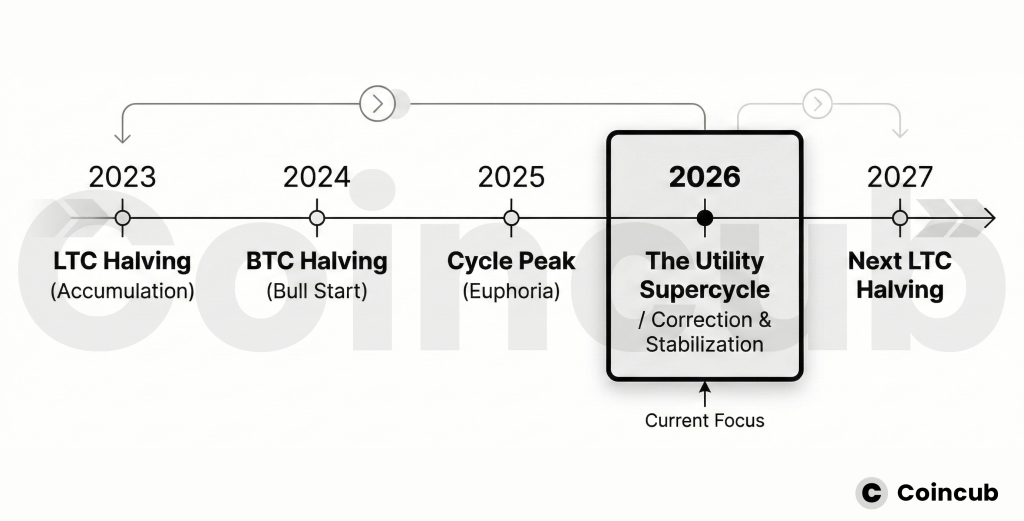
This predictable, deflationary supply schedule ensures that no central entity can debase the currency. By 2026, over 90% of all Litecoin will have been mined, increasing the scarcity premium.
How to Buy & Store LTC in 2026
Investors can purchase LTC on virtually every centralized exchange (Coinbase, Binance, Kraken) and increasingly through traditional brokerage apps. For storage, hardware wallets like Trezor and Ledger remain the gold standard. In 2026, we also expect “institutional custody” solutions from banks like Fidelity to support Litecoin, allowing for insured holdings.
Smart Contracts on Bitcoin’s Little Brother
While Ethereum dominates the DeFi conversation, Litecoin quietly launched its own tokenization layer called OmniLite. Built on the same protocol that launched the original Tether (USDT) on Bitcoin, OmniLite allows developers to issue custom tokens directly on the Litecoin blockchain.
This is not about competing with Solana for high-frequency trading. It is about stablecoin optionality. OmniLite enables the creation of decentralized stablecoins that inherit the security of the Litecoin network. For 2026, the potential for a native “USDT-on-LTC” offers a compelling use case: cheap, secure stablecoin transfers that cost pennies, avoiding the congestion spikes of Ethereum or the outage risks of Solana. This layer activates “smart contract” capabilities without bloating the base layer, preserving Litecoin’s primary function as hard money.
Ordinals and “Litecoin Punks”
The “Inscription” craze that clogged the Bitcoin network in 2023 naturally spilled over to Litecoin. Because Litecoin shares Bitcoin’s code base (specifically the SegWit and Taproot upgrades), it supports Ordinals, NFTs inscribed directly onto the smallest unit of the currency (litoshis).
The launch of the LTC-20 token standard proved that the Litecoin network could handle massive throughput stress. During the peak of the minting frenzy, daily transactions on Litecoin spiked to over 500,000, surpassing Bitcoin for the first time in history. Crucially, the network did not crash, and fees remained negligible (less than $0.01). This real-world stress test validated Litecoin’s scalability claims. While the speculative hype around JPEG images may fade by 2026, the infrastructure proof remains: Litecoin can handle enterprise-grade volume without breaking a sweat.
Fundamental Drivers: Why “Silver” Still Matters
Critics often label Litecoin as a “dino-coin,” yet the onchain metrics paint a picture of a vibrant, utilized network.
Adoption as Currency
Bitcoin evolved into a store of value, effectively digital gold. It is too valuable and often too slow for buying coffee. Litecoin fills this void. BitPay data consistently ranks Litecoin as the #1 or #2 cryptocurrency for payments, often surpassing Bitcoin. Users prefer LTC because transaction fees cost fractions of a cent, and settlements occur in 2.5 minutes rather than 10. In 2026, as crypto payment gateways expand into Shopify and everyday commerce, this friction-less utility ensures constant buy pressure for LTC.
The “AuxPoW” Revolution: A Symbiotic Security Shield
Most investors misunderstand how Litecoin secures its network. They assume it competes for hashrate against other Scrypt-based chains. In reality, Litecoin effectively “owns” the Scrypt algorithm through a mechanism called Auxiliary Proof of Work (AuxPoW), or merged mining.
This system allows miners to submit their work to both the Dogecoin and Litecoin blockchains simultaneously. A miner does not split their hashrate; they use the full force of their computational power to secure both chains at once. This created a mutually assured survival pact between the two largest Scrypt assets.
When Dogecoin experienced a viral, meme-driven explosion in 2021, the profitability of mining Doge skyrocketed. Consequently, miners poured capital into new hardware to capture those Doge rewards. Because of AuxPoW, every single hash deployed to mine Doge also secured the Litecoin ledger. This symbiotic relationship grants Litecoin an unprecedented security budget, one that it does not have to pay for entirely out of its own block rewards.
The Mathematical Impossibility of a 51% Attack
Critics often point to “51% attacks” on smaller Proof-of-Work chains like Ethereum Classic or Bitcoin Gold as a risk for Litecoin. The math proves otherwise. To attack Litecoin in 2026, a hostile actor would need to acquire more hashrate than the entire existing network combined.
This is a hardware supply chain impossibility. The network is secured primarily by Bitmain’s Antminer L7 units. These are industrial-grade ASICs (Application-Specific Integrated Circuits). Bitmain produces these in limited batches, and the vast majority are already deployed by friendly, profit-seeking mining farms. An attacker cannot simply “rent” this hash power from a cloud provider like NiceHash because the available liquidity of Scrypt hash power is a fraction of what protects the network. To attack Litecoin, you would effectively need to build your own semiconductor foundry, manufacture thousands of unreleased ASICs, and deploy them without the market noticing. The capital expenditure alone would exceed billions of dollars, destroying the value of the very asset the attacker sought to manipulate.
Hardware Industrialization: The Antminer L7 Effect
The shift from GPU mining to ASIC dominance changed the price floor mechanics. In the early days, hobbyists mined Litecoin on graphics cards. If the price dropped, they simply turned off their rigs or switched to gaming. Today, the network relies on industrial miners running Antminer L7s. These machines cost thousands of dollars and have multi-year ROI horizons.
This industrialization creates a “miner capitulation floor.” Large mining operations have fixed electricity contracts and debt obligations. They are unlikely to sell their mined LTC below their breakeven cost of production. As difficulty rises and hardware efficiency plateaus, this cost of production naturally drifts upward. In 2026, we project the average “shut-off price” for older generation hardware to approach $75-$80. This level acts as a formidable psychological and economic support zone, as miners effectively go on strike (refusing to sell) rather than realize a loss.
Network Upgrades: The MWEB Factor
The MimbleWimble Extension Blocks (MWEB) upgrade was the most significant technical achievement in Litecoin’s history. It introduced optional confidentiality, allowing users to conceal transaction amounts. This fungibility is essential for sound money; a merchant should not know your entire bank balance just because you bought a sandwich.
By 2026, wallet integration for MWEB will likely reach maturity. Major mobile wallets and potentially some compliant exchanges will support these private transactions. This unique feature distinguishes Litecoin from Bitcoin and Dogecoin, offering a privacy-preserving option that regulators can tolerate because it is optional, not mandatory.
When a user chooses to move their funds to the MWEB lane (via an “Extension Block”), their transaction data becomes obfuscated. The protocol uses “Confidential Transactions” to encrypt the amount being sent and “CoinJoin” techniques to mix the inputs and outputs. To the outside observer, it simply looks like a car entered a tunnel and exited at a different location; the observer cannot see who was inside or how much cargo they carried. Crucially, this is an opt-in feature. The main chain remains fully transparent, satisfying the need for public auditability, while the extension block offers privacy for those who require it.
Fungibility: The “Sound Money” Requirement
Privacy is often marketed as a tool for illicit activity, but in monetary theory, it serves a different purpose: fungibility. For a currency to be sound, one unit must be indistinguishable from another. If a merchant receives a Litecoin that was previously used in a gambling transaction, they might redlist that specific coin if the ledger is fully transparent. This “taint” destroys the concept of equal value.
MWEB restores fungibility. By washing coins through the extension block, users break the heuristic link to the coin’s past history. A Litecoin exiting the MWEB block looks mathematically identical to a freshly mined Litecoin. This ensures that a merchant in 2026 can accept LTC without worrying about its provenance, making it a superior medium of exchange compared to fully transparent chains where “tainted” coins can be frozen by centralized exchange compliance tools.
The Regulatory Tightrope: Optional vs. Mandatory
The genius of MWEB lies in its optionality. When MWEB launched, South Korean exchanges (Upbit, Bithumb) delisted Litecoin, citing strict anti-money laundering laws that prohibit “privacy coins.” However, US and European regulators took a different stance. Because MWEB is not mandatory, and because exchanges can choose not to support the MWEB address format, Litecoin avoided the “privacy coin” label that crushed Monero and Zcash.
This places Litecoin in a unique “Goldilocks” zone for 2026. It offers enough privacy for personal financial sovereignty (preventing your neighbor from seeing your bank balance) but retains enough transparency to remain compliant with global banking standards. It is the only major asset that successfully straddles this regulatory divide.
Litecoin Hashrate & Security
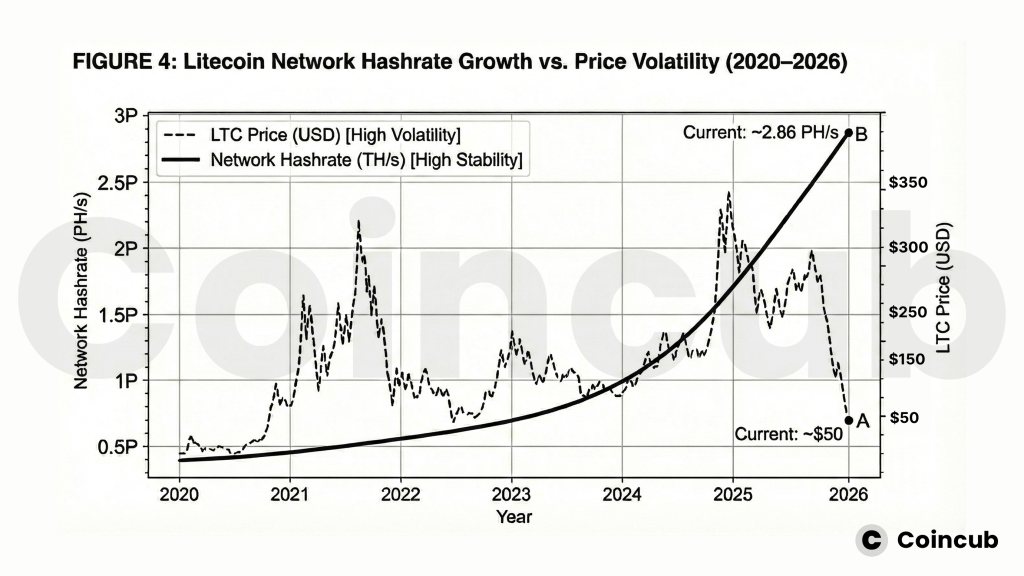
Price follows security. The Litecoin network currently boasts an all-time high hashrate. This metric indicates that miners are deploying millions of dollars in hardware to secure the chain. They do not do this for charity; they do it because they project long-term profitability. A rising hashrate creates a “security budget” that makes the network impervious to attacks. In an era where smaller chains suffer 51% attacks, Litecoin’s immutable security record (100% uptime since launch) commands a premium.
Litecoin (LTC) Price Forecast for 2026
The year 2026 represents a pivotal moment in the four-year cycle. Ideally, the market reaches a euphoric peak in late 2025. Therefore, 2026 operates as the year of “The Great Unwinding” or, conversely, the “Utility Supercycle.” We analyze the price action through quarterly phases.
Q1-Q2 2026 Outlook for LTC: The Post-Cycle Hangover
Historically, the first half of the year following a cycle peak brings volatility. If Bitcoin hits a new all-time high in late 2025, Q1 2026 will likely see capital rotation. Traders take profits from high-risk assets and move into “defensive” crypto positions. Litecoin fits this profile perfectly.
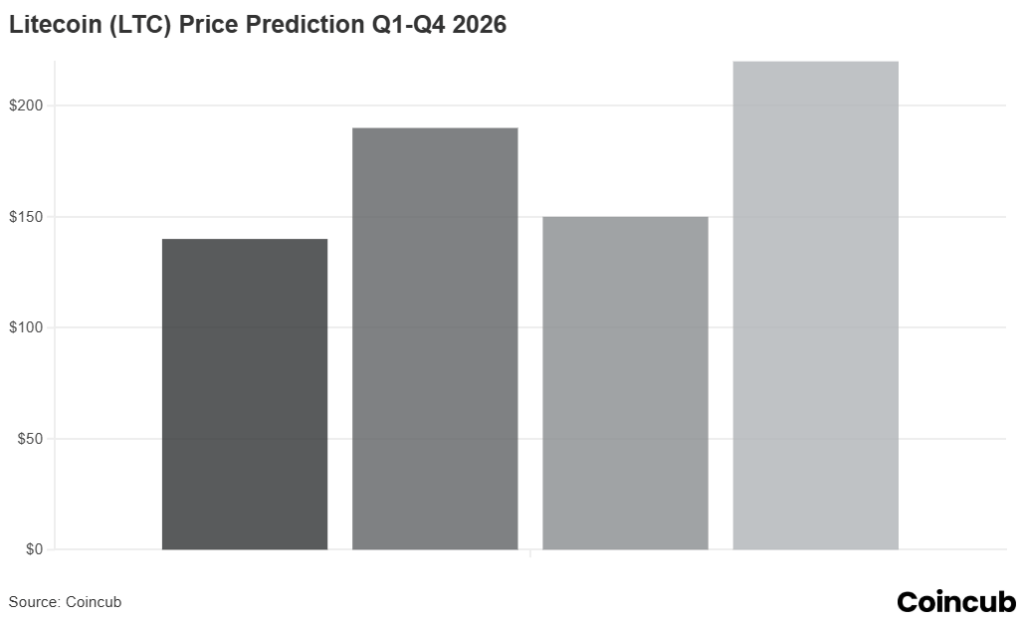
We expect LTC to outperform the broader altcoin market during this correction phase. While speculative tokens may drop 70% or more, Litecoin typically retains value due to its deep liquidity and integration with every major exchange and payment processor. During Q1 and Q2, we forecast a trading range between $140 and $190. This period will likely see the “Silver Narrative” tested as investors seek safety without exiting to fiat currency entirely.
Q3-Q4 2026 LTC Outlook: Stabilization and Accumulation
By the second half of 2026, the market usually stabilizes. This accumulation phase often bores retail investors but excites institutional players. If the ETF narrative gains traction during this period, LTC could decouple from Bitcoin’s price action.
In a neutral scenario, we project a stabilization around the $150 mark. However, if global liquidity conditions improve (central banks lowering rates), LTC could begin an early ascent toward $220 by year-end. The key determinant here is the LTC/BTC ratio. If Litecoin can reclaim the 0.003 BTC level, it signals a massive shift in institutional interest.
Scenario Analysis for Litecoin
The Bull Case: The ETF Approval ($350+)
In this scenario, Wall Street issuers turn their attention to Litecoin as the next logical ETF product. Because LTC shares Bitcoin’s code lineage and lacks a pre-mine or ICO, it faces fewer regulatory hurdles than Solana or Ripple. An ETF approval, or even credible rumors of one, would force a massive repricing event. Institutional desks would need to acquire physical LTC, creating a supply shock that pushes the price past its 2021 highs toward $350 or even $400.
The Bear Case: Layer-1 Obsolescence ($85)
The risk remains that newer, faster blockchains render “payment coins” obsolete. If stablecoins on networks like Solana or Arbitrum capture 90% of the merchant payment market, Litecoin loses its primary value proposition. In this scenario, LTC becomes a “zombie chain”, secure but unused. The price would likely bleed slowly back to its historical support levels around $85, maintaining value solely through its brand recognition and legacy status.
Litecoin Technical Analysis: The Path to 2026
The Network Value to Transactions (NVT) ratio serves as the “P/E ratio” of cryptocurrency. It measures the market cap relative to the volume of value settled on the chain. A high NVT suggests the network is overvalued (speculative bubble), while a low NVT implies undervaluation (high utility, low price).
Historically, Litecoin maintains one of the lowest NVT ratios in the top 20 assets. While meme coins often trade at astronomical NVT multiples driven by hype, Litecoin frequently trades at a discount relative to the billions of dollars it settles weekly. Heading into 2026, if the NVT ratio dips below its 5-year average while transaction volume from BitPay and other processors climbs, it signals a massive “value trap” upside. Smart money watches this divergence closely; when utility outpaces price action for too long, a violent upward correction typically follows to close the gap.
Whale Cohorts: The 10k-100k LTC Club
We track the behavior of “Whale” wallets, addresses holding between 10,000 and 100,000 LTC. This specific cohort often represents smart money: family offices, proprietary trading firms, and early miners.
Onchain data reveals distinct accumulation patterns. During the 2024-2025 cycle, this cohort aggressively absorbed supply whenever the price dipped into the double digits. Conversely, “Retail” wallets (holding <10 LTC) tend to buy only when price candles turn green. For a bullish 2026 prediction to hold, we need to see the Whale Cohort supply percentage trend upward or remain flat. If this metric begins to decline while price rises, it indicates distribution (whales selling to retail), signaling an impending top. Currently, the trend remains accumulative, suggesting these large holders position themselves for a multi-year hold rather than a quick flip.
The Grayscale Premium (LTCN)
Institutional appetite often reveals itself in the secondary market before it hits the spot market. The Grayscale Litecoin Trust (LTCN) allows accredited investors to gain exposure to LTC through a traditional brokerage vehicle.
In previous cycles, LTCN traded at a massive premium, sometimes 1,000% over the value of the underlying asset. This absurdity signaled desperate institutional demand that could not access spot markets. As we approach 2026, tracking the discount or premium to Net Asset Value (NAV) becomes a leading indicator. If LTCN moves from a discount (trading below the value of the Litecoin it holds) to a premium, it confirms that Wall Street is front-running a potential ETF approval or a macro-rotation into commodities.
Litecoin vs. The Market
LTC vs. BTC
Traders obsess over the LTC/BTC pair. For years, this ratio has bled downward, leading many to declare Litecoin dead against Bitcoin. However, historical reversals occur swiftly. The “Silver to Gold” ratio in traditional markets suggests a correlation. In crypto, this correlation broke down, but 2026 could see a mean reversion. If Bitcoin transaction fees spike to $50+ during the next bull run, users will flood back to Litecoin, driving the ratio up. We target a modest recovery to 0.004 BTC, which would double the USD value of Litecoin even if Bitcoin’s price remains flat.
LTC vs. Payment Coins (DOGE, BCH, XRP)
- Litecoin vs. Dogecoin: DOGE relies on Elon Musk and social sentiment. It has infinite inflation. Litecoin has a hard cap and relies on utility. In 2026, institutional money will prefer the predictability of Litecoin over the volatility of Dogecoin.
- Litecoin vs. Bitcoin Cash (BCH): Both fork from Bitcoin’s code, but Litecoin has a distinct identity and no contentious hard fork history. Litecoin maintains significantly higher daily active addresses than BCH.
- Litecoin vs. XRP: XRP faces perpetual uncertainty regarding its centralization and SEC battles. Litecoin, as a decentralized PoW commodity, faces zero regulatory existential threats.
LTC vs. Kaspa (KAS)
The primary challenger to Litecoin’s throne in the Proof-of-Work arena is Kaspa (KAS). Kaspa utilizes a BlockDAG (Directed Acyclic Graph) architecture to achieve near-instant block times, theoretically solving the “scalability trilemma” that slows down older chains.
However, the comparison reveals Litecoin’s entrenched advantage: liquidity and distribution. In 2026, Kaspa remains a “technology bet,” struggling to gain listings on tier-1 regulated exchanges in the US due to its novelty and fair launch nuances. Litecoin, conversely, is listed on every brokerage from Robinhood to PayPal. While Kaspa may win on raw speed, Litecoin wins on accessibility. In the race for global payments, the superior technology often loses to the superior network effect. Litecoin is the “VHS” to Kaspa’s “Betamax”, perhaps technically simpler, but ubiquitously adopted.
LTC vs. The Lightning Network
Bitcoin maximalists argue that Litecoin is redundant because the Bitcoin Lightning Network offers instant, cheap payments. In practice, the Lightning Network remains complex for the average user, requiring channel management and inbound liquidity balancing. Routing failures still plague the user experience.
Litecoin offers a simpler solution: “Base Layer” scaling. A user sends LTC, and it arrives. No channels, no liquidity management, no watchtowers. For transactions between $10 and $1,000, Litecoin’s onchain finality is often preferred over the complexity of Bitcoin’s Layer 2. By 2026, we expect a hybrid model where Bitcoin handles large settlements (digital gold), Lightning handles micro-payments (streaming money), and Litecoin dominates the “middle class” of transactions, everyday commerce.
LTC vs. Monero (XMR)
Monero is the undisputed king of privacy, but that title comes with a heavy cost: regulatory exclusion. Major exchanges continue to delist XMR to comply with FATF travel rules. This forces Monero into the shadows of peer-to-peer markets.
Litecoin’s MWEB upgrade offers “good enough” privacy for 99% of users without the regulatory heat. It protects the user from their nosey neighbor but allows the exchange to remain compliant. This strategic compromise positions Litecoin to capture the privacy-conscious capital that is forced to exit Monero due to liquidity constraints.
Litecoin Regulatory Environment
This is Litecoin’s ace in the hole. In a 2026 environment where the SEC may aggressively pursue “staking” coins as securities, Litecoin stands safe. It is Proof-of-Work, had a fair launch, and has no CEO. This safety makes it the only viable alternative for risk-averse institutions that want exposure to crypto beyond Bitcoin but cannot touch DeFi tokens due to compliance mandates.
Frequently Asked Questions (FAQ)
Will Litecoin reach $1,000 in 2026?
It is highly unlikely. Reaching $1,000 requires Litecoin to surpass a $75 billion market cap. While possible in a hyper-inflationary scenario, a target of $1,000 is more realistic for the 2029-2030 cycle.
Is Litecoin dead?
No. Network activity is at all-time highs. “Dead” chains have zero transactions. Litecoin processes millions of transactions monthly and dominates crypto payments on processors like BitPay.
How does the Bitcoin halving affect Litecoin?
Litecoin typically rallies before its own halving and stabilizes during Bitcoin’s halving. The 2024 Bitcoin halving supply shock will trickle down to Litecoin in 2025 and 2026 as investors seek undervalued assets with similar deflationary mechanics.
Can Litecoin flip Ethereum?
No. Ethereum serves a different purpose (smart contracts and decentralized applications). Litecoin competes with Bitcoin and fiat currency as a medium of exchange. They run in different lanes.
What is the maximum price of Litecoin in 2026?
Our bullish models project a maximum ceiling of $350-$400, driven by potential ETF approvals and a rotation of profits from Bitcoin into large-cap commodities.