Buy a Licensed Company
  Explore VASP Data
  Talk to an Expert

 Atis Shala
Atis is a senior analyst and community lead with four years of experience in crypto. He has a bachelor from the Rochester Institute of Technology.
Atis Shala
Atis is a senior analyst and community lead with four years of experience in crypto. He has a bachelor from the Rochester Institute of Technology.
Smart Wallets: Why You Will Never Lose a Seed Phrase Again
- Smart wallets replace traditional single private keys with programmable smart contracts, moving away from fragile seed phrases toward customizable security rules.
- You can now sign in and approve transactions using your device’s built-in Face ID or fingerprint scanner. This cuts onboarding time down to seconds and drastically reduces the risk of password phishing.
- Losing your device no longer guarantees lost funds. By proactively setting up trusted guardian contacts or a secondary backup key, you can safely restore access to your wallet without needing a 12-word phrase.
- Through the use of “paymaster” contracts, decentralized applications can sponsor your transaction fees. This allows newcomers to interact with the blockchain immediately, without needing to purchase ETH first.
- Thanks to established standards like ERC-4337 and the recent EIP-7702 upgrade, users can easily opt into these smart features without having to abandon their existing wallet addresses.
- While removing seed phrase anxiety, smart wallets shift trust toward smart contract code and device ecosystems like Apple or Google cloud backups, making it absolutely crucial to configure recovery methods before an emergency strikes.
- You don’t have to choose exclusively between ultimate security and daily convenience. Many users successfully pair a smart wallet for everyday decentralized app usage with a traditional hardware wallet for long-term cold storage.
Smart Wallets As a Simplified Crypto Vault
A smart wallet replaces the twelve-word seed phrase with something most people already trust: a fingerprint, a face scan, and a set of recovery contacts. Because the wallet is a programmable smart contract rather than a single private key, it can be designed to survive a lost phone, log you in with a passkey, and let an app cover your transaction fees. Coinbase reports that creating one of its smart wallets takes about 15 seconds with a single biometric prompt, compared with several minutes of writing down and safeguarding a seed phrase the old way.
That shift is one of the biggest usability changes crypto has seen. It removes the single scariest part of self-custody, the fear that one slip with a backup phrase wipes out everything you own. This article explains what a smart wallet actually is, how features like social recovery and gasless transactions work, what the trade-offs are, and where the technology stands in 2026.
A smart wallet is a crypto account run by a smart contract instead of a single key. That programmability enables passkey login with your fingerprint, social recovery if you lose your device, sponsored gas so transactions can be free, and batched actions. The trade-off is that you lean on standards and providers, so choosing a reputable one and setting up recovery properly matters.

What Is a Smart Wallet?
To see why smart wallets are different, it helps to know how an ordinary crypto wallet works. A traditional wallet, called an externally owned account, is controlled by one private key. Whoever holds that key controls the funds, full stop. The seed phrase is just a human-readable backup of that key. Lose it and there is no help desk, no reset link, and no recovery. The design is unforgiving by nature.
A smart wallet flips this. The account is a piece of code on the blockchain, a smart contract that can hold its own rules for who may approve a transaction and how. This idea is called account abstraction, the shift from a hardcoded account controlled by one key to a programmable account that defines its own logic for validation, fees, and recovery. Because the rules live in code, the wallet can do things a single key never could.
ERC-4337 and EIP-7702
Two standards make this work on Ethereum today. ERC-4337, live since March 2023, lets wallets behave as smart contracts without changing the blockchain itself, so users sign richer instructions that enable passkeys, sponsored gas, and batched actions. EIP-7702, activated in the Pectra upgrade on May 7, 2025, lets an existing regular account temporarily borrow smart-contract abilities while keeping its same address. Together they made hybrid setups the practical default, where an account keeps its familiar identity but gains smart features on demand.
It is worth clearing up a common point of confusion. A smart wallet is not the same as a custodial account where a company holds your funds.
With a well-designed smart wallet you still control your assets, the difference is that control is expressed through programmable rules rather than a single fragile key. It is also distinct from an MPC wallet, which splits one key into shares. Both aim at the same goal of removing single points of failure, but a smart wallet does it in open, onchain code that anyone can inspect.
The Four Features That Change Everything
Most of the benefit of a smart wallet comes from four capabilities. None are possible with a plain single-key wallet, and each removes a specific source of friction or fear.
| Feature | What it does | Why it matters |
|---|---|---|
| Passkey login | Sign in and approve with Face ID or a fingerprint, no password or seed phrase. | Onboarding drops to about 15 seconds and removes phishing of passwords. |
| Social recovery | Trusted contacts or a recovery key can restore access if your device is lost. | A lost phone no longer means lost funds. |
| Sponsored gas | Apps can pay transaction fees through a paymaster contract. | Transactions can be free, so newcomers need no ETH to start. |
| Batching and session keys | Combine several actions into one approval, or pre-authorize limited actions. | Fewer confirmations and smoother app experiences. |
The core capabilities that distinguish smart wallets from single-key wallets.
Passkeys: Your Fingerprint Becomes Your Key
The headline feature for most users is passkey login. Instead of a seed phrase, a passkey wallet stores a cryptographic key inside the tamper-resistant hardware already built into modern phones and laptops, the same secure element that guards Apple Pay or Windows Hello. Every signature is gated behind your biometrics, so approving a transaction feels like unlocking your phone. There is no password to leak and no phrase to write down.
This is why onboarding collapses from minutes to seconds. Coinbase makes its smart wallet passkey-first, letting someone create a wallet in a single biometric prompt with no app install, and syncing it across devices through their Apple or Google account. For people who grew up with apps but never with seed phrases, this removes the steepest part of the learning curve.
There is a security upside beyond convenience. Because the private key lives inside the device secure element and never leaves it, there is no seed phrase sitting in a drawer, a photo, or a cloud note for a thief to find. The most common ways people lose crypto, a leaked or photographed phrase and a phished password, simply do not apply. The attacker would need your physical device and your biometrics at the same time.
Social Recovery: The End of Permanent Loss
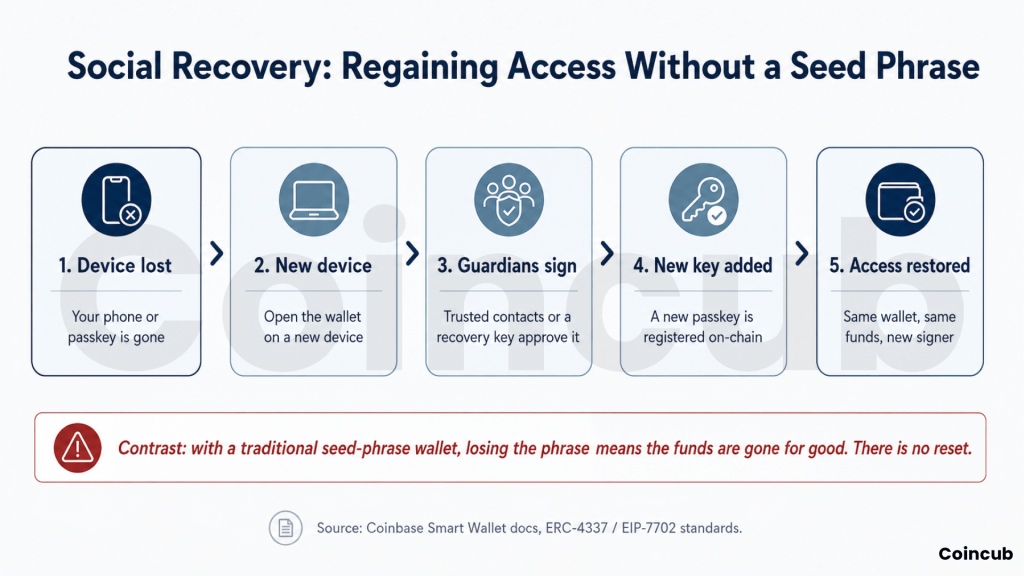
Social recovery is the feature that gives this article its title. Because the account is a smart contract, it can be set up so that designated guardians, trusted contacts, or a secondary hardware key, can collectively approve a recovery if you lose access. A recovery key can generate a new signer onchain that adds a fresh passkey and restores the wallet after a device is lost or a passkey is deleted. The funds never move and the account stays the same. Only the way you sign changes.
The diagram below shows the flow. Compare it with the old model, where losing your seed phrase ends the story with your money gone for good.
Sponsored Gas: Transactions That Cost You Nothing
Gas fees are a quiet barrier for newcomers, because a brand-new user needs to acquire ETH before they can do anything at all. Smart wallets solve this with paymasters, smart contracts that pay gas on a user’s behalf. An app deposits funds into a paymaster and sets rules for when to sponsor transactions, which can make the experience completely gasless. The vast majority of smart-wallet transactions already use paymasters, with tens of millions of dollars in fees sponsored by applications.
This unlocks business models that look familiar from the web. An app can absorb fees the way a website absorbs hosting costs, treating them as the price of acquiring a user. For the person clicking, the blockchain disappears into the background, which is exactly the point. The friction that once made onchain apps feel technical is removed without taking custody of anyone’s funds.
Batching and Session Keys
Finally, smart wallets can bundle multiple steps into a single approval. Swapping a token might normally require approving the token and then making the trade, two confirmations. A smart wallet can batch these into one. Session keys go further, letting you pre-authorize a narrow set of actions for a limited time, so a game or trading app can act on your behalf within strict limits without asking you to sign every move.
How Fast Is Adoption?
This is not a future promise. By the end of 2024, ERC-4337 had facilitated more than 100 million user operations, a tenfold rise from the year before, and nearly 20 million smart accounts were deployed in 2024 alone, roughly seven times the prior year. Biometric authentication was used by about 80% of digital wallets globally in 2025. The pieces that make smart wallets usable have moved from experimental to mainstream in a short span.
The arrival of EIP-7702 accelerated this further by letting ordinary accounts opt into smart features without abandoning their existing address. That lowered the cost of trying smart wallets, since users no longer had to migrate to a brand-new account to benefit.
Adoption numbers tell only part of the story. What they signal is that the supporting infrastructure, the bundlers that process these transactions, the paymasters that sponsor fees, and the wallet apps themselves, has matured to the point where smart wallets work reliably at scale. A few years ago this was research. Today it powers consumer apps that millions of people use without ever knowing the term account abstraction.
The Trade-Offs You Should Understand
Smart wallets remove old risks but introduce new considerations, and it would be dishonest to present only the upside. The most important trade-off is around where trust now sits.
A passkey wallet often depends on your device ecosystem, such as Apple or Google cloud backup, which makes it somewhat less self-sovereign than a pure seed-phrase wallet that depends on nothing but the phrase. If your only passkey lives on a single laptop or security key and that device is bricked, stolen, or lost without a recovery method in place, you can be locked out completely. The lesson is that social recovery is only protection if you actually set it up, with guardians or a backup key chosen in advance.
There is also a smart-contract dimension. Because the account is code, it relies on that code and on supporting contracts like paymasters being secure and well audited. Researchers have noted that paymasters, while excellent for user experience, add components that must be implemented carefully. For users, the practical takeaway is to favor established, audited wallets and standards rather than untested ones.
| Consideration | What to do about it |
|---|---|
| Device dependence | Set up social recovery and a backup signer so one lost device cannot lock you out. |
| Provider and code trust | Choose reputable, audited smart wallets built on established standards like ERC-4337. |
| Recovery setup | Configure guardians or a recovery key when you create the wallet, not after a loss. |
| Self-sovereignty | If full independence matters most, keep a hardware seed-phrase wallet for cold storage alongside it. |
Trade-offs of smart wallets and how to manage them.
A Short History of How We Got Here
Smart wallets did not appear overnight. The idea of account abstraction circulated among Ethereum developers for years, but earlier proposals required deep changes to the network and stalled. The breakthrough was ERC-4337, which delivered the same benefits as a layer on top of Ethereum, so no risky change to the core protocol was needed. That design choice is why it could ship in 2023 and grow quickly.
The next step was making the features available to the hundreds of millions of existing accounts rather than only to newly created ones. EIP-7702, shipped in the Pectra upgrade in May 2025, did exactly that by letting a normal account temporarily act like a smart contract. The result in 2026 is a landscape where a beginner can start with a passkey smart wallet and an experienced user can bolt smart features onto the account they already have, with both relying on the same underlying standards.
None of this means seed phrases vanish overnight. Plenty of wallets and cold-storage devices still use them, and for some advanced users that simplicity is a feature rather than a flaw. The honest framing is that smart wallets give people a genuine choice for the first time. You can opt for biometric convenience with recovery, or for the absolute independence of a phrase you alone control, and you can even combine the two. The era of being forced into one unforgiving model is what is ending.
Who Should Use a Smart Wallet
For newcomers and everyday users, smart wallets are close to ideal. They remove the seed-phrase anxiety that scares people away from self-custody, make onboarding feel like any modern app, and allow recovery from the most common disaster, a lost or broken phone. For someone holding a moderate amount of crypto and using onchain apps, the usability gains clearly outweigh the trade-offs.
For large holders and maximalists who prize total independence, the picture is more nuanced. A common 2026 approach is hybrid, using a smart wallet for daily activity and convenience while keeping the bulk of holdings in a hardware wallet for cold storage. That blends the smoothness of account abstraction with the bedrock security of keys that never touch the internet.
It is also worth thinking about inheritance and long-term access, an area traditional wallets handle badly. A seed phrase written on paper can be lost in a move, destroyed in a fire, or found by the wrong person. Smart wallets open cleaner options, since guardians and recovery keys can be arranged so that a trusted family member or a secondary device can help restore access under defined conditions. This does not solve estate planning on its own, but it gives ordinary users tools that previously required custodians or complex multisignature setups.
The broader significance is about who crypto is for. For a decade, self-custody asked people to behave like their own bank with none of a bank’s safety nets, and that bargain kept many away. Smart wallets keep the core promise of self-custody, which is that you control your assets, while restoring the everyday forgiveness people expect from technology. That combination is what makes 2026 feel like a turning point rather than just another upgrade.
Frequently Asked Questions (FAQ)
What is a smart wallet in simple terms? +
It is a crypto wallet run by a smart contract instead of a single private key. That lets it log you in with biometrics, recover from a lost device, and let apps pay your fees, none of which a traditional wallet can do.
Do smart wallets still use a seed phrase? +
Most are designed so you never handle one. Instead they use a passkey stored in your device hardware plus social recovery. Some wallets let advanced users add a seed-phrase backup if they want one.
What happens if I lose my phone? +
With social recovery set up, you open the wallet on a new device and your designated guardians or a recovery key approve restoring access. The funds stay put and a new signer is added. Without recovery configured in advance, you can be locked out, which is why setup matters.
Are smart wallets safe? +
Reputable ones built on audited standards are considered safe and remove several old risks. The main cautions are to use an established provider and to configure recovery, since the security now rests partly on the contract code and your setup choices.
Do I need ETH to use a smart wallet? +
Often no. Many apps sponsor gas through paymaster contracts, so you can transact without holding ETH first. This removes one of the most confusing hurdles for newcomers, who previously had to buy a fee token before doing anything.
Can I still use a smart wallet with a hardware wallet? +
Yes, and many people do. A hardware wallet can serve as a recovery signer or hold cold-storage funds, while the smart wallet handles everyday activity. This hybrid setup is a popular way to combine convenience with strong security.