Buy a Licensed Company
  Explore VASP Data
  Talk to an Expert

 Atis Shala
Atis is a senior analyst and community lead with four years of experience in crypto. He has a bachelor from the Rochester Institute of Technology.
Atis Shala
Atis is a senior analyst and community lead with four years of experience in crypto. He has a bachelor from the Rochester Institute of Technology.
Passkey Crypto Wallets vs Seed Phrase Wallets

- Your face or fingerprint is not the private key. Biometrics unlock an authenticator, which then uses a cryptographic credential. Confusing the two leads to bad assumptions about what happens when a device is lost.
- Passkeys are phishing-resistant by design because WebAuthn binds the credential to a specific origin, so a lookalike domain cannot obtain a valid assertion. That protection does not stop you approving a malicious transaction on the real site.
- The FIDO Alliance classifies both synced and device-bound passkeys as phishing-resistant. They differ in assurance level, with device-bound hardware keys meeting NIST AAL3 and synced passkeys meeting AAL2.
- Coinbase Smart Wallet recovery illustrates the general rule: a cloud-synced passkey usually survives device loss, and a device-bound passkey may not, so a separate recovery signer must be created while you still have access.
- Seed phrases are portable and provider-independent, and they concentrate all authority into a single secret that cannot be revoked once exposed.
- Neither model is universally safer. The answer depends on your threat model, the amount at stake, whether your passkey is synced or device-bound, and whether you have actually tested recovery.
- The most common failure in both models is the same: an untested recovery path. Restore a small balance before you trust either with a large one.
Why “Face ID Versus 12 Words” Is the Wrong Comparison
The choice gets framed as convenience against strictness: scan your face, or write down a phrase and hide it. Framed that way, the answer is obvious and also wrong, because the visible interaction is the least important difference between these two architectures.
What actually differs is the whole chain of authority. Which key signs, where that key lives, who else can influence it, what happens when the device holding it disappears, and whether you can take your funds elsewhere if the provider stops existing. Passkey wallets and seed phrase wallets give different answers to every one of those questions, and the answers vary between individual passkey wallets more than most comparisons admit.
What Are Passkey and Seed Phrase Wallets?
A seed phrase is a human-readable backup, typically 12 or 24 words, from which a wallet’s private keys are deterministically derived. Anyone holding the phrase can regenerate the keys and control the funds, on any compatible software, forever. It is a single secret that is simultaneously the backup and the master key.

A passkey is a public-key credential created and managed by an authenticator, scoped under the WebAuthn standard to a particular relying party. The private half never leaves the authenticator. Authentication happens by the authenticator signing a challenge, having verified the user locally, usually through biometrics or a device PIN.
Clearing up the Biometric Misconception
A fingerprint or face scan is not a private key and is not transmitted anywhere. It unlocks the authenticator, which then performs the cryptographic operation with the stored credential. This matters practically: your biometric cannot be stolen and used remotely, and it also cannot be backed up, transferred, or used to reconstruct anything if the authenticator is gone.
Passkeys Do at Least Three Different Jobs
The largest source of confusion in this comparison is that “passkey wallet” describes several architectures.
In some wallets, the passkey is the smart-account signer: the credential directly authorises onchain transactions through a smart-contract account. Other wallets, however, have the passkey as only a login credential for a wallet application whose keys are held or derived some other way. In others still, the passkey is a recovery factor attached to an otherwise conventional wallet.
Only the first genuinely replaces the seed phrase’s role. The other two sit alongside a key-management scheme you still need to understand. Before comparing any specific passkey wallet to a seed wallet, establish which of the three you are looking at, because the security analysis differs completely.
Terms that are not synonyms
“Seedless,” “passkey,” “MPC,” and “social recovery” get used interchangeably in marketing and describe unrelated things. MPC splits a key across parties. Social recovery lets designated guardians restore access. A passkey is a credential type. A wallet can use all, some, or none of these and still call itself seedless. Read the technical documentation rather than the category label.
How Does Each Wallet Authorize a Transaction?
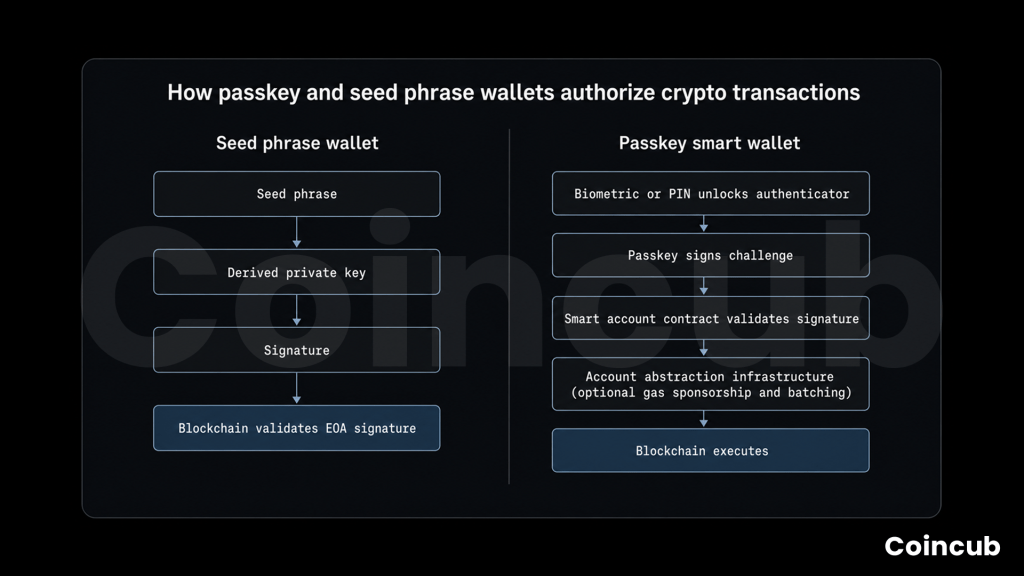
The seed phrase model is short. The phrase derives one or more private keys along a defined derivation path. Wallet software, or a hardware device holding those keys, signs the transaction. The blockchain validates the externally owned account’s signature against the address. There is no intermediary, no contract logic, and no third party in the path. Whoever holds the key signs, and the chain does not care who they are.
The passkey smart-wallet model has more moving parts. The passkey authenticator produces a signature over the transaction data after local user verification. A smart-contract account, deployed at the user’s address, validates that signature against the registered credential according to its own logic. Account-abstraction infrastructure may then batch operations, sponsor gas, or apply spending policies before the transaction is included.
Coinbase and Safe both document passkey-controlled smart accounts, and their implementations, supported networks, and recovery designs differ.
What the Extra Layer Buys and Costs
The smart-contract layer is where the genuinely new capabilities live: multiple signers on one account, spending limits enforced in code, session keys, gas sponsorship, batched approvals, and recovery mechanisms that do not require a single master secret.
It also introduces dependencies a seed wallet does not have. The account is a deployed contract, so it exists only on chains where it has been deployed and where the required cryptographic verification is supported. Contract bugs are possible. Upgrade authority, if the contract is upgradeable, is a question you should be able to answer before depositing anything meaningful. And gas sponsorship usually depends on infrastructure operated by someone, which is a liveness dependency even when it is not a custody one.
Which Model Is Safer From Phishing and Theft?
Neither wins across the board. The threats they address barely overlap.
| Threat | Seed phrase wallet | Passkey wallet |
| Fake wallet website asking for credentials | High risk: phrase can be entered and stolen | Strong: credential is origin-bound, will not release |
| Seed phrase extracted from a photo or note | High risk | Not applicable if no phrase exists |
| Physical device theft | Depends on device passcode | Depends on device passcode and biometric |
| Cloud account compromise | Low, unless phrase stored in cloud | Meaningful, for synced passkeys |
| Malware or clipboard hijacking | High risk | Reduced, though approvals can still be manipulated |
| SIM swap or email takeover | Low direct risk | Relevant where the credential manager uses those factors |
| Physical backup theft | Real, and irreversible | Not applicable |
| Approving a malicious transaction | High risk | High risk, unchanged |
Why Passkeys Resist Phishing
WebAuthn signs data that includes the legitimate origin, so a credential registered for the real site cannot produce a valid assertion for a lookalike domain. The browser and authenticator simply will not release one. This protection operates at the protocol level, which means it does not depend on the user noticing the difference between two similar URLs. That is a meaningful improvement over any human-vigilance-based defence, and it eliminates the single most common route by which seed phrases are stolen.
The Attack Passkeys Do Not Address
Origin binding protects the credential. It does nothing about what you sign once you are on the genuine site.
A user connected to a real dApp who approves an unlimited token allowance to a malicious contract, or signs an offchain order draining their NFTs, has lost funds without any credential ever being phished. The passkey worked exactly as designed. This class of attack is now the dominant one in practice, and the defences against it are entirely separate: transaction simulation, human-readable signing, allowance management, and wallet warnings.
When comparing wallets, weight those features at least as heavily as the credential model. A passkey wallet without transaction simulation may leave you more exposed than a seed wallet with it.
The Custody Exposure of Synced Credentials
For synced passkeys, whoever can access your credential-manager account can potentially access the credential. That reframes the threat model: your cloud account’s security, including its own recovery flow, becomes part of your wallet’s security. If that account can be recovered by a support agent, an SMS code, or an email reset, your wallet inherits that weakness. Check what protections your credential manager offers, and enable the strongest ones.
How Does Recovery Work After Losing a Device?
This is the question that separates the two models most sharply, and it is where most users discover their assumptions were wrong.
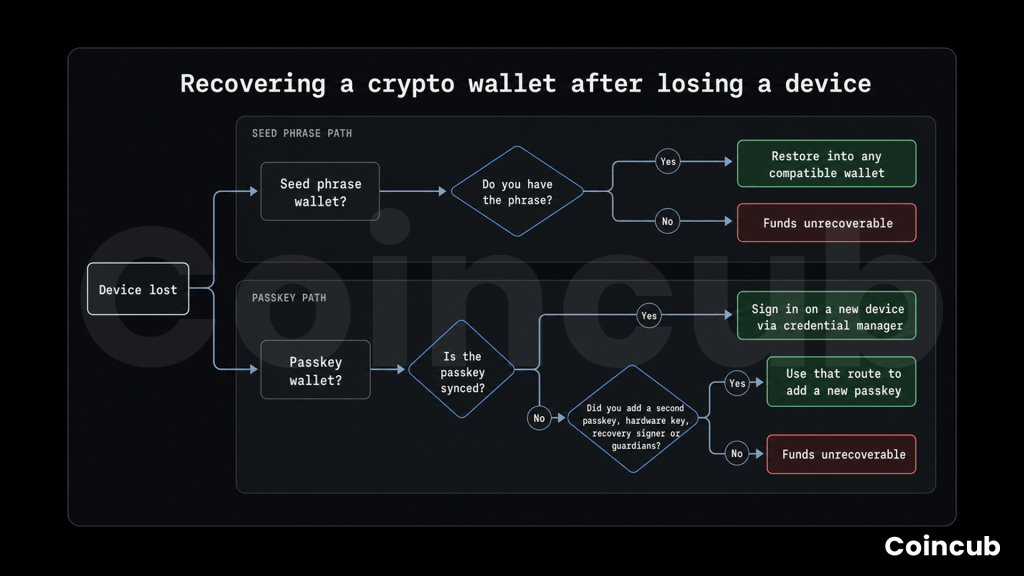
Seed phrase recovery is conceptually simple. Obtain your phrase, enter it into compatible software or a hardware device, and the keys regenerate. It works offline, requires no permission from anyone, and functions as long as the phrase exists. It fails completely and permanently if the phrase is lost, and it fails in the other direction if the phrase is found by someone else.
Passkey recovery depends on choices made before the loss. The possible routes:
| Recovery route | Works after total device loss? | Requires setup in advance? |
| Synced passkey via credential manager | Usually yes, on a new device | No, if sync was enabled |
| Second passkey on another device | Yes | Yes |
| Hardware security key | Yes, if the key is not also lost | Yes |
| Recovery signer or phrase added to the smart account | Yes | Yes, critically |
| Guardian or social recovery | Yes, subject to guardian availability | Yes |
| Device-bound passkey, no other factor | No | Not applicable |
Coinbase’s smart wallet documentation illustrates the pattern clearly. A passkey created through a cloud-based method such as iCloud Keychain or a password manager generally does not require a separate backup, because it syncs to a new device. A device-bound passkey, such as one tied to specific hardware or a browser profile, is not accessible if that device is lost. For those cases, users can generate a recovery key that creates a new signer onchain, capable of adding a fresh passkey later. The essential detail is that this recovery signer must be created while you still have access to the original passkey. Safe similarly recommends combining passkeys with additional authentication methods rather than relying on one.
The Failure Mode to Plan Around
Read that requirement again, because it is the one that catches people. Passkey recovery is a configuration you either set up in advance or do not have, rather than a property of the technology you can invoke after the fact. A user who sets up a device-bound passkey, deposits funds, and loses the device has no recourse, and no support desk can create one for them without compromising the self-custody model entirely.
The practical instruction is straightforward. Before funding a passkey wallet, determine whether your passkey is synced or device-bound, add at least one independent recovery route, and then test it: on a different device, with a small balance, all the way through to a successful transaction. The same test applies to a seed wallet, where the equivalent check is restoring the phrase into a second piece of software rather than assuming it works.
Which Option Offers Better Portability and Independence?
Seed phrases are portable in principle, and the practice has caveats. A BIP-39 phrase can generally be restored into any compatible wallet, which is a genuine and valuable form of provider independence: if the wallet company disappears tomorrow, your funds do not.
The friction sits in the details. Different wallets use different derivation paths, so restoring a phrase can produce a valid but empty address, and users conclude their funds are gone when they are simply looking at a different account in the same tree. Account types, network support, and optional BIP-39 passphrases (the “25th word”) add further ways for a technically correct restoration to appear to fail. These are recoverable situations that cause real panic.
Passkey portability depends on the layer you mean. The credential itself may sync across devices within a credential-manager ecosystem, which makes moving from one iPhone to another trivial and moving from Apple to Android considerably less so, since passkeys do not straightforwardly transfer between ecosystems. Hardware security keys sidestep this by being independent of any ecosystem.
The account is a separate question. A smart account exists on the chains where it is deployed, and its recovery and management logic lives in a contract that a given wallet interface knows how to talk to. If the wallet provider shuts down, the relevant question is whether the contract remains usable through another interface or directly, which depends on the implementation and is worth checking before you commit funds.
Custodial or not
Passkey wallets are frequently described as custodial by people who dislike them, and this is usually wrong. Custody is determined by who can authorise the account, not by which credential type is used. A smart account whose only signer is your passkey is self-custodial in the meaningful sense: no one else can move the funds.
What passkey wallets do introduce is provider dependence, which is a different property. You may depend on a credential manager for credential availability, on infrastructure for gas sponsorship, on a wallet interface for usability, and on a contract’s upgrade authority for continuity. Those are liveness and governance dependencies rather than custody, and they still deserve to be understood before use.
What Are Synced and Device-Bound Passkeys?
Synced passkeys are available across devices through a credential manager such as iCloud Keychain, Google Password Manager, or a third-party password manager. Losing one device is a non-event, because the credential is available on the next one after signing into the manager.
Device-bound passkeys stay on a specific authenticator: a hardware security key, a platform authenticator tied to one machine, or a browser profile. They cannot be extracted or synced.
| Property | Synced passkey | Device-bound passkey |
| Survives device loss | Yes, via the credential manager | No, unless another factor exists |
| Assurance level | Meets NIST AAL2 | Hardware keys meet NIST AAL3 |
| Attestation support | Not supported | Supported |
| Main exposure | Credential-manager account compromise | Physical loss or damage |
| Ecosystem dependence | High | Low |
The FIDO Alliance classifies both types as phishing-resistant, so the choice between them is not about phishing at all. It is a trade between availability and control. Synced credentials optimise for not losing access and accept an account-compromise exposure. Device-bound credentials optimise for control and accept the risk that a lost object is a lost credential.
For wallets specifically, this maps neatly onto amount at stake. Synced is sensible for a spending wallet. Device-bound hardware, with a documented second factor, is more appropriate for holdings you would be seriously upset to lose.
Which Wallet Should Different Users Choose?
There is no architecture that is best in the abstract. Match it to what you are protecting and who you are protecting it from.
| Profile | Suggested setup | Why |
| Beginner, small onchain amounts | Passkey smart wallet, synced, with a recovery signer configured and tested | Removes the highest-frequency failure: phishing and mishandled phrases |
| Active dapp user | Either model, chosen for transaction simulation and allowance tools, with limited balances | The dominant threat is malicious approvals, not credential theft |
| Long-term holder | Hardware-backed seed wallet, or a multi-factor smart account with hardware and geographically separate backups | Optimises for durability over convenience |
| Business or family treasury | Multisignature or policy-based smart account | Removes single points of failure, whether that point is a phrase or a passkey |
Two principles cut across all four. First, separate your spending wallet from your storage wallet, so a compromise of the convenient thing does not reach the important thing. Second, whichever architecture you pick, the recovery path is only real if you have executed it. An untested recovery is a belief, not a control.
Forum threads on this topic are useful for spotting common confusions and unreliable as technical guidance. The recurring questions are whether a smart wallet has a recovery phrase, where passkeys are physically stored, and what device loss actually means for access, and the answers vary by wallet in ways that generic advice cannot capture. Treat community explanations as anecdotal, then verify against the specific wallet’s own documentation.
Frequently Asked Questions (FAQ)
Is Face ID my crypto private key? +
No. Biometrics unlock an authenticator, which holds the cryptographic credential and performs the signing. Your fingerprint or face data is never transmitted and cannot be used to reconstruct a key, which is why authenticator loss matters more than biometric security.
Are passkey wallets self-custodial? +
They can be. Custody depends on who can authorise the smart account and how recovery is designed, not on the credential type. A smart account whose only signer is your passkey is self-custodial, though it may still depend on providers for availability.
Can I recover a passkey wallet after losing my phone? +
Only if a synced credential, second passkey, hardware security key, guardian arrangement, or recovery signer exists. Device-bound passkeys with no additional factor cannot be recovered, and the backup must be configured while you still have access.
Can a seed phrase restore any wallet? +
It restores compatible keys, but derivation paths, account types, network support, and optional BIP-39 passphrases differ between wallets. A correct phrase can produce an empty-looking account in the wrong software, which is a configuration issue rather than a lost-funds one.
Can passkeys be phished? +
Conventional credential phishing fails, because WebAuthn binds the credential to the legitimate origin and lookalike domains cannot obtain a valid assertion. Users can still be tricked into approving malicious transactions on genuine sites, which passkeys do nothing to prevent.
Do passkey wallets work on every blockchain? +
No. Smart-account support and the required signature verification vary by network, and the account must be deployed on each chain where you intend to use it. Check supported networks before assuming a passkey wallet covers your assets.
Which is better for storing large amounts? +
A tested hardware, multisignature, or multi-factor setup, rather than any single untested recovery method. Device-bound hardware keys meet a higher assurance level than synced credentials, and multiple independent signers matter more than the credential type itself.