


 Buy a Licensed Company
  Explore VASP Data
  Talk to an Expert

 Atis Shala
Atis is a senior analyst and community lead with four years of experience in crypto. He has a bachelor from the Rochester Institute of Technology.
Atis Shala
Atis is a senior analyst and community lead with four years of experience in crypto. He has a bachelor from the Rochester Institute of Technology.
How to Mine Ergo (ERG): A Complete Educational Guide
- Ergo (ERG) uses the ASIC-resistant, memory-hard Autolykos v2 algorithm, so it stays profitable on consumer GPUs instead of expensive industrial hardware.
- As of 2026, the block reward has reached its floor of 3 ERG, supplemented by transaction fees and the “Storage Rent” mechanism that recycles dormant coins back to miners.
- Profitability depends on cheap electricity (ideally under $0.12/kWh), GPU efficiency, network difficulty, and the ERG price.
- The best value cards are NVIDIA RTX 3060 Ti / 4070 and AMD RX 6000 / 7000 series with 8GB+ VRAM.
- Joining a mid-sized pool (HeroMiners, 2Miners, WoolyPooly) and undervolting / tuning memory clocks maximizes long-term returns and supports network decentralization.
Ergo represents a sophisticated return to the foundational principles of blockchain technology. It champions decentralization, financial sovereignty, and security through a Proof-of-Work (PoW) consensus. Unlike many modern projects that rely on venture capital or pre-mined allocations, Ergo launched with a fair start. This means every token in circulation today originated from a miner’s computational effort. This commitment to fairness ensures that the network remains a grassroots endeavor rather than a corporate-controlled entity.
Mining remains the central pillar of the Ergo ecosystem. It does more than just issue new coins. It secures the ledger against attacks and validates complex smart contracts. For those interested in the technical side of crypto, Ergo provides one of the most accessible entry points available. While Bitcoin requires expensive, specialized industrial hardware, Ergo remains profitable and functional on standard consumer graphics cards.
This guide serves as a roadmap for beginners, hobbyists, and small-scale miners. You will explore the mechanics of the Autolykos v2 algorithm and evaluate the economics of a mining operation. By the end of this article, you will possess the knowledge to set up a hardware rig, configure mining software, and contribute to one of the most resilient networks in the Web3 space.

Understanding Ergo’s Proof-of-Work System
What Is Proof of Work?
Proof of Work is a consensus mechanism that requires participants to prove they performed a specific amount of computational labor. This labor involves solving mathematical puzzles that are difficult to solve but easy for the network to verify. Ergo utilizes PoW because it provides an objective, unforgeable history of transactions. Unlike Proof of Stake (PoS), which can lead to wealth concentration and governance issues, PoW anchors the network’s security in the physical world through energy and hardware.
What is the Autolykos Algorithm?
The heart of Ergo mining is the Autolykos v2 algorithm. Developers designed this algorithm to be memory-hard, which means it requires significant Video RAM (VRAM) to function. This design choice serves as a defense against ASICs (Application-Specific Integrated Circuits). ASICs are highly specialized machines that can solve certain algorithms much faster than general-purpose hardware. While ASICs increase hashrate, they often centralize power in the hands of those who can afford massive industrial farms.
Autolykos v2 solves the “k-sum problem.” This requires the GPU to access and manipulate large amounts of data in its memory. This process favors the versatile architecture of Graphics Processing Units (GPUs) found in gaming PCs. Compared to the old Ethash algorithm, Autolykos is remarkably efficient. It generates less heat and places lower stress on the hardware, which extends the lifespan of your mining equipment.
Ergo’s Emission and Block Rewards
Ergo follows a strict and transparent emission schedule. The network produces a new block approximately every two minutes. In the early stages, block rewards were high to incentivize early adopters. As of 2026, the network has transitioned into a more mature phase. The block reward recently reached its floor of 3 ERG per block.
To ensure long-term sustainability, Ergo utilizes a “Storage Rent” mechanism. If a wallet remains dormant for more than four years, the network charges a small fee. This fee goes directly to the miners. This creates a circular economy where “lost” coins eventually return to the active market. This ensures that miners receive compensation even after the primary emission of new coins concludes.
Is Ergo Mining Profitable?
Key Factors Affecting Ergo Mining Profitability
Determining whether mining is worth your time requires a cold analysis of several variables. First, your hashrate determines how many puzzles you solve. Second, electricity costs represent your primary overhead. If your utility company charges more than $0.12 per kilowatt-hour, your margins will be thin.
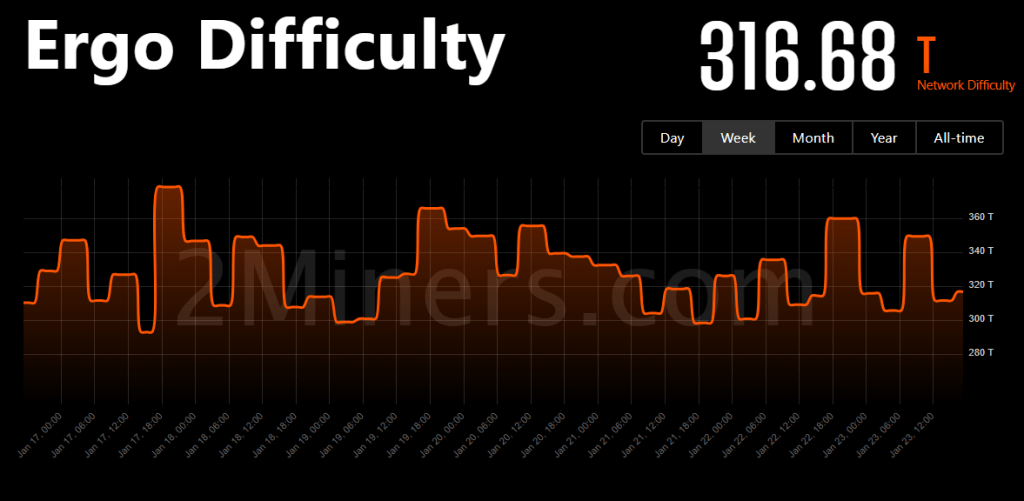
Third, the network difficulty adjusts every 1,024 blocks. As more miners join, the puzzles become harder. Finally, the market price of ERG fluctuates. A “profitable” rig today could become a loss-maker tomorrow if the price drops, though many miners view this as a way to accumulate assets for the next market cycle.
Ergo Mining Profitability Calculators
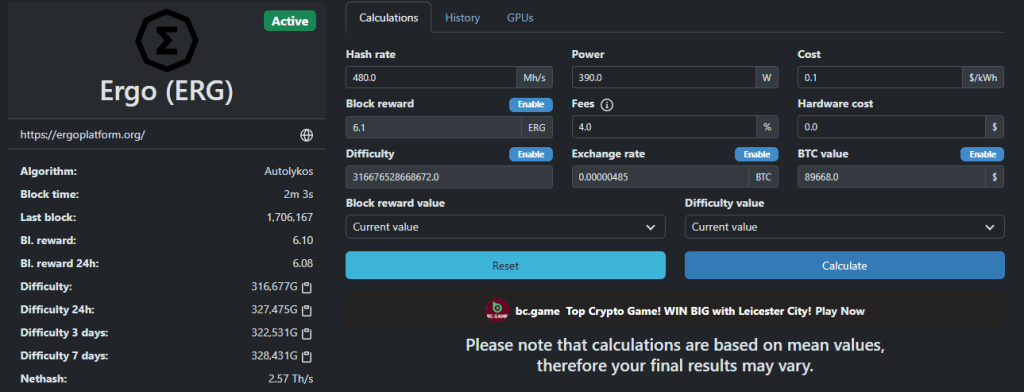
Miners should use online calculators like WhatToMine or ErgoPlatform’s official tools. You must input your hashrate, power consumption in watts, and electricity price. These tools provide a snapshot of daily or monthly earnings. Remember that calculators cannot predict the future. They assume that difficulty and price remain static, which they never do. Use these figures as a baseline rather than a guarantee.
Long-Term vs. Short-Term Ergo Mining Perspective
Short-term miners often jump between different coins based on daily profitability. This is called “speculative mining.” In contrast, long-term Ergo miners often prioritize the health of the network and the accumulation of a specific asset. They believe the utility of the Ergo platform will drive higher prices in the future. For these individuals, mining at a small loss today is a strategic investment in a decentralized future.
Hardware Requirements for Mining Ergo
GPU Mining Overview
GPUs are the ideal tools for Ergo mining because of their high-speed memory. Ergo requires at least 4GB of VRAM to function, though 8GB is the current industry standard for efficiency. As the “DAG” (Directed Acyclic Graph) file grows over time, cards with more memory will remain relevant for longer periods.
Best GPUs to Mine Ergo
NVIDIA remains a popular choice for Ergo due to its excellent power efficiency. The RTX 3060 Ti and RTX 4070 series provide a great balance between hashrate and electricity draw. AMD cards, particularly the RX 6000 and 7000 series, are also highly effective. AMD hardware often requires more “tuning” to reach peak efficiency, but it provides a lower entry price for hobbyists. Older cards like the GTX 1080 Ti can still mine Ergo, but their power consumption makes them less attractive in 2026.
CPU, RAM, and Storage Requirements to Mine Ergo
The CPU plays a secondary role in the mining process. You only need a basic processor to handle the operating system and the mining software. A dual-core Celeron or an older Ryzen chip is sufficient. You should have at least 8GB of system RAM to ensure the OS runs smoothly. For storage, a 120GB SSD is more than enough to hold the mining software and a lightweight operating system.
Power Supply and Cooling Considerations
The Power Supply Unit (PSU) is the most critical component for safety. You must choose a PSU with an 80 Plus Gold or Platinum rating. Always calculate your total power draw and ensure your PSU provides at least 20% more capacity than you need. Overloading a cheap power supply is a fire hazard. Furthermore, heat is the enemy of hardware. Use high-quality fans and maintain a clean, dust-free environment to prevent your GPUs from “thermal throttling,” which reduces your hashrate.
For a more detailed guide on building your own miner, read our Build Your First Mining Rig article.
Software Requirements to Mine Ergo
Windows is the most common choice for beginners. It is easy to set up and allows you to use your PC for other tasks when you are not mining. However, dedicated mining operating systems like HiveOS or SimpleMining OS are better for serious rigs. These Linux-based systems allow you to monitor and manage multiple GPUs from a web dashboard. They are more stable and offer better tools for overclocking.
Ergo Wallets
You need a place to store your earned ERG. The official Ergo Wallet is a robust choice for desktop users. For mobile users, the Terminus or Nautilus wallets provide great security and ease of use. Never use an exchange wallet address for mining payouts. Exchanges often change their deposit addresses without notice, which could result in lost funds. Always keep your seed phrase offline on a piece of paper or a metal backup.
Mining Software Options
Several software packages support the Autolykos v2 algorithm. Popular choices include:
| Software | Compatibility | Developer Fee |
| LolMiner | NVIDIA / AMD | 1.0% |
| NBminer | NVIDIA / AMD | 2.0% |
| TeamRedMiner | AMD Only | 2.0% |
| Rigel Miner | NVIDIA Only | 1.0% |
Developer fees are a small percentage of your hashrate that goes to the software creators. This supports the ongoing development and optimization of the miner.
How to Choose a Mining Pool for ERG?
Solo Mining vs. Pool Mining
Solo mining is like a lottery. You keep the entire 3 ERG reward if you find a block, but your hardware might take months or years to find one. Most miners should join a pool. In a pool, hundreds of miners combine their power. The pool finds blocks frequently and distributes the rewards proportionally based on each person’s contribution.
Pool Fees and Payout Schemes
Pools typically charge a fee of 1% to 2%. They use different payout methods like PPLNS (Pay Per Last N Shares) or PPS (Pay Per Share). PPLNS rewards loyalty and is generally better for miners who keep their rigs running 24/7. PPS pays a flat rate for every share you submit, regardless of when the pool finds a block.
Popular Ergo Mining Pools
Current leaders in the Ergo ecosystem include:
- HeroMiners: Known for a global server network and a user-friendly interface.
- 2Miners: Provides high reliability and consistent payouts.
- WoolyPooly: Offers low fees and supports several low-cap gems alongside Ergo.
How to Choose the Right Pool to Mine Ergo
Do not simply pick the largest pool. If one pool controls more than 50% of the network’s hashrate, it creates a security risk. Distributing hashrate across smaller, reliable pools strengthens Ergo’s decentralization. Choose a pool with a server location near your physical house to reduce “stale shares” caused by high latency.
Step-by-Step Guide: How to Mine ERG
Preparing Your Wallet
Download the Nautilus wallet extension or the mobile Ergo wallet. Create a new wallet and write down the 12 or 24-word recovery phrase. Store this phrase in a secure location. Copy your “Receive” address. This long string of characters is where the pool will send your earnings.
Configuring Mining Software
Download your chosen miner from the official GitHub repository. Windows might flag the file as a virus. This is a “false positive” common with mining software – doublecheck nevertheless. Create a folder for the miner and add it to your antivirus exclusion list. Open the .bat file (or configuration file) with a text editor like Notepad.
Starting the Miner
Replace the placeholder address in the file with your own wallet address. Update the pool URL to match your chosen mining pool. Your configuration line should look similar to this:
lolMiner.exe –algo AUTOLYKOS2 –pool ergo.herominers.com:1180 –user YOUR_WALLET_ADDRESS.YOUR_RIG_NAME
Save the file and double-click it to start. A command prompt window will appear. It should show the miner connecting to the pool and detecting your GPUs.
Monitoring Performance
Wait about ten minutes and then visit your mining pool’s website. Enter your wallet address in the search bar. You should see your hashrate appearing on the dashboard. This confirms the pool recognizes your work. Monitor your GPU temperatures in the miner console. Ideally, your core temperature should stay below 65°C, and your memory temperature should stay below 90°C.
Optimization and Efficiency Tips
Overclocking and Undervolting
Mining is about efficiency, not raw power. You should “undervolt” your GPU to reduce electricity consumption and heat. In Ergo mining, the memory clock is more important than the core clock. Increase your memory frequency in small steps while lowering the power limit to 60% or 70%. Use software like MSI Afterburner to find the “sweet spot” where your hashrate is high but your power draw is low.
Reducing Power Costs
If your electricity provider offers cheaper rates at night, consider running your rigs primarily during those hours. Some miners move their operations to colder climates or rooms with better ventilation to save on cooling costs. Every cent you save on electricity is a cent added to your profit. Additionally, if you are interested in more of a silent build, you can build it differently. This is known as silent mining.
Maximizing Long-Term Hardware Health
Thermal cycles damage electronics more than constant use does. Instead of turning your rig on and off constantly, try to keep it running at a stable, cool temperature. Clean your fans every few months with compressed air. If a fan starts to make noise, replace it immediately. Proper maintenance ensures your cards can mine for years.
Security, Risks, and Common Mistakes
Your private keys are the only thing that proves you own your ERG. If someone gains access to your seed phrase, your funds are gone forever. Never type your seed phrase into a website or store it in a digital file like a PDF or a photo. Use a hardware wallet like Ledger or a dedicated “cold” device for large amounts of ERG.
Next, only download miners from official sources like GitHub. Scammers often create fake websites that offer “high-performance” miners which actually contain malware designed to steal your coins. Always verify the “checksum” or the developer’s signature if possible.
Another very common mistake is ignoring the cost of power. Beginners often get excited by the “revenue” number and forget that their electricity bill will rise. Another mistake is poor cable management. Never use “SATA” power adapters for GPUs. These cables are not designed for the high current that mining requires and can melt or catch fire. Always use 6+2 pin PCIe cables.
Environmental and Decentralization Considerations
Ergo’s Autolykos v2 algorithm is one of the more environmentally friendly PoW options. Because it is memory-intensive rather than core-intensive, GPUs consume less total power than they would mining other assets. Furthermore, by resisting ASICs, Ergo ensures that the network stays in the hands of thousands of individuals worldwide. This prevents the centralization seen in Bitcoin, where a few massive companies control the majority of the hashrate. Small-scale miners are the backbone of Ergo’s security model.
The outlook for Ergo mining in 2026 remains positive for those with efficient hardware. While the block rewards are lower than in previous years, the growth of Ergo’s DeFi and NFT ecosystems creates more transaction fees for miners. The development of “sub-blocks” and other protocol improvements continues to make the network faster and more robust. As long as Ergo remains a haven for decentralized applications, there will be a need for miners to secure the chain.
Final Thoughts: Should You Mine ERG?
Mining Ergo is more than just a way to generate income. It is a way to participate in a fair, open-source financial revolution. While it requires an initial investment in hardware and a willingness to learn technical concepts, the rewards go beyond the tokens themselves. You gain a deep understanding of how decentralized systems work.
Ergo mining is best suited for individuals who value privacy, decentralization, and long-term asset accumulation. As we move further into 2026, the network’s maturity provides a stable environment for those willing to put in the work. Start small, optimize your hardware, and stay curious.
Frequently Asked Questions (FAQ)
Is Ergo mining still profitable in 2026?
Yes. However, profitability depends entirely on your electricity cost and hardware efficiency. With block rewards at 3 ERG plus storage rent and transaction fees, efficient GPUs can still yield a profit, especially if you have access to low-cost power.
Can I mine Ergo with a laptop GPU?
It is possible but not recommended. Laptops have poor heat dissipation. The intense, constant load of mining can quickly damage a laptop’s internal components.
What is the minimum VRAM required to mine Ergo?
The current minimum is 4GB of VRAM. However, cards with 8GB or more are more “future-proof” and generally offer better efficiency.
How often do mining pools pay out ERG?
Most pools have a minimum payout threshold, such as 1 ERG. Once your earnings reach this limit, the pool sends the funds to your wallet during the next payout cycle, which usually happens once or twice a day.
Can Ergo be mined alongside other coins?
Yes, this is called “dual mining.” Some software allows you to mine Ergo and a core-heavy coin like Alephium or Radiant at the same time. This increases your total revenue but also increases heat and power consumption.
Is Ergo resistant to ASICs long term?
Yes, Ergo’s Autolykos v2 is designed to be ASIC-resistant. While no algorithm is perfectly immune, the memory-hard nature makes it very expensive and difficult to build an ASIC that is significantly more efficient than a high-end GPU.
Should I mine Ergo or buy ERG directly?
Mining is a way to “dollar-cost average” into a position while gaining hardware assets. Buying directly is faster and easier if you simply want exposure to the price. Many people do both to balance their portfolio.