Buy a Licensed Company
 Explore VASP Data
 Talk to an Expert

 Atis Shala
Atis is a senior analyst and community lead with four years of experience in crypto. He has a bachelor from the Rochester Institute of Technology.
6 Best Anonymous Crypto Wallets in 2027

- Bitcoin and Ethereum record every payment on public ledgers, so the privacy you get depends on the wallet you choose and how you use it.
- Every wallet on this list is non-custodial, asks for no identity documents and shipped updates during 2026.
- Wasabi Wallet is still the main automated CoinJoin wallet for Bitcoin. Since June 2024 it has run through independent coordinators that users pick themselves.
- Sparrow Wallet removed CoinJoin in April 2024 and now stands out for coin control, PayJoin and Silent Payments, which it can both send and receive.
- Zodl, the Zcash wallet known as Zashi until early 2026, uses shielded transactions by default, while Cake Wallet brings Monero privacy to phones and desktops.
- Atomic Wallet covers 1,000+ assets on desktop and mobile with local keys and no account sign-up, which makes it the multi-asset pick.
- Nunchuk adds multisig custody and timelocked inheritance with zero KYC, though it suits security-first users more than anonymity-first ones.
- Mutiny Wallet, part of an earlier version of this list, shut down at the end of 2024, and Samourai’s Whirlpool CoinJoin ended with the US prosecution of its founders.
Why your wallet decides how private you are
Public blockchains were built so that anyone can audit them, which means most coins leave a permanent trail. A Bitcoin or Ethereum address carries no name, yet the payments in and out of it form a history that analysts can group, date and link to exchanges. Once a single address in that history is tied to a verified account, much of the rest can follow.
Investigators and analytics firms now do this routinely, following funds from wallet to wallet until they reach a regulated platform and then asking that platform for its identity records. That request is usually the last step in how investigators turn public ledgers into evidence. Privacy wallets exist to break those links before they form.
Wallets tackle the problem in different ways. Some mix coins with other users, some hide transaction details with cryptography, and some keep metadata such as your IP address away from the servers your wallet talks to. Choosing well starts with knowing which of those layers you need.

What makes a wallet anonymous in practice
A wallet earns the anonymous label only when several layers work together, because each layer covers a different leak.
The first layer is custody. A non-custodial wallet keeps your private keys on your own device, so no company can freeze your funds or hand over your balance. That only helps if the wallet also skips identity checks, since submitting a passport at sign-up ties every later transaction to you.
The second layer is what happens on the blockchain itself. Several techniques do this work:
- CoinJoin: A CoinJoin combines inputs from many users into one transaction, so an outside observer cannot tell which input paid which output.
- PayJoin: PayJoin is a payment in which the sender and receiver both add inputs, which breaks the common assumption that all inputs in a transaction belong to the sender.
- Coin control: Coin control lets you pick exactly which coins a payment spends, so you can keep coins from different sources apart.
- Silent Payments: A Silent Payments address is a reusable Bitcoin address that produces a fresh, unlinkable onchain address for every payment it receives.
- Shielded transactions and ring signatures: Zcash’s shielded pool and Monero’s ring signatures hide senders, receivers or amounts at the protocol level.
The third layer is the network. Every wallet has to ask a server about balances and broadcast transactions, and those requests reveal your IP address unless they travel over Tor or go to a node you run yourself. A wallet with strong onchain privacy can still expose you here.
How the six wallets were selected
Each wallet had to pass five tests, checked against the project’s own documentation.
| Test | What it means |
|---|---|
| Non-custodial | Keys are generated and stored on the user’s device |
| No KYC | The wallet can be downloaded and used without identity documents |
| Open source | The wallet code is published for independent review |
| Network privacy | Built-in Tor, support for your own node, or both |
| Active development | At least one release or documented update during 2026 |
Four of the six wallets pass every test. Nunchuk passes four, and its section explains the network privacy gap so you can close it yourself. Atomic Wallet, included for multi-asset users, is not fully open source and has no built-in Tor, and its section covers how to work around that.
6 Best Anonymous Crypto Wallets for 2026
Wasabi Wallet 2.x (Bitcoin, Desktop): CoinJoin and Tor Integration
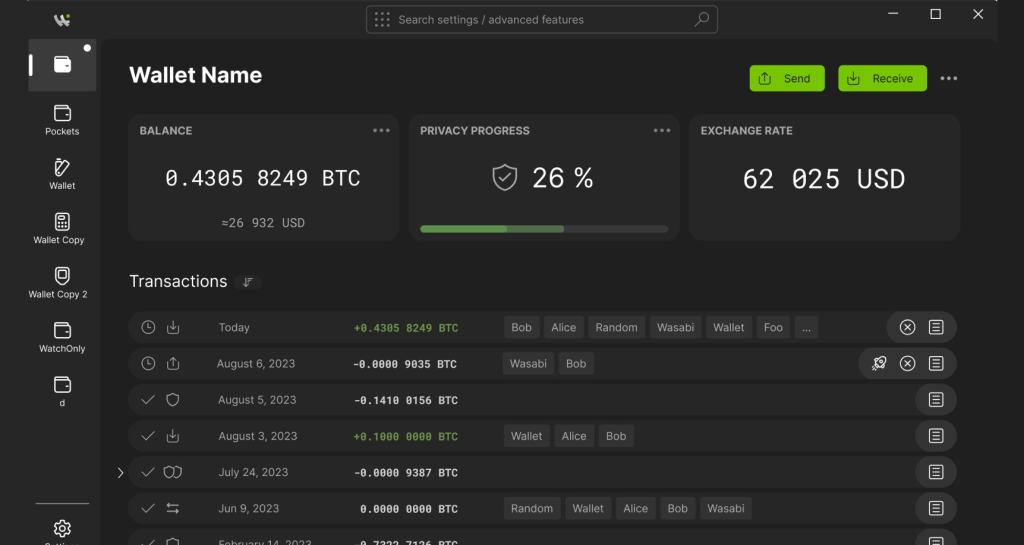
Who it’s for: Bitcoin users who want automated privacy without manual mixing or technical setup.
Wasabi Wallet suits Bitcoin users on desktop who want privacy to happen in the background without manual mixing. It is open source, runs on Windows, macOS and Linux, and builds its CoinJoins with the WabiSabi protocol, which lets many users join coins of different sizes in one round.
The most important change since 2024 is who runs the rounds. The original coordinator, operated by the company zkSNACKs, closed in June 2024, and Wasabi now connects to independent coordinators instead. Wasabi’s documentation states that a coordinator has to be configured before you coinjoin for the first time. The protocol is designed so that a coordinator can neither take your coins nor see which input belongs to which output.
Costs have also changed in the user’s favour. From client version 2.2.0, Wasabi only joins rounds in which you pay the mining fee for your own share of block space, and it skips any round where the coordinator asks for a coordination fee. The one exception is tiny leftover change of up to 10,000 sats, which goes to the coordinator because creating such a small output would cost more than it is worth. By default the client refuses rounds above 50 sat/vB or with fewer than 21 inputs, and you can tighten either limit.
Network privacy is built in. Wasabi registers each input and each output through separate Tor identities, so even the coordinator cannot connect them. Since version 2.6.0 you can also point the wallet at your own Bitcoin node over RPC, and version 2.8.0, released on 27 June 2026, moved block filter downloads onto Bitcoin’s peer-to-peer network and added the option to pay someone directly inside a CoinJoin. The latest release at the time of writing, 2.8.2 from 29 August 2026, makes the client check other participants’ inputs before signing.
Three trade-offs matter in practice:
- Coordinator choice is yours: Rounds are only as large as the coordinator you pick, and a small coordinator means a smaller crowd to hide in.
- Hardware wallets cannot coinjoin: The keys must sit in a hot wallet on your computer while mixing runs.
- Mixing takes time: Automatic coinjoin is off by default and stops below a 0.005 BTC balance unless you change the threshold.
Sparrow Wallet (Bitcoin, Desktop): Advanced Coin Control and PayJoin Support
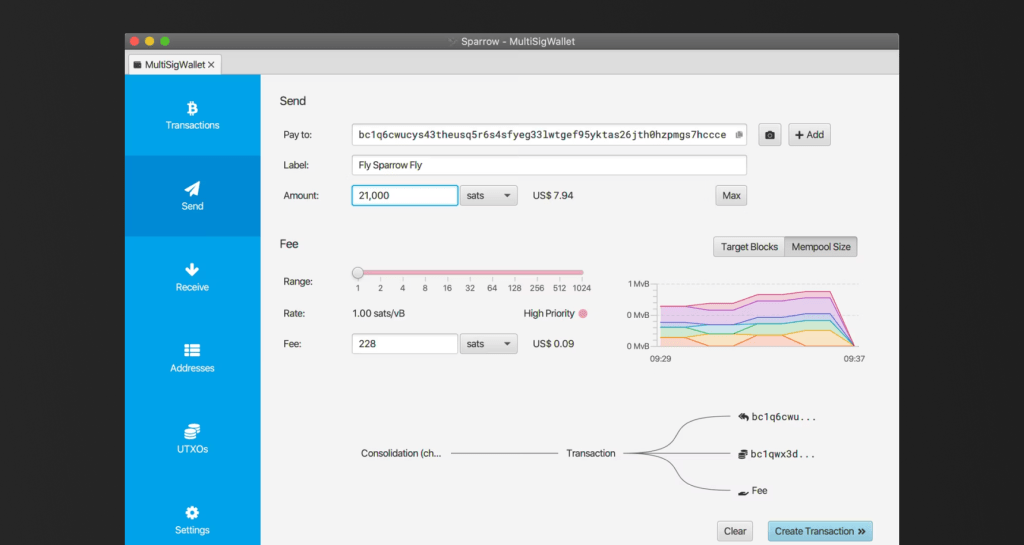
Who it’s for: Experienced Bitcoin users who prefer manual control and precision over automation.
Sparrow Wallet suits experienced Bitcoin users who prefer to control every transaction by hand. It is a free, open-source desktop wallet for Windows, macOS and Linux, and it works with nearly every popular hardware signer.
Sparrow used to offer CoinJoin through Samourai’s Whirlpool. Version 1.9.0, released on 25 April 2024, removed the Whirlpool client and related Samourai features. The release followed the arrest of Samourai Wallet’s founders, whose coordinator powered Whirlpool.
Sparrow’s privacy tools are now manual. Its coin control and labelling let you see every unspent output, freeze coins you never want to spend together and preview how a transaction will look before broadcasting it. It supports PayJoin, and its 2026 releases added Silent Payments in two steps: version 2.4.0 in February 2026 let hardware wallets sign payments to Silent Payments addresses, and version 2.5.0 on 21 May 2026 added wallets that can receive them.
Network privacy is flexible. Sparrow ships its own Tor client and can connect to your own Bitcoin Core node, a private Electrum server or a public server, so running a full node is optional. The newest release, 2.5.5 from 17 September 2026, continued a run of security hardening that includes checking proof of work and merkle proofs on data received from servers.
The main trade-off is effort. Sparrow does no mixing, so the privacy it delivers depends on how carefully you select coins and handle addresses, and a careless consolidation can undo months of discipline.
Atomic Wallet (Multi-Asset, Desktop & Mobile): No-KYC Self-Custody for 1,000+ Assets
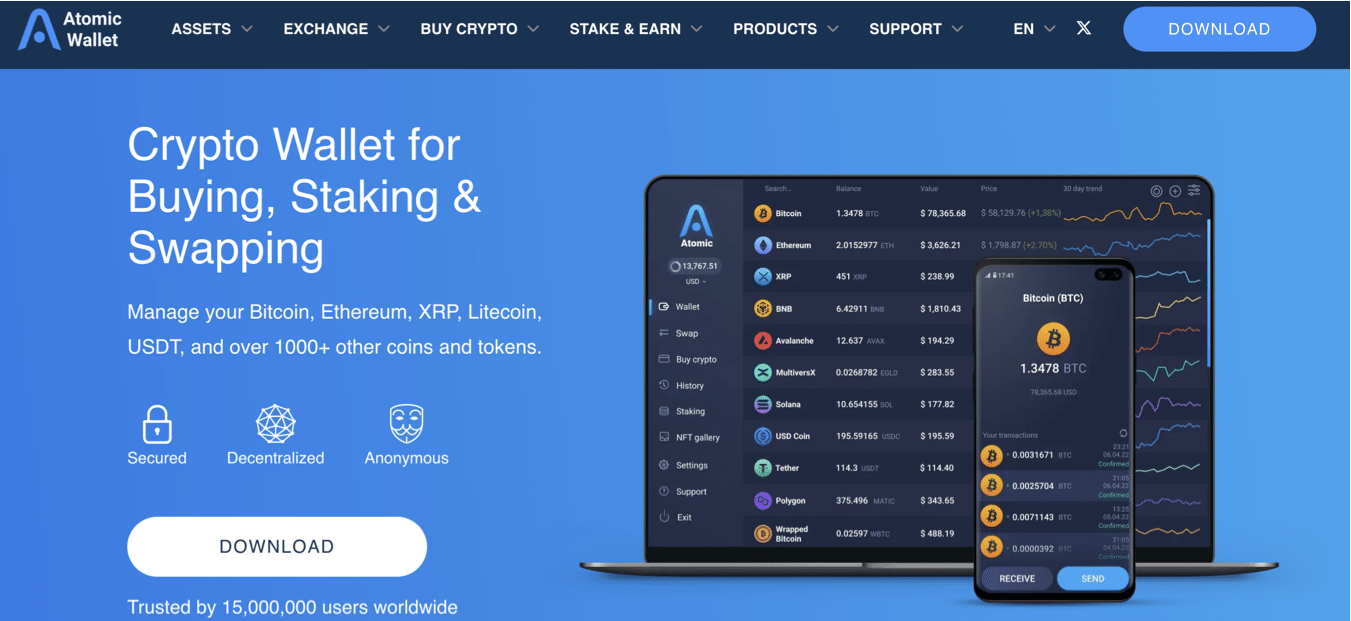
Who it’s for: Users who hold many different coins and want one non-custodial app on desktop and phone, with no account or identity checks.
Atomic Wallet suits users who want a self-custodial wallet that works across desktop and mobile without making portfolio management feel complicated. It supports 1,000+ coins and tokens and runs on Windows, macOS, Linux, iOS and Android.
Its privacy case rests on custody and sign-up. Private keys are generated and encrypted on your own device, Atomic does not hold funds through a centralised account, and creating a wallet needs no email, account or identity documents. You can buy, swap and stake from inside the app, so moving between assets does not require depositing them on a centralised exchange that keeps your identity on file.
Atomic has three limits:
- Hot wallet: Keys live on an internet-connected device, so it is not a substitute for a hardware wallet for large holdings.
- No onchain mixing: It offers no CoinJoin, shielded transactions or built-in Tor, so pair it with a dedicated privacy wallet when you need to break transaction links.
- Third-party providers: Swaps and fiat purchases run through outside partners that may apply their own checks.
Zashi (Zcash, Mobile): Shielded Transactions and Viewing Key Control
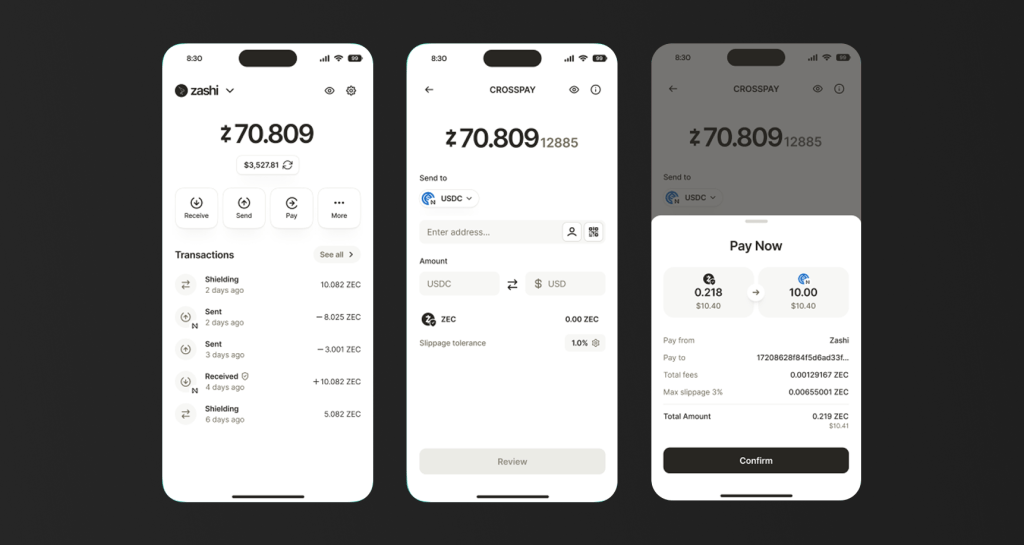
Who it’s for: Mobile users who prioritize transaction privacy through zero-knowledge proofs.
Zodl suits mobile users who want transaction details hidden by cryptography, with no mixing step involved. It is a self-custody Zcash wallet for iOS and Android whose app listing describes it as built by the original Zcash engineers.
The wallet changed hands and names in early 2026. The team that built Zashi at Electric Coin Company left to form its own company and renamed the app Zodl. The Android package identifier stayed the same, so existing installations updated in place without a new seed phrase.
Zcash privacy works through shielded transactions. When both sides use shielded addresses, zero-knowledge proofs confirm that a payment is valid without revealing the sender, receiver or amount on the public chain. Zodl applies that protection by default and adds built-in swaps into and out of shielded ZEC, plus a payment feature that lets you pay someone in another asset while spending shielded ZEC.
Recent releases show active maintenance. Version 3.4.0, added to F-Droid on 15 May 2026, introduced wallet birthday heights for Keystone hardware wallet users, and earlier releases added a prompt to switch on Tor protection for network traffic.
Zodl has three limits:
- Zcash only: Zodl holds no other assets.
- Transparent ZEC stays visible: Funds sent to or from transparent addresses remain public, so shielding before you spend matters.
- Mobile only: There is no desktop version of Zodl.
Cake Wallet: Monero privacy on mobile and desktop
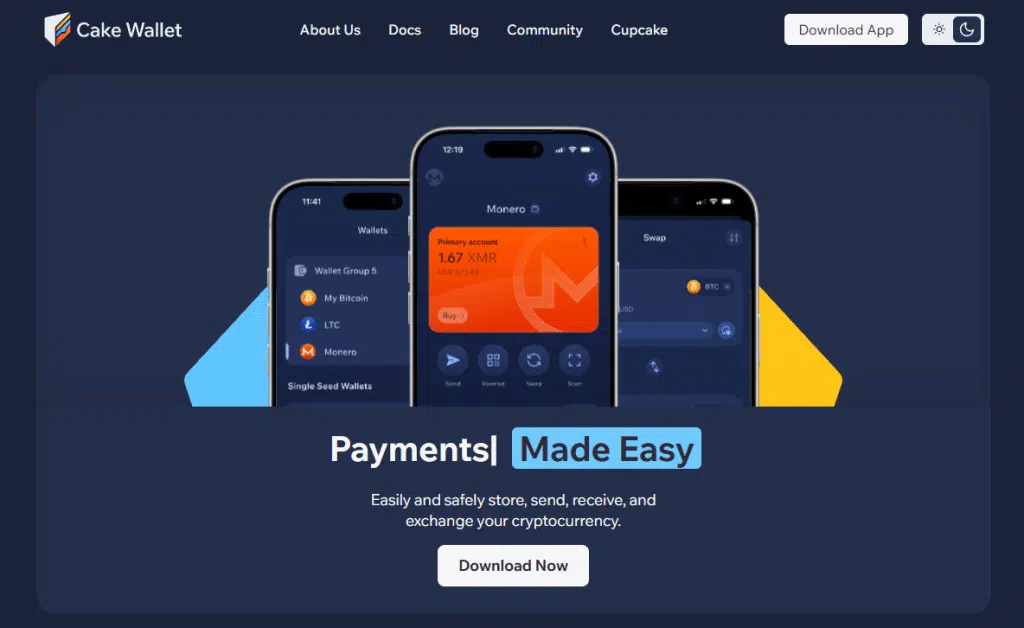
Cake Wallet is the Monero pick on this list. Monero hides sender, receiver and amount on every transaction by default, using ring signatures, one-time stealth addresses and confidential amounts, so users get privacy without needing to opt in.
The wallet has been building privacy tools since 2018 and is open source under the MIT licence. Its app store listing highlights Monero support, Bitcoin Silent Payments, PayJoin and native Tor integration. Native Tor arrived through a library that Foundation relicensed under MIT in September 2024, which Cake announced it would integrate.
That mix makes Cake Wallet useful for people who hold both Monero and Bitcoin and want strong defaults on a phone. Monero transactions carry protocol-level privacy, while the Bitcoin side relies on Silent Payments and PayJoin to cut down address reuse and common tracing assumptions.
Desktop Monero users have a strong alternative in Feather, a free, open-source Monero wallet for Linux, Tails, Windows and macOS. Feather is lighter and Monero only, which some users prefer for larger holdings.
The trade-offs mostly come from convenience features. Built-in swaps and fiat purchases route through third-party providers that may apply their own checks, so moving value through them can leave a record outside the wallet. Holding several assets in one app also means the app’s security protects all of them at once.
Nunchuk (Bitcoin, Mobile & Desktop): Multisig Security with Privacy Discipline
Who it’s for: Advanced users who prioritize long-term storage, inheritance, or collaborative custody while maintaining privacy.
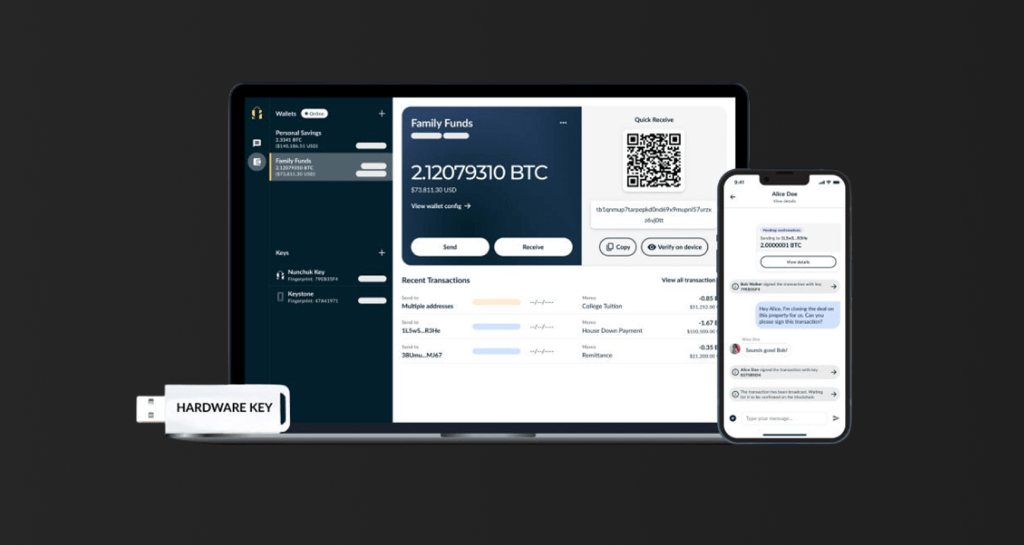
Nunchuk suits long-term Bitcoin holders who want to remove single points of failure without giving up privacy to a custodian. It is a multisig wallet for iOS, Android, Windows, macOS and Linux, with its code published on GitHub.
Its approach to privacy is to collect as little as possible. Nunchuk describes its products as zero KYC, including its inheritance plans, and lists decoy wallets, advanced coin control and air-gapped signing among its security features. It works with a long list of signers, including Coldcard, Jade, Trezor, Ledger, BitBox, Passport, Keystone, SeedSigner and Tapsigner.
The inheritance tools are what set it apart. Nunchuk offers onchain timelocks that let a beneficiary claim funds after a set date even if the company no longer exists. Self-managed single-sig and multisig wallets are free, while assisted plans cost $120 a year for Iron Hand and $480 a year for the Honey Badger inheritance package
Network privacy is where Nunchuk falls short of the dedicated privacy wallets above. Its public pages do not document built-in Tor, so users who care about hiding their IP address should route the app through a system-level Tor setup or a node they control. Multisig custody is also more complex, and a mistake in backing up a wallet configuration can lock you out. That backup discipline is a big part of where large holders store their coins and how they protect them.
| Wallet | Chains | Main privacy tools | Network privacy | Platforms | Best for |
|---|---|---|---|---|---|
| Wasabi Wallet | Bitcoin | WabiSabi CoinJoin, coin control, pay in CoinJoin | Built-in Tor; own node via RPC | Windows, macOS, Linux | Automated Bitcoin privacy |
| Sparrow Wallet | Bitcoin | Coin control, PayJoin, Silent Payments send and receive | Built-in Tor; own node, private or public server | Windows, macOS, Linux | Manual, precise Bitcoin privacy |
| Atomic Wallet | 1,000+ coins and tokens | Non-custodial, local keys, no-KYC setup, in-app swaps | Not built in; add Tor or a VPN yourself | Windows, macOS, Linux, iOS, Android | Multi-asset self-custody without sign-up |
| Zodl | Zcash | Shielded transactions by default, shielded swaps | Optional Tor | iOS, Android | Cryptographic privacy on mobile |
| Cake Wallet | Monero, Bitcoin and others | Monero default privacy, Silent Payments, PayJoin | Native Tor | iOS, Android, desktop | Monero on a phone |
| Nunchuk | Bitcoin | Multisig, coin control, decoy wallets, timelocked inheritance | Not documented; add Tor yourself | iOS, Android, Windows, macOS, Linux | Secure long-term custody |
The Bitcoin wallets now combine several smaller techniques where one mixer used to do the job, while the strongest default privacy belongs to the two wallets built around privacy coins.
What changed for privacy wallets since 2024
The privacy wallet market went through two years of prosecutions, shutdowns and redesigns.
| Date | Event |
|---|---|
| 24 April 2024 | US prosecutors charge Samourai Wallet’s founders with money laundering conspiracy and running an unlicensed money transmitting business |
| 25 April 2024 | Sparrow 1.9.0 removes its Whirlpool client |
| June 2024 | zkSNACKs closes the default Wasabi coordinator |
| 5 August 2024 | Mutiny announces its wallet will shut down at the end of 2024 |
| August 2025 | Qubic performs a six-block reorganisation of the Monero chain |
| 6 and 19 November 2025 | Samourai’s founders are sentenced to five and four years in prison |
| Early 2026 | Zashi becomes Zodl under its original team |
| 21 May 2026 | Sparrow adds Silent Payments receiving wallets |
| 27 June 2026 | Wasabi 2.8.0 adds payments inside CoinJoins and peer-to-peer filter sync |
Samourai’s founders pleaded guilty and were sentenced in November 2025. Because one operator ran the coordinator, a single prosecution ended Whirlpool for every user. The wallets that remain let users choose their own coordinators, servers and nodes.
Privacy coins at the end of 2026
Zcash is now worth close to twice as much as Monero. As of 31 October 2026, ZEC traded around $1,225 with a market capitalisation near $20.8 billion, ranking 11th on CoinGecko. Monero traded near $591 with a market capitalisation of about $11.1 billion, below its 14 January 2026 peak of $798.91.
Grayscale has also filed to list its Zcash Trust on NYSE Arca under the ticker ZCSH and rename it as an ETF, a plan that depended on the SEC declaring its registration effective.
Monero’s August 2025 reorganisation showed that privacy also depends on the health of the network. The Qubic project rewrote six Monero blocks and orphaned around 60 more, although security researchers noted that a reorganisation of that depth does not prove sustained majority control. User privacy features were unaffected. The episode is a case study in how concentrated mining power can threaten a chain and what happens when a blockchain is attacked or halted.
Habits that keep a privacy wallet private
Careless use can undo any of the wallets above.
Start with addresses and coins. Use a fresh receive address for each payment unless you are using Silent Payments, and avoid spending coins from an identified exchange together with coins you received privately, because one shared transaction links both histories.
Protect the network layer next. Run your wallet over Tor or connect it to your own node, since a public server sees which addresses you ask about. A VPN only moves that trust to the VPN provider.
Verify every download. Fake wallet sites and tampered installers remain a common way to steal funds, and backdoors that drain crypto wallets often arrive through exactly these channels. Download from the project’s own site or repository and check the signature or hash.
Finally, back up keys safely. A privacy wallet still relies on a seed phrase or similar backup, and the trade-offs between passkey and seed phrase wallets matter as much here as anywhere.
How to pick the right privacy wallet
Four questions narrow the choice.
- Which asset do you hold? Bitcoin holders should start with Wasabi or Sparrow, Zcash holders with Zodl, Monero holders with Cake Wallet or Feather, and anyone holding many different coins with Atomic Wallet.
- Do you want automation or control? Wasabi mixes in the background, while Sparrow expects you to manage each coin yourself.
- Which device do you use? Wasabi, Sparrow and Feather are desktop wallets, while Zodl and Cake Wallet are built for phones.
- Is your main risk loss or exposure? If losing access worries you more than being tracked, Nunchuk’s multisig and inheritance tools come first, with Tor added on top.
Many experienced users combine two wallets, for example Wasabi for mixing and Sparrow for careful spending, or Cake Wallet on a phone and Feather on a laptop.
Final thoughts on anonymous crypto wallets
The best anonymous crypto wallets in 2027 look different from the ones of two years ago. Since 2024, a centrally run mixer was shut down by prosecution and a popular Lightning wallet closed, while the remaining wallets moved to designs where users pick their own coordinators, servers and nodes.
For Bitcoin, privacy now comes from layering: CoinJoin where you want it, PayJoin and Silent Payments for everyday payments, and strict coin control throughout. For stronger defaults, the privacy coins remain the most direct route, with Zodl for shielded Zcash and Cake Wallet or Feather for Monero.
No wallet makes you invisible once funds touch a platform that knows who you are. Tracing usually starts where coins enter or leave self-custody, so plan those steps as carefully as the choice of wallet.
Frequently Asked Questions (FAQ)
What is the most private crypto wallet in 2027? +
It depends on the asset and how you use it. For Bitcoin, Wasabi offers automated CoinJoin and Sparrow offers the strongest manual controls. For default privacy, Zodl protects shielded Zcash and Cake Wallet or Feather protect Monero.
Does Sparrow Wallet still support CoinJoin? +
No. Sparrow removed its Whirlpool CoinJoin client in version 1.9.0 in April 2024. It now focuses on coin control, PayJoin and Silent Payments.
Does Wasabi Wallet still work after zkSNACKs shut down its coordinator? +
Yes. Wasabi now connects to independent coordinators that you configure in the app. The client only joins rounds where you pay the mining fee for your own block space.
What happened to Zashi? +
Zashi was renamed Zodl in early 2026 after its development team left Electric Coin Company to form a new company. The app updated in place, so existing users kept their wallets.
Is Mutiny Wallet still available? +
No. Mutiny announced in August 2024 that it would stop hosting the wallet and remove its apps at the end of 2024, leaving self-hosting as the only option.
Are anonymous crypto wallets legal? +
Using a non-custodial privacy wallet is legal in most countries. Operating a mixing service as a business can trigger money transmission rules, as the Samourai prosecution in the US showed, so check local law.
Can a privacy wallet hide my activity from exchanges and tax authorities? +
No. Once funds move through an exchange that verified your identity, that exchange can link those transactions to you. Privacy wallets protect activity within self-custody and do not remove tax obligations.
What is a Silent Payments address? +
A Silent Payments address is a reusable Bitcoin address that creates a new, unlinkable onchain address for each payment. Senders and outside observers cannot connect separate payments to the same recipient.