


 Buy a Licensed Company
  Explore VASP Data
  Talk to an Expert

 Atis Shala
Atis is a senior analyst and community lead with four years of experience in crypto. He has a bachelor from the Rochester Institute of Technology.
Atis Shala
Atis is a senior analyst and community lead with four years of experience in crypto. He has a bachelor from the Rochester Institute of Technology.
Mining Rig Cooling: Prevent Overheating Failure

Cryptocurrency mining demands consistent performance, yet every miner eventually learns that powerful hardware produces intense heat. That heat accumulates fast, especially when multiple GPUs or ASICs run at full capacity inside small or poorly ventilated spaces. As temperatures climb, components struggle to maintain stable hash rates. Electricity costs rise because overheated hardware draws more power to compensate. Failures become more likely and each failure carries a real financial cost.
Cooling turns into a core operational priority rather than an optional upgrade. It protects hardware, safeguards uptime, and preserves the long term economics of a mining setup. The challenge grows as miners scale their rigs or place them in environments that already face high ambient temperatures. Without a clear cooling strategy, even high quality equipment loses efficiency and eventually breaks down.
A well designed cooling system does more than keep temperatures in check. It creates predictable performance, reduces throttling, and extends the life of every component that keeps the rig running. In a competitive mining landscape where margins shift constantly, proper cooling often separates profitable miners from those forced to shut down due to avoidable overheating failures.

Is Mining Rig Cooling Important?
Mining hardware works at its best when it can move heat away from the core components quickly. GPUs and ASICs generate a constant stream of thermal output because they solve cryptographic calculations without pause. Each calculation forces transistors to switch at high speed, which releases heat into the surrounding environment. A single GPU can reach unsafe temperatures if the airflow is weak. An ASIC produces even more heat because it pushes specialized chips to run at maximum intensity for long periods.
Rig temperature control becomes essential once multiple units sit close together. Heat that escapes from one device gets pulled into the intake of another. The room temperature rises, the airflow becomes turbulent, and every component works harder just to maintain its baseline performance. If the hardware cannot cool itself fast enough, the system enters thermal throttling. Hash rates drop because the chips slow down to protect themselves. The drop may look small at first, yet it compounds over weeks or months and directly affects crypto mining efficiency.
Higher temperatures also increase power consumption. Fans spin faster, circuits lose efficiency, and the power supply unit strains to keep up with the demand. Energy costs rise even when the output falls. The risk of mining hardware failure increases when heat stays trapped around VRMs, memory modules, and power cables. Solder joints weaken, bearings inside fans fail, and thermal pads degrade. Once that degradation starts, the hardware becomes more vulnerable to future spikes in temperature.
Core Causes of Mining Rig Overheating
The core causes of mining rig overheating are:
- Restricted airflow
- Dust accumulation
- Poor room ventilation
- Rising ambient temperature
- PSU generated heat
Heat becomes a constant pressure inside any active mining setup, and it often builds up for reasons that seem small at first. Airflow problems sit at the center of most overheating events. When air cannot travel freely across heatsinks and through the frame, the rig traps warm air around the components. Fans try to compensate, yet they only circulate the same hot air without providing real ventilation. As the ambient temperature climbs, the entire system enters a cycle where heat rises faster than the rig can release it.
Dust compounds this problem. It settles on heatsinks, blocks fan blades, and forms a thin layer over components that need open contact with moving air. Even a small amount of dust can reduce cooling efficiency because it disrupts the airflow path. The thermal load increases because the hardware must push more power through dirty surfaces that no longer transfer heat well. Over time this leads to higher noise levels, reduced hash stability, and more frequent thermal throttling.
Room design affects cooling just as much as the rig itself. A mining setup placed in a closed room without exhaust will hit high temperatures even with strong fans. Heat accumulates in corners, airflow becomes uneven, and pockets of warm air collect near the ceiling and behind equipment racks. Poor ventilation forces rigs to recycle warm air, which triggers an upward temperature spiral. Once the room hits a certain threshold, cooling equipment works at reduced efficiency and hardware stress rises sharply.
The power supply unit adds its own heat load. It pulls significant wattage, converts it into usable power, and releases heat during the process. A PSU placed too close to the GPUs or ASICs raises the temperature in that zone and increases the thermal load on the entire rig. If miners ignore PSU placement, they create hotspots that undermine the overall cooling strategy.
Cooling Methods for Mining Rigs
Cooling a mining rig becomes much easier once you understand the strengths and limits of each method. Miners often mix several approaches to build the best cooling setup for mining rigs, especially when they scale beyond a single GPU. The goal is simple. Move heat away from the hardware as fast as possible and replace it with a steady stream of cool, clean air. The following methods help you reach that goal with predictable, measurable results.
Air Cooling Basics
Air cooling remains the most familiar option for miners. It uses fans to pull cold air in and push warm air out. The technique works well when the airflow path stays clean and direct. You want a clear intake, an unobstructed exhaust, and enough distance between components for air to travel without resistance. Even small adjustments make a difference. Tilting GPUs slightly or spacing them evenly can reduce hotspots and improve the thermal balance across the entire rig.
High Static Pressure Fans
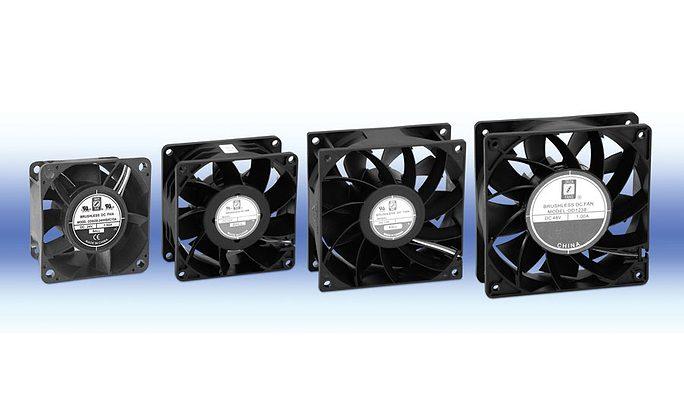
Many miners underestimate how much fan choice influences temperature control. High static pressure fans push air through tight spaces, dense heatsinks, and narrow gaps between GPUs. Standard case fans often fail in these conditions because they lose force when they encounter resistance. Static pressure models maintain airflow even inside crowded rigs. This improves cooling efficiency, lowers thermal load, and reduces the chance of sudden temperature spikes.
Server Rack Style Setups
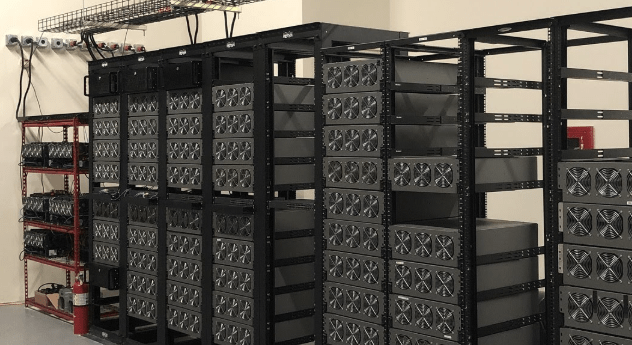
Some miners adopt a server oriented layout to gain more consistent ventilation. A rack frame creates a structured airflow channel that moves air from the front to the back in a straight line. This reduces turbulence and improves airflow optimization for crypto mining. With a rack design, miners can stack multiple rigs while preserving a predictable cooling pattern. It also simplifies maintenance because each unit has a clear intake and exhaust zone that stays separate from the others.
Open Frame vs Closed Case Rigs
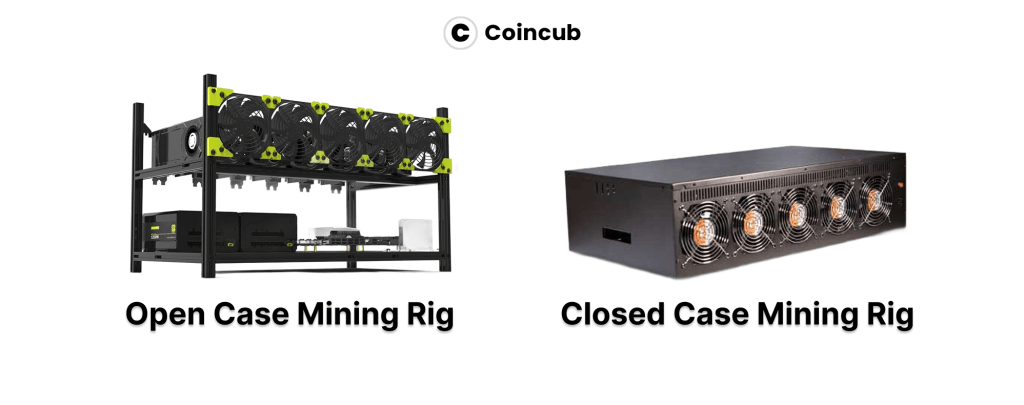
Open frame rigs expose the GPUs to open air, which helps heat escape quickly. They tend to stay cooler because they avoid the confinement of a case. The trade off is more dust and noise. Closed case rigs offer better protection for the hardware and allow more controlled airflow, but they can trap heat if the intake and exhaust are not strong enough. Miners often choose open frames for simplicity and cooling potential, especially when running several GPUs side by side.
Liquid Cooling
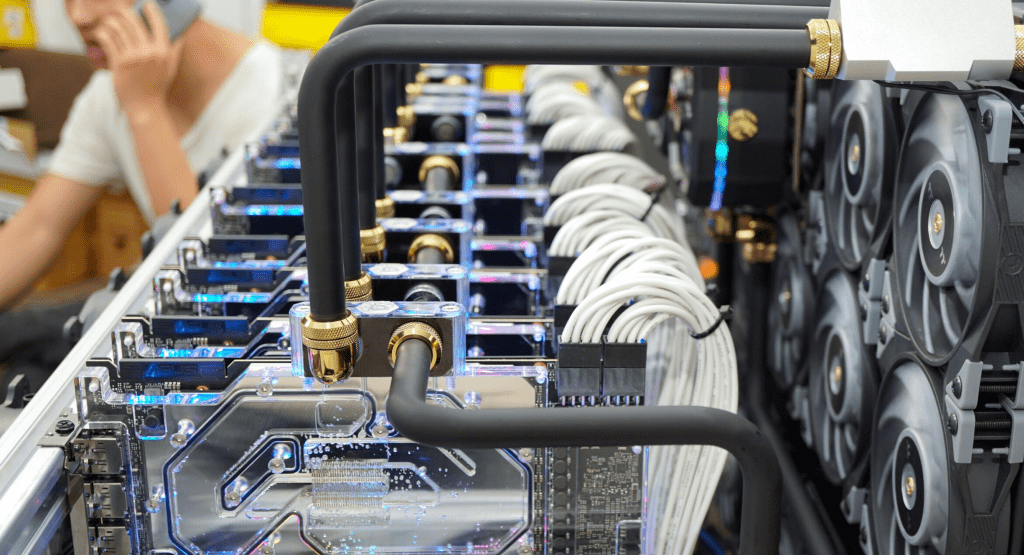
Liquid cooling removes heat faster than air because liquid transfers thermal energy more efficiently. A water block pulls heat from the GPU and sends it into a radiator, where fans dissipate it. The method keeps temperatures stable during long mining sessions. It also reduces noise because fans do not need to run at full speed. The downside is complexity. Liquid systems need periodic maintenance, leak checks, and careful planning to route tubes without restricting flow.
Immersion Cooling Advantages and Drawbacks
Immersion cooling takes temperature control to another level. The entire rig sinks into a non conductive oil designed to absorb and disperse heat. This creates extremely stable temperatures and eliminates most noise. Many large scale miners use immersion to protect expensive hardware from thermal stress. The drawbacks involve cost, weight, and setup difficulty. The oil must stay clean, heat must be removed through external coolers, and the system requires a strong support structure.
Exhaust Systems and Airflow Optimization
Even the most efficient cooling method fails if warm air stays trapped in the room. Strong exhaust systems give miners the final piece of the cooling equation. Pulling heat out of the environment lowers ambient temperature and prevents rigs from recycling the same warm air. Inline duct fans, window exhausts, and ceiling mounted ventilation systems all improve thermal performance. When intake air stays cool and exhaust air leaves the room quickly, rigs operate at their most efficient point.
Temperature Monitoring Tools
Real cooling control requires accurate data. Monitoring tools track GPU and ASIC temperatures, fan speeds, and power draw in real time. Software like Hive OS, Afterburner, or ASIC control panels helps miners identify rising temperatures before they become dangerous. Alerts and logs show patterns that reveal deeper issues, such as weak fans or blocked airflow paths. With proper monitoring, miners adjust their cooling setup before heat becomes a threat.
How to Set Up an Ideal Mining Environment
A mining room should guide heat out and pull fresh air in without creating turbulence or bottlenecks. Start by looking at the layout. Rigs perform better when arranged in straight, predictable airflow paths. Avoid corners, tight clusters, or placing rigs directly against walls. Leave enough space for air to enter from the front and exit from the back without obstruction. Even a few inches of clearance can lower temperatures across the entire setup.
Humidity control plays a major role in long term stability. High humidity encourages corrosion on contacts and metal surfaces, while extremely low humidity increases static electricity risks. Most miners aim for a balanced range between 40 and 55 percent. A dehumidifier helps in damp climates, while an air purifier reduces dust in dry regions. Stable humidity protects thermal pads, fan bearings, and PCB surfaces that degrade faster in unstable environments.
Ambient temperature decides your baseline cooling performance. If the room starts hot, every rig inside will run hotter. Proper ventilation becomes mandatory once multiple units operate together. Window fans, duct systems, or portable AC units can pull heat out and bring cooler air in. In larger setups, negative pressure rooms work well because they constantly draw warm air out and replace it with cooler intake air.
Insulation also matters. Thick walls hold heat, so miners in hot regions often prefer rooms with lighter materials or buildings with natural airflow. If insulation cannot be changed, compensate by boosting exhaust power to ensure heat leaves faster than it accumulates. Noise is another factor. Rigs running at full fan speed can become loud, so consider acoustic panels or placing the mining room in a section of the property that does not disturb daily activity. Noise control does not affect performance directly, but it creates a more manageable long term mining environment.
Frequently Asked Questions (FAQs)
What is a safe temperature for a mining rig?
A safe temperature for most mining rigs stays between 60 and 75 degrees Celsius. This range protects GPUs and ASICs from thermal stress, prevents throttling, and maintains stable hash rates. Rigs that regularly exceed 80 degrees risk long term damage and reduced efficiency.
How often should I clean my mining rig?
Clean your mining rig every 30 to 60 days to prevent dust from blocking airflow and raising temperatures. Rigs in dusty or humid rooms may need more frequent cleaning to maintain safe cooling performance and stable hardware operation.
What is the cheapest cooling method?
Air cooling with properly placed fans is the cheapest cooling method for mining rigs. Simple intake and exhaust fans create consistent airflow without expensive hardware. It works well for small and medium mining setups that do not require advanced liquid or immersion cooling systems.
How do I monitor GPU temperatures?
You can monitor GPU temperatures using mining operating systems or hardware monitoring software. Tools like Hive OS, MSI Afterburner, and GPU-Z show real time temperatures, fan speeds, and power usage. They help you identify overheating issues before they cause throttling or hardware failure.
How to keep an ASIC miner cool?
You keep an ASIC miner cool by maximizing airflow, lowering ambient room temperature, and using strong exhaust systems. ASICs generate intense heat and rely on clear ventilation paths to maintain safe performance. Dust control and stable humidity also improve long term reliability.
How to cool a mining rig?
You cool a mining rig by improving airflow, using quality fans, controlling room temperature, and monitoring heat levels. Open frame layouts, strong exhaust systems, and regular cleaning all prevent heat buildup. Optional upgrades include liquid cooling or immersion cooling for larger operations.