


 Buy a Licensed Company
  Explore VASP Data
  Talk to an Expert

 Atis Shala
Atis is a senior analyst and community lead with four years of experience in crypto. He has a bachelor from the Rochester Institute of Technology.
Atis Shala
Atis is a senior analyst and community lead with four years of experience in crypto. He has a bachelor from the Rochester Institute of Technology.
Silent Mining: How to Build a Quiet Home Rig
Crypto mining at home often starts with excitement, but that excitement fades quickly once the noise becomes part of daily life. Many new miners discover that a rig built for efficiency sounds more like a small turbine than a workstation. Fans spin at high speed, air rushes through open frames, and vibrations carry across floors and walls. A build that produces great hash rates can become uncomfortable to live with if you ignore acoustics from the beginning.
Silent mining focuses on a different priority. Instead of chasing maximum output, you shape a system that balances performance, comfort, and long term reliability. A quiet rig protects your home environment, runs at stable temperatures, and reduces stress on hardware. It replaces the chaotic sound profile of an untuned setup with a steady low hum that blends into the background. With the right planning, you can mine crypto inside an apartment, home office, or shared space without constant disruption.
Why Are Mining Rigs So Loud
Mining rigs create noise because every component works under continuous load. The system pulls steady power, generates heat, and forces cooling hardware to respond aggressively. Once you understand the source of that noise, you can design a quiet rig with far fewer compromises.

The Main Noise Sources In A Mining Rig
GPU fans dominate the sound profile of any mining setup. They spin fast to control heat, and their tone shifts as temperatures rise. Power supplies add their own fan noise when efficiency drops or ambient temperature climbs. Case fans, risers, and even loose frame parts introduce vibration that amplifies the overall volume. When these sounds combine, the rig produces a constant high frequency layer that becomes tiring over time.
How Heat, Hashrate, And Noise Connect
High hashrate settings draw more power and produce more heat. The moment temperatures rise, fans ramp up and create sharper noise. If the airflow is weak or the room traps heat, the entire system pushes into louder RPM ranges. Noise becomes a consequence of thermal pressure rather than a flaw in the hardware.
Basics You Should Know Before You Build Your Mining Rig
Sound intensity uses decibels, and small numerical changes feel large in real life. Ten extra decibels can make a rig seem twice as loud. A comfortable home mining setup usually stays between 35 and 45 decibels at one meter. This range gives you steady airflow without harsh tones that disrupt work or sleep.
A Decibel Reference for Home Miners
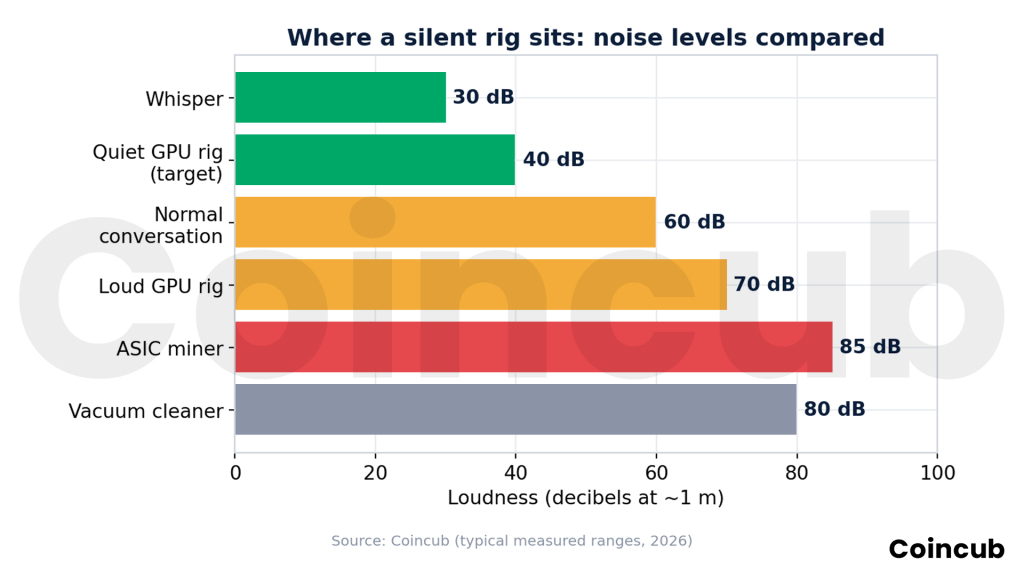
Sound is measured in decibels, and the scale is not linear, so small numbers matter. An increase of about 10 decibels is perceived as roughly twice as loud. A comfortable home mining setup should stay between 35 and 45 decibels at one meter, which gives you steady airflow without a harsh tone. The table below puts common noise sources in context so you can set a realistic target for your room.
| Source | Approx. loudness (dB at ~1 m) | Comfort for living space |
|---|---|---|
| Whisper or quiet room | ~30 dB | Silent |
| Well tuned quiet GPU rig (target) | ~35 to 45 dB | Livable in an office or bedroom |
| Normal conversation | ~60 dB | Noticeable, tiring over time |
| Loud, untuned GPU rig | ~70 dB | Disruptive in shared space |
| ASIC miner | ~85 dB | Needs isolation or ventilation |
The gap between a tuned GPU rig at 40 decibels and an ASIC at 85 decibels is the difference between background hum and a machine you cannot live beside. This is why home miners who want silence lean toward efficient GPUs and purpose built mining heaters rather than raw ASIC hardware.
Planning A Quiet Home Mining Rig
A quiet mining build begins with decisions you make before you buy a single part. Noise control depends on location, expectations, and the amount of airflow you can support inside your home. If the plan feels clear early on, the build becomes easier and far more comfortable to run long term.
Set Clear Goals For Silence, Space, And Budget
Start by deciding how quiet the rig needs to be. A bedroom requires much lower noise than a garage or a utility room. Once you know the target environment, you can set a realistic budget that covers higher quality fans, better airflow layouts, and efficient hardware. Absolute silence costs more and limits performance, so choose a level that matches both your comfort and your needs.
Choose The Right Location In Your Home
Physical placement shapes acoustic results more than most people expect. A rig positioned a few meters farther from your living area can feel dramatically quieter without changing a single component. Avoid placing your system in sealed spaces that trap heat, such as closets or cabinets without ventilation. A quiet rig still needs fresh air, and the room must support smooth intake and exhaust. Corners, tight shelves, and cramped furniture usually increase noise because they reflect sound back toward you.
Why Quiet Mining Also Means Efficient Mining in 2026
Building a quiet rig used to be mostly about comfort. In the middle of 2026 it is also about survival, because the same choices that lower noise are the choices that keep a home miner profitable. The link is heat. A rig that runs cool and efficient spins its fans slower, and a rig that wastes power as heat is both louder and more expensive to run. In a thin margin year, the acoustic tuning in this guide doubles as economic tuning.
The numbers explain the pressure. Bitcoin hashprice, the daily revenue for a unit of computing power, sat near $29 to $31 per petahash per day in July 2026, which is at or below breakeven for many operators. Network difficulty eased 5 percent to 127.17 trillion on 11 July 2026, and total hashrate fell to roughly 908 EH per second, down about 15 percent from the January peak as less efficient machines were switched off. Electricity typically accounts for 60 to 80 percent of a miner’s running cost, so every watt you do not waste as noise and heat is a watt that protects your margin.
That is why the quiet approach and the profitable approach now point in the same direction. Lowering a GPU’s power limit, choosing a high efficiency power supply, and keeping temperatures flat all reduce the fan speed you hear and the electricity bill you pay. A silent rig in 2026 is usually the more efficient rig, not a compromise against it.
Hardware That Keeps Your Rig Quiet
The core principle has not changed: efficient parts run cooler, and cooler parts run quieter. What is worth refreshing is the emphasis. In 2026, performance per watt is the single most important spec for both noise and profit. Choose GPUs that hold a stable hash rate at a reduced power limit, since mining algorithms usually favour memory performance over core frequency, meaning you can cut wattage with little loss of output. Pair them with a Gold or Platinum rated power supply running at roughly half to two thirds of its capacity, where it stays cool and often near silent.
For apartments and offices where even a tuned rig is too present, purpose built mining heaters remain the cleanest answer. Devices such as Heatbit and Qarnot units are engineered for near silent airflow and turn the waste heat into a useful room warmer. They do not match a full GPU rig on raw output, but in a year when margins are dictated by power cost, a machine that also offsets your heating bill changes the math in your favour.
Quiet mining depends heavily on component selection. Efficient hardware produces less heat, which reduces the fan speed required to keep temperatures stable. Every part of the rig influences how much noise you hear and how predictable the acoustic profile becomes over long sessions.
GPUs With Better Efficiency And Lower Fan Noise
Choose GPUs known for strong performance per watt. Efficient cards generate less heat, so their fans rarely need to run at aggressive speeds. Large heatsinks and triple fan designs usually offer smoother airflow and lower noise. When possible, aim for cards that maintain stable hash rates at reduced power limits. Lower draw keeps both core and memory temperatures in a predictable range.
Power Supplies Built For Quiet, Continuous Load
High efficiency power supplies reduce waste heat and keep fan noise low. A Gold or Platinum unit running at roughly half to two thirds of its rated capacity stays cool without heavy airflow demands. Some PSUs include semi fanless modes that remain silent under light load, although you must ensure that the room stays cool enough to support these features safely.
Frames, Racks, And Cases For Low Noise
Open frames offer excellent cooling but expose every sound to the room. Semi closed cases or custom enclosures reduce noise by directing airflow through fixed intake and exhaust zones. A simple mining cabinet with front intake, rear exhaust, and minimal sound absorbing material can produce a calmer noise signature.
Fans, Bearings, And Airflow Design
Large, slow spinning fans create smoother airflow and lower acoustic pressure. Quality bearings extend fan lifespan and prevent rattling. Straight airflow paths prevent turbulence, which often sounds louder than the fans themselves.
Miners That Serve As Heaters Or Utility Devices
Some devices mine crypto while acting as functional household tools. Home mining heaters such as Heatbit or Qarnot QC units warm a room while producing hash rate. Their design focuses on silent or near silent airflow, which makes them suitable for apartments and offices. They do not match the performance of a full GPU rig, but they offer utility value and solve the noise challenge through purpose built engineering.
Tuning That Pays for Itself
Software tuning delivers the biggest noise reduction because it controls heat at the source, and in 2026 it also delivers the biggest saving. Lowering the GPU power limit cuts heat before the fans ever need to react, keeping them in a quiet range while trimming the electricity that eats most of your revenue. Set a conservative power target, then shape a smooth fan curve so temperature rises gradually instead of triggering sharp, audible RPM spikes. Mining operating systems automate this and give you the monitoring to hold a steady acoustic and thermal profile over long sessions.
Maintenance closes the loop. Dust traps heat, heat raises fan speed, and higher fan speed means more noise and more wasted power. A rig cleaned on a fixed schedule stays quieter and cheaper to run. In the tight economics of 2026, treating noise as a proxy for wasted energy is a useful habit: if your rig has gotten louder, it has very likely gotten less efficient, and both problems usually share the same fix.
Acoustic Design For Silent Mining
Acoustic engineering transforms a functional mining setup into a comfortable one. Once you choose efficient hardware, you can shape the environment around it to control vibration, airflow tone, and reflected sound. The goal is not complete silence. The goal is a clean, low frequency hum that stays steady and easy to ignore.
How To Decouple And Dampen Vibration
Vibration travels through rigid surfaces and increases perceived noise. A mining frame placed on bare wood or metal often sounds louder because the surface acts like an amplifier. You can break this chain by using rubber feet, padded mats, or vibration dampening risers. Keep the frame away from walls and furniture so it does not transfer mechanical noise into larger surfaces that carry sound through the room. Tighten all screws, secure loose riser cables, and ensure that fans do not touch the frame.
Building A Quiet Enclosure Or Mining Box
A custom enclosure can dramatically lower the audible footprint of a mining rig. Build a box with a strong front intake, a rear exhaust path, and enough space for unrestricted airflow. Add modest acoustic foam along the side walls to absorb reflections while keeping the airflow path open. A well built enclosure lowers high frequency noise without trapping heat. You maintain consistent airflow and create a smoother, softer sound profile.
Smart Use Of Acoustic Materials
Acoustic foam reduces reflections, not raw volume. Place it around the rig or on nearby walls where high frequency sound tends to bounce. Avoid sealing vents or blocking air channels because airflow must remain clean and unobstructed. Panels on the side walls, behind the rig, or on the ceiling above it can soften the sound significantly.
Room Level Noise Control
Rooms with soft surfaces naturally absorb sound. Curtains, rugs, and upholstered furniture reduce reflections that make rigs sound harsher. Sealing door gaps prevents noise from leaking into hallways. If the rig still sounds intrusive in a living space, consider placing it in a nearby room and using remote monitoring tools to manage it.
Software Tuning To Reduce Mining Noise
Software adjustments often produce the biggest noise reduction because they directly control heat output. When you manage voltage, clocks, and fan behavior with intention, the rig stays cool without relying on loud, rapid fan ramps.
Efficient Power And Fan Settings
Lowering the GPU power limit cuts heat at the source and keeps fans in a quiet operating range. Most cards maintain solid hash rates at reduced wattage because mining algorithms favor memory performance over core frequency. After setting a conservative power target, refine your fan curve so temperature rises smoothly instead of triggering sharp RPM spikes. A steady curve keeps the noise stable while maintaining safe core and memory temperatures. Mining operating systems help automate this process and provide consistent monitoring so you can maintain acoustic control without frequent adjustments.
Monitoring and Maintenance of Silent Mining
Quiet mining rigs stay quiet because you maintain them with intention. Noise creeps in when dust collects, bearings wear out, or temperatures drift higher than expected. When you track the system regularly, small changes become obvious before they grow into acoustic problems that disrupt your home.
Tools To Track Noise, Heat, And Stability
Reliable monitoring helps you protect both performance and comfort. Mining dashboards reveal GPU temperatures, memory temperatures, and fan speeds in real time. Hardware tools like GPU-Z or Hive OS make it easy to spot rising trends that signal heavier thermal load. Simple phone dB meter apps show how noise changes throughout the day. Aim for stable lines across all metrics. Flat temperature curves usually mean predictable airflow and a steady acoustic footprint.
Cleaning Routines That Preserve Silence
Dust acts like a blanket that traps heat. As temperatures rise, fans spin faster and produce sharper noise. Clean the rig on a fixed schedule. Check GPU heatsinks, fan blades, PSU intakes, and dust filters. Even a brief cleaning session can restore cooler temperatures and reduce the overall noise level.
Frequently Asked Questions (FAQs)
What is a silent crypto miner?
A silent crypto miner is a mining device or rig designed to operate with minimal noise while still producing hash rate. It relies on efficient hardware, low fan speeds, and controlled airflow to keep temperatures stable without loud cooling. Some commercial models double as room heaters to stay quiet and useful. However, SilentCryptoMiner is a known hidden cryptocurrency miner that can mine crypto using your GPU without you knowing. Many confuse these terms.
Is bitcoin mining loud?
Yes. Bitcoin mining is usually loud because ASIC miners use high speed fans to cool extremely hot chips. These machines often reach sound levels similar to a vacuum cleaner, which makes them unsuitable for bedrooms, offices, or shared living spaces without sound reduction or dedicated ventilation.
How far away can you hear a bitcoin mine?
A bitcoin mine can be heard from several hundred feet away, depending on the number of ASICs, building structure, and surrounding environment.
How loud is a crypto miner?
A typical crypto miner ranges from 60 to 90 decibels, depending on the hardware. GPU rigs, however, usually sit between 40 and 60 decibels, similar to a desktop PC under load.