


 Buy a Licensed Company
 Explore VASP Data
 Talk to an Expert

 Atis Shala
Atis is a senior analyst and community lead with four years of experience in crypto. He has a bachelor from the Rochester Institute of Technology.
What Is an RFQ in Crypto? How Request for Quote Trading Works in 2026

- An RFQ (request for quote) in crypto is a trading workflow in which a trader asks one or more market makers for a firm, executable price on a specific size, then accepts the best quote or lets it expire.
- Quote lifetimes vary enormously by venue. Coinbase Prime holds RFQ quotes for a maximum of 2.5 seconds, Binance Convert defaults to 10 seconds, and 0x quotes on Ethereum mainnet last roughly 60 seconds.
- Derivatives traders use RFQ for large and multi-leg trades. Deribit’s Block RFQ cleared more than $23 billion in its first four months, and Paradigm reports a 30% average share of listed crypto options volume over the twelve months to July 2026.
- In DeFi, RFQ systems such as 0x, Hashflow and UniswapX let professional market makers sign prices off-chain that settle on-chain, which removes slippage on the quoted portion and shields the order from sandwich attacks.
- Under MiCA, the same RFQ button can be an exchange service, an execution service or a trading platform, depending on whose capital fills the trade and who sees the quotes, and each answer carries different obligations.
What Is an RFQ in Crypto?
An RFQ in crypto is a request for quote: a trader specifies an asset, a size and sometimes a direction, sends that request to one or more liquidity providers, and receives firm prices that can be accepted within a short window. The quoted price applies to the whole size, so the trader knows the execution price before committing, and nothing is shown on a public order book until the trade prints.
Bond, foreign exchange and swap dealers have quoted on request for decades, and the European Union’s securities rules define a request for quote trading system as one where quotes are provided in response to a request submitted by one or more members or participants. Crypto adopted the workflow first for large over-the-counter trades, where desks used chat groups and phone calls to poll each other for prices. When Paradigm launched its electronic platform, an industry source told The Block that perhaps as much as half of over-the-counter crypto options trading ran through a single Telegram group.
RFQ now runs well beyond the institutional desk, however. It sits behind the convert button on exchange apps, inside prime brokerage APIs, on derivatives block trading screens and inside DEX aggregators. Large holders still use it to buy without signalling their size, which is also why tracking OTC block trades relies on settlement and hedging footprints instead of the trade itself.

How an RFQ Trade Works, Step by Step
Every RFQ system, from a prime broker to a smart contract, follows the same five stages, even when the interface hides most of them.
- Request: The taker specifies the instrument or structure, the size and, on some venues, the direction. On Deribit the taker leaves the direction unstated, so makers can answer with one-sided or two-sided quotes.
- Quote: Each invited maker returns a price for the full size or part of it, with an expiry time. On-chain systems add a cryptographic signature so the quote can be verified by a smart contract.
- Compare: The taker, or the venue’s matching logic, ranks the responses. Some venues show only the best price, and some aggregate several partial quotes into one.
- Accept or expire: The taker accepts before the quote lapses. A late acceptance fails and a new request is needed.
- Settle: The trade books on the venue’s ledger, clears through its margin engine, or settles on-chain against the signed quote.
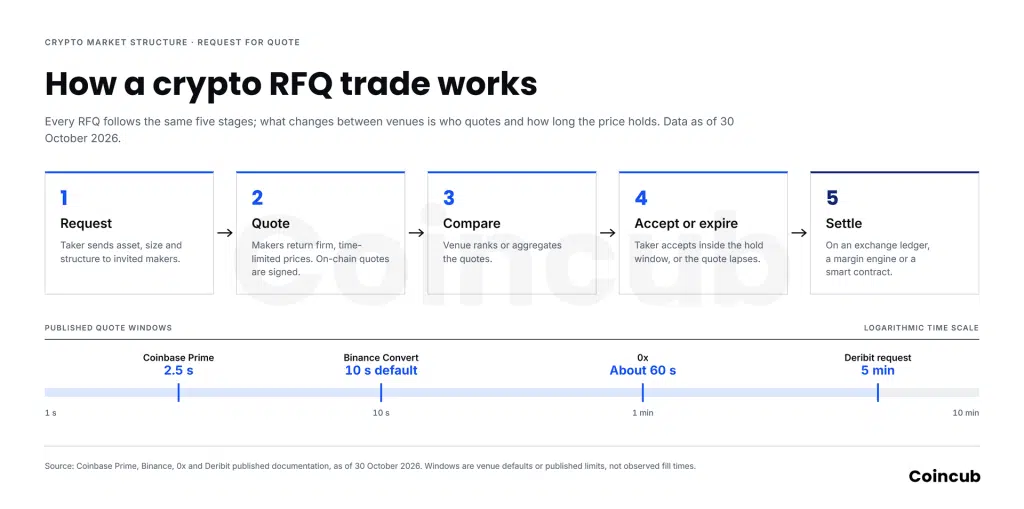
The fourth stage carries a hidden cost. A maker who promises a price for 60 seconds is writing the taker an option on the market for those 60 seconds, and it prices that option into the quote. Venues that publish their windows set them very differently.
| Venue and product | Who quotes | Published quote or request lifetime |
|---|---|---|
| Coinbase Prime RFQ | Connected market makers | Maximum 2.5 seconds from the maker’s quote |
| Binance Convert API | Binance | 10 seconds by default, with 30 second and 1 minute options |
| 0x Swap API RFQ (Ethereum mainnet) | Professional market makers | Roughly 60 seconds |
| UniswapX on Ethereum | Permissioned quoters | Quoters must respond within 500 milliseconds |
| Deribit Block RFQ | Onboarded market makers | Request expires after 5 minutes without a trade |
Venues that serve professional API users compress the window to seconds, because a short hold lets makers quote tighter. Additionally, venues that serve wallets and apps accept longer windows, because a human has to read the price and sign a transaction, and the maker builds that delay into the spread.
RFQ vs Order Book, AMM and Intent Auctions
A crypto order can find its counterparty in four main ways. A central limit order book matches resting orders continuously and in public. An automated market maker (AMM) is a smart contract that prices trades from a formula over pooled reserves, so the price moves with every trade. An intent auction lets a user sign the outcome they want and has competing solvers bid to deliver it. An RFQ asks a chosen group of makers for private, firm prices.
| Feature | RFQ | Order book | AMM | Intent auction |
|---|---|---|---|---|
| Price discovery | Private quotes from invited makers | Public, continuous | Formula over pool reserves | Competing solvers |
| Price certainty before trading | Firm price for the full size | Depends on depth walked | Depends on pool depth and slippage setting | Bounded by the signed order |
| Pre-trade visibility of the order | Invited makers only | Whole market | Public mempool unless privately routed | Solvers and the auction operator |
| Typical use | Large blocks, multi-leg structures, illiquid pairs | Standard sizes on liquid pairs | Long-tail tokens, small swaps | Retail swaps, cross-chain transfers |
| Main execution risk | Information leakage and quote expiry | Market impact | Price impact and MEV | Solver concentration |
In practice the models overlap. UniswapX starts many Ethereum orders with an RFQ round and falls back to a public Dutch auction if the winning quoter fails to fill, and solver networks increasingly pull RFQ liquidity into the same order. Whatever the product is called, handing execution to a small set of solvers and relayers concentrates the same risks.
Where RFQ Runs in Crypto in 2026
RFQ products fall into four families, each built for a different user and a different trade size.
Exchange convert screens and prime brokerage
The most common RFQ in crypto is one most users never call by that name. When an app shows a single locked price for a swap and a countdown timer, it has requested a quote, usually from its own dealing desk or a liquidity partner. Binance’s Convert API makes the mechanics explicit: a quote request returns a ratio, an expiry timestamp and a quote ID that is returned only when the account holds enough funds, and the trade completes only if the quote is accepted before it expires.
Revolut’s European crypto entity describes the same pattern in its MiCA commercial policy, showing clients a firm price quote valid for a limited period on the order confirmation screen. Institutional platforms add competition. Coinbase Prime routes RFQ requests to connected market makers and guarantees full execution at the accepted price, provided the client accepts within the hold window and sets a marketable limit price. Coinbase also asks clients to create quotes only when they intend to trade, warning that using the endpoint for price polling may restrict access.
Derivatives block RFQ
Derivatives venues use RFQ for trades too large or too complex for the screen. Deribit launched its Block RFQ interface in March 2025, five months before Coinbase completed its acquisition of the exchange for about $2.9 billion on 14 August 2025. CoinDesk reported that the tool cleared more than $23 billion in under four months, rising from $883 million in March to $9.8 billion in May, and that its share of Deribit block trades reached 27.5% in the first half of June 2025.
Deribit’s rules try to make the auction fair to both sides. A structure can combine up to 20 legs of options, futures or spot, with one optional futures hedge leg. Takers are anonymous by default and must then target at least five makers, a minimum waived when they disclose their identity. Only onboarded market makers can quote, and each maker sees its own quotes but never its rivals’ quotes. When several makers fill parts of an order, the whole execution prints at the price of the last quote used. Each RFQ trade books as a block trade, which means block trade fees and minimum sizes apply, such as 25 BTC for bitcoin options.
OKX runs a comparable model through its Liquid Marketplace, where a trader sends an RFQ to selected counterparties across spot, perpetual swaps, futures, options and multi-leg strategies. OKX‘s own guide requires identity verification at its Level 2 and an account balance of at least $100,000 before the block trading screen opens. Coinbase International Exchange applies RFQ to derivatives orders in a different way, routing eligible orders to RFQ as an execution enhancement with a guarantee of the same price as the order book or better.
Options liquidity is spread across many strikes and expiries, so most large crypto options strategies are priced as packages by makers who can hedge the combined risk.
RFQ networks
A third family sits above individual exchanges. Paradigm introduced RFQ functionality to crypto options in August 2019 and added multi-dealer RFQ in November 2020. Its network negotiates the trade and the resulting block settles on a partner venue, and Paradigm describes its settlement as automated without requiring customer funds or assets on its own platform.
Paradigm’s July 2026 announcement of an integration with Bullish describes a network of more than 1,000 institutional counterparties, more than $1 trillion in cumulative volume and an average 30% share of listed crypto options volume over the previous twelve months. Bullish, which launched bitcoin options in October 2025, had passed $20 billion in options volume and a record $6 billion in open interest by then. The network reached a decentralized venue in September 2026, when Paradex integrated Paradigm’s RFQ engine and saw its options open interest rise 2.6 times to $202 million within four days.
On-chain RFQ in DeFi
The fourth family brings professional market makers into DeFi without an order book. A maker computes a price off-chain, signs it, and the user submits the signed quote to a settlement contract that checks the signature and the expiry before swapping. Hashflow built its exchange around this model, and its API documentation describes makers signing EIP-712 quotes that settle through its router contract.
0x has blended RFQ quotes into its Swap API since 2019. Makers must beat the available AMM price to be included, and 0x states that RFQ beat AMMs on price about 52% of the time on blue-chip pairs such as USDC and WETH. Because the RFQ portion of a trade fills at the signed price, it carries no slippage. The trade-off is the expiry window of roughly 60 seconds, after which an unsubmitted RFQ order can revert.
UniswapX uses RFQ to set the starting terms of an auction. On Ethereum, Avalanche, Base, BNB Smart Chain and Tempo, permissioned quoters compete for an exclusive right to fill the order. If the winner fades, meaning it fails to fill within its exclusivity window, the order falls into an open Dutch auction and the quoter is penalized, with repeated fades able to block it temporarily from receiving requests on every chain. Arbitrum skips the RFQ step and runs an open Dutch auction from the start.
Bots can sandwich a pending AMM swap by trading on either side of it, and that extraction is the MEV invisible tax paid by ordinary DEX users. A signed quote that pins the output amount leaves no slippage budget for a sandwich to extract.
Main RFQ venues compared
| Venue | Type | Instruments | Who can quote | Access |
|---|---|---|---|---|
| Binance Convert | Single-dealer | Spot pairs | Binance | Retail and API users |
| Coinbase Prime | Multi-dealer, broker-routed | Spot | Connected market makers | Institutional clients |
| Deribit Block RFQ | Multi-maker auction | Options, futures, spot, up to 20 legs | Onboarded market makers | Any Deribit member as taker |
| OKX Liquid Marketplace | Multi-dealer | Spot, perpetuals, futures, options | Selected counterparties | KYC Level 2 and $100,000 balance |
| Paradigm | Multi-dealer network | Options and futures across partner venues | Network dealers | Eligible institutions, excluding US persons |
| 0x Swap API | On-chain, blended with AMMs | ERC-20 tokens | Professional market makers | Integrators on a custom plan |
| UniswapX | RFQ then Dutch auction | ERC-20 tokens | Permissioned quoters, then any filler | Uniswap users and API |
How Market Makers Price a Quote
A firm quote is a promise the maker has to price before it knows who is asking or why. The quoted price starts from the maker’s estimate of fair value, built from order books, index prices and, for options, a volatility surface. The maker then adds the cost of hedging the position, which depends on how deep the hedge market is and how long the hedge takes to build.
The three additional costs
The first is inventory, because a maker already long the asset will quote a better price to buyers than to sellers. The second is the option the maker writes for the length of the quote window, which grows in value with volatility and with the length of the hold. The third is adverse selection, the risk that the taker knows something the maker does not, which is highest when a large trader asks for a price just before a move.
Together these costs form the spread inside the quote. On a convert screen that spread is the main cost of the trade, a distinction that matters when comparing crypto exchange spreads vs trading fees. Competition is the taker’s main lever: each additional maker in the auction gives the requester another chance at a tighter price, which is why multi-dealer networks spread quickly once a market grows large enough to support them.
Venue rules also move the price. Deribit prints multi-maker fills at a single price because, under pay-as-quoted fills, the most aggressive maker would always lose against the theoretical price after the trade, and removing that penalty lets makers quote tighter. Last look pushes the other way. In foreign exchange, last look gives the liquidity provider a final opportunity to accept or reject a trade request at its quoted price. The FX Global Code’s Principle 17 requires providers who use it to disclose it and, since a December 2017 revision, bars them from trading on information from the request during the last look window. Crypto venues that promise firm quotes, such as Coinbase Prime with its guaranteed full execution, are in effect offering RFQ without last look.
The Risks of Trading by RFQ
A firm price removes slippage on the quoted size. Four other risks remain.
Information leakage
Every maker that receives a request learns that someone wants to trade a given size. A taker who polls many dealers widens the circle of firms that know, and a maker that loses the auction can still trade on what it learned. Deribit keeps takers anonymous by default and exposes their history instead. Each taker carries a rating based on a weighted fill ratio over a rolling three-month window, visible to makers when they decide whether to quote, so a taker who repeatedly requests prices and walks away earns wider quotes or none at all. Coinbase Prime’s warning against price polling serves the same purpose.
Quote expiry and failed fills
Short windows protect makers and push the operational risk onto takers. A request that arrives late, a signature that misses its deadline or a margin check that fails at execution leaves the taker without a fill, possibly after the market has moved. On-chain, an expired 0x RFQ order can revert, and 0x advises refreshing quotes about every 30 seconds. Deribit rechecks margin when an RFQ trade executes and will reject the trade if conditions have changed, while keeping the request open so the taker can retry.
Counterparty and settlement risk
An RFQ only fixes the price, so the protection behind the trade depends on where it settles. A block trade booked on an exchange inherits that venue’s margin, liquidation and default rules, which differ sharply from the safeguards of a regulated derivatives clearing house. A bilateral OTC trade adds direct credit exposure to the dealer until both legs move, and an on-chain RFQ fill depends on the security of the settlement contract.
Maker concentration
Competition only works when enough makers answer. Many RFQ systems restrict quoting to a short list of approved market makers, and a quiet market or a stressed day can leave a taker with one or two responses. The best quote in a thin auction can still be worse than working the order patiently on an order book.
How MiCA Classifies RFQ Trading
Regulators classify an RFQ by who the client is actually trading with, whatever the product is called. In the European Union, where MiCA has applied to crypto-asset service providers (CASPs) since 30 December 2024, that answer decides which service a firm is performing and which obligations follow. The EU’s wider regulatory picture is covered in the Europe Crypto Report 2026.
Single-dealer quotes and the exchange service
A CASP that quotes its own price and fills the client from its own capital is exchanging crypto-assets for funds or for other crypto-assets under Article 77 of MiCA. It must publish a non-discriminatory commercial policy, publish a firm price or a method for determining the price, execute client orders at the price displayed when the order becomes final, and publish information about the transactions it concludes. ESMA said in a May 2024 Q&A that those prices belong in a public location accessible without registration, that they must let a party anticipate the exchange price with certainty, and that transaction data should typically remain available until midnight of the following business day.
When a dealer quote counts as execution
In a Q&A answered on 14 October 2025, ESMA told national authorities to classify services by the order fulfilment flow, ignoring the labels a firm uses in its contracts. A CASP that acts as the client’s counterparty may still be providing execution of orders on behalf of clients, with best execution duties, if a reasonable person in the client’s position would expect it to act as an agent. ESMA added that where there is doubt and the client is retail, authorities should presume the firm provides execution. A retail RFQ screen can therefore carry best execution obligations even when the firm fills every trade from its own book, so firms need to scope CASP permissions around how orders are actually filled.
Routing quotes to OTC dealers and DEXs
Brokers that route client orders to outside quote providers face a consent rule. Article 78(5) of MiCA requires a CASP executing orders on behalf of clients to inform them and obtain their prior express consent before executing outside a trading platform. ESMA confirmed in a Q&A answered on 8 December 2025 that only platforms authorized under MiCA count as trading platforms here, so execution through OTC venues, third-country trading platforms or decentralized exchanges triggers the consent requirement, either as a general agreement or trade by trade.
Multi-dealer RFQ on a trading platform
A system that brings together the requests and quotes of multiple parties under its own rules starts to look like a trading platform under Article 76, which carries pre-trade and post-trade transparency duties. MiCA’s transparency standard, Commission Delegated Regulation (EU) 2025/417, lists continuous order books, quote-driven systems, periodic auctions, automated market makers, hybrid systems and any other trading system, with no dedicated row for RFQ. ESMA’s 2023 consultation on the standard said RFQ and voice systems would fall into the residual category and remain subject to pre-trade transparency, stressing that MiCA contains no pre-trade transparency waivers.
The traditional rulebook
The rulebook for traditional instruments has moved the other way. The 2024 review of the EU’s Markets in Financial Instruments Regulation (MiFIR) removed request for quote and voice systems from pre-trade transparency obligations for bonds and derivatives, and real-time pre-trade transparency for those instruments now applies only to central limit order books and periodic auctions. Crypto derivatives traded on EU venues generally fall under that financial instruments regime, while spot crypto RFQ falls under MiCA, so the same workflow can face different transparency treatment depending on the instrument being quoted.
| How the RFQ is structured | Likely MiCA service | Main obligations |
|---|---|---|
| CASP quotes and fills from its own capital | Exchange of crypto-assets for funds or crypto-assets (Article 77) | Commercial policy, firm price or pricing method, execution at displayed price, post-trade publication |
| CASP fills as counterparty but acts like a broker for retail | Execution of orders on behalf of clients (Article 78) | Best execution, presumed in case of doubt for retail clients |
| CASP routes the request to OTC dealers or DEXs | Execution, or reception and transmission of orders | Prior express client consent for execution outside a MiCA trading platform |
| Venue matches requests and quotes from many parties | Operation of a trading platform (Article 76) | Pre-trade and post-trade transparency under Delegated Regulation (EU) 2025/417, with no waivers |
When an RFQ Makes Sense
An RFQ tends to beat working an order on screen in four situations.
- Size relative to depth: An RFQ pays off when the order would walk a significant part of the visible order book, because a single firm price avoids the market impact of working through the book level by level.
- Multi-leg structures: Options spreads, basis trades and calendar rolls priced as one package remove the risk of one leg filling while the market moves before the next.
- Illiquid pairs: Thin books on long-tail tokens make dealer inventory worth paying for, provided several makers are actually quoting.
- On-chain swaps exposed to MEV: A signed quote with a fixed output protects a large DEX trade from sandwich attacks better than a wide slippage tolerance.
Small, liquid trades run the other way. For a few hundred dollars of bitcoin, a limit order on a liquid order book usually costs less than the spread inside a convert quote.
Before trading, check who is quoting, whether the quote is firm or subject to last look, how long the hold window lasts, where the trade settles and, in the EU, which MiCA service the platform says it is providing.
Frequently Asked Questions (FAQ)
What does RFQ mean in crypto? +
RFQ stands for request for quote. A trader asks one or more market makers for a firm price on a specific size and accepts the best response within a short window, so the full size trades at a known price.
Is RFQ the same as OTC trading? +
RFQ is the pricing workflow and OTC describes where the trade happens. Most OTC desks price trades by RFQ, but RFQ also runs on exchanges, such as Deribit Block RFQ and the OKX Liquid Marketplace, and on-chain through protocols such as 0x and UniswapX.
Does RFQ eliminate slippage? +
RFQ removes slippage on the quoted size, because the whole amount fills at the agreed price. The cost reappears as the spread inside the quote, which competition among makers keeps in check.
How long is a crypto RFQ quote valid? +
It depends on the venue. Coinbase Prime holds quotes for a maximum of 2.5 seconds, Binance Convert defaults to 10 seconds with options up to 1 minute, and 0x quotes on Ethereum mainnet last roughly 60 seconds.
What is a block RFQ? +
A block RFQ is a request for quote on a trade above a venue's minimum block size, typically for options and futures. On Deribit, RFQ trades book as block trades, so block fees and minimums such as 25 BTC for bitcoin options apply.
What is last look in exchanges? +
Last look is a practice, common in foreign exchange, that gives a liquidity provider a final chance to accept or reject a trade request at its quoted price. The FX Global Code requires providers to disclose it and bars trading on the request's information during the last look window.
Is RFQ trading regulated under MiCA? +
MiCA regulates the service behind the RFQ. A firm quoting from its own capital provides an exchange service under Article 77, a firm acting for the client provides execution with best execution duties, and a venue matching many parties' quotes operates a trading platform with transparency duties.